THE LATEST
EXIT STRATEGY FROM THE IRAQ
WAR
Archive:
2003 |
2004 |
2005
|
early 2006
|
late 2006 |
early 2007
The Iraq war's exit strategy.
"What is the exit strategy from the war in Iraq?"
you may ask.
The answer depends on whom you ask, and when.
"Victory means exit strategy, and it's important for the
president to explain to us what the exit strategy is." - George W.
Bush, April 9, 1999.
Disclaimer: Some of these transcripts may not be exactly accurate. I have discovered that the White House often 'cleans up' what Mr. Bush actually says to make it more presentable and presidential, removing the 'umm's, 'uhh's, and 'you-know's.
Updated
May 09, 2022
|
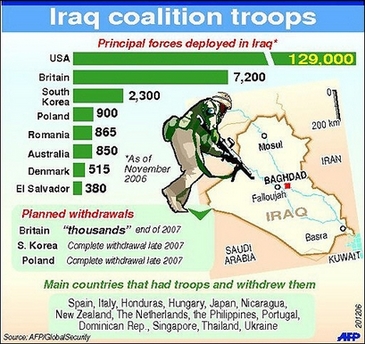
Graphic on coalition troops
in Iraq after the White House
announced Tuesday that the US
could increase the number of its
troops stationed there.(AFP/File)
And I'm going to take my time
to make sure that the policy,
when it comes out, the American
people will see that we are --
have got a new way forward to
achieve an important objective,
which is a country that can
govern, sustain and defend
itself.
And one thing that will be clear
is that I want the American
people to know that -- and the
Iraqi people to know that -- we
expect the Iraqi people to
continue making hard choices and
doing hard work necessary to
succeed, and our job is to help
them do so.
...
I think one of the --
obviously, the real problem we
face is the sectarian violence
that needs to be dealt with. So
part of my policy review is how
do we deal with that in a way
that then enables the Iraqi
people to live in a more secure
society so that the government
can prove its worth to the
people -- saying, we can help
you. And one of the main
functions of government is to
provide security for its people.
Our job is to help the Iraqis
provide that security. And I'll
come forward with a plan that
will enable us to achieve that
objective.
There's other threats, by the
way. It's a multiple-front war,
if you really think about it.
You got Shia discord in the
south; you've got Sunni attacks,
much of that -- many of them are
caused by al-Qaeda. A lot of
them, former Baathists and
regimists who are angry that
Saddam is no longer in power,
and they are a source of
conflict in al-Anbar province.
And we've got a very robust
effort -- I said the other day
something that, I guess, people
didn't pay that much attention
to -- but for October and
November and the first week of
December, our actions on the
ground have -- as a result of
action on the ground, we killed
or captured nearly 5,900 people.
My point in making that point is
our troops and coalition troops
are on the offense in a lot of
areas.
And then the third area of
conflict, the one that gets a
lot of attention, as it should,
is the sectarian violence taking
place in Baghdad. And I fully
understand that we've got to
help the Iraqis deal with that.
So my thinking is -- and a lot
of our strategy sessions revolve
around how best to deal with
this problem, and how best to
help the Iraqis deal with it.
And I've got some more work to
do, and I'll come forth at the
appropriate time and explain the
way forward to the country.
...
I think what the people want
is -- they want a couple of
things. They want to see
Democrats and Republicans work
together to achieve a common
objective, and they want us to
win in Iraq. A lot of people
understand that if we leave
Iraq, there will be dire
consequences -- in other words,
if we leave before the job is
done. There are some, a fair
number of people, who say, "Get
out now." So I view the election
results as people are not
satisfied with the progress
being made in Iraq and expect to
see a different strategy to
achieve an important objective.
...
... I want to achieve the
objective. I think the American
people -- I know the American
people are very worried about an
external threat and that they
recognize that failure in Iraq
would embolden that external
threat, and they expect this
administration to listen with
people, to work with Democrats,
to work with the military, to
work with the Iraqis to put a
plan in place that achieves the
objective. There's not a lot of
people saying, "Get out now."
Most Americans are saying, "We
want to achieve the objective."
...
... I've got four
constituencies I speak to on a
regular basis; one is the
American people, who are
justifiably frustrated at the
progress in Iraq. And they
expect the commander in chief
and the people in Washington to
support our troops. Supporting
our troops not only means good
equipment, good [pay], good
housing -- it also means a plan
that helps achieve the
objective.
The second constituency is the
enemy. ... The enemy wants to
know whether or not the United
States has the will to stay
engaged in this ideological
struggle. They don't believe we
do. That's what they say. And I
believe that's what they
believe.
The third group of people I
speak to are the Iraqis. They
wonder whether the United States
has got the will to help them
achieve their objectives. That's
what they wonder. The leaders I
have talked to wonder whether or
not -- what the elections mean,
or what the Baker-Hamilton
commission means, or what
changing [former defense]
secretary [Donald H.] Rumsfeld
means -- that's what they
wonder. But in the back of their
mind, they're saying, "Are they
going to leave us again?" And
that's an important question for
them to have answered, because
in order to make difficult
choices and to take risk for
peace, they're going to have to
be assured that they'll get
support. This is a group of
people that have had their hopes
dashed in the past.
And the fourth group is the
military. Our troops wonder
whether or not our country
supports them, and they do. They
wonder whether or not the
mission and the sacrifice and
the toil that they're making is
worth it. And they need to know
from the commander in chief: Not
only is it worth it, but I
strongly support them and
believe that their work will
lead to victory. That's what I
believe.
...
I believe [the war is]
justifiable and necessary.
Obviously, the war has not --
the results on the ground
haven't happened as quickly as I
hoped, and part of this review
process is to develop new
strategies and tactics so that
we can expedite success. Look, I
of all people would like to see
the troops come home. But I
don't want them to come home
without achieving our objective,
because I understand what
happens if there's failure. And
I'm going to keep repeating this
over and over again, that I
believe we're in an ideological
struggle that is -- that our
country will be dealing with for
a long time.
- George W. Bush, 25
Minutes in the Oval Office:
President Bush on Iraq,
Elections and Immigration,
December 20, 2006
This 25-minute interview was
conducted yesterday [December
19, 2006] in the Oval Office by
Washington Post staff writers
Peter Baker, Michael A. Fletcher
and Michael Abramowitz.
source:
http://www.washingtonpost.com/wp-dyn/content/article/2006/12/19/AR2006121900886.html
© 2006 The Washington Post
Company
BAGHDAD (Reuters) - Prime
Minister Tony Blair said on
Sunday British troops would stay
in Iraq "until the job is done"
and pledged to support the
country's weak government as it
battles sectarian violence and a
raging Sunni Arab insurgency.
...
Blair said he and Iraqi Prime
Minister Nuri al-Maliki had
discussed the need for national
reconciliation and building up
Iraq's security forces to fight
soaring Shi'ite-Sunni sectarian
violence that has pushed the
country close to all-out civil
war.
"We stand ready to support you
in every way that we can so that
in time the Iraq government and
the Iraqi people can take full
responsibility for their
affairs," Blair, who is touring
the Middle East, told a news
conference.
The visit by Blair, Washington's
closest ally, comes as U.S.
President George W. Bush is
rethinking his Iraq strategy
following the defeat of his
Republicans in mid-term
elections and in the face of
mounting U.S. military
casualties.
Blair defended London's plans
for a gradual withdrawal of its
7,200 troops in the south,
mostly in and around oil-rich
Basra, as Iraq's fledgling
security forces take over.
"This isn't a change of our
policy," he said. "Don't be
under any doubt at all. British
troops will remain until the job
is done."
Britain has transferred
authority to Iraqis in two of
the four southern provinces it
took responsibility for after
the U.S.-led invasion in 2003.
It has said it is confident it
can hand over Basra to the
Iraqis early next year and hopes
to have brought thousands of
troops home by the end of 2007.
- Blair says UK-Iraq troops
to stay, By Ross Colvin and
Katherine Baldwin, Reuters,
December 17, 2006
source:
http://www.hemelhempsteadtoday.co.uk/viewarticle.aspx?articleid=1934688§ionid=5055
©2006 Reuters, Johnston Press
Digital Publishing
I've just concluded a very
productive meeting with the
Secretary of Defense Rumsfeld,
and Chairman of the Joint Chiefs
Pete Pace, the Joint Chiefs of
Staff, Vice President. I thank
these men who wear our uniform
for a very candid and fruitful
discussion about the -- about
how to secure this country, and
how to win a war that we now
find ourselves in.
We spent a lot of time talking
about a new way forward in Iraq,
to help the Iraqi government
confront and defeat the enemies
of a free Iraq. We all agree
it's in our nation's interest
that we help this government
succeed. We recognize there are
enemies that would like to
topple this young democracy so
they could have safe haven from
which to plot and plan attacks
against moderate nations in the
Middle East, as well as attacks
against the United States. It's
in our interest that we help
this government succeed.
There has been a lot of violence
in Iraq. And the violence has
been horrific. Scores of
innocent men, women, and
children are being brutally
killed by ruthless murderers.
Our troops are engaged in
offensive operations, and we
mourn the loss of life. We are
saddened by the loss of every
single life amongst our
servicemen and women. Our folks
are very active in al Anbar and
in Baghdad, which is where the
enemy is concentrated.
Our commanders report that the
enemy has also suffered.
Offensive operations by Iraqi
and coalition forces against
terrorists and insurgents and
death squad leaders have yielded
positive results. In the months
of October, November, and the
first week of December, we have
killed or captured nearly 5,900
of the enemy.
While the enemy is far from
being defeated, there should be
no doubt in anybody's mind that
every day and night, the Iraqi
government and our brave men and
women of the Armed Forces are
taking the fight to the enemy;
that in spite of the fact that I
am conducting a strategic review
of the best way forward in Iraq,
there are a lot of operations
taking place, day and night.
Yesterday, the Secretary and the
Vice President and General Pace
and I were on the SVTS with
General Casey, and he's talking
about the hard work our troops
and Iraqi troops are doing to
defeat these enemies.
I do want to say something to
those who wear our uniform. The
men and women in uniform are
always on my mind. I am proud of
them. I appreciate their
sacrifices. And I want them to
know that I am focused on
developing a strategy that will
help them achieve their mission.
Oh, I know there's a lot of
debate here at home, and our
troops pay attention to that
debate. They hear that I am
meeting with the Pentagon or the
State Department or outside
officials, that my National
Security team and I are working
closely with Iraqi leaders, and
they wonder what that means.
Well, I'll tell you what it
means. It means I am listening
to a lot of advice to develop a
strategy to help you succeed.
There's a lot of consultations
taking place, and as I announced
yesterday, I will be delivering
my -- my plans, after a long
deliberation, after steady
deliberation. I'm not going to
be rushed into making a
difficult decision, a necessary
decision, to say to our troops,
we're going to give you the
tools necessary to succeed and a
strategy to help you succeed. I
also want the new Secretary of
Defense to have time to evaluate
the situation, so he can provide
serious and deliberate advice to
me.
I do want our troops to
understand this, though: that
this government and this group
of military leaders are
committed to a strategic goal of
a free Iraq that is democratic,
that can govern itself, defend
itself and sustain itself, and
be a strong ally in this war
against radicals and extremists
who would do us harm; secondly,
that our troops deserve the
solid commitment of the
Commander-in-Chief and our
political leaders and the
American people.
You have my unshakable
commitment in this important
fight to help secure the peace
for the long-term. I pledge to
work with the new Congress to
forge greater bipartisan
consensus to help you achieve
your mission. I will continue to
speak about your bravery and
your commitment and the
sacrifices of your families to
the American people. We're not
going to give up. The stakes are
too high and the consequences
too grave to turn Iraq over to
extremists who want to do the
American people and the Iraqi
people harm.
...
I've heard some ideas that
would lead to defeat, and I
reject those ideas -- ideas such
as leaving before the job is
done; ideas such as not helping
this government take the
necessary and hard steps to be
able to do its job.
I've heard interesting ideas. I
won't share them with you
because I want to make sure I
continue to collect those ideas
and put them together in a
strategy that our military and
the commanders and our national
security team understands will
lead to an Iraq that can govern
and sustain and defend itself.
...
But one thing people got to
understand is we'll be headed
toward achieving our objectives.
And I repeat, if we lose our
nerve, if we're not steadfast in
our determination to help the
Iraqi government succeed, we
will be handing Iraq over to an
enemy that would do us harm, the
consequences of which -- of
leaving Iraq before the job is
done, for example, would be
grave for the American citizens.
As we learned on September the
11th, the enemy has got the
capacity to strike us. And
there's no doubt in my mind a
failure in Iraq would make it
more likely the enemy would
strike us. It would certainly
make it more likely that
moderate people around the
Middle East would wonder about
the United States' will.
Moderate people -- moderate
governments in the Middle East
would be making irrational
decisions about their future. It
would be a disaster for
governments that have got energy
resources to be in the hands of
these extremists. They would use
energy to extract blackmail from
the United States. And when you
couple all that with a regime
that is -- doesn't like the
United States having a nuclear
weapon, you can imagine a world
of turmoil. And we're not going
to let it happen.
...
I think that our military
cannot do this job alone. Our
military needs a political
strategy that is effective. And
that includes things such an oil
law passed by the Iraqis that
basically says to the people,
all of you, regardless of where
you live or your religion, get
to share in the bounty of our
nation. It requires a
reconciliation effort, including
a rational de-Baathification
law.
...
And so there needs to be a
political track. And we're
working very hard with the
Maliki government to achieve
that political track. That's
what I've been doing the last
couple of days. As a matter of
fact, today on the telephone I
spoke to the two Kurdish
leaders. These men have been
outspoken about the desire to
have a moderate governing
coalition, which we support. I
met with the major Sunni leader
yesterday, all talking about how
we hope that there is political
reconciliation and a commitment
to a political process that says
to the Iraqi people, you count;
you matter for the future of our
country.
There needs to be an economic
component. As you know, part of
our successful strategies in
parts of Iraq have been based
upon "clear, hold and build."
Well, "build" means getting
projects up and running in key
parts of the country, so that
people see the benefits of
either working with coalition
forces, and/or the benefits of
supporting a government. And so
this is much more than a
military operation.
And finally, there's the foreign
policy piece that's necessary.
And we spend a lot of time in
our government talking to people
like Saudi Arabia, or Egypt, or
Jordan, or Turkey, and sending
messages, clear messages, to
countries like Syria and Iran.
And I believe, for example, the
Saudis are committed to a
government that will bring peace
and stability, and that's a
unity government. It's in their
interest they do so. And we're
working hard with them to figure
out a strategy to help the
Maliki government succeed.
I'm pleased when Iraqi leaders
go to Saudi Arabia and talk to
my friend, the King of Saudi
Arabia, and talk about how they
can work together to achieve
stability. It's in Saudi's
interest, it's in Jordan's
interest, it's in the Gulf Coast
countries' interest that there
be a stable Iran [sic], an Iran
[sic] that is capable of
rejecting Iranian influence -- I
mean, Iraq that is capable of
rejecting Iranian influence.
It's in our interests that we
succeed in Iraq so that we can
continue to send a clear message
to those in Iran that are
desirous of a free society that
freedom is possible in your
neighborhood.
And so the stakes are high in
this fight. Nobody knows that
better than the gentlemen
standing behind me. They clearly
understand the stakes that are
confronted -- that confront this
nation. And I am proud to have
listened to their points of
view. And I'm proud to be
working with them, as they help
lead the greatest military ever
assembled -- a military, by the
way, in which we've got brave
volunteers, people who
understand the stakes of this
fight, saying, I want to be in,
I want to serve my country.
It's a remarkable period in
American history right now. And
as I deliberate the way forward,
I keep in mind that we've got
brave souls that need -- to need
to know that we're in this fight
with a strategy to help them
achieve the objectives that
we've got.
- George W. Bush, President
Bush Meets with Senior U.S.
Defense Officials on Iraq,
December 13, 2006
source:
http://www.whitehouse.gov/news/releases/2006/12/20061213-5.html
This week, I held important
meetings at the White House
about the situation in Iraq.
On Monday, I met in the Oval
Office with one of Iraq's most
influential Shia leaders, His
Eminence Abdul Aziz al Hakim. We
discussed the desire of the
Iraqi people to see their unity
government succeed, and how the
United States can help them
achieve that goal.
On Thursday, I had breakfast
with Prime Minister Tony Blair
of Britain. We discussed the
sectarian violence in Iraq and
the need to confront extremists
inside Iraq and throughout the
region. The Prime Minister
explains it this way: "The
violence is not ... an accident
or a result of faulty planning.
It is a deliberate strategy. It
is the direct result of outside
extremists teaming up with
internal extremists -- al Qaeda
with [the] Sunni insurgents,
[and Iran with] Shia militia --
to foment hatred and thus
throttle at birth the
possibility of non-sectarian
democracy."
The Prime Minister and I also
discussed the report I received
this week from the Iraq Study
Group, chaired by former
Secretary of State James Baker
and former Congressman Lee
Hamilton. Their report provides
a straightforward picture of the
grave situation we face in Iraq.
The Iraq Study Group's report
also explicitly endorses the
strategic goal we've set in
Iraq: an Iraq that can "govern
itself, sustain itself, and
defend itself."
The report went on to say, "In
our view, this definition
entails an Iraq with a broadly
representative government that
maintains its territorial
integrity, is at peace with its
neighbors, denies terrorism a
sanctuary, and doesn't brutalize
its own people. Given the
current situation in Iraq,
achieving this goal will require
much time and will depend
primarily on the actions of the
Iraqi people."
I agree with this assessment. I
was also encouraged that the
Iraq Study Group was clear about
the consequences of a
precipitous withdrawal from
Iraq. The group declared that
such a withdrawal would "almost
certainly produce greater
sectarian violence" and lead to
"a significant power vacuum,
greater human suffering,
regional destabilization, and a
threat to the global economy."
The report went on to say, "If
we leave and Iraq descends into
chaos, the long-range
consequences could eventually
require the United States to
return."
The Iraq Study Group understands
the urgency of getting it right
in Iraq. The group also
understands that while the work
ahead will not be easy, success
in Iraq is important, and
success in Iraq is possible. The
group proposed a number of
thoughtful recommendations on a
way forward for our country in
Iraq. My administration is
reviewing the report, and we
will seriously consider every
recommendation. At the same
time, the Pentagon, the State
Department, and the National
Security Council are finishing
work on their own reviews of our
strategy in Iraq. I look forward
to receiving their
recommendations. I want to hear
all advice as I make the
decisions to chart a new course
in Iraq.
I thank the members of the Iraq
Study Group for their hard work
and for the example of
bipartisanship that they have
set. The group showed that
Americans of different political
parties can agree on a common
goal in Iraq and come together
on ways to achieve it. Now it is
the responsibility of all of us
in Washington -- Republicans and
Democrats alike -- to come
together and find greater
consensus on the best way
forward.
As part of this effort, I met
this week with House and Senate
leaders from both parties, as
well as senior members of the
Armed Services, Foreign
Relations, and Intelligence
Committees. We had productive
discussions about our shared
duty to forge a bipartisan
approach to succeed in Iraq. The
future of a vital region of the
world and the security of the
American people depend on
victory in Iraq. I'm confident
that we can move beyond our
political differences and come
together to achieve that
victory. I will do my part.
- George W. Bush, Radio
Address, December 9, 2006
source:
http://www.whitehouse.gov/news/releases/2006/12/20061209.html
We agree that victory in Iraq
is important; it's important for
the Iraqi people, it's important
for the security of the United
States and Great Britain, and
it's important for the civilized
world. We agree that an Iraq
that can govern itself, defend
itself and sustain itself as an
ally on the war on terror is a
noble goal. The Prime Minister
and I seek a wide range of
opinions about how to go forward
in Iraq, and I appreciate your
opinions and your advice.
The increase in sectarian
attacks we're seeing in and
around Baghdad are unsettling.
It has led to much debate in
both our countries about the
nature of the war that is taking
place in Iraq. And it is true
that Sunni and Shia extremists
are targeting each other's
innocent civilians and engaging
in brutal reprisals. It's also
true that forces beyond Iraq's
borders contribute to this
violence. And the Prime Minister
put it this way, he said, "The
violence is not an accident or a
result of faulty planning. It is
a deliberate strategy. It is the
direct result of outside
extremists teaming up with
internal extremists -- al Qaeda
with the Sunni insurgents, and
Iran with the Shia militia -- to
foment hatred and to throttle,
at birth, the possibility of a
non-sectarian democracy." You
were right, and I appreciate
your comments.
The primary victims of the
sectarian violence are the
moderate majority of Iraqis --
Sunni and Shia alike -- who want
a future of peace. The primary
beneficiaries are Sunni and Shia
extremists, inside and outside
of Iraq, who want chaos in that
country so they can take control
and further their ambitions to
dominate the region.
These Sunni and Shia extremists
have important differences, yet
they agree on one thing: the
rise of free and democratic
societies in the Middle East
where people can practice their
faith, choose their leaders, and
live together in peace would be
a decisive blow to their cause.
And so they're supporting
extremists across the region who
are working to undermine young
democracies. Just think about
the Middle East. In Iraq, they
support terrorists and death
squads who are fomenting
sectarian violence in an effort
to bring down the elected
government of Prime Minister
Maliki. In Lebanon, they're
supporting Hezbollah, which
recently declared its intention
to force the collapse of Prime
Minister Siniora's
democratically-elected
parliament and government. In
Afghanistan, they're supporting
remnants of the Taliban that are
seeking to destabilize President
Karzai's government and regain
power. In the Palestinian
Territories, they are working to
stop moderate leaders like
President Abbas from making
progress toward the vision of
two democratic states, Israel
and Palestine, living side by
side in peace and security.
In each of these places,
radicals and extremists are
using terror to stop the spread
of freedom. And they do so
because they want to spread
their ideologies -- their
ideologies of hate -- and impose
their rule on this vital part of
the world. And should they
succeed, history will look back
on our time with unforgiving
clarity and demand to know, what
happened? How come free nations
did not act to preserve the
peace?
Prime Minister Blair and I
understand that we have a
responsibility to lead and to
support moderates and reformers
who work for change across the
broader Middle East. We also
recognize that meeting this
responsibility requires action.
We will take concerted efforts
to advance the cause of peace in
the Middle East. Prime Minister
Blair informed me that he will
be heading to the Middle East
soon to talk to both the
Israelis and the Palestinians.
And I support that mission. I
support the mission because it's
important for us to advance the
cause of two states living side
by side in peace, and helping
both parties eliminate the
obstacles that prevent an
agreement from being reached.
And your strong leadership on
this issue matters a lot.
We'll support the democratic
government of Prime Minister
Maliki as he makes difficult
decisions and confronts the
forces of terror and extremism
that are working hard to tear
his country apart.
Britain and America are old
allies, and the Prime Minister
and I are strong friends. But
Britain and America aren't
standing together in this war
because of friendship. We're
standing together because our
two nations face an
unprecedented threat to
civilization. We're standing
together to prevent terrorists
and extremists from dominating
the Middle East. We stand
together to prevent extremists
from regaining the safe haven
they lost in Afghanistan, a safe
haven from which they launched
attacks that killed thousands of
our citizens.
We stand together because we
understand the only way to
secure a lasting peace for our
children and grandchildren is to
defeat the extremist ideologies
and help the ideology of hope,
democracy, prevail. We know the
only way to secure peace for
ourselves is to help millions of
moms and dads across the Middle
East build what our citizens
already have: societies based on
liberty that will allow their
children to grow up in peace and
opportunity.
It's a tough time. And it's a
difficult moment for America and
Great Britain. And the task
before us is daunting. Yet our
nations have stood before in
difficult moments. Sixty-five
years ago this day, America was
jolted out of our isolationism
and plunged into a global war
that Britain had been fighting
for two years. In that war, our
nation stood firm. And there
were difficult moments during
that war, yet the leaders of our
two nations never lost faith in
the capacity to prevail.
We will stand firm again in this
first war of the 21st century.
We will defeat the extremists
and the radicals. We will help a
young democracy prevail in Iraq.
And in so doing, we will secure
freedom and peace for millions,
including our own citizens.
...
The thing I liked about the
Baker-Hamilton report is it
discussed the way forward in
Iraq. And I believe we need a
new approach. And that's why
I've tasked the Pentagon to
analyze the way forward. That's
why Prime Minister Blair is here
to talk about the way forward,
so we can achieve the objective,
which is an Iraq which can
govern itself, sustain itself,
and defend itself, and be an
ally in the war on terror.
...
I understand how tough it is.
And I've been telling the
American people how tough it is.
And they know how tough it is.
And the fundamental question is,
do we have a plan to achieve our
objective. Are we willing to
change as the enemy has changed?
And what the Baker-Hamilton
study has done is it shows good
ideas as to how to go forward.
What our Pentagon is doing is
figuring out ways to go forward,
all aiming to achieve our
objective.
Make no mistake about it, I
understand how tough it is, sir.
I talk to families who die. I
understand there's sectarian
violence. I also understand that
we're hunting down al Qaeda on a
regular basis and we're bringing
them to justice. I understand
how hard our troops are working.
I know how brave the men and
women who wear the uniform are,
and therefore, they'll have the
full support of this government.
I understand what long
deployments mean to wives and
husbands, and mothers and
fathers, particularly as we come
into a holiday season. I
understand. And I have made it
abundantly clear how tough it
is.
I also believe we're going to
succeed. I believe we'll
prevail. Not only do I know how
important it is to prevail, I
believe we will prevail. I
understand how hard it is to
prevail. But I also want the
American people to understand
that if we were to fail -- and
one way to assure failure is
just to quit, is not to adjust,
and say it's just not worth it
-- if we were to fail, that
failed policy will come to hurt
generations of Americans in the
future.
And as I said in my opening
statement, I believe we're in an
ideological struggle between
forces that are reasonable and
want to live in peace, and
radicals and extremists. And
when you throw into the mix
radical Shia and radical Sunni
trying to gain power and topple
moderate governments, with
energy which they could use to
blackmail Great Britain or
America, or anybody else who
doesn't kowtow to them, and a
nuclear weapon in the hands of a
government that is -- would be
using that nuclear weapon to
blackmail to achieve political
objectives -- historians will
look back and say, how come Bush
and Blair couldn't see the
threat? That's what they'll be
asking. And I want to tell you,
I see the threat and I believe
it is up to our governments to
help lead the forces of
moderation to prevail. It's in
our interests.
And one of the things that has
changed for American foreign
policy is a threat overseas can
now come home to hurt us, and
September the 11th should be a
wake-up call for the American
people to understand what
happens if there is violence and
safe havens in a part of the
world. And what happens is
people can die here at home.
So, no, I appreciate your
question. As you can tell, I
feel strongly about making sure
you understand that I understand
it's tough. But I want you to
know, sir, that I believe we'll
prevail. I know we have to
adjust to prevail, but I
wouldn't have our troops in
harm's way if I didn't believe
that, one, it was important,
and, two, we'll succeed.
...
One of the things the report
did mention, and I think you've
said it in your comment, if
conditions so allow. And we want
our combat troops out as quick
as possible. We want the Iraqis
taking the fight. But it's very
important to be -- as we design
programs, to be flexible and
realistic. And as the report
said -- I don't -- got the exact
words, but it was along the
lines of depending upon
conditions, I believe is what
the qualifier was. And I thought
that made a lot of sense. I've
always said we'd like our troops
out as fast as possible. I think
that's an important goal.
On the other hand, our
commanders will be making
recommendations based upon
whether or not we're achieving
our stated objective. And the
objective, I repeat, is a
government which can sustain,
govern, and defend itself --
free government of Iraq that can
do that -- and will be an ally
in this movement -- against this
movement that is threatening
peace and stability. And it's
real.
I like to remind people it's
akin to the Cold War in many
ways. There's an ideological
clash going on. And the question
is, will we have the resolve and
the confidence in liberty to
prevail? That's really the
fundamental question facing --
it's not going to face this
government or this government,
because we made up our mind.
We've made that part clear. But
it will face future governments.
There will be future
opportunities for people to say,
well, it's not worth it, let's
just retreat. I would strongly
advise a government not to
accept that position because of
the dangers inherent with
isolationism and retreat.
...
I do know that we have not
succeeded as fast as we wanted
to succeed. I do understand that
progress is not as rapid as I
had hoped. And therefore, it
makes sense to analyze the
situation and to devise a set of
tactics and strategies to
achieve the objective that I
have stated.
And so if the present situation
needs to be changed, it follows
that we'll change it if we want
to succeed. What's really
interesting is the battle has
changed in Iraq from the
rejectionists and former
Baathists and definitely foreign
fighters who have entered the
country that were trying to
destabilize the new government
to one that Mr. Zarqawi stated
clearly -- he said, look, let's
kill Shia in order to create
enough chaos and confusion and
doubt of the government, and set
off a sectarian battle. And he
succeeded in that extent. He
didn't succeed at avoiding us,
but he did succeed at starting
off sectarian strife. And now
the fundamental question is,
what strategy is necessary to
deal with this type of violence?
We'll continue after al Qaeda.
Al Qaeda will not have safe
haven in Iraq. And that's
important for the American
people to know. We've got
special operators, we've got
better intelligence. And al
Qaeda is effective at these
spectacular bombings, and we'll
chase them down, and we are,
along with the Iraqis. The
strategy now is how to make sure
that we've got the security
situation in place such that the
Iraqi government is capable of
dealing with the sectarian
violence, as well as the
political and economic
strategies, as well.
So, yes, I think you'll see
something differently, because
it's a practical answer to a
situation on the ground that's
not the way we like it. You
wanted frankness -- I thought we
would succeed quicker than we
did, and I am disappointed by
the pace of success.
- George W. Bush, President
Bush Meets with British Prime
Minister Tony Blair, December 7,
2006
source:
http://www.whitehouse.gov/news/releases/2006/12/20061207-1.html
And so the question is, how
do we make sure that it does,
indeed, succeed? And in respect
of Iraq, I, like you, welcome
the Baker-Hamilton study group.
It offers a strong way forward.
I think it is important now we
concentrate on the elements that
are necessary to make sure that
we succeed, because the
consequences of failure are
severe. And I believe this is a
mission we have to succeed in
and we can succeed in.
And I think there are three
elements that we can take
forward. The first is to make
sure that we are supporting the
Maliki government in making sure
that that government's
non-sectarian nature is
reflected in the policies of
that government and the way that
it conducts itself. I think in
respect of governance and
security and capability --
particularly economic capability
-- there is much that we are
doing, but can do even more in
order to make sure that they are
supported in the vital work that
they do, and in the work of
reconciliation, in bringing the
different parts of Iraq together
in order to give effect to the
will of the Iraqi people,
expressed in their democratic
election.
I think, secondly, it's
important that all of us who are
engaged in this, but
particularly those in the
region, live up to their
responsibilities in supporting
the Maliki government, in
ensuring that Iraq is able to
proceed in a democratic and
non-sectarian way.
- British Prime Minister Tony
Blair, President Bush
Meets with British Prime
Minister Tony Blair, December 7,
2006
source:
http://www.whitehouse.gov/news/releases/2006/12/20061207-1.html
December 3, 2006
Rumsfeld’s Memo of Options for
Iraq War
Following is the text of a
classified Nov. 6 memorandum
that Defense Secretary Donald H.
Rumsfeld sent to the White House
suggesting new options in Iraq.
The memorandum was sent one day
before the midterm Congressional
elections and two days before
Mr. Rumsfeld resigned.
Nov. 6, 2006
SUBJECT: Iraq — Illustrative New
Courses of Action
The situation in Iraq has been
evolving, and U.S. forces have
adjusted, over time, from major
combat operations to
counterterrorism, to
counterinsurgency, to dealing
with death squads and sectarian
violence. In my view it is time
for a major adjustment. Clearly,
what U.S. forces are currently
doing in Iraq is not working
well enough or fast enough.
Following is a range of options:
ILLUSTRATIVE OPTIONS
Above the Line: (Many of these
options could and, in a number
of cases, should be done in
combination with others)
¶Publicly announce a set of
benchmarks agreed to by the
Iraqi Government and the U.S. —
political, economic and security
goals — to chart a path ahead
for the Iraqi government and
Iraqi people (to get them
moving) and for the U.S. public
(to reassure them that progress
can and is being made).
¶Significantly increase U.S.
trainers and embeds, and
transfer more U.S. equipment to
Iraqi Security forces (ISF), to
further accelerate their
capabilities by refocusing the
assignment of some significant
portion of the U.S. troops
currently in Iraq.
¶Initiate a reverse embeds
program, like the Korean Katusas,
by putting one or more Iraqi
soldiers with every U.S. and
possibly Coalition squad, to
improve our units’ language
capabilities and cultural
awareness and to give the Iraqis
experience and training with
professional U.S. troops.
¶Aggressively beef up the Iraqi
MOD and MOI, and other Iraqi
ministries critical to the
success of the ISF — the Iraqi
Ministries of Finance, Planning,
Health, Criminal Justice,
Prisons, etc. — by reaching out
to U.S. military retirees and
Reserve/National Guard
volunteers (i.e., give up on
trying to get other USG
Departments to do it.)
¶Conduct an accelerated
draw-down of U.S. bases. We have
already reduced from 110 to 55
bases. Plan to get down to 10 to
15 bases by April 2007, and to 5
bases by July 2007.
¶Retain high-end SOF capability
and necessary support structure
to target Al Qaeda, death
squads, and Iranians in Iraq,
while drawing down all other
Coalition forces, except those
necessary to provide certain key
enablers for the ISF.
¶Initiate an approach where U.S.
forces provide security only for
those provinces or cities that
openly request U.S. help and
that actively cooperate, with
the stipulation being that
unless they cooperate fully,
U.S. forces would leave their
province.
¶Stop rewarding bad behavior, as
was done in Fallujah when they
pushed in reconstruction funds,
and start rewarding good
behavior. Put our reconstruction
efforts in those parts of Iraq
that are behaving, and invest
and create havens of opportunity
to reward them for their good
behavior. As the old saying
goes, “If you want more of
something, reward it; if you
want less of something, penalize
it.” No more reconstruction
assistance in areas where there
is violence.
¶Position substantial U.S.
forces near the Iranian and
Syrian borders to reduce
infiltration and, importantly,
reduce Iranian influence on the
Iraqi Government.
¶Withdraw U.S. forces from
vulnerable positions — cities,
patrolling, etc. — and move U.S.
forces to a Quick Reaction Force
(QRF) status, operating from
within Iraq and Kuwait, to be
available when Iraqi security
forces need assistance.
¶Begin modest withdrawals of
U.S. and Coalition forces (start
“taking our hand off the bicycle
seat”), so Iraqis know they have
to pull up their socks, step up
and take responsibility for
their country.
¶Provide money to key political
and religious leaders (as Saddam
Hussein did), to get them to
help us get through this
difficult period.
¶Initiate a massive program for
unemployed youth. It would have
to be run by U.S. forces, since
no other organization could do
it.
¶Announce that whatever new
approach the U.S. decides on,
the U.S. is doing so on a trial
basis. This will give us the
ability to readjust and move to
another course, if necessary,
and therefore not “lose.”
¶Recast the U.S. military
mission and the U.S. goals (how
we talk about them) — go
minimalist.
Below the Line (less attractive
options):
¶Continue on the current path.
¶Move a large fraction of all
U.S. Forces into Baghdad to
attempt to control it.
¶Increase Brigade Combat Teams
and U.S. forces in Iraq
substantially.
¶Set a firm withdrawal date to
leave. Declare that with Saddam
gone and Iraq a sovereign
nation, the Iraqi people can
govern themselves. Tell Iran and
Syria to stay out.
¶Assist in accelerating an
aggressive federalism plan,
moving towards three separate
states — Sunni, Shia, and Kurd.
¶Try a Dayton-like process.
- New York Times Article, "Rumsfeld’s
Memo of Options for Iraq War",
December 3, 2006
source:
http://www.nytimes.com/2006/12/03/world/middleeast/03mtext.html
Copyright 2006 The New York
Times Company
...I returned home this week
from a visit to the Middle East.
On my trip, I met with Prime
Minister Maliki of Iraq to
discuss how we can improve the
situation on the ground in his
country and help the Iraqis
build a lasting democracy.
My meeting with Prime Minister
Maliki was our third since he
took office six months ago. With
each meeting, I'm coming to know
him better, and I'm becoming
more impressed by his desire to
make the difficult choices that
will put his country on a better
path. During our meeting, I told
the Prime Minister that America
is ready to make changes to
better support the unity
government of Iraq, and that
several key principles will
guide our efforts.
First, the success of Prime
Minister Maliki's government is
critical to success in Iraq. His
unity government was chosen
through free elections in which
nearly 12 million Iraqis cast
their ballots in support of
democracy. Our goal in Iraq is
to strengthen his democratic
government and help Iraq's
leaders build a free nation that
can govern itself, sustain
itself, and defend itself -- and
is an ally in the war on terror.
Second, the success of the Iraqi
government depends on the
success of the Iraqi security
forces. The training of Iraqi
security forces has been steady,
yet we both agreed that we need
to do more, and we need to do it
faster. The Prime Minister wants
to show the people who elected
him that he's willing to make
the hard decisions necessary to
provide security.
To do that, he needs larger and
more capable Iraqi forces under
his control, and he needs them
quickly. By helping Iraq's
elected leaders get the Iraqi
forces they need, we will help
Iraq's democratic government
become more effective in
fighting the terrorists and
other violent extremists, and in
providing security and
stability, particularly in
Baghdad.
Third, success in Iraq requires
strong institutions that will
stand the test of time and
hardship. Our goal in Iraq is to
help Prime Minister Maliki build
a country that is united, where
the rule of law prevails and the
rights of minorities are
respected. The Prime Minister
made clear that splitting his
country into parts is not what
the Iraqi people want and that
any partition of Iraq would lead
to an increase in sectarian
violence.
Security in Iraq requires
sustained action by the Iraqi
security forces, yet in the long
term, security in Iraq hinges on
reconciliation among Iraq's
different ethnic and religious
communities. And the Prime
Minister has committed his
government to achieving that
goal.
The Prime Minister and I also
discussed the review of
America's strategy in Iraq that
is now nearing completion. As
part of this review, I've asked
our military leaders in the
Pentagon and those on the ground
in Iraq to provide their
recommendations on the best way
forward.
A bipartisan panel, led by
former Secretary of State James
Baker and former Congressman Lee
Hamilton, is also conducting a
review. And I look forward to
receiving their report next
week. I want to hear all advice
before I make any decisions
about adjustments to our
strategy in Iraq.
I recognize that the recent
violence in Iraq has been
unsettling. Many people in our
country are wondering about the
way forward. The work ahead will
not be easy, yet by helping
Prime Minister Maliki strengthen
Iraq's democratic institutions
and promote national
reconciliation, our military
leaders and diplomats can help
put Iraq on a solid path to
liberty and democracy. The
decisions we make in Iraq will
be felt across the broader
Middle East.
Failure in Iraq would embolden
the extremists who hate America
and want nothing more than to
see our demise. It would
strengthen the hand of those who
are seeking to undermine young
democracies across the region
and give the extremists an open
field to overthrow moderate
governments, take control of
countries, impose their rule on
millions, and threaten the
American people. Our Nation must
not allow this to happen.
Success in Iraq will require
leaders in Washington --
Republicans and Democrats alike
-- to come together and find
greater consensus on the best
path forward. So I will work
with leaders in both parties to
achieve this goal. Together we
can help Iraqis build a free and
democratic nation in the heart
of the Middle East, strengthen
moderates and reformers across
the region who are working for
peace, and leave our children
and grandchildren a more secure
and hopeful world.
- George W. Bush, Radio
Address, December 2, 2006
source:
http://www.whitehouse.gov/news/releases/2006/12/20061202.html
NASSIRIYA, Iraq, Dec 1
(Reuters) - Italy pulled its
last remaining troops out of
Iraq on Friday, lowering the
tricolour flag at its base in
the south of a country where 32
of its soldiers have died since
the contingent arrived in June
2003.
Defence Minister Arturo Parisi
read out the names of each of
the Italian fallen, including
secret serviceman Nicola
Calipari who was shot dead by
U.S. soldiers in March 2005 as
he escorted a freed hostage to
Baghdad airport.
"Your sacrifice has not been in
vain," Parisi said of the
military dead. "We will always
remember you."
Under former prime minister
Silvio Berlusconi, a close ally
of U.S. President George W.
Bush, Italy deployed the fourth
largest contingent in the
"coalition of the willing" in
Iraq, around 3,000 soldiers,
based in the south of the
country.
But the mission was widely
unpopular in Italy and
opposition leader Romano Prodi
said if elected he would pull
the troops out by the end of the
year. Prodi won a close-run
election in April.
Italy, which had only 44
soldiers remaining in Nassiriya
on Friday, hands control of the
area to Australian troops.
"We have rendered Dhi Qar
province more stable and
secure," General Carmine De
Pascale said. "The authorities
are holding and socio-economic
conditions have improved
visibly."
In November 2003, 17 Italian
military and two Italian
civilians were killed by a
suicide attack using a fuel
tanker at their base, an
incident that turned public
opinion in Italy even more
against the country's
involvement in the war.
- Italy pulls last troops out
of Iraq, Reuters, By Antonella
Cinelli, December 1, 2006
source:
http://www.alertnet.org/thenews/newsdesk/L013163.htm
Copyright 2006 Reuters
PRESIDENT BUSH: I've told the
Prime Minister that our goal in
Iraq is to strengthen his
government and to support his
efforts to build a free Iraq
that can govern itself, sustain
itself, and defend itself, and
is an ally in the war against
the terrorists.
Secondly, the success of the
Iraqi government depends on the
success of the Iraqi security
forces. During our meetings, the
Prime Minister and I heard an
update from an important group
that our government established
last month: the Joint Committee
on Accelerating the Transferring
of Security Responsibility. We
agreed on the importance of
speeding up the training of
Iraqi security forces. Our goal
is to ensure that the Prime
Minister has more capable forces
under his control so his
government can fight the
terrorists and the death squads,
and provide security and
stability in his country.
Third, success in Iraq requires
a united Iraq where democracy is
preserved, the rule of law
prevails, and minority rights
are respected. The Prime
Minister made clear that
splitting his country into
parts, as some have suggested,
is not what the Iraqi people
want, and that any partition of
Iraq would only lead to an
increase in sectarian violence.
I agree. In the long-term,
security in Iraq requires
reconciliation among Iraq's
different ethnic and religious
communities, something the
overwhelming majority of Iraqis
want.
The Prime Minister and I also
discussed the review of our
strategy in Iraq that is now
nearing completion. I assured
the Prime Minister that our
review is aimed at strengthening
the capacity of the sovereign
government of Iraq to meet their
objectives, which we share. As
part of the review, I've asked
our military leaders in the
Pentagon and those on the ground
in Iraq to provide their
recommendations on the best way
forward.
Others outside the government
are conducting their own review,
and I look forward to hearing
their recommendations. I want to
hear all advice before I make my
decisions about adjustments to
our strategy and tactics in Iraq
to help this government succeed.
My consultations with the Prime
Minister and the unity
government are a key part of the
assessment process. And that's
why I appreciate him coming over
from Iraq so that we could have
a face-to-face visit. The Prime
Minister and I agree that the
outcome in Iraq will affect the
entire region. To stop the
extremists from dominating the
Middle East, we must stop the
extremists from achieving their
goal of dominating Iraq. If the
extremists succeed in Iraq, they
will be emboldened in their
efforts to undermine other young
democracies in the region, or to
overthrow moderate governments,
establish new safe havens, and
impose their hateful ideology on
millions. If the Iraqis succeed
in establishing a free nation in
the heart of the Middle East,
the forces of freedom and
moderation across the region
will be emboldened, and the
cause of peace will have new
energy and new allies.
...
PRESIDENT BUSH: Our objective
is to help the Maliki government
succeed. And today we discussed
how to further the success of
this government. This is a
government that is dedicated to
pluralism and rule of law. It's
a government elected by the
Iraqi people under a
constitution approved by the
Iraqi people, which, in itself,
is an unusual event in the
Middle East, by the way.
We talked today about
accelerating authority to the
Prime Minister so he can do what
the Iraqi people expect him to
do, and that is bring security
to parts of his country that
require firm action. It's going
to -- the presence of the United
States will be in Iraq so long
as the government asks us to be
in Iraq. This is a sovereign
government. I believe that there
is more training to be done. I
think the Prime Minister agrees
with me. I know that we're
providing a useful addition to
Iraq by chasing down al Qaeda
and by securing -- by helping
this country protect itself from
al Qaeda.
Al Qaeda wants a safe haven in
Iraq. Al Qaeda made it clear
earlier that suicide bombers
would increase sectarian
violence. That was part of their
strategy. One of our goals is to
deny safe haven for al Qaeda in
Iraq, and the Maliki government
expects us and wants us to
provide that vital part of
security.
So we'll be in Iraq until the
job is complete, at the request
of a sovereign government
elected by the people. I know
there's a lot of speculation
that these reports in Washington
mean there's going to be some
kind of graceful exit out of
Iraq. We're going to stay in
Iraq to get the job done, so
long as the government wants us
there.
We want the people of Iraq to
live in a free society. It's in
our interests. In my judgment,
if we were to leave before the
job is done, it would only
embolden terrorists, it would
only embolden the extremists. It
would dash the hopes of millions
of people who want to live in a
free society, just like the 12
million people who voted in the
Iraqi election. They want to
live in a free society. And we
support this government, because
the government understands it
was elected by the people. And
Prime Minister Maliki is working
hard to overcome the many
obstacles in the way to a
peaceful Iraq, and we want to
help him.
...
Q Time limit on meeting
goals. Is there a time limit on
meeting goals?
PRESIDENT BUSH: A time limit. As
soon as possible. But I'm
realistic, because I understand
how tough it is inside of Iraq.
The Prime Minister is dealing
with sectarian violence. The
Prime Minister is having to deal
with al Qaeda. The Prime
Minister is having to deal with
criminal elements. And we want
to help him.
And, yes, I talked about making
sure that al Qaeda doesn't take
-- doesn't provide -- gets safe
haven in Iraq. Sure, that's an
important part of our strategy.
But I also have said that the
goal is a country that can
defend, sustain, and govern
itself. And therefore, to the
extent that our troops are
needed to help do that, we're
willing to do that. That's part
of the operation in Baghdad.
Part of the plan in Baghdad was
to prevent -- prevent killers
from taking innocent life.
Q Including sectarian violence?
PRESIDENT BUSH: Well that's --
killers taking innocent life is,
in some cases, sectarian. I
happen to view it as criminal,
as well as sectarian. I think
any time you murder somebody,
you're a criminal. And I believe
a just society and a society of
-- that holds people to account
and believes in rule of law
protects innocent people from
murderers, no matter what their
political party is.
And I discussed this with the
Prime Minister, and I don't want
to put words in his mouth, but I
received a satisfactory answer
about the need to protect
innocent life. And that's
exactly what our troops have
been doing, along with the
Iraqis. My plan, and his plan,
is to accelerate the Iraqis'
responsibility. See, here's a
man who has been elected by the
people; the people expect him to
respond, and he doesn't have the
capacity to respond. And so we
want to accelerate that
capacity. We want him to be in
the lead in taking the fight
against the enemies of his own
country.
And that's exactly what we
discussed today. We had a Joint
Committee on Accelerating the
Transfer of Security
Responsibility Report. And it
was a report that General Casey,
who is with us today, and our
Ambassador Zal Khalilzad, who is
with us today, as well as the
Prime Minister's team, delivered
to both of us about how to
accelerate responsibility to the
Iraqi government so this person
elected by the people can take
the fight to those who want to
destroy a young democracy.
You had a question --
Q Sir, there are no time limits
here?
PRESIDENT BUSH: As quick as
possible, Martha. As quick --
I've been asked about timetables
ever since we got into this. All
timetables mean is that it -- it
is a timetable for withdrawal.
You keep asking me those
questions. All that does is --
Q Mr. President --
PRESIDENT BUSH: Hold on a
second. All that does is set
people up for unrealistic
expectations. As soon as
possible. And today, we made a
step toward as soon as possible
by transferring a --
accelerating the transfer of
authorities, military
authorities to the Prime
Minister.
...
PRESIDENT BUSH: .... And it's
in our interest to help liberty
prevail in the Middle East,
starting with Iraq.
And that's why this business
about graceful exit just simply
has no realism to it at all.
We're going to help this
government. And I'm able to say
that it is -- that we have a
government that wants our help
and is becoming more capable
about taking the lead in the
fight to protect their own
country. The only way that Iraq
is going to be able to succeed
is when the Iraqis, led by a
capable person, says, we're
tired of it, we don't want
violence, we want the peace that
our 12 million people voted for.
And it's in the world's interest
that Iraq succeed.
...
- President Bush Participates
in Joint Press Availability with
Prime Minister Maliki of Iraq,
November 30, 2006
source:
http://www.whitehouse.gov/news/releases/2006/11/20061130-1.html
Tomorrow, I'm going to travel
to Jordan where I will meet with
the Prime Minister of Iraq. We
will discuss the situation on
the ground in his country, our
ongoing efforts to transfer more
responsibility to the Iraqi
Security Forces, and the
responsibility of other nations
in the region to support the
security and stability of Iraq.
We'll continue to be flexible,
and we'll make the changes
necessary to succeed. But
there's one thing I'm not going
to do: I'm not going to pull our
troops off the battlefield
before the mission is complete.
- George W. Bush, President
Bush Discusses NATO Alliance
During Visit to Latvia, November
28, 2006
http://www.whitehouse.gov/news/releases/2006/11/20061128-13.html
LONDON -- Britain said Monday
it expects to withdraw thousands
of its 7,000 military personnel
from Iraq by the end of next
year, while Poland and Italy
announced the impending
withdrawal of their remaining
troops.
Polish President Lech Kaczynski
said his country, a U.S. ally in
Iraq and Afghanistan, would pull
its remaining 900 soldiers out
of Iraq by the end of 2007. And
Italian Premier Romano Prodi
said the last of Italy's
soldiers in Iraq -- some 60-70
troops -- will return home this
week, ending the Italian
contingent's presence in the
south of the country after more
than three years.
British Defense Secretary Des
Browne was the second senior
official in recent days to talk
of reducing the number of
British troops in Iraq. In a
speech to the Royal Institute of
International Affairs, Browne
also warned Iran that it faces
increasing isolation if it does
not use its influence in Iraq
constructively.
Last week, Foreign Secretary
Margaret Beckett said Britain
may be able to hand over
security responsibility in the
southern port city of Basra by
the spring of 2007. Britain also
hopes to hand security control
over to the Iraqis in the
province of Maysan on the
Iranian border in January.
"We have said that we and the
Iraqis hope they will be ready
to take over Maysan in January,"
Browne said. "We have said --
and the foreign secretary
reiterated last week -- that we
hope they will be ready to take
over Basra in the spring.
"If both of these go to plan, we
will be able to start drawing
down our forces."
Browne said that handing over
security would not mean a
complete British withdrawal.
"I do not believe it is right to
give precise numbers, nor to
assume what the next 12 months
will hold.
"But I can tell you that by the
end of next year I expect
numbers of British forces in
Iraq to be significantly lower
-- by a matter of thousands. The
planning for this has been going
on for some months."
Any troop pullback, he said,
would be "driven not by
arbitrary deadlines but by
reality on the ground."
"We will stay as long as we are
making a positive difference,
and as long as the Iraqi
government need our support,"
Browne said.
- Britain May Start Pulling
Out of Iraq, By JENNIFER QUINN,
Associated Press Writer,
November 27, 2006
http://abcnews.go.com/International/wireStory?id=2681182
I know some have
suggested that by liberating
Iraq from Saddam Hussein, we
simply stirred up a hornet's
nest. They overlook a
fundamental fact: We were not in
Iraq on September 11, 2001 --
and the terrorists hit us
anyway. The fact is they regard
the entire world as a
battlefield. That's why al Qaeda
has operatives in Iraq right
now. They are making a stand in
that country because they
believe they can frighten and
intimidate America into a policy
of retreat.
Some in our country may believe
in good faith that retreating
from Iraq would make America
safer. Recent experience teaches
the opposite lesson. Time and
time again over the last
generation, terrorists have
targeted nations whose behavior
they believe they can change
through violence. To get out
before the job is done will
convince the terrorists, once
again, that free nations will
change our policies, forsake our
friends, and abandon our
interests whenever we are
confronted with violence and
blackmail. They would simply
draw up another set of demands,
and instruct Americans to act as
they direct or face further acts
of murder.
Retreat would also send a
message to everyone in that part
of the world who trusted us; to
the millions of Iraqis and
Afghans who have voted in free
elections, despite threats from
car bombers and assassins; to
the hundreds of thousands who
have signed on for the security
forces; and to leaders like
Musharraf and Karzai, who risk
their lives every day just by
going to work.
They know what is at stake, and
so do we. Defeating the
terrorists in Iraq is essential
to overcoming the advance of
extremism in the broader Middle
East. As we help Iraq's unity
government to defeat common
enemies, we build the peace and
stability that will help make
our own country more secure.
There's still tough work ahead,
and as the enemy switches
tactics we will do the same. As
General Pace has put it, "From a
military standpoint, every day
is reassessment day." We will be
flexible. We'll do all we can to
adapt to conditions on the
ground. We'll make every change
needed to do the job. The key is
to get Iraqis into the fight,
and we'll continue training
local forces so they can take
the lead in defending their own
country. America is going to
complete our mission; we're
going to get it done right; and
then we'll bring our troops home
with victory.
-
U.S. Vice President Richard
"Dick" Cheney, Remarks at the
Federalist Society's National
Convention, November 17, 2006
source:
http://www.whitehouse.gov/news/releases/2006/11/20061117-11.html
Despite the violence
engulfing Baghdad and
British-controlled Basra, Mr
Blair insisted that British
troops were not ready to pull
out.
"We are not walking away from
Iraq," he said. "We will stay
for as long as the government
needs us to stay.
"And the reason for that is that
what is happening in Iraq, as in
Afghanistan, as elsewhere in
parts of the Middle East, is a
struggle between the decent
majority of people, who want to
live in peace together, and
those who have an extreme and
perverted and warped view of
Islam, who want to create war.
"In those circumstances, our
task has got to be to stand up
for the moderates and the
democrats against the extremists
and the sectarians. They are
testing our will at the moment,
and our will has not to be found
wanting."
- Iraq is a 'disaster' admits
Blair, By TIM SHIPMAN, November
17, 2006
source:
http://www.dailymail.co.uk/pages/live/articles/news/news.html?in_article_id=417121
©2006 Associated Newspapers
Ltd
Q Thank you, Mr. President.
Does the departure of Don
Rumsfeld signal a new direction
in Iraq? A solid majority of
Americans said yesterday that
they wanted some American
troops, if not all, withdrawn
from Iraq. Did you hear that
call, and will you heed it?
THE PRESIDENT: Terry, I'd like
our troops to come home, too,
but I want them to come home
with victory, and that is a
country that can govern itself,
sustain itself and defend
itself. And I can understand
Americans saying, come home. But
I don't know if they said come
home and leave behind an Iraq
that could end up being a safe
haven for al Qaeda. I don't
believe they said that. And so,
I'm committed to victory. I'm
committed to helping this
country so that we can come
home.
- George W. Bush, Press
Conference, November 8, 2006
source:
http://www.whitehouse.gov/news/releases/2006/11/20061108-2.html
PARIS, Nov 2 (Reuters) -
Iraqi President Jalal Talabani
said on Thursday that U.S.
troops should stay for up to
three more years in Iraq to
enable local authorities to
build up their own security
forces.
At the start of a week-long
visit to France, Talabani said
his country was not in a civil
war and accused the media of
focusing only on negative
stories.
However, he said that
"international terrorists" were
still concentrating all their
efforts in Iraq which meant the
country needed outside help to
defeat them.
"We need time. Not 20 years, but
time. I personally can say that
two to three years will be
enough to build up our forces
and say to our American friends
'Bye bye with thanks'," Talabani
told a conference.
Talabani is due to meet French
President Jacques Chirac later
on Thursday. The Iraqi president
said he wanted France to be
actively involved in the
rebuilding of the country and
help train Iraqi forces.
Public pressure is building in
both the United States and
Britain to bring back troops
from Iraq.
- U.S. troops should stay few
more years-Iraqi leader,
Reuters, November 2, 2006
http://www.alertnet.org/thenews/newsdesk/L02881666.htm
© Reuters Foundation 2002
Good afternoon, folks. In
recent days, the Iraqi and
coalition leaders have discussed
ways to try to accurately gauge
and as appropriate accelerate
the efforts for the Iraqi
government to assume greater
responsibility over their
territory, their security and
the governance of their country.
As the president noted
yesterday, coalition forces will
stand with the Iraqi people as
they take on a greater role in
combating the terrorists and the
militants in their country.
What's being undertaken here is
difficult, complex. It's an
enormously challenging process
to defeat the terrorists and to
build relatively stable allies
in countries that have little or
no history of representative
government, that lack the civil
institutions and the
capabilities that many of us
take for granted here, that have
little or no experience with an
effective criminal justice
system, that lack legitimate
financial institutions, and
where for decades the local
police previously had served not
to protect, as they do in our
country, but as notorious
instruments of the state.
Changing decades of tradition
and distrust takes time to be
sure, but the alternative is
unacceptable. Recently, a
magazine column was entitled
"Would defeat in Iraq be so
bad?" Well, the answer is: Yes,
it would be. Those who are
fighting against the Iraqi
government want to seize power
so that they can establish a new
sanctuary and a base of
operations for terrorists -- not
one in the remote mountains of
Central Asia, but in the heart
of the Middle East with access
to the world's energy supplies.
And that's not a prospect that
anyone should welcome, nor
should anyone try to shrug it
off as not important. Our troops
understand that, and they're
working through the
difficulties. And any idea that
U.S. military leaders are
rigidly refusing to make
adjustments in their approaches
is just flat wrong.
For example, when assessments
were made that training the
Iraqi army needed to be adjusted
to focus on internal security
and fighting terrorists, the
military didn't say, "Well,
let's just keep on doing the
same," they changed their
training strategy. The result
today is a security force of
more than 310,000 trained and
equipped Iraqis bearing the
brunt of the battle for their
country, and increasingly taking
over chunks of their territory.
When it became clear that the
coalition's initial plan for
transferring sovereignty could
be expedited, the timetable for
the transfer of sovereignty was
accelerated, and the elections
and the drafting of a new
constitution went forward. The
result was a series of
successful, unprecedented
elections that transformed the
struggle in Iraq from a battle
against a foreign occupation to
an unpopular assault on the
democratically elected
government of Iraq.
When commanders decided to move
more troops, where needed, in
Baghdad to respond to rising
sectarian violence, several
thousand U.S. troops were
brought into Baghdad in a matter
of days.
In short, the military is
continuing to adapt and to
adjust as required. Yes, there
are difficulties and problems,
to be sure. But the goal of a
secure Iraq with a
representative government that's
at peace with its neighbors is
the challenge. It will require
more work. It will mean giving
our troops and the Iraqi people
the time to get the job done.
We're blessed to have our fine
troops, volunteers each of them,
doing a superb job and putting
their lives at risk every day to
help make the American people
safer.
...
Q Sir, what I don't
understand about the benchmark
plan, if we can call it that, is
what happens if and when the
Iraqi government fails to meet
the timelines, projections,
whatever you want to call them,
for some of the major
benchmarks? I mean, we've been
told that they're not given
ultimatums. We've been told --
but we've also been told by the
president in recent days that
U.S. patience is not unlimited.
So there's -- but I don't
understand; there must be
consequences or responses built
into this plan. Can you address
that at all?
SEC. RUMSFELD: Well, it's a
political season, and everyone's
trying to make a little mischief
out of this and make -- turn it
into a political football and
see if we can't get it on the
front page of every newspaper
and find a little daylight
between what the Iraqis say or
someone in the United States
says or somebody else in the
United States says.
And I mean, it is not
complicated. I've explained it
two or three times. The
president did an excellent job
of explaining it yesterday.
And the situation is this; it is
-- it is that the United States,
in the persons of our ambassador
and the embassy and General
Casey and his team, have been,
over a period of time, in
continuous discussions with the
Iraqi government at various
levels, and they've been
discussing the way forward
through the rest of this year
and next year. That's a
perfectly logical thing for them
to do.
As they do that, they then
discuss, well, when might
something happen? And it isn't a
date and it isn't a penalty if
it doesn't. I mean, you're
trying to add a degree of
formality and finality and
punishment to something. My
goodness.
You could sit down today and
take the remaining 16 provinces
in the country and say, well,
when -- today, when do we -- the
U.S. and the Iraqis --
government -- think that this
province might move over to the
governance of the Iraqis instead
of the multinational force? What
about this province and that
province? And you could lay out
and say, well, in this quarter
or this two- or three-month
period that might -- we might be
able to do that, and lay it out.
And as I've said before, in some
cases you may beat it; you may
do it faster than that. In some
cases you may do it later than
that. In some cases you may do
it exactly when you thought and
then find it didn't work out,
and then you'd have to go back
in, take it back, fix it, and
then give it back again.
Now, you're looking for some
sort of a guillotine to come
flowing down if some date isn't
met. That is not what this is
about. This is complicated
stuff. It's difficult. We're
looking out into the future. No
one can predict the future with
absolute certainty.
So you ought to just back off,
take a look at it, relax,
understand that it's
complicated, it's difficult,
that honorable people are
working on these things
together; there isn't any
daylight between them. They will
be discussing this and
discussing that; they may have a
change here or a change there,
but it will get worked out. And
the value of it, in my view, is
that you are, in effect,
establishing priorities. You're
saying, among the coalition and
the Iraqi government, that the
goal is to kind of get from
where we are to there, and
"there" is having the Iraqis
govern their country and provide
for their own security. And the
way to get there is in steps.
And we've already passed over
two provinces to the Iraqis, and
we've already passed over some
divisions to the Iraqi military
chain of command.
But it's not just security, it
is, as I've said, the
reconciliation process is going
to have three or four major
milestones. You can't know when
you're going to find agreement
with the Sunnis and the Kurds
and the Shi'a on some of these
complicated things. You can say,
"Well, we'd like to try to do it
in the first quarter, or the
second quarter," and then you
can, you know, work hard to try
to achieve that, but you may or
may not achieve that. This is --
the situation in Iraq is not
going to be solved militarily,
obviously. It's political, it's
economic, and it's security, and
all of those have to go forward.
And therefore, it makes it that
much -- it's multidimensional;
it's that much more difficult to
predict when any one of those
pieces will, in fact, arrive at
what today, sitting here in
October of 2006, looks like
would be desirable or possible.
And so this is something they're
going to work through. And I
wouldn't waste a lot of
newsprint trying to find
daylight between everybody on
this, or try to find things that
are wrong with it. I think --
the idea of saying, "We're here,
we want to get there, here are
some steps to get there. Let's
go ahead and tell the world that
we think those are the steps we
want to get there, we've kind of
agreed on them," and then see if
we can't do it. And then, of
course, you can point with alarm
and say, "Oh my goodness, you
didn't make it." And you can
have a front-page article and
everyone will have a good time.
And we'll say, "That's right,
you didn't make it." And then
the ones that we make earlier
than we thought, we'll never see
it on the front page.
...
Q On benchmarks, without some
formality to the process,
without some specific incentives
or disincentives, doesn't it
become just more wishful
thinking, which some critics
will claim is the way much of
the war has been run so far?
SEC. RUMSFELD: Well, you know, I
mean, if you take -- go to the
last year or two, there were
benchmarks or projections or
hopes or expectations. The hope
would be that you could draft a
constitution and elect a
constituent assembly, and that
you could have an election based
on that constitution -- and they
did it, and 12 million people
went out and voted. Impressive.
Now, that is a benchmark. The
dates, in some cases, were
earlier, in some cases were
later. But the same thing will
be true next year. The advantage
of having targets or projections
or benchmarks -- whatever you
want to call them -- if they're
agreed, which they would have to
be; you're dealing with a
sovereign country, you'd have to
come to some understanding -- it
drives priorities, it drives
their budget. They would have to
decide, if those are their
priorities, then their budget
ought to reflect that. And then
they look at the legislative
calendar in their parliament,
and they'd have to kind of
schedule things to fit the
reconciliation process or to fit
the federalism issue. And those
are decisions they're going to
have to make.
But what it does is it allows
people to point towards
something and kind of track
along that line. And to the
extent they're public, it gives
people a sense of that's the
direction you're going. And
that's encouraging in a
democracy for people to say,
okay, they've kind of indicated
-- when they do; they have not
done it yet, obviously, because
they haven't come to
understandings on it -- but when
they do announce it, they'll
say, "That's where we're going,
out that way. And here are kind
of the steps we hope to take."
And that means the parliament
has to get ready and see if they
want to arrange their calendar
to fit that, or they may
disagree in a democracy.
Parliaments occasionally do,
we've noticed.
So I think that -- I think
there's an advantage in having
it public because it's a
declaration of your priorities
and what you think you would
like to accomplish. The risk of
it is that someone will say: Oh
my goodness, look at there, they
missed it by a day or two or a
week or something else, and fuss
at you. Well, that's life.
People fuss anyway. (Scattered
laughter.)
Yes?
Q Mr. Secretary, there were some
pretty biting comments from
Prime Minister Maliki today. He
says he could get control of the
violence in Iraq in six months
if he had more weaponry and more
control over his forces. One
quote said, "If anyone is
responsible for the poor
security situation in Iraq, it
is the coalition." And he says,
"You have to be careful fighting
militias and terrorists because
they are better armed than the
army and police."
Your thoughts on this?
SEC. RUMSFELD: Well, first,
let's say I haven't seen the
remarks. And I like to read -- I
certainly accept what you're
saying is what you read. I don't
know if you were there to hear
him say it or that you
understood the translation.
Certainly I didn't. Therefore,
I'm kind of old-fashioned; I'd
like to see what he actually
said, what the context was, and
what the questions being raised.
I find almost every day I see
all kinds of mythology repeated
in the press day after day of
things that never happened, just
unbelievable what I see.
Now, first of all, he's got a
tough job. He's under a lot of
pressure. He's got a parliament,
he's got a cabinet, he's trying
to get things done, and it's
difficult. And there's no doubt
but that they -- there's a NATO
train-and-equip program that's
assisting the Iraqis and
providing weaponry and things
for their security forces. Is it
first-line U.S.-type equipment?
No. In many cases it's coming
from Eastern European countries,
and it tends to have Soviet and
Russian backgrounds in some of
those Eastern European
countries, which is where the
Iraqi capabilities had been.
And so he sees the contrast,
obviously, between our forces'
equipment and the equipment that
his forces have, and they're not
-- it's not as good. And that's
fair enough. If I were in his
shoes, I'd feel the same way.
(Chuckles.) I'd say I need more
and better equipment sooner.
Now, what we've done is we have
recently -- I've done it three
times now, in the case of Iraq
and Afghanistan -- been
uncomfortable with the proposals
that came to me and the path
that we were put on for Afghan
and Iraqi security forces. And
I've had, I think, three
separate assessments teams go in
and take a look and come back
and say, "How do you feel about
it today? The situation's
changed." So, over a period of
2-1/2 years, we've had, I think,
three different assessment
teams, and each time they've
come back they've had a
different view, that the mix
ought to be different, or the
pace of it ought to be faster.
And so, within the last -- oh,
I'm going to guess three months
-- I looked at it again, and was
again dissatisfied. And I talked
to General Dempsey and to the
folks in Afghanistan, General
Eikenberry, and they have come
back in with new proposals as to
the levels they believe the
security forces in those two
countries ought to be, the mix
among them, and the emphasis as
between combat forces, police,
support, airlift, intelligence,
and the various other pieces.
And we now have that -- my --
our latest set of
recommendations circulating in
the interagency.
And we intend to do two things;
one is to increase the budgets
-- their budgets -- they have to
increase their budgets as well
-- and our effort. And second,
to increase the levels of their
capabilities, with some
adjustments in the mix. And
third, to move the date at which
it would be accomplished to the
left, and try to achieve some of
it still sooner, at a higher
level than had previously been
estimated.
And it shouldn't be any surprise
that that's what you have to do
in this business. No one is
going to sit down and paint a
perfect picture. Two, three
years ago, they painted what
they thought was best, and then
we looked at it six months later
and didn't like it, and we fixed
it up better and tweaked it. And
we're in the process of doing
that once again. And I think
that the prime minister is aware
of that and is pleased with it.
He may -- I shouldn't say he's
aware of it; I don't know,
because he wouldn't know the
state of play in our interagency
process.
But it is -- we are absolutely
convinced that the right way to
do this is to see that they are
able to take care of their own
security. And it is an awful lot
cheaper for the taxpayers of
America to have Iraqi and Afghan
soldiers out there providing
their security than it is to
have coalition forces doing it.
...
Well, I think the way to
think about it is this, that our
challenge, and it's tough, is to
get the Iraqi people capable of
governing and providing security
for their country. Therefore, we
are functioning in support of
that government. And there are
people trying to prevent that
government from succeeding, and
they are of various types.
You've heard General Casey
comment that -- you say, "Well,
who's the enemy?" And the answer
is the enemy is different in
different parts of the country.
There's more than one enemy.
There are different elements to
the insurgency and to the al
Qaeda activities. And there are
common criminals who are hired
by various elements there to go
out and put out IEDs and do
various other things.
So -- and there's sectarian
violence. And there are also
people that would be
characterized as al Qaeda or
insurgents trying to take over
that country, extremists, who
are trying to foment sectarian
violence and they -- I mean, the
golden dome and the intelligence
we've received on various pieces
of what's taking place was
purposeful; it was to try get a
civil war going between the
Shi'a and the Sunnis.
And therefore, I'm not going to
try to characterize and begin at
one end of the spectrum, go to
the other end of the spectrum
and say when is it or is it not
appropriate for U.S. military
personnel to be involved in the
conflict, other than to say that
the president addressed it. I
have addressed it by saying
they're there to support the
Iraqi government.
And clearly, sectarian violence
can have the effect that the
people who are fomenting it
want, and that is to cause the
government to fail. And our goal
is to help the government from
failing.
- U.S. Secretary of Defense
Donald H. Rumsfeld, News
Briefing, October 26, 2006
source:
http://www.defenselink.mil/Transcripts/Transcript.aspx?TranscriptID=3772
(C) COPYRIGHT 2005, FEDERAL
NEWS SERVICE, INC.
The events of the past month
have been a serious concern to
me, and a serious concern to the
American people. Today I will
explain how we're adapting our
tactics to help the Iraqi
government gain control of the
security situation. I'll also
explain why, despite the
difficulties and bloodshed, it
remains critical that America
defeat the enemy in Iraq by
helping the Iraqis build a free
nation that can sustain itself
and defend itself.
Our security at home depends on
ensuring that Iraq is an ally in
the war on terror and does not
become a terrorist haven like
Afghanistan under the Taliban.
The enemy we face in Iraq has
evolved over the past three
years. After the fall of Saddam
Hussein, a sophisticated and a
violent insurgency took root.
Early on this insurgency was
made up of remnants of Saddam
Hussein's Baath Party, as well
as criminals released by the
regime. The insurgency was
fueled by al Qaeda and other
foreign terrorists, who focused
most of their attention on
high-profile attacks against
coalition forces and
international institutions.
We learned some key lessons from
that early phase in the war. We
saw how quickly al Qaeda and
other extremist groups would
come to Iraq to fight and try to
drive us out. We overestimated
the capability of the civil
service in Iraq to continue to
provide essential services to
the Iraqi people. We did not
expect the Iraqi army, including
the Republican Guard, to melt
away in the way that it did in
the phase of advancing coalition
forces.
Despite these early setbacks,
some very important progress was
made, in the midst of an
incredibly violent period.
Iraqis formed an interim
government that assumed
sovereignty. The Iraqi people
elected a transitional
government, drafted and adopted
the most progressive democratic
constitution in the Arab world,
braved the car bombs and
assassins to choose a permanent
government under that
constitution, and slowly began
to build a capable national
army.
Al Qaeda and insurgents were
unable to stop this progress.
They tried to stand up to our
forces in places like Fallujah,
and they were routed. So they
changed their tactics. In an
intercepted letter to Osama bin
Laden, the terrorist Zarqawi
laid out his strategy to drag
Iraq's Shia population into a
sectarian war. To the credit of
the Shia population, they
resisted responding to the
horrific violence against them
for a long time.
Yet the persistent attacks,
particularly last February's
bombing of the Golden Mosque in
Samarra, one of Shia Islam's
most holy shrines, eventually
resulted in sectarian reprisals.
The cycle of violence, in which
al Qaeda insurgents attacked
Shia civilians and Shia death
squads retaliated against
Sunnis, has sharply increased in
recent months, particularly in
Baghdad.
As the enemy shifts tactics, we
are shifting our tactics, as
well. Americans have no
intention of taking sides in a
sectarian struggle or standing
in the crossfire between rival
factions. Our mission is to help
the elected government in Iraq
defeat common enemies, to bring
peace and stability to Iraq, and
make our nation more secure. Our
goals are unchanging. We are
flexible in our methods to
achieving those goals.
On the military side, our
commanders on the ground are
constantly adjusting our tactics
to stay ahead of our enemies. We
are refining our training
strategy for the Iraqi security
forces so we can help more of
those forces take the lead in
the fight, and provide them
better equipment and fire power
to be successful. We've
increased the number of
coalition advisors in the Iraqi
Ministries of Defense and
Interior so they can better plan
and execute security operations
against the enemy.
We have changed our force
structure so we can better
respond to the conditions on the
ground. For example, during the
Iraqi elections, we increased
our force levels to more than
150,000 troops to ensure people
could vote. Most recently, we
have moved additional coalition
and Iraqi forces into Baghdad so
they can help secure the city
and reduce sectarian violence.
After some initial successes,
our operations to secure Baghdad
have encountered greater
resistance. Some of the Iraqi
security forces have performed
below expectations. Many have
performed well and are fighting
bravely in some of Baghdad's
toughest neighborhoods. Once
again, American troops are
performing superbly under very
difficult conditions. Together,
with the Iraqis, they've
conducted hundreds of missions
throughout Baghdad. They've
rounded up or killed key
insurgents and death squad
leaders.
As we fight this enemy, we're
working with the Iraqi
government to perform the
performance -- to improve the
performance of their security
forces, so they can regain
control of the nation's capital,
and eventually resume primary
responsibility for their
country's security.
A military solution alone will
not stop violence. In the end,
the Iraqi people and their
government will have to make the
difficult decisions necessary to
solve these problems. So, in
addition to refining our
military tactics to defeat the
enemy, we're also working to
help the Iraqi government
achieve a political solution
that brings together Shia and
Sunnis and Kurds and other
ethnic and religious groups.
Yesterday, our Ambassador to
Iraq, Zal Khalilzad laid out a
three-step approach. First,
we're working with political and
religious leaders across Iraq,
urging them to take steps to
restrain their followers and
stop sectarian violence.
Second, we're helping Iraqi
leaders to complete work on a
national compact to resolve the
most difficult issues dividing
their country. The new Iraqi
government has condemned
violence from all quarters and
agreed to a schedule for
resolving issues, such as
disarming illegal militias and
death squads, sharing oil
revenues, amending the Iraqi
constitution, and reforming the
de-Baathification process.
Third, we're reaching out to
Arab states such as Saudi
Arabia, the UAE and Jordan, and
asking them to support the Iraqi
government's efforts to persuade
Sunni insurgents to lay down
their arms and accept national
reconciliation. The
international community is also
supporting the international
compact that outlines the
support that will be provided to
Iraq as it moves forward with
its own program of reform.
These are difficult tasks for
any government. It is important
for Americans to recognize that
Prime Minister Maliki's unity
government has been in office
for just over five months. Think
about that. This young
government has to solve a host
of problems created by decades
of tyrannical rule. And they
have to do it in the midst of
raging conflict, against
extremists from outside and
inside the country who are doing
everything they can to stop this
government from succeeding.
We're pressing Iraq's leaders to
take bold measures to save their
country. We're making it clear
that America's patient [sic] is
not unlimited. Yet we also
understand the difficult
challenges Iraq's leaders face,
and we will not put more
pressure on the Iraqi government
than it can bear. The way to
succeed in Iraq is to help
Iraq's government grow in
strength and assume more control
over its country as quickly as
possible.
I know the American people
understand the stakes in Iraq.
They want to win. They will
support the war as long as they
see a path to victory. Americans
can have confidence that we will
prevail because thousands of
smart, dedicated military and
civilian personnel are risking
their lives and are working
around the clock to ensure our
success. A distinguished
independent panel of Republicans
and Democrats, led by former
Secretary of State Jim Baker and
former Congressman Lee Hamilton,
is taking a fresh look at the
situation in Iraq and will make
recommendations to help achieve
our goals. I welcome all these
efforts. My administration will
carefully consider any proposal
that will help us achieve
victory.
It's my responsibility to
provide the American people with
a candid assessment on the way
forward. There is tough fighting
ahead. The road to victory will
not be easy. We should not
expect a simple solution. The
fact that the fighting is tough
does not mean our efforts in
Iraq are not worth it. To the
contrary; the consequences in
Iraq will have a decisive impact
on the security of our country,
because defeating the terrorists
in Iraq is essential to turning
back the cause of extremism in
the Middle East. If we do not
defeat the terrorists or
extremists in Iraq, they will
gain access to vast oil
reserves, and use Iraq as a base
to overthrow moderate
governments across the broader
Middle East. They will launch
new attacks on America from this
new safe haven. They will pursue
their goal of a radical Islamic
empire that stretches from Spain
to Indonesia.
I know many Americans are not
satisfied with the situation in
Iraq. I'm not satisfied, either.
And that is why we're taking new
steps to help secure Baghdad,
and constantly adjusting our
tactics across the country to
meet the changing threat. But we
cannot allow our dissatisfaction
to turn into disillusionment
about our purpose in this war.
We must not look at every
success of the enemy as a
mistake on our part, cause for
an investigation, or a reason to
call for our troops to come
home. We must not fall prey to
the sophisticated propaganda by
the enemy, who is trying to
undermine our confidence and
make us believe that our
presence in Iraq is the cause of
all its problems
If I did not think our mission
in Iraq was vital to America's
security, I'd bring our troops
home tomorrow. I met too many
wives and husbands who have lost
their partners in life, too many
children who won't ever see
their mom and dad again. I owe
it to them and to the families
who still have loved ones in
harm's way to ensure that their
sacrifices are not in vain.
Our country has faced adversity
before during times of war. In
past wars, we've lost young
Americans who gave everything to
protect our freedom and way of
life. In this war, we've lost
good men and women who've given
their lives for a cause that is
necessary and it is just. We
mourn every loss, and we must
gird ourselves for the
sacrifices that are yet to come.
America's men and women in
uniform are the finest in the
world. I'm awed by their
strength and their character. As
General Casey reported yesterday
in Iraq, "the men and women of
the Armed Forces... have never
lost a battle in over three
years in the war." Every
American can take pride in our
troops, and the vital work they
are doing to protect us.
Our troops are fighting a war
that will set the course for
this new century. The outcome
will determine the destiny of
millions across the world.
Defeating the terrorists and
extremists is the challenge of
our time and the calling of this
generation. I'm confident this
generation will answer that call
and defeat an ideology that is
bent on destroying America and
all that we stand for.
...
And so it's going to take a
long time, Terry. I am confident
we will succeed. I am confident
we'll succeed in Iraq. And the
reason I'm confident we'll
succeed in Iraq is because the
Iraqis want to succeed in Iraq.
The ultimate victory in Iraq,
which is a government that can
sustain itself, govern itself,
and defend itself, depends upon
the Iraqi citizens and the Iraqi
government doing the hard work
necessary to protect their
country. And our job is to help
them achieve that objective. As
a matter of fact, my view is the
only way we lose in Iraq is if
we leave before the job is done.
...
People now understand the
stakes. We're winning, and we
will win, unless we leave before
the job is done. And the crucial
battle right now is Iraq. And as
I said in my statement, I
understand how tough it is,
really tough. It's tough for a
reason; because people
understand the stakes of success
in Iraq. And my point to the
American people is, is that
we're constantly adjusting our
tactics to achieve victory.
...
Q Thank you, Mr. President.
Are you considering sending more
U.S. troops to Iraq? What would
be the justification for it? And
how reliable is this new
timetable of 12 to 18 months?
THE PRESIDENT: I will send more
troops to Iraq if General Casey
says, I need more troops in Iraq
to achieve victory. And that's
the way I've been running this
war. I have great faith in
General Casey. I have great
faith in Ambassador Khalilzad. I
trust our commanders on the
ground to give the best advice
about how to achieve victory. I
want to remind you, victory is a
government that can sustain
itself, govern itself -- a
country that can govern itself,
sustain itself and defend
itself, and serves as an ally in
the war on terror -- which
stands in stark contrast to a
government that would be
chaotic, that would be a safe
haven for the enemy to launch
attacks on us.
One way for the American people
to understand what Iraq could
look like is what Afghanistan
looked like under the Taliban, a
place where there was no
freedom; a place where women
were taken to the public square
and beaten if they did not
adhere to the strict, intolerant
guidelines of the Taliban; a
place where thousands trained to
attack America and our allies.
Afghanistan doesn't have nearly
the resources that Iraq has.
Imagine a safe haven for an
enemy that ended up with the
resources that it had.
It is -- and so this is a war
where I say to our generals, do
you have what it takes to win.
Now, General Casey talked about
part of our strategy, and part
of the strategy is to give the
Iraq government the tools
necessary to protect itself, to
defend itself. If you're able to
defend yourself, you're more
likely to be able to govern
yourself, as well. But politics
-- the political way forward and
the military way forward must go
hand in hand.
And what the General was saying
yesterday is that there is a
three-step process to enable the
Iraqi forces to be able to help
this government bring security.
One was to train and equip. The
goal is 325,000 troops; 137,000
military and the balance,
police.
Second was to put the Iraqi
security forces in the lead. Six
of ten divisions now are in the
lead in helping this government
defend itself. The strategy has
been to embed U.S. personnel,
officers and non-com officers,
into these forces to help them
gain the confidence and the
capacity to be effective when
they're in the lead.
And the third step is for the
Iraqi security forces to be able
to operate independently. And
this, perhaps, is going to be
one of the most difficult
aspects of having the Iraqis
ready to go, because that means
they have to be able to drive
themselves, maintain their
vehicles, provide logistics,
have combat service support. And
that's what General Casey was
describing.
The key is that our commanders
feel that there -- they have got
enough flexibility to design the
program to meet the conditions
on the ground. You know, last
spring, I thought for a period
of time we'd be able to reduce
our troop presence early next
year. That's what I felt. But
because we didn't have a fixed
timetable, and because General
Casey and General Abizaid and
the other generals there
understand that the way we're
running this war is to give them
flexibility, have the confidence
necessary to come and make the
right recommendations here in
Washington, D.C., they decided
that that wasn't going to
happen. And so what he was
describing to you was the way
forward to make sure that the
Iraqis are fully prepared to
defend themselves.
Q What about the 12 to 18 month
estimate?
THE PRESIDENT: It's a condition,
a base estimate. And that's
important for the American
people to know. This notion
about, you know, fixed timetable
of withdrawal, in my judgment,
is a -- means defeat. You can't
leave until the job is done. Our
mission is to get the job done
as quickly as possible.
Let's see here -- David.
Q Mr. President, for several
years you have been saying that
America will stay the course in
Iraq; you were committed to the
policy. And now you say that,
no, you're not saying, stay the
course, that you're adapting to
win, that you're showing
flexibility. And as you
mentioned, out of Baghdad we're
now hearing about benchmarks and
timetables from the Iraqi
government, as relayed by
American officials, to stop the
sectarian violence.
In the past, Democrats and other
critics of the war who talked
about benchmarks and timetables
were labeled as defeatists,
defeat-o-crats, or people who
wanted to cut and run. So why
shouldn't the American people
conclude that this is nothing
from you other than semantic,
rhetorical games and all
politics two weeks before an
election?
THE PRESIDENT: David, there is a
significant difference between
benchmarks for a government to
achieve and a timetable for
withdrawal. You're talking about
-- when you're talking about the
benchmarks, he's talking about
the fact that we're working with
the Iraqi government to have
certain benchmarks to meet as a
way to determine whether or not
they're making the hard
decisions necessary to achieve
peace. I believe that's what
you're referring to. And we're
working with the Iraqi
government to come up with
benchmarks.
Listen, this is a sovereign
government. It was elected by
the people of Iraq. What we're
asking them to do is to say,
when do you think you're going
to get this done, when can you
get this done, so the people
themselves in Iraq can see that
the government is moving forward
with a reconciliation plan and
plans necessary to unify this
government.
That is substantially different,
David, from people saying, we
want a time certain to get out
of Iraq. As a matter of fact,
the benchmarks will make it more
likely we win. Withdrawing on an
artificial timetable means we
lose.
Now, I'm giving the speech --
you're asking me why I'm giving
this speech today -- because
there's -- I think I owe an
explanation to the American
people, and will continue to
make explanations. The people
need to know that we have a plan
for victory. Like I said in my
opening comments, I fully
understand if the people think
we don't have a plan for
victory, they're not going to
support the effort. And so I'll
continue to speak out about our
way forward.
...
This is a tough war in Iraq.
I mean, it's a hard fight, no
question about it. All you've
got to do is turn on your TV.
But I believe that the military
strategy we have is going to
work. That's what I believe,
Peter. And so we've made changes
throughout the war, we'll
continue to make changes
throughout the war. But the
important thing is whether or
not we have the right strategy
and the tactics necessary to
achieve that goal. And I believe
we do.
...
And I told you what the
scenario, Dick, could look like,
20 or 30 years from now, if we
leave before the job is done.
It's a serious business. And
that's why I say it's the call
of this generation. And I
understand how tough it is, see,
but I also said in my remarks,
just because the enemy has been
able to make some progress
doesn't mean we should leave.
Quite the contrary; we ought to
do everything we can to help
prevent them from making
progress. And that is what our
strategy is.
...
It's in our government's
interest that we help him [Prime
Minister Maliki] succeed because
he wants a unified country. And
I believe we will succeed. I
know we're not going to succeed,
however, if we set artificial
timetables for withdrawal, or we
get out of there, or we say to
the enemy, just keep fighting,
we'll leave soon. That's not
going to work. What will work is
a strategy that's constantly --
tactics that constantly change
to meet the enemy. And that's
what I was describing in my
speech, we're constantly
adjusting. As the enemy changes,
we change. War is not a -- this
war, and other wars, they're not
static. They're dynamic events.
And we must adjust to meet those
events, and we are.
...
Q Thank you, Mr. President.
Does the United States want to
maintain permanent bases in
Iraq? And I would follow that by
asking, are you willing to
renounce a claim on permanent
bases in Iraq?
THE PRESIDENT: Jim, any
decisions about permanency in
Iraq will be made by the Iraqi
government. And, frankly, it's
not in much of a position to be
thinking about what the world is
going to look like five or 10
years from now. They are working
to make sure that we succeed in
the short-term. And they need
our help. And that's where our
focus is.
But remember, when you're
talking about bases and troops,
we're dealing with a sovereign
government. Now, we entered into
an agreement with the Karzai
government. They weren't called
permanent bases, but they were
called arrangements that will
help this government understand
that there will be a U.S.
presence so long as they want
them there. And at the
appropriate time, I'm confident
we'll be willing to sit down and
discuss the long-term security
of Iraq. But right now we're
discussing how to bring security
to Baghdad, and what do we do in
al Anbar province, where al
Qaeda still uses violent methods
to achieve political objectives.
...
Q Thank you, sir. You've long
talked about the importance when
the federal government is
involved in an effort, spending
money and resources, of
measuring success,
accountability, as Peter said.
Now you've set some benchmarks
on the Maliki government. You've
said that you're expecting him
to make tough decisions. Can you
tell the American people how you
plan to measure his success in
reaching those benchmarks, and
what happens if he doesn't hit
those benchmarks?
THE PRESIDENT: David, the first
objective is to develop
benchmarks that the government
agrees with and that we think
are important. You can't -- it's
really important for the
American people to understand
that to say, okay, these are the
benchmarks you must live with,
is not going to work nearly as
effectively as if we have --
when we have buy-in from the
government itself, the sovereign
government of Iraq.
And so the step is to say to the
Maliki government, which we're
doing, let us work in concert to
develop a series of benchmarks
to achieve different objectives.
And the purpose of that is to
assure the Iraqi people that
this unity government is going
to work to -- for the
improvement of the Iraqi people.
In other words, it will be
beneficial for the government to
say to the Iraqi people, here is
what we intend to do and here's
when we intend to do it.
It will also be beneficial for
the American people to be able
to see that this Iraqi
government is going to make the
difficult decisions necessary to
move forward, to achieve the
goal. And that's what we're
talking about when it comes to
benchmarks. It's -- again, I
repeat: One should not expect
our government to impose these
benchmarks on a sovereign
government. You'd expect us to
work closely with that
government to come up with a way
forward that the government
feels comfortable with. And
there's probably going to be
some bones of contention during
these discussions, but,
nevertheless, we'll respect the
fact that the Iraq government is
sovereign, and they must respect
the fact that we've got
patience, but not unlimited
patience.
Q What happens if that patience
runs out?
THE PRESIDENT: See, that's that
hypothetical Keil is trying to
get me to answer. Why do we work
to see to it that it doesn't
work out -- run out? That's the
whole objective. That's what
positive people do. They say,
we're going to put something in
place and we'll work to achieve.
...
Q Thank you, Mr. President.
Your comment earlier that last
spring you believed that troops
would be able to come home early
next year --
THE PRESIDENT: Yes.
Q -- I wonder if you could talk
to us about how you came to
believe that, and over what
period of time, or whether it
was a single development because
you realized that wasn't
feasible.
THE PRESIDENT: No, no, no, look,
Mike, here's the way it works. I
meet with our -- or talk to our
generals all the time. And the
security situation looked like
at that point in time that
beginning next year, we could
reduce our troop presence.
That's what we felt -- until the
conditions on the ground
changed. And when they changed,
our generals changed their
attitude. And when their
attitude changed, my attitude
changed.
Look, I want to get our troops
home as fast as we can. But I do
not want to leave before we
achieve victory. And the best
way to do that is to make sure
we have a strategy that works,
tactics that adjust to the
enemy, and commanders that feel
confident making recommendations
to the Secretary and to the
Commander-in-Chief. And that's
how that happened. In other
words, they're saying it looks
like things are positive, things
are stepping up. The security
situation is -- looks like it
could be this way. And then when
it change, we changed. And
that's important for the
American people to know, that
we're constantly changing
tactics to meet the situation on
the ground.
...
Q I just wanted to ask you
quickly, sir, if you believe
that Iraq will be able to
defend, sustain and govern
itself by the time you leave
office?
THE PRESIDENT: Mike, I believe
Iraq will be able to defend,
govern and sustain itself;
otherwise, I'd pull our troops
out. See, you all got to
understand that. And the parents
of our troops must understand,
that if I didn't believe we
could succeed, and didn't
believe it was necessary for the
security of this country to
succeed, I wouldn't have your
loved ones there. That's what I
want these parents to hear.
And that's a backhanded way of
getting me to put a timetable.
My answer is, we'll work as fast
as we can get the job done.
...
- George W. Bush, Press
Conference, October 25, 2006
source:
http://www.whitehouse.gov/news/releases/2006/10/20061025.html
Q Iraq obviously is the most
controversial issue of the
administration. The big, I
guess, debate that's going on
now is over the phrase or the
term -- the President has used
it in the past -- "stay the
course." Now people say, well,
we seem to be changing that
phrase. What specifically is the
administration's position on
that phrase, and what does that
mean now?
THE VICE PRESIDENT: Well, the
way I think about it, Sean, is
what our objective is obviously.
And it's to -- in Iraq to get
the situation stabilized with
good government, self
government, for the Iraqis, with
adequate Iraqi security forces
to deal with the security
threat. That's where we're
headed. That's what it takes to
complete the mission.
The process for getting there is
to get the Iraqis actively
involved in this process, to
train and equip a 325,000-man
force that's capable of
providing that security. So I
think about it in terms of
completing the mission.
Now, strategy has stayed the
same pretty much all the way
down the road. That is giving
the Iraqis a position where they
could deal with their own
affairs. We change tactics from
time to time. We move forces
around different areas.
Sometimes we've had to beef up
our forces in order to deal with
anticipated violence when there
were national elections. We
recently moved troops into
Baghdad to help deal with the
Baghdad security threat. So we
are flexible in terms of how we
adapt and adjust to individual
circumstances. That's the way I
think about it.
- Interview of the Vice
President by Sean Hannity, The
Sean Hannity Show, October 24,
2006
source:
http://www.whitehouse.gov/news/releases/2006/10/20061024-1.html
The top U.S. commander in
Iraq said Tuesday that it will
take another 12 to 18 months
before Iraqi security forces are
ready to take over in the
country.
"We will continue to adjust our
tactics to meet and stay ahead
of conditions on the ground,"
Gen. George W. Casey Jr. said.
Casey's remarks came at a news
conference with Zalmay Khalilzad,
the U.S. ambassador in Iraq, as
the United States reassesses its
tactics and strategy in Iraq,
where sectarian and insurgent
violence persists.
Khalilzad said that "success in
Iraq is possible and can be
achieved on a realistic
timetable."
- CNN, October 24, 2006
source:
http://www.cnn.com/2006/WORLD/meast/10/24/iraq.main/index.html
© 2006 Cable News Network LP,
LLLP.
Casey said Iraqi forces would
be "completely capable" of
controlling the country within
the next 1 1/2 years.
"We are about 75 percent of the
way through a three-step process
in building those (Iraqi)
forces," the general said. "It
is going to take another 12 to
18 months or so until I believe
the Iraqi security forces are
completely capable of taking
over responsibility for their
own security. That's still
coupled with some level of
support from us."
- U.S. Considers Adding
Troops in Baghdad, By STEVEN R.
HURST, Associated Press Writer,
October 24, 2006
source:
http://www.latimes.com/news/nationworld/wire/ats-ap_top10oct24,0,6609121.story
Copyright 2006 Los Angeles
Times
STEPHANOPOULOS: I know you
don't think that Iraq is in the
middle of a civil war...
BUSH: Right.
STEPHANOPOULOS: ... Right now.
BUSH: Right.
STEPHANOPOULOS: But whatever you
call it, aren't American men and
women now dying to prevent
Sunnis and Shiites from killing
each other?
BUSH: No. George, I -- it's
dangerous. And you're right, no
matter what you call it.
The fundamental question is: Are
we on our way to achieving a
goal, which is an Iraq that can
defend itself, sustain itself
and govern itself and be an ally
in the war on terror in the
heart of the Middle East.
STEPHANOPOULOS: It seems like,
every month, we're going farther
from that.
BUSH: Well, I don't know why you
would say that. I mean...
STEPHANOPOULOS: The casualties
are going up.
BUSH: ... if that's the
definition of success or
failure, the number of
casualties, then you're right.
But that's what the enemy knows.
See, they try to define success
or failure. I define
success or failure as to whether
or not the Iraqis will be able
to defend themselves. I define
success or failure as whether
the unity government's making
difficult -- the difficult
decisions necessary to unite the
country. I define success
or failure as whether schools
are being built, or hospitals
are being opened. I define
success or failure as whether
we're seeing a democracy grow in
the heart of the Middle East.
Because a democracy in the
Middle East, a society based
upon liberty, will be a defeat
for the terrorists, who have
clearly said they want a safe
haven from which to launch
attacks against America, a safe
haven from which to topple
moderate governments in the
Middle East, a safe haven from
which to spread their jihadist
point of view, which is that
there are no freedoms in the
world; we will dictate to you
how you think. I know some
Americans don't think that is a
threat. I view it as a threat
because -- and the reason it's a
threat is I can conceivably see
a world in which radicals and
extremists control oil. And they
would say to the West: You
either abandon Israel, for
example, or we're going to run
the price of oil up. Or
withdraw...
STEPHANOPOULOS: Aren't some of
the (inaudible) in the Iraqi
government right now, Muqtada
al-Sadr?
BUSH: The people voted for a
government. And this government
is going to have to perform to
the will of the people. And that
stands in stark contrast to the
tyrant that preceded them and to
the vision of those who would
like to change the governments
all throughout the Middle East.
STEPHANOPOULOS: Is the
government format to your
standards right now?
BUSH: The government is -- look,
I think the guy's been in office
for about four months, Maliki.
In my judgment, Maliki has got
what it takes to lead a unity
government. But what
you're seeing is a new form of
government actually beginning to
evolve after years of tyranny.
I'm patient. I'm not patient
forever. And I'm not patient
with dawdling. But I recognize
the degree of difficulty of the
task, and therefore, say to the
American people, we won't cut
and run. On the other
hand, we'll constantly adjust
our strategy to...
STEPHANOPOULOS: Exactly what I
wanted to ask you about, because
James Baker said that he's
looking for something between
cut and run...
BUSH: Cut and run and.
STEPHANOPOULOS: ... and stay the
course.
BUSH: Well, listen, we've never
been stay the course, George. We
have been -- we will complete
the mission, we will do our job
and help achieve the goal, but
we're constantly adjusting the
tactics, constantly.
STEPHANOPOULOS: Here's what I
don't get.
BUSH: OK.
STEPHANOPOULOS: James Baker's a
smart guy. He's got a solid
group of people on that study
group. But what can he come up
with that you and your military
commanders haven't already
thought of?
BUSH: Well, why don't we wait
and see? I don't -- you know,
we're not in collaboration with
the Baker-Hamilton committee. I
think this is a good idea, to
get people outside to come and
take a look. That's
an interesting question. I'm
looking forward to seeing the
answer.
STEPHANOPOULOS: Well, a lot of
people think we shouldn't wait,
and that if a change of strategy
is needed it shouldn't come
after the elections, it should
come now.
BUSH: Well, they're constantly
changing tactics, constantly
changing tactics. The strategy
-- remember, the goal is, like I
defined, a government that can
defend, sustain and govern
itself. The strategy is a
political strategy, a security
strategy, and a rebuilding the
country strategy. And the
tactics inherent in the three
strategies, particularly the
security strategy, are
constantly being adjusted.
STEPHANOPOULOS: (OFF-MIKE)
strategy working now?
BUSH: If it's not working, our
commanders change it. And
there's progress being made on
the political front. There is
some progress being made on the
security front in terms of
getting more Iraqi unit.
Eventually, it's going to be up
to Iraq to defend herself.
Eventually it's going to be the
decision of the Iraqi people as
to whether or not they want a
form of government based upon
liberty. That's going to be
their choice. Our job is
to help them achieve that
objective. And so there is some
progress. Look, no
question it's violent, but
remember why it's violent,
because some -- much of the
violence is caused by people
that want us to leave. And the
fundamental question the
American people have to make is,
should we stay? Should we
constantly adjust our tactics to
achieve the objective, but is it
worth it to be in Iraq?
There's some decent people who
say: No, we should have never
gone in the first place.
STEPHANOPOULOS: Can you imagine
any circumstances...
BUSH: I wasn't quite through
yet.
STEPHANOPOULOS: Let me ask the
question...
BUSH: OK.
(LAUGHTER)
STEPHANOPOULOS: Are U.S. troops
going to leave Iraq before you
leave the presidency?
BUSH: No. I cannot -- you mean,
any U.S. troops?
STEPHANOPOULOS: Right.
BUSH: Well, U.S. troops have
been leaving Iraq since I've
been the president.
STEPHANOPOULOS: But complete
withdrawal; no way?
BUSH: You mean every single
troop out? No.
STEPHANOPOULOS: Are these
midterm elections a referendum
on Iraq?
BUSH: You know, I think they're
a referendum, from my
perspective, which is kind of
like your perspective, which is
the Washington perspective,
based upon: who best to secure
this country from further attack
and who best to help this
economy continue to grow. The
truth of the matter is, as you
well know, most elections are
very local elections. Sometimes
those issues are salient, but
sometimes there's other issues
at the local level as well. I'm
not on the ballot. This set of
elections is much different from
a presidential election year.
I'm going to continue saying:
Vote Republican because we have
got the best plan to protect you
and we'll keep your taxes low to
keep this economy growing.
STEPHANOPOULOS: You're not on
the ballot, but we went back and
counted. There are 72 Democratic
candidates for the House who are
putting you in their campaign.
BUSH: Are they saying good
things?
STEPHANOPOULOS: I don't think
so.
(LAUGHTER)
BUSH: Look, maybe that strategy
will work; maybe it won't work.
I've always found that when a
person goes in to vote, they're
going to want to know what that
person's going to do. What
is the plan for a candidate on
Iraq? What do they believe?
Frankly, I hear disparate voices
all over the place from the
Democrats' side about Iraq. We
got some saying: Get out. The
person I ran against in 2004,
Senator Kerry, said at a date
certain, time, withdraw.
We got one of the top leaders in
the House said: Let's move
troops to an island and maybe
respond from there.
I would suspect most voters are
going to be saying: What is the
plan? Or most voters will be
saying: How come the majority of
Democrats voted against the
detainee program where we're
going to question high-value
detainees to determine whether
they've got information
necessary to protect the
country?
STEPHANOPOULOS: You've used
some pretty tough rhetoric,
though. You said this election's
a choice between Republicans and
Democrats who want to wave the
white flag of surrender in the
war on terror.
Can you name a Democrat who
wants to wave the white flag of
surrender?
BUSH: I can name a Democrat
who said there ought to be a
date certain from which to
withdraw from Iraq, whether or
not we've achieved a victory or
not. And I...
STEPHANOPOULOS: Is that
surrender?
BUSH: Yes, it is, if you pull
the troops out before the job is
done. Absolutely, George.
And if we were to -- and if we
were to leave before the job is
done, in my judgment, the, you
know, al Qaeda would find a safe
haven from which to attack.
This is exactly what they said.
STEPHANOPOULOS: So you don't
think that's questioning their
patriotism when you say that?
BUSH: No. I know it's not
questioning their patriotism. I
think it's questioning their
judgment.
- George Stephanopoulos' Full
Interview With President Bush,
ABC News, October 22, 2006
source:
http://abcnews.go.com/ThisWeek/story?id=2594541&page=1
Our goal in Iraq is clear and
unchanging: Our goal is victory.
What is changing are the tactics
we use to achieve that goal. Our
commanders on the ground are
constantly adjusting their
approach to stay ahead of the
enemy, particularly in Baghdad.
General Pete Pace, the Chairman
of the Joint Chiefs, recently
put it this way: "From a
military standpoint, every day
is a reassessment day." We have
a strategy that allows us to be
flexible and to adapt to
changing circumstances. We've
changed the way we train the
Iraqi security forces. We have
changed the way we deliver
reconstruction assistance in
areas that have been cleared of
terrorist influence. And we will
continue to be flexible, and
make every necessary change to
prevail in this struggle.
...
The terrorists are trying to
divide America and break our
will, and we must not allow them
to succeed. So America will
stand with the democratic
government of Iraq. We will help
Prime Minister Maliki build a
free nation that can govern
itself, sustain itself, and
defend itself. And we will help
Iraq become a strong democracy
that is a strong ally in the war
on terror.
There is one thing we will not
do: We will not pull our troops
off the battlefield before the
mission is complete. There are
some in Washington who argue
that retreating from Iraq would
make us safer. I disagree.
Retreating from Iraq would allow
the terrorists to gain a new
safe haven from which to launch
new attacks on America.
Retreating from Iraq would
dishonor the men and women who
have given their lives in that
country, and mean their
sacrifice has been in vain. And
retreating from Iraq would
embolden the terrorists, and
make our country, our friends,
and our allies more vulnerable
to new attacks.
The last few weeks have been
rough for our troops in Iraq,
and for the Iraqi people. The
fighting is difficult, but our
Nation has seen difficult fights
before. In World War II and the
Cold War, earlier generations of
Americans sacrificed so that we
can live in freedom. This
generation will do its duty as
well. We will defeat the
terrorists everywhere they make
their stand, and we will leave a
more hopeful world for our
children and our grandchildren.
- George W. Bush, Radio
Address, October 21, 2006
source:
http://www.whitehouse.gov/news/releases/2006/10/20061021.html
"We will stay in Iraq, we
will fight in Iraq and we will
win in Iraq," Bush told
Republican contributors in
Washington. "Our goal hasn't
changed, but the tactics are
constantly adjusting to an enemy
which is brutal and violent."
- Bush Open to Shift in Iraq
War 'Tactics', By Paul Richter
and Doyle McManus, Times Staff
Writers, October 21, 2006
source:
http://www.latimes.com/news/printedition/front/la-fg-usiraq21oct21,1,2908040.story
Copyright 2006 Los
Angeles Times
WASHINGTON, Oct. 18, 2006 —
President Bush said in a
one-on-one interview with ABC
News' George Stephanopoulos that
a newspaper column comparing the
current fighting in Iraq to the
1968 Tet offensive in Vietnam,
which was widely seen as the
turning point in that war, might
be accurate.
Stephanopoulos asked whether the
president agreed with the
opinion of columnist Tom
Friedman, who wrote in The New
York Times today that the
situation in Iraq may be
equivalent to the Tet offensive
in Vietnam almost 40 years ago.
"He could be right," the
president said, before adding,
"There's certainly a stepped-up
level of violence, and we're
heading into an election."
"George, my gut tells me that
they have all along been trying
to inflict enough damage that
we'd leave," Bush said. "And the
leaders of al Qaeda have made
that very clear. Look, here's
how I view it. First of all, al
Qaeda is still very active in
Iraq. They are dangerous. They
are lethal. They are trying to
not only kill American troops,
but they're trying to foment
sectarian violence. They believe
that if they can create enough
chaos, the American people will
grow sick and tired of the Iraqi
effort and will cause government
to withdraw."
Bush said he could not imagine
any circumstances under which
all U.S. troops would be
withdrawn from Iraq before the
end of his presidency.
"You mean every single troop
out? No," he told
Stephanopoulos.
Bush also had some tough words
for Democrats, saying that
pulling troops from Iraq would
be the equivalent of surrender.
"If we were to leave before the
job is done, in my judgment, the
al Qaeda would find a safe haven
from which to attack. This is
exactly what they said," Bush
said. The president insisted he
was not disparaging his
opponents.
"It's not questioning their
patriotism. I think it's
questioning their judgment," he
said.
When asked whether the midterm
elections are a referendum on
Iraq, the President replied, "I
think they're a referendum, from
my perspective, which is kind of
like your perspective, which is
the Washington perspective,
based upon: who best to secure
this country from further attack
and who best to help this
economy continue to grow. The
truth of the matter is, as you
well know, most elections are
very local elections. Sometimes
those issues are salient, but
sometimes there's other issues
at the local level as well."
"I'm not on the ballot," Bush
said. "This set of elections is
much different from a
presidential election year."
Stephanopoulos pointed out that
72 Democrats running for the
House had used Bush in their
campaign ads.
"Are they saying good things?"
Bush joked. "Look, maybe that
strategy will work; maybe it
won't work. I've always found
that when a person goes in to
vote, they're going to want to
know what that person's going to
do. What is the plan for a
candidate on Iraq? What do they
believe?"
Bush said he reads "every
casualty."
"The hardest part of the
presidency is to meet with
families who've lost a loved
one," he said.
October is shaping up to be one
of the bloodiest months in Iraq
since the war began, and the
president assessed the situation
somberly: "I'm patient. I'm not
patient forever. But I recognize
the degree of difficulty of the
task, and therefore, say to the
American people, we won't cut
and run."
- George Stephanopoulos
Interviews President Bush, ABC
News, October 18, 2006
source:
http://abcnews.go.com/WNT/story?id=2583579
Copyright © 2006 ABCNews
Internet Ventures
Q: How long should the United
States maintain the current
level of troops in Iraq?
A: This is related to the
success of the Iraqi security
forces and their ability to
control the situation. I think
it's in America's interest, so
they can start leaving sooner
rather than later, to hand over
responsibility to Iraqi security
forces. And put a lot of
emphasis on and increase the
speed of building our security
forces.
If we are successful in building
our security forces, and making
them capable of controlling the
situation, then it's only a
matter of months before they can
start leaving and freeing
themselves from this burden.
Q: Do you mean by the end of the
year?
A: What we're aiming for is for
the Iraqi security forces to
take over the security portfolio
entirely and keep some
multinational forces only in a
supporting role when needed.
This requires an exceptional
effort by the multinational
forces in helping Iraq in
equipping and training the Iraqi
forces. This would enable the
multinational forces to reduce
their numbers on a large scale
and allow the Iraqi security
forces to take responsibility.
Meanwhile, to make this
experiment that the
multinational forces have begun
in Iraq succeed, we could reach
an agreement to keep a number of
troops here in Iraq to help when
necessary.
The fact is, America has
achieved successes here by
removing a dictatorship and
establishing a stable,
democratic system. These
successes should not be allowed
to be lost. Preserving these
successes would be a point of
victory for America.
- Interview with Iraqi Prime
Minister al-Maliki, by USA
TODAY's Rick Jervis, October 15,
2006
source:
http://www.usatoday.com/news/world/iraq/2006-10-15-al-maliki-full-length_x.htm
Copyright 2006 USA TODAY
We understand the objectives
of the terrorists. They want to
seize control of a country in
the Middle East, so they can
acquire a base for launching
attacks, and oil wealth to
finance their ambitions. They
want to target and overthrow
other governments in the region,
and eventually to establish a
totalitarian empire that
encompasses a region from Spain,
across North Africa, through the
Middle East and South Asia, all
the way around to Indonesia.
They have declared, as well,
their ultimate aims: to arm
themselves with chemical,
biological, or even nuclear
weapons; to destroy Israel; to
intimidate all Western countries
and to cause great harm to the
United States. We are their
prime target. They hate us, they
hate our country, they hate the
liberties for which we stand.
They want to destroy our way of
life, so that freedom no longer
has a home and defender in this
world. That leaves us only one
option: to rise to America's
defense, to take the fight
directly to the enemy, and to
accept no outcome but victory
for the cause of freedom.
The war on terror is difficult
because the enemy sees the
entire world as a battlefield.
That's why al Qaeda has
operatives in Iraq right now.
Bin Laden himself calls this
conflict the "third world war",
and he knows the stakes as well
as we do. If the terrorists were
to succeed, they would return
Iraq to the rule of tyrants,
make it a source of instability
in the Middle East, and use it
as a staging area for more
attacks. The terrorists also
know that as freedom takes hold,
the ideologies of hatred and
resentment will lose their
appeal, and the advance of
liberty, equality, and self
government in the broader Middle
East will lead to a much safer
world for our children and our
grandchildren.
The terrorists know they cannot
beat us in a stand-up fight.
They never have. The only way
they can win is if we lose our
nerve and abandon our mission.
So they continue committing acts
of random horror, believing they
can intimidate the civilized
world and break the will of the
American people. They base this
view, in part, on the history of
the 1980s and '90s, when they
concluded that if they killed
enough Americans, they could
change American policy. In
Beirut in 1983, terrorists
killed 241 of our service
members. Thereafter, US forces
withdrew from Beirut. In
Mogadishu in 1993, terrorists
killed 19 Americans. Thereafter,
U.S. forces withdrew from
Somalia.
The attacks continued: the first
bombing at the World Trade
Center in 1993; the murders at
the Saudi Arabia National Guard
training facility in 1995; the
attack on Khobar Towers in 1996;
the simultaneous bombing of our
embassies in Kenya and Tanzania
in 1998; and the attack on the
USS Cole in 2000. With each
attack, the terrorists grew more
confident in believing they
could strike America without
paying a price. So they kept at
it, and eventually struck the
homeland here on September 11th
and killed 3,000 of our fellow
citizens. Bin Laden continues to
predict that the people of the
United States simply do not have
the stomach to stay in the fight
against terror.
But this nation has learned the
lessons of history. We know that
terrorist attacks are not caused
by the use of strength; they are
invited by the perception of
weakness. We know that if we
leave Iraq before the mission is
completed, the enemy will simply
come after us. Having seen our
interests attacked repeatedly
over the years, and knowing the
ambitions of the terrorists,
this nation has made a decision:
We will engage these enemies.
We'll face them far from home,
so we do not have to face them
on the streets of our own
cities.
Our strategic goal in Iraq is a
nation that can govern itself,
sustain itself, defend itself,
and be an ally in the war on
terror. Having been on the
ground, all of you know that
we've made progress -- not
easily, but steadily. And we can
be confident going forward. By
voting in free elections, by
ratifying a constitution, by
going to the polls with a voter
turnout rate higher than that in
our country, the Iraqi people
have shown they value their
liberty and are determined to
choose their own destiny.
America is a good and a generous
country. We're showing the Iraqi
people the true character of the
United States. Members of our
military have worked diligently
to make sure that more Iraqi
families have police protection,
and electricity, and water, and
sanitation for their homes. By
your openness and your decency,
by your honor and your kindness
to others in thousands of
interactions, you've built bonds
of friendship that are very
important to our two countries.
It's a sign that much is right
with the world as a
democratically-elected people
works to serve the government,
end the violence, and resolve
differences through peaceful
means, while Saddam Hussein, the
tyrant who filled mass graves
and terrorized Iraq for decades,
sits in a courtroom facing the
truth and awaiting justice.
In all the difficult work that
lies ahead, the Iraqi people can
know that the United States is a
nation that keeps its word.
We'll continue the work of
reconstruction. We'll continue
striking the enemy -- conducting
raids, countering attacks,
seizing weapons, and capturing
killers. We'll continue training
Iraqi forces so they can defend
their own country and make it a
source of stability in a
troubled region. We'll change
our tactics as necessary to
achieve the mission, as we have
from the beginning. And all
Americans can be certain: any
decisions about troop levels
will be driven by the conditions
on the ground and the judgment
of our commanders -- not by
artificial time lines set by
politicians in Washington, D.C.
-
U.S. Vice President Richard
"Dick" Cheney, Vice President's
Remarks at a Rally for the 101st
Airborne Division, October 16,
2006
source:
http://www.whitehouse.gov/news/releases/2006/10/20061016-2.html
Q General Schoomaker said
this morning that for planning
purposes, the Army is putting
together troop rotations at
current levels through 2010. And
I realize that planning is done
with a lot of uncertainty in
mind. My question to you is, can
you keep up that pace for that
long without loosening the
limitations on the use of
National Guard and Reserve, and
without wearing out the active
force?
SEC. RUMSFELD: You know, I saw
the Associated Press headline
that said, "Army: Troops to Stay
in Iraq Until 2010." Schoomaker
did not, of course, say anything
like that, and it's unfortunate
that stories go out
mischaracterizing what people
say.
The Army has the responsibility,
at the direction of General
Pace, and David Chu, and me, and
the president, to look out over
a period of time and do a series
of sensitivities as to what if
this, or what if that, and how
might they do it, and to then
undertake a planning process to
see if they were asked to do
this, what might they do. And
that's what the Army does.
General Schoomaker and the Army
does not set force levels in
Iraq. They're not the ones who
determine how many will be there
and until what year they'll be
there. That's a function of
General Casey and General
Abizaid reporting to me and to
the president.
- U.S. Secretary of Defense
Donald H. Rumsfeld, DoD Press
Briefing, October 11, 2006
source:
http://www.defenselink.mil/Transcripts/Transcript.aspx?TranscriptID=3755
(C) COPYRIGHT 2005, FEDERAL
NEWS SERVICE, INC
Now I'd like to remind
everybody of where that puts us
in the overall process. The
overall process of building the
Iraqi security forces is a
three-step process.
The first step: train and equip.
You organize them into units.
You give them the individual
training, and you equip them and
you put them in a position where
they are ready to go out and
conduct operations.
The second step: you make them
better. And for the army, that
means you put them in the lead.
And our strategy is to put the
Iraqis in the lead with our
continued support so that they
learn while doing rather than
learn while watching us.
And the third step is you make
them independent, and that's
what you'll see going on here
over the better part of the next
12 months. We've said all along
that we wanted to give the
Iraqis the capability to conduct
independent counterinsurgency
operations, and that is the
program that we are currently
on.
I would also say that we
continue to make progress with
the Ministry of Interior and
police forces. Now, the police
have a bad reputation in Iraq,
and from my view, that's
undeserved. Broadly, it's
undeserved. There are units
within the national police
forces that deserve that
reputation, and I think you just
saw recently where one of those
units was actually pulled off
line by the minister of Interior
for complicity in some sectarian
violence.
With respect to the Ministry of
Interior forces, two of the 18
Iraqi provinces now have already
assumed Iraqi control in their
province.
What that means is that the
police forces in that province
are capable of maintaining
domestic order without routine
coalition support, and in
Muthanna province and Dhi Qar
province that is happening. I
would expect to see six or seven
Iraqi provinces under provincial
Iraqi control by the end of the
year.
We are about 90 percent through
building the police and border
forces that we said we were
going to help the Iraqis build,
and we expect to complete that
by the end of the year. We've
also with the Iraqis started a
national police reform program,
where will take a whole Iraqi
national police brigade offline,
move them to a training base and
give them three weeks of police
training and loyalty training,
so that we change not only the
-- their abilities but the ethos
of the unit. That will go on at
about one brigade a month here
until it's completed in the
August timeframe.
Finally, we have -- because our
goals here are to help the
Iraqis over the long term, we
have instituted -- helped them
institute two professional
development courses for junior
and mid-level officers this
year, and we will put it -- and
help them put in place a course
for senior officers and
non-commissioned officers over
the course of next year.
And lastly, as some of you have
seen this, but the minister of
Interior himself has instituted
a ministry reform program. He
announced it at the Council of
Representatives. He emphasizes
loyalty, accountability and
operational performance. And as
part of this program, his
inspector general and his
internal affairs divisions have
already processed over 3,000
corruption cases -- are
investigating 3,000 corruption
cases and almost a thousand
human rights cases, and he's
taken action already in
relieving over 1,200 officers,
including a few general
officers.
So lots of work to do with the
police and still with the army,
but the progress you're seeing
there is heartening.
Now, another way to look at
progress to help you get some
perspective on this is take a
look at what one of our
divisions accomplishes in Iraq
over the course of a deployment.
In this case, I'll talk about
the 101st Airborne Division, who
was responsible for an area in
northwest Iraq, was there from
November 2005 until just this
last September.
Over that period, they detained
over 150 high-value individuals,
each one of these a painstaking
intelligence collection and
development effort that led to
the capture of an individual.
They secured over 200 polling
sites for the December elections
and allotted 1-1/2 million
Iraqis to vote in those
provinces.
They moved two Iraqi divisions,
nine brigades and 35 battalions
into the lead. They brought five
provincial and 11 district
police headquarters up to the
second-highest level of
preparation. They oversaw the
training integration of over
32,000 police. They supported
the development of two strategic
infrastructure brigades with 14
battalions.
They supervised the building of
a hundred police stations, 130
border forts and improved seven
international ports of entry in
the -- along the borders. And as
a result of that progress with
the Iraqi security forces, they
were able to reduce a two-star
headquarters, two coalition
brigades, a total of 10,000
coalition forces, and they
closed 25 bases over the course
of that time.
Looking back, it's not
insignificant what a division
can get done by taking small
steps every day. And that's what
we say. We make progress in Iraq
every day, small steps at a
time.
So bottom line? Tough situation
in Iraq. And I suspect that
through Ramadan and over the
next couple of months, it's
going to continue to be
difficult.
That said, we continue to make
progress across the country
every day. It's a tough
business, but the soldiers,
sailors, airmen and Marines of
the coalition and their Iraqi
colleagues are well up to the
task, and they do magnificent
job under difficult
circumstances.
In closing, I think it's
important for the American
people to know what a
magnificent job their servicemen
and -women are doing in a very,
very difficult environment. And
we and then the Iraqis continue
to move forward against very
divisive forces that are trying
to deny the Iraqi people the
prosperous future that they so
well deserve after 35 years
under Saddam Hussein. And we
will succeed in Iraq, but it
will take patience, and it will
take will.
- General George Casey,
Commander of Multi-National
Force-Iraq , DoD News Briefing,
October 11, 2006
source:
http://www.defenselink.mil/Transcripts/Transcript.aspx?TranscriptID=3755
(C) COPYRIGHT 2005, FEDERAL
NEWS SERVICE, INC
LONDON (Reuters) - Britain's
top army commander said British
troops in Iraq should be
withdrawn soon because their
presence was exacerbating
security problems in the
country, according to a British
newspaper.
General Sir Richard Dannatt
also told the Daily Mail in an
interview published on Friday
that Britain's Iraq venture was
aggravating the security threat
elsewhere in the world.
In unusually blunt comments for
a serving senior officer,
Dannatt said the troops should
"get ... out sometime soon
because our presence exacerbates
the security problems."
Britain, Washington's main ally
in Iraq, has around 7,000
soldiers deployed, mainly in the
Shi'ite south.
The March 2003 U.S.-led invasion
to oust former president Saddam
Hussein has come under heavy
criticism, as the civilian
death-toll mounts and British
and U.S. troops are increasingly
in the firing line. Britain has
lost 119 soldiers so-far.
Dannatt, who took over as Chief
of the General Staff in August,
suggested troops in Iraq had
out-stayed their welcome.
"The military campaign we fought
in 2003 effectively kicked the
door in. Whatever consent we may
have had in the first place, may
have turned to tolerance and has
largely turned to intolerance.
That is a fact. I don't say that
the difficulties we are
experiencing round the world are
caused by our presence in Iraq
but undoubtedly our presence in
Iraq exacerbates them."
Dannatt appeared to be
suggesting the presence of
British and U.S. troops in Iraq
was fanning Islamic militancy --
something British Prime Minister
Tony Blair has consistently
denied.
POST-WAR FAILINGS
Putting himself directly at odds
with Blair and President Bush,
the general criticised the
post-invasion planning by the
U.S.-led coalition.
"I think history will show that
the planning for what happened
after the initial successful war
fighting phase was poor,
probably based more on optimism
than sound planning."
He continued: "The original
intention was that we put in
place a liberal democracy that
was an exemplar for the region,
was pro-West and might have a
beneficial effect on the balance
within the Middle East. That was
the hope, whether that was a
sensible or naive hope history
will judge. I don't think we are
going to do that. I think we
should aim for a lower
ambition."
U.S.-led forces and the Iraqi
government face a challenge both
from insurgency and sectarian
fighting between Shi'ites and
Sunni Muslims that has brought
the country close to civil war.
A spokeswoman at Blair's office
issued a statement in response
to the Dannatt interview that
was echoed by the Ministry of
Defense.
"It's important that people
remember that we are in Iraq at
the express wish of the
democratically elected Iraqi
government, to support them
under the mandate of a U.N.
resolution," the Downing Street
statement said.
The opposition Conservatives'
defense spokesman, however,
welcomed the general's
intervention, while expressing
surprise at his bluntness.
"We need urgent clarification
now from ministers about whether
there has been any change in the
government's position," Liam Fox
said in a statement.
Blair has insisted that British
troops must remain in Iraq until
the Iraqi government is able to
take control of security.
Bush, however, said on Wednesday
he was open to adjusting the
U.S. strategy in the country
after two senior Republicans
suggested there were
alternatives to his policy,
described by critics as
"stay-the-course."
UK troops worsen problems in
Iraq: army chief - By
Deborah Haynes, Reuters, October
12, 2006
source:
http://abcnews.go.com/US/wireStory?id=2560666
Copyright © 2006 Reuters
Limited
The reason I bring this up,
these examples up, is that
there's a political process
that's going forward, and it's
the combination of security and
a political process that will
enable the United States to
achieve our objective, which is
an Iraq that can govern itself,
sustain itself, defend itself,
and be an ally in this war on
terror.
Iraq's government -- Iraq's
democratic government is just
four months old. Yet, in the
face of terrorist threats and
sectarian violence, Iraq's new
leaders are beginning to make
tough choices. And as they make
these tough decisions, we'll
stand with them, we'll help
them. It's in our interests that
Iraq succeed.
I fully understand the American
people are seeing unspeakable
violence on their TV screens.
These are tough times in Iraq.
The enemy is doing everything
within its power to destroy the
government and to drive us out
of the Middle East, starting
with driving us out of Iraq
before the mission is done. The
stakes are high. As a matter of
fact, they couldn't be higher.
If we were to abandon that
country before the Iraqis can
defend their young democracy the
terrorists would take control of
Iraq and establish a new safe
haven from which to launch new
attacks on America. How do I
know that would happen? Because
that's what the enemy has told
us would happen. That's what
they have said. And as
Commander-in-Chief of the United
States military, and as a person
working to secure this country,
I take the words of the enemy
very seriously, and so should
the American people.
We can't tolerate a new
terrorist state in the heart of
the Middle East, with large oil
reserves that could be used to
fund its radical ambitions, or
used to inflict economic damage
on the West. By helping the
Iraqis build a democracy -- an
Iraqi-style democracy -- we will
deal a major blow to terrorists
and extremists, we'll bring hope
to a troubled region, and we'll
make this country more secure.
...
Steve, we're constantly
changing tactics to achieve a
strategic goal. Our strategic
goal is a country which can
defend itself, sustain itself,
and govern itself. The strategic
goal is to help this young
democracy succeed in a world in
which extremists are trying to
intimidate rational people in
order to topple moderate
governments and to extend a
caliphate.
The stakes couldn't be any
higher, as I said earlier, in
the world in which we live.
There are extreme elements that
use religion to achieve
objectives. And they want us to
leave, and they want us to --
and they want to topple
government. They want to extend
an ideological caliphate that is
-- has no concept of liberty
inherent in their beliefs. They
want to control oil resources,
and they want to plot and plan
and attack us again. That's
their objectives. And so -- and
our strategic objective is to
prevent them from doing that.
And we're constantly changing
tactics to achieve that
objective.
And I appreciate Senator Warner
going over there and taking a
look. I want you to notice what
he did say is, if the plan is
now not working -- the plan
that's in place isn't working,
America needs to adjust. I
completely agree. That's what I
talk to General Casey about. I
said, General, the Baghdad
security plan is in its early
implementation. I support you
strongly, but if you come into
this office and say we need to
do something differently, I
support you. If you need more
troops, I support you. If you're
going to devise a new strategy,
we're with you, because I trust
General Casey to make the
judgments necessary to put the
tactics in place to help us
achieve an objective.
And I appreciate Jimmy Baker
willingness to -- he and Lee
Hamilton are putting this --
have got a group they put
together that I think was
Congressman Wolf's suggestion --
or passing the law. We supported
the idea. I think it's good to
have some of our elder statesmen
-- I hate to call Baker an elder
statesmen -- but to go over
there and take a look, and to
come back and make
recommendations. Somebody said
he said, well, you know,
cut-and-run isn't working.
That's not our policy. Our
policy is to help this country
succeed, because I understand
the stakes. I'm going to repeat
them one more time. As a matter
of fact, I'm going to spend a
lot of time repeating the stakes
about what life is like in the
Middle East.
It is conceivable that there
will be a world in which radical
forms, extreme forms of religion
fight each other for influence
in the Middle East, in which
they've got the capacity to use
oil as an economic weapon. And
when you throw in the mix a
nuclear weapon in the hands of a
sworn enemy of the United
States, you begin to see an
environment that would cause
some later on in history to look
back and say, how come they
couldn't see the problem? What
happened to them in the year
2006? Why weren't they able to
see the problems now and deal
with them before it came too
late, Steve?
And so Iraq is an important part
of dealing with this problem.
And my vow to the American
people is I understand the
stakes, and I understand what it
would mean for us to leave
before the job is done. And I
look forward to listening how --
what Jimmy Baker and Lee
Hamilton say about how to get
the job -- I appreciate them
working on this issue because I
think they understand what I
know, and the stakes are high.
...
I believe that the situation
in Iraq is, no question, tough
on the American psyche, like I
said I think at this very spot
last time I faced the press
corps. And it's serious
business. Look, the American
people want to know, can we win
-- that's what they want to know
-- and do we have a plan to win.
There are some who say, get out,
it's not worth it. And those are
some of the voices, by the way,
in the Democrat Party. Certainly
not all Democrats, but some of
the loud voices in the party
say, get out.
...
And Iraq is a part of the war
on terror. Now, I recognize
Democrats say that's not the
case, and what I say to the
American people when I am out
there is, all you got to do is
listen to what Osama bin Laden
says. Don't believe me that it's
a part of the war on terror;
listen to the enemy, or listen
to Mr. Zawahiri, the number two
of al Qaeda, both of whom made
it clear that Iraq is central in
their plans. And I firmly
believe that the American people
understand that this is
different from other war because
in this war if we were to leave
early before the job is done,
the enemy will follow us here.
- George W. Bush, Press
Conference, October 11, 2006
source:
http://www.whitehouse.gov/news/releases/2006/10/20061011-5.html
WASHINGTON - The U.S. Army
has plans to keep the current
level of soldiers in Iraq
through 2010, the top Army
officer said Wednesday, a later
date than Bush administration or
Pentagon officials have
mentioned thus far.
The Army chief of staff, Gen.
Peter J. Schoomaker, cautioned
against reading too much into
the planning, saying troops
levels could be adjusted to
actual conditions in Iraq. He
said it is easier to hold back
forces scheduled to go there
than to prepare and deploy units
at the last minute.
“This is not a prediction that
things are going poorly or
better,” Schoomaker told
reporters. “It’s just that I
have to have enough ammo in the
magazine that I can continue to
shoot as long as they want us to
shoot.”
Even so, his comments were the
latest acknowledgment by
Pentagon officials that a
significant withdrawal of troops
from Iraq is not likely in the
immediate future.
Currently there are 141,000
troops in Iraq, including
120,000 Army soldiers. Those
soldiers are divided among 15
Army combat brigades plus other
support units.
Comments as elections loom
Schoomaker’s comments come less
than four weeks before
congressional elections, in
which the unpopular war in Iraq
and the Bush administration’s
policies there are a major
campaign issue.
Last month, the top U.S.
commander in the Middle East,
Gen. John Abizaid, said the
military would likely maintain
or possibly even increase the
current force levels through
next spring.
In recent months the Army has
shown signs of strain, as
Pentagon officials have had to
extend the Iraq deployments of
two brigades in order to bolster
security in Baghdad and allow
units heading into the country
to have at least one year at
home before redeploying.
Schoomaker said he has received
no new guidance from commanders
in Iraq as to when the U.S. will
be able to begin reducing the
number of troops there. Last
year officials had hoped to be
down to about 100,000 by the end
of this year, but escalating
violence and sectarian tensions
have prompted military leaders
to increase forces.
He also said the Army will have
to rely on the National Guard
and Reserves to maintain the
current level of deployments.
When asked about concerns that
reserve units are struggling to
get the training and equipment
they need before going back to
Iraq, Schoomaker said that no
troops would be sent into war
without needed resources.
- Army plans current Iraq
troop levels until 2010, The
Associated Press via MSNBC,
October 11, 2006
source:
http://www.msnbc.msn.com/id/15220816/
© 2006 The Associated Press
As terrorists wage their
attacks, they know they cannot
beat us in a stand-up fight;
they never have. But they are
absolutely convinced they can
break the will of the American
people. And the only way they
can win is if we lose our nerve
and abandon our mission, but the
world can have confidence in the
resolve of the United States. We
will stand by our friends. We
will help Iraqis build a nation
that is free, secure, and able
to defend itself. We will
confront our enemies on this and
every other front in the war on
terror. And with good allies at
our side, we will prevail.
...
The mission of the United States
and our coalition will continue
to change as necessary, as it
has from the beginning. And all
Americans can be certain -- any
decisions about troop levels
will be driven by the conditions
on the ground and the judgment
of our commanders, not by
artificial timelines set by
politicians in Washington, D.C.
...
We are a democracy defended by
volunteers, who deserve all the
tools and all the support we can
possibly provide. Americans
appreciate our fellow citizens
who go out on long deployments
and endure the hardship of
separation from home and family.
We care about those who have
returned with injuries and who
face a hard road ahead. And our
nation grieves for the brave men
and women whose lives have ended
in freedom's cause. No one can
take away the sorrow that has
come to the families of the
fallen. We can only say, with
complete certainty, that these
Americans served in a noble and
a necessary cause, and we will
honor their memory forever.
We will honor their sacrifice by
completing the mission.
-
U.S. Vice President Richard
"Dick" Cheney, Remarks at a
Rally for the Troops, October 4,
2006
source:
http://www.whitehouse.gov/news/releases/2006/10/20061004-3.html
It's hard work. But it's
necessary work. Iraq is a
central part on the war on
terror, and we have a plan for
victory there. We have a
security plan that will chase
down those extremists and
radicals who would like to do us
harm, and enable the Iraqis to
defend themselves. We have a
political strategy, and that is
to stand squarely with the 12
million people who said loud and
clear: We want to be free.
You know, it must seem like an
eternity to you, when you think
about those elections last
December. It certainly does to
me, in some ways. Ultimately,
when this chapter of history
will be written, however, it's
going to be a comma -- the
Iraqis voted, comma, and the
United States of America
understood that Iraq was a
central front in the war on
terror and helped this young
democracy flourish so that a
generation of Americans wouldn't
have to worry about the
extremists emanating from that
country to hurt the American
people.
The stakes are high. The
Democrats are the party of cut
and run. Ours is a party that
has got a clear vision and says
we will give our commanders and
troops the support necessary to
achieve that victory in Iraq. We
will stay in Iraq, we will fight
in Iraq, and we will win in
Iraq.
Our strategy is to stay on the
offense, and we will do that.
You just got to know there's
some fine, fine, brave men and
women in uniform, and some not
in uniform in the intelligence
services, doing everything they
can to find the enemy every
single day. It's hard to plot
and plan when you're hiding in a
cave and are on the run. And
that's our strategy, and that's
the way we're going to keep it.
- George W. Bush, Remarks by
the President at Richard Pombo
for Congress Breakfast, October
3, 2006
source:
http://www.whitehouse.gov/news/releases/2006/10/20061003-3.html
RUMSFELD: ...And I
guess the short answer is that
insurgencies are historically
very difficult things. They take
time. They take anywhere from 5,
8,10,12,15 years.
And go back to the
Philippines or Algeria or any
number of other countries. The
United States does know how to
deal with them, but, there isn't
a silver bullet. There's not
something that you do that ends
it. Not a single big battle and
it takes the development of that
government because in that last
analysis that insurgency is
going to be dealt with in Iraq
by the Iraqi people, by the
success of that government and
over time it isn't going to be
dealt with by foreigners in my
view.
And our task is to see that they
have sufficient security forces
that they can in fact achieve
their goal of a, of a reasonably
stable environment so that they
can move forward as a country.
...
SESNO: You have talked about
this as a long war, that's going
to go on possibly as long as the
Cold War, that could be decades.
America could find itself in
Iraq for years to come.
RUMSFELD: No, no, no, no, no,
no, no, no, no, no, no. The long
war is not Iraq.
SESNO: No, I know that.
RUMSFELD: Just a minute. And
it's not keeping Americans in
Iraq for a long time. There is
no one with that intention.
- Frank Sesno's interview
with Secretary of Defense Donald
Rumsfeld, CNN, September 30,
2006
source:
http://www.cnn.com/2006/US/09/30/rumsfeld.transcript/index.html
© 2006 Cable News Network LP,
LLLP.
The only way to protect our
citizens at home is to go on the
offense against the enemy across
the world. When terrorists spend
their days working to avoid
capture, they are less able to
plot, plan, and execute new
attacks on our people. So we
will remain on the offense until
the terrorists are defeated and
this fight is won.
In my recent speeches, I've said
we are in the early hours of a
long struggle for civilization,
and that our safety depends on
the outcome of the battle in
Iraq. The National Intelligence
Estimate declares "perceived
jihadist success there would
inspire more fighters to
continue the struggle
elsewhere." It also says that
"Should jihadists leaving Iraq
perceive themselves, and be
perceived, to have failed, we
judge fewer fighters will be
inspired to carry on the fight."
Withdrawing from Iraq before the
enemy is defeated would embolden
the terrorists. It would help
them find new recruits to carry
out even more destructive
attacks on our Nation, and it
would give the terrorists a new
sanctuary in the heart of the
Middle East, with huge oil
riches to fund their ambitions.
America must not allow this to
happen. We are a Nation that
keeps its commitments to those
who long for liberty and want to
live in peace. We will stand
with the nearly 12 million
Iraqis who voted for their
freedom, and we will help them
fight and defeat the terrorists
there, so we do not have to face
them here at home.
- George W. Bush, Radio
Address, September 30, 2006
source:
http://www.whitehouse.gov/news/releases/2006/09/20060930.html
TIRANA, Sept. 27 (Reuters) -
U.S. Defense Secretary Donald
Rumsfeld said on Wednesday that
American operations in Iraq
would end when Iraqi security
forces were able to take over
the job, but he would not
estimate when that might be.
"Our view has been that it's for
the Iraqi people to provide for
their government, for the Iraqi
people to provide for their own
security, and our task has been
to assist them during this
period, the early days of their
free system, so they can develop
the security forces capable of
providing for security in the
country," he told reporters in
the Albanian capital Tirana.
He said Iraqi security forces
were making progress and
beginning to take on additional
responsibilities. But he would
not estimate when the transfer
of authority for security in all
provinces could happen.
"One can't predict with perfect
certainty the pace at which that
will happen," Rumsfeld said. "We
do know it is happening."
"Trying to set a specific date
just isn't manageable," he said,
speaking after a meeting of
southeast European defense
ministers.
Unrelenting violence in Iraq has
frustrated the Pentagon's
efforts to begin bringing home
the 142,000 U.S. troops there.
It is also a critical campaign
issue in the United States ahead
of November elections that will
determine control of Congress.
- Rumsfeld-unclear when Iraq
troops can replace U.S., By
Kristin Roberts, Reuters,
September 27, 2006
source:
http://www.alertnet.org/thenews/newsdesk/L27699613.htm
© 2006 Reuters Limited
(CNN) -- Seventy-one percent
of Iraqis responding to a new
survey favor a commitment by
U.S.-led forces in Iraq to
withdraw in a year.
The majority of respondents to
the University of Maryland poll
said that "they would like the
Iraqi government to ask for
U.S.-led forces to be withdrawn
from Iraq within a year or
less," according to the survey's
summary.
"Given four options, 37 percent
take the position that they
would like U.S.-led forces
withdrawn 'within six months,'
while another 34 percent opt for
'gradually withdraw(ing)
U.S.-led forces according to a
one-year timeline.' (Watch why
one analyst says U.S. strategy
is flawed -- 1:45)
"Twenty percent favor a two-year
timeline and just 9 percent
favor 'only reduc(ing) U.S.-led
forces as the security situation
improves in Iraq.'"
- Poll: Most Iraqis favor
U.S. pullout in a year, CNN,
September 27, 2006
source:
http://www.cnn.com/2006/WORLD/meast/09/27/iraq.poll/index.html
© 2006 Cable News Network LP,
LLLP.

Most Iraqis Favor Immediate U.S. Pullout, Polls Show
Leaders' Views Out of Step With Public
Breakdown of Iraqi Responses
A majority of Iraqis across the country say they want U.S.-led coalition forces to leave immediately, according to a new poll conducted by the U.S. State Department.
SOURCE: State Department | The Washington Post - September 27, 2006
By Amit R. Paley
Washington Post Staff Writer
Wednesday, September 27, 2006; A22
BAGHDAD, Sept. 26 -- A strong majority of Iraqis want U.S.-led military forces to immediately withdraw from the country, saying their swift departure would make Iraq more secure and decrease sectarian violence, according to new polls by the State Department and independent researchers.
In Baghdad, for example, nearly three-quarters of residents polled said they would feel safer if U.S. and other foreign forces left Iraq, with 65 percent of those asked favoring an immediate pullout, according to State Department polling results obtained by The Washington Post.
Another new poll, scheduled to be released on Wednesday by the Program on International Policy Attitudes at the University of Maryland, found that 71 percent of Iraqis questioned want the Iraqi government to ask foreign forces to depart within a year. By large margins, though, Iraqis believed that the U.S. government would refuse the request, with 77 percent of those polled saying the United States intends keep permanent military bases in the country.
The stark assessments, among the most negative attitudes toward U.S.-led forces since they invaded Iraq in 2003, contrast sharply with views expressed by the government of Prime Minister Nouri al-Maliki. Last week at the United Nations, President Jalal Talabani said coalition troops should remain in the country until Iraqi security forces are "capable of putting an end to terrorism and maintaining stability and security."
"Only then will it be possible to talk about a timetable for the withdrawal of the multinational forces from Iraq," he said.
Recent polls show many Iraqis in nearly every part of the country disagree.
"Majorities in all regions except Kurdish areas state that the Multi-National Force-Iraq (MNF-I) should withdraw immediately, adding that the MNF-I's departure would make them feel safer and decrease violence," concludes the 20-page State Department report, titled "Iraq Civil War Fears Remain High in Sunni and Mixed Areas." The report was based on 1,870 face-to-face interviews conducted from late June to early July.
The Program on International Policy Attitudes poll, which was conducted over the first three days of September for WorldPublicOpinion.org, found that support among Sunni Muslims for a withdrawal of all U.S.-led forces within six months dropped to 57 percent in September from 83 percent in January.
"There is a kind of softening of Sunni attitudes toward the U.S.," said Steven Kull, director of PIPA and editor of WorldPublicOpinion.org. "But you can't go so far as to say the majority of Sunnis don't want the U.S. out. They do. They're just not quite in the same hurry as they were before."
The PIPA poll, which has a margin of error of 3 percent, was carried out by Iraqis in all 18 provinces who conducted interviews with more than 1,000 randomly selected Iraqis in their homes.
Using complex sampling methods based on data from Iraq's Planning Ministry, the pollsters selected streets on which to conduct interviews. They then contacted every third house on the left side of the road. When they selected a home, the interviewers then collected the names and birth dates of everyone who lived there and polled the person with the most recent birthday.
Matthew Warshaw, a senior research manager at D3 Systems, which helped conduct the poll, said he didn't think Iraqis were any less likely to share their true opinions with pollsters than Americans. "It's a concern you run up against in Iowa or in Iraq," he said. "But for the most part we're asking questions that people want to give answers to. People want to have their voice heard."
The greatest risk, he said, was the safety of the interviewers. Two pollsters for another Iraqi firm were recently killed because of their work.
The State Department report did not give a detailed methodology for its poll, which it said was carried out by an unnamed Iraqi polling firm. Lou Fintor, a spokesman for the U.S. Embassy in Baghdad, said he could not comment on the public opinion surveys.
The director of another Iraqi polling firm, who spoke on condition of anonymity because he feared being killed, said public opinion surveys he conducted last month showed that 80 percent of Iraqis who were questioned favored an immediate withdrawal. Eight-five percent of Sunnis in that poll supported an immediate withdrawal, a number virtually unchanged in the past two years, except for the two months after the Samarra bombing, when the number fell to about 70 percent, the poll director said.
"The very fact that there is such a low support for American forces has to do with the American failure to do basically anything for Iraqis," said Mansoor Moaddel, a professor of sociology at Eastern Michigan University, who commissioned a poll earlier this year that also found widespread support for a withdrawal. "It's part of human nature. People respect authority and power. But the U.S. so far has been unable to establish any real authority."
Interviews with two dozen Baghdad residents in recent weeks suggest one central cause for Iraqi distrust of the Americans: They believe the U.S. government has deliberately thrown the country into chaos.
The most common theory heard on the streets of Baghdad is that the American military is creating a civil war to create an excuse to keep its forces here.
"Do you really think it's possible that America -- the greatest country in the world -- cannot manage a small country like this?" Mohammad Ali, 42, an unemployed construction worker, said as he sat in his friend's electronics shop on a recent afternoon. "No! They have not made any mistakes. They brought people here to destroy Iraq, not to build Iraq."
As he drew on a cigarette and two other men in the store nodded in agreement, Ali said the U.S. government was purposely depriving the Iraqi people of electricity, water, gasoline and security, to name just some of the things that most people in this country often lack.
"They could fix everything in one hour if they wanted!" he said, jabbing his finger in the air for emphasis.
Mohammed Kadhem al-Dulaimi, 54, a Sunni Arab who used to be a professional soccer player, said he thought the United States was creating chaos in the country as a pretext to stay in Iraq as long as it has stayed in Germany.
"All bad things that are happening in Iraq are just because of the Americans," he said, sipping a tiny cup of sweet tea in a cafe. "When should they leave? As soon as possible. Every Iraqi will tell you this."
Many Iraqi political leaders, on the other hand, have been begging the Americans to stay, especially since the February bombing of a Shiite Muslim shrine in Samarra, which touched off the current round of sectarian reprisal killings between Sunnis and Shiites.
The most dramatic about-face came from Sunni leaders, initially some of the staunchest opponents to the U.S. occupation, who said coalition forces were the only buffer preventing Shiite militias from slaughtering Sunnis.
Mahmoud al-Mashhadani, the outspoken Sunni speaker of parliament who this summer said that "the U.S. occupation is the work of butchers," now supports the U.S. military staying in Iraq for as long as a decade.
"Don't let them go before they have corrected what they have done," he said in an interview this month. "They should stay for four years. This is the minimum. Maybe 10 years."
Particularly in mixed neighborhoods here in the capital, some Sunnis say the departure of U.S. forces could trigger a genocide. Hameed al-Kassi, 24, a recent college graduate who lives in the Yarmouk district of Baghdad, worried that rampages by Shiite militias could cause "maybe 60 to 70 percent of the Sunnis to be killed, even the women, old and the young."
"There will be lakes of blood," Kassi said. "Of course we want the Americans to leave, but if they do, it will be a great disaster for us."
In a barbershop in the capital's Karrada district Tuesday afternoon, a group of men discussed some of the paradoxical Iraqi opinions of coalition troops. They recognized that the departure of U.S.-led forces could trigger more violence, and yet they harbored deep-rooted anger toward the Americans.
"I really don't like the Americans who patrol on the street. They should all go away," said a young boy as he swept up hair on the shop's floor. "But I do like the one who guards my church. He should stay!"
Sitting in a neon-orange chair as he waited for a haircut, Firas Adnan, a 27-year-old music student, said: "I really don't know what I want. If the Americans leave right now, there is going to be a massacre in Iraq. But if they don't leave, there will be more problems. From my point of view, though, it would be better for them to go out today than tomorrow."
He paused for a moment, then said, "We just want to go back and live like we did before."
|
|
By Amit R. Paley ,Washington
Post, September 26, 2006
source:
http://www.washingtonpost.com/wp-dyn/content/article/2006/09/26/AR2006092601721.html
© 2006 The Washington Post
Company
If you know of any other instances where a top official describes the exit strategy (or non-exit strategy) from Iraq, please
email the information to me.
In accordance with Title 17 U.S.C. Section 107, the material on this site is distributed without profit to those who have expressed a prior interest in receiving the included information for research and educational purposes. For more information go to:
http://www.law.cornell.edu/uscode/17/107.shtml. If you wish to use copyrighted material from this site for purposes of your own that go beyond 'fair use', you must obtain permission from the copyright owner.
What is the latest exit strategy from Iraq?
What is the Iraq exit strategy?
What is the exit strategy from Iraq?
What is the Iraq war's exit strategy?
What is the official exit strategy from the war in Iraq?
What is the Iraq war's official exit strategy?
Page created on February 7, 2005