|
IRAQ EXIT STRATEGY 2005Archive: 2003 | 2004 | 2005 | early 2006 | late 2006 | early 2007 A living history of the Iraq war's exit strategyWhat is the exit strategy from the war in Iraq?It depends on whom you ask, and when."Victory means exit strategy, and it's important for the president to explain to us what the exit strategy is." - George W. Bush, April 9, 1999.Disclaimer: Some of these transcripts may not be exactly accurate. I have discovered that the White House often 'cleans up' what Mr. Bush actually says to make it more presentable and presidential, removing the 'umm's, 'uhh's, and 'you-know's. Updated May 09, 2022 The United States has a vital interest in the success of a free Iraq, so in the year ahead, we will continue to pursue the comprehensive strategy for victory that I have discussed with you in recent weeks. This strategy has security, political, and economic elements. First, our coalition is staying on the offense, finding and clearing the enemy out of Iraqi cities, towns, and villages, transferring more control to Iraqi units, and building up the Iraqi security forces so they can increasingly lead the fight to secure their country. Second, we are helping Iraqis build the political institutions of an inclusive, unified, and lasting democracy. And third, our coalition is overcoming earlier setbacks and moving forward with a reconstruction plan to rebuild Iraq's economy and infrastructure. As we help Iraq build a peaceful and stable democracy, the United States will gain an ally in the war on terror, inspire reformers across the Middle East, and make the American people more secure. - George W. Bush, Radio Address, December 31, 2005 source: http://www.whitehouse.gov/news/releases/2005/12/20051231.html Rumsfeld: Bush OKs cutting number of Iraq troops source: http://www.cnn.com/2005/WORLD/meast/12/23/iraq.main/index.html © 2005 Cable News Network LP, LLLP. THE PRESIDENT: ...Last night I addressed the nation about
our strategy for victory in Iraq, and the historic elections that
took place in the country last week. In a nation that once lived by
the whims of a brutal dictator, the Iraqi people now enjoy
constitutionally protected freedoms, and their leaders now derive
their powers from the consent of the government. Millions of Iraqis
are looking forward to a future with hope and optimism. ... Q Thank you, sir. Looking ahead to this time next year, what are the top three or top five -- take your pick -- accomplishments that you hope to have achieved? And in particular, what is your best-case scenario for troop levels in Iraq at this time next year? THE PRESIDENT: This is kind of like -- this is the ultimate benchmark question. You're trying to not only get me to give benchmarks in Iraq, but also benchmarks domestically. ... You see, I hope by now you've discovered something about me, that
when I say we're not going to have artificial timetables of
withdrawal, and/or try to get me out on a limb on what the troop
levels will look like -- the answer to your question on troop levels
is, it's conditions-based. We have an objective in Iraq, and as we
meet those objectives, our commanders on the ground will determine
the size of the troop levels. ... Q Mr. President, you said last night that there were only two
options in Iraq -- withdraw or victory. And you asked Americans,
especially opponents of the war, to reject partisan politics. Do you
really expect congressional Democrats to end their partisan warfare
and embrace your war strategy? And what can you do about that to
make that happen? - George W. Bush, Press Conference of the President, December 19, 2005 source: http://www.whitehouse.gov/news/releases/2005/12/20051219-2.html Since the removal of Saddam, this war, like other wars in our
history, has been difficult. The mission of American troops in urban
raids and desert patrols, fighting Saddam loyalists and foreign
terrorists, has brought danger and suffering and loss. This loss has
caused sorrow for our whole nation -- and it has led some to ask if
we are creating more problems than we're solving. - George W. Bush, President's Address to the Nation, December 18, 2005 source: http://www.whitehouse.gov/news/releases/2005/12/20051218-2.html PRESIDENT BUSH: ... And, you know, I think if we have a policy of
zero violence, it won't be met, but the policy of getting the Iraqis
in the fight and marginalizing those who are trying to stir up
trouble will be effective. And the definition of victory which is
really an important thing for the American people to understand is
that we have an ally in the war on terror, that democracy is able to
sustain itself and defend itself, and the Iraqi people feel that the
security forces that we've trained up are capable of defending
themselves against the violent. ... JIM LEHRER: Well, what would you say, then, Mr. President, if
somebody would say, well, wait a minute, are you suggesting that the
United States is going to have to stay in Iraq for years and years
and years while this kind of mild form of insurgency, violence,
continues? - George W. Bush, PBS Newshour with Jim Lehrer, December 16, 2005 source: http://www.pbs.org/newshour/bb/white_house/july-dec05/bush_12-16-05.html Copyright ©2005 MacNeil/Lehrer Productions BLOCK: There are also a large number of Iraqis, a majority I think, who would like to see U.S. troops out very quickly. SEC. RUMSFELD: Well of course, so would the majority of Americans. So would I. I don't know what you think about it, but the goal is not to stay over there. There are a bunch of people running around telling lies and saying oh, my goodness, they're there to get their oil, or they're there to stay there forever and occupy the country. That's utter nonsense. The United States went in there to do what we did, to replace that regime, and to turn that country back over to the Iraqi people, and that's what's going to happen. That's what the Iraqis want, that's what the Americans want, and that's what's going to happen, and that country is going to be vastly better off for it. - U.S. Secretary of Defense Donald Rumsfeld, Interview with Melissa Block, NPR, December 16, 2005 source: http://www.defenselink.mil/transcripts/2005/tr20051216-12175.html In the war on terror, Iraq is now the central front -- and over the last few weeks, I've been discussing our political, economic, and military strategy for victory in that country. A historic election will take place tomorrow in Iraq. And as millions of Iraqis prepare to cast their ballots, I want to talk today about why we went into Iraq, why we stayed in Iraq, and why we cannot -- and will not -- leave Iraq until victory is achieved. ... The stakes in Iraq are high, and we will not leave until victory has been achieved. ... ... And now the terrorists think they can make America run in
Iraq. There's only one way the terrorists can prevail: if we lose
our nerve and leave before the job is done. And that is not going to
happen on my watch. - George W. Bush, President Discusses Iraqi Elections, Victory in the War on Terror, December 14, 2005 source: http://www.whitehouse.gov/news/releases/2005/12/20051214-1.html This is an enemy without conscience, and they cannot be appeased.
If we were not fighting and destroying this enemy in Iraq, they
would not be leading quiet lives as good citizens. They would be
plotting and killing our citizens, across the world and here at
home. By fighting the terrorists in Iraq, we are confronting a
direct threat to the American people, and we will accept nothing
less than complete victory. - George W. Bush, President Discusses War on Terror and Upcoming Iraqi Elections, December 12, 2005 source: http://www.whitehouse.gov/news/releases/2005/12/20051212-4.html JIM LEHRER: Also, you told reporters this morning that, assuming
the Dec. 15 elections in Iraq go well, that the U.S. can start
drawing down forces. Tell me what you mean and give us some numbers
on this. ... DONALD RUMSFELD: I sat down and I prepared a list of all the
things that could really be bad. And I walked people through them in
the Pentagon. And I walked the president through them. And there are
an awful lot of things that could have gone wrong, some of which
have and some of which have not. And the thing that might be useful to talk about some night would
be what would the world look like if we pulled out? What would the
world look like if we quit and if we just tossed in the towel and
said it's too tough? - U.S. Secretary of Defense Donald Rumsfeld, Newshour with Jim Lehrer, December 8, 2005 source: http://www.pbs.org/newshour/bb/fedagencies/july-dec05/rumsfeld_12-08.html Copyright ©2005 MacNeil/Lehrer Productions Last week at the Naval Academy, I gave the first in a series of
speeches outlining our strategy for victory in Iraq. I explained
that our strategy begins with a clear understanding of the enemy we
face. The enemy in Iraq is a combination of rejectionists and
Saddamists and terrorists. The rejectionists are ordinary Iraqis,
mostly Sunni Arabs, who miss the privileged status they had under
the regime of Saddam Hussein -- they reject an Iraq in which they
are no longer the dominant group. We believe that, over time, most
of this group will be persuaded to support a democratic Iraq led by
a federal government that is strong enough to protect minority
rights. - George W. Bush, President Discusses War on Terror and Rebuilding Iraq, December 7, 2005 source: http://www.whitehouse.gov/news/releases/2005/12/20051207-1.html Q Howard Dean says the idea that the U.S. will win in Iraq is
just plain wrong, and he's comparing the war to Vietnam. Is that a
fair comparison, and what do you think about his comments? - George W. Bush, President Meets with World Health Organization Director-General, December 6, 2005 source: http://www.whitehouse.gov/news/releases/2005/12/20051206-1.html I realize that some have advocated a sudden withdrawal of our
forces from Iraq. This would be unwise in the extreme: a victory for
terrorists, bad for the Iraqi people, and bad for the United States.
To leave that country before the job is done would be to hand Iraq
over to car bombers and assassins. That nation would return to the
rule of tyrants, become a massive source of instability in the
Middle East, and be a staging area for ever greater attacks against
America and other civilized nations. - U.S. Vice President Richard "Dick" Cheney, Vice President's Remarks at a Rally for the Troops, December 6, 2005 source: http://www.whitehouse.gov/news/releases/2005/12/20051206-2.html
November 30, 2005 The terrorists in Iraq share the same ideology as the terrorists
who struck the United States on September the 11th. Those terrorists
share the same ideology with those who blew up commuters in London
and Madrid, murdered tourists in Bali, workers in Riyadh, and guests
at a wedding in Amman, Jordan. Just last week, they massacred Iraqi
children and their parents at a toy give-away outside an Iraqi
hospital. - George W. Bush, President Outlines Strategy for Victory in Iraq, November 30, 2005 source: http://www.whitehouse.gov/news/releases/2005/11/20051130-2.html Challenges remain; let there be no doubt. Among them: further developing their logistics and administrative capacity at the brigade, division and ministry levels, to fully sustain Iraqi units through the range of combat operations. And Iraqis are struggling to overcome the legacy of the Saddam era military, which punished initiative and centralized virtually all decision-making. Let's be clear. U.S. forces are in Iraq to help the Iraqis fight the terrorists there, so we don't have to fight them here in the United States. Indeed, amid all the questions being asked about the situation in Iraq today, consider these: Would America and the world be better off, would the American people be safer if the United States were to abandon the effort in Iraq prematurely, allowing the terrorists to prevail, or will the American people be better (sic) if we continue to work with the Iraqi people so that they're able to gain the experience and capabilities that they need to fight and defeat terrorists in their country? The answer is clear. Quitting is not an exit strategy. It would be a formula for putting the American people at still greater risk. It would be an invitation for more terrorist violence. Indeed, the more the enemies make it sound as though the United States is going to quit, the more encouraged they will be and the more successful they will be in recruiting and in raising money and in trying to wait us out. Rather than thinking in terms of an exit strategy, we should be focused on our strategy for victory. That is the president's strategy, to succeed in passing responsibility to the Iraqi people and in helping them to further develop the capabilities needed to assume that responsibility. The strategy is working and we should stick to it, and those who do will be proud of the accomplishment that we will see. - U.S. Secretary of Defense Donald H. Rumsfeld, News briefing, November 29, 2005 source: http://www.defenselink.mil/transcripts/2005/tr20051129-secdef4361.html (C) COPYRIGHT 2005, FEDERAL NEWS SERVICE, INC Q Sir, with elections coming up next year, how much pressure are
you under to reduce the U.S. troop presence in Iraq, before the end
of 2006? - George W. Bush, President Tours Border, Discusses Immigration Reform in Texas, November 29, 2005 source: http://www.whitehouse.gov/news/releases/2005/11/20051129-2.html WASHINGTON - Rep. Tim Murphy, one of two members of Congress
treated at a military hospital after a weekend accident in Iraq,
said Monday that wounded soldiers had told him the United States
should remain in Iraq. Murphy: Soldiers Say U.S. Should Stay By KIMBERLY HEFLING, Associated Press Writer November 28, 2005 source: http://news.yahoo.com/s/ap/20051129/ap_on_go_co/congressmen_injured_10 Copyright © 2005 The Associated Press Bush set to pull out 60,000 troops - Times Online, November 24, 2005 source: http://www.timesonline.co.uk/article/0,,7374-1887806,00.html Copyright 2005 Times Newspapers Ltd. However, U.S. Secretary of State Condoleezza Rice said Tuesday that the number of U.S. troops in Iraq "is clearly going to come down" because Iraqi forces are becoming more capable of taking over security functions themselves, but she stopped short of saying how many troops might leave or when they might come home. "I suspect that the American forces are not going to be needed in the numbers that they are there for that much longer," Rice said in an interview with CNN's John King. - U.S. Secretary of State Condoleezza Rice, November 22, 2005 source: http://www.cnn.com/2005/POLITICS/11/23/liberman.iraq/ © 2005 Cable News Network LP, LLLP. "I do not think that American forces need to be there in the numbers that they are now for much longer because Iraqis are stepping up." - U.S. Secretary of State Condoleezza Rice, November 22, 2005 source: http://www.foxnews.com/story/0,2933,176452,00.html Copyright 2005 FOX News Network, LLC. In light of the commitments our country has made, and given the
stated intentions of the enemy, those who advocate a sudden
withdrawal from Iraq should answer a few simple questions: Would the
United States and other free nations be better off, or worse off,
with Zarqawi, bin Laden, and Zawahiri in control of Iraq? Would we
be safer, or less safe, with Iraq ruled by men intent on the
destruction of our country? ... - U.S. Vice President Richard "Dick" Cheney, Vice President's Remarks on the War on Terror, November 21, 2005 source: http://www.whitehouse.gov/news/releases/2005/11/20051121-2.html Q: When are US forces pulling out of Iraq? Rumsfeld: Well, they are going to be drawing down over time as conditions permit and military commanders and the Embassy in Baghdad are working with the Iraqi government to determine what those conditions are and in what case that would be appropriate. In the meantime, we have put more forces in for the referendum in October and the election coming in December so we are up from 138,000 to 160,000 and we’ll be going down from 160,000 back to 138,000 after the December 15 elections. But reductions beyond that are things the President will decide based on the recommendations from the battlefield commanders. My guess is we’ll continue to find that the conditions will permit reductions as Iraqi Security Forces continue to grow. U.S. Secretary of Defense Donald H. Rumsfeld, Stakeout After Appearance on Fox, November 20, 2005 source: http://www.defenselink.mil/transcripts/2005/tr20051120-secdef4342.html Iraq withdrawal handily defeated - CNN, November 19, 2005 source: http://www.cnn.com/2005/POLITICS/11/18/congress.iraq.ap/index.html Copyright 2005 The Associated Press. (C) 2005 CNN Iraq: We stay in fight, says Bush source: http://www.cnn.com/2005/WORLD/meast/11/19/iraq.bush/index.html (C) 2005 CNN Bush: Early Iraq Exit Would Be a Mistake WASHINGTON - President Bush, opening a new push to defend his
embattled war policy, said Tuesday a U.S. military pullout from Iraq
would be a terrible mistake. His Pentagon chief said, "Quitting is
not an exit strategy." Associated Press writer Deb Riechmann contributed to this report. AP Article, November 19, 2005 source: http://abcnews.go.com/Politics/wireStory?id=1357200 Copyright 2005 The Associated Press, Copyright © 2005 ABC News Internet Ventures Defense official: Rumsfeld given Iraq withdrawal plan ... Rumsfeld has yet to sign Casey's withdrawal plan but, the senior
defense official said, implementation of the plan, if approved,
would start after the December 15 Iraqi elections so as not to
discourage voters from going to the polls. November 18, 2005 (C) 2005 CNN While the American people understandably want to know when our forces can leave Iraq, I believe they do not want them to leave until our mission is accomplished and the Iraqis are able to sustain their fledgling democracy. As the president has said, one cannot set arbitrary deadlines. Timing of the handover of responsibility to Iraqis depends on conditions on the ground. And already some responsibilities are being assumed by the Iraqi security forces. We must be careful not to give terrorists the false hope that if they can simply hold on long enough, that they can outlast us. ... Third, it's going to be a mix of U.S., coalition, and Iraqi security forces. And how long will they stay there? They'll stay there as long as the battlefield commander decides it's a good idea to stay there. ... So it seems to me that we're all very much in agreement, the president of the United States, who says he wants to hand over responsibility as soon as is possible and is working very hard to achieve that. We're already handing over responsibility in a number of areas. I expect that after this election, we'll be able to hand over additional responsibilities as the Iraqi security forces continue to grow in number. And that's the desire of the -- at least a number of the Iraqi leaders, just as it's the desire of the president of the United States and the troops themselves. We don't go into a country to stay in a country. We go into a country to try to be helpful and then leave as soon as is possible, but not in a manner that's precipitous; and not in a manner that would inject an instability into the situation; and not in a manner that would suggest to the terrorists that all they have to do is wait us out, and they'll be able to have their way. Because if they have their way and impose their medieval vision on that country in that part of the world, it would be an enormous price to pay. And I don't think that's going to happen. - Secretary of Defense Donald H. Rumsfeld, Press Briefing, November 15, 2005 source: http://www.defenselink.mil/transcripts/2005/tr20051115-secdef4301.html (C) COPYRIGHT 2005, FEDERAL NEWS SERVICE, INC On September the 11th, 2001, history called on our nation to defend freedom once again. On that morning more than four years ago, Americans witnessed the violence and the hatred of a new enemy. We saw the terrorists' destructive vision for us and for all who love freedom. And in the face of this threat, our nation has made a clear choice: We will confront this mortal danger. We will stay on the offensive, we will not wait to be attacked again, and we will press on until this war is won. ... The tactics of al Qaeda and other Islamic extremists have been consistent for a quarter century: They hit us, and they expect us to run. The terrorists witnessed our response after the attacks on American troops in Beirut in 1983, and in Mogadishu in 1993, and they concluded that America can be made to run again -- only this time on a larger scale, with greater consequences. The terrorists are mistaken. America will never run. We will stand, we will fight, and we will win the war on terror. ... In Afghanistan, we put the terrorists on the run, we routed them, and now they've set their sights on another country. They're trying to turn Iraq into what Afghanistan was under the Taliban -- a terrorist sanctuary from which they can plan and launch attacks against our people. The terrorists regard Iraq as the central front in their war against humanity. And we must recognize Iraq as the central front in the war on terror. These militants believe that controlling one country will rally the Muslim masses, enabling them to overthrow moderate governments in the region, and establish a radical Islamic empire that reaches from Indonesia to Spain. If they are not stopped, the terrorists will be able to advance their agenda to develop weapons of mass destruction, to destroy Israel, to intimidate Europe, to break our will and blackmail our government into isolation. I make you this solemn commitment: That's not going to happen so long as I'm the President of the United States. Some might be tempted to dismiss the terrorist goals as fanatical
or extreme. They are fanatical and extreme -- but we cannot afford
to dismiss them. Evil men, obsessed with ambition and unburdened by
conscience, must be taken very seriously. Against such an enemy,
there is only one effective response: We will never back down, we
will never give in, and we will never accept anything less than
complete victory. ... The work ahead involves great risk. A time of war is a time of sacrifice, and the greatest burden falls on our military families. We've lost some of our nation's finest men and women in the war on terror. Each of these men and women left grieving families and loved ones back home. Each loss is heartbreaking. And the best way to honor the sacrifices of our fallen troops is to complete the mission and lay the foundation of peace for generations to come. - George W. Bush, President Delivers Remarks at Elmendorf AFB on War on Terror, November 14, 2005 source: http://www.whitehouse.gov/news/releases/2005/11/20051114-3.html Iraqi, U.S. Officials Talk of Withdrawal LA Times, November 15, 2005 source: http://www.latimes.com/news/nationworld/world/la-fg-withdraw15nov15,0,3712901.story Copyright 2005 Los Angeles Times UK troops out of Iraq 'next year' -BBC, November 13, 2005 source: http://news.bbc.co.uk/2/hi/uk_news/4432480.stm (C) MMV BBC At this hour, a new generation of Americans is defending our flag and our freedom in the first war of the 21st century. The war came to our shores on September the 11th, 2001. That morning, we saw the destruction that terrorists intend for our nation. We know that they want to strike again. And our nation has made a clear choice: We will confront this mortal danger to all humanity; we will not tire or rest until the war on terror is won. ... Over the years these extremists have used a litany of excuses for violence: the Israeli presence on the West Bank, the U.S. military presence in Saudi Arabia, the defeat of the Taliban, or the Crusades of a thousand years ago. In fact, we're not facing a set of grievances that can be soothed and addressed. We're facing a radical ideology with inalterable objectives: to enslave whole nations and intimidate the world. No act of ours invited the rage of killers -- and no concession, bribe, or act of appeasement would change or limit their plans for murder. On the contrary, they target nations whose behavior they believe they can change through violence. Against such an enemy, there is only one effective response: We will never back down, we will never give in, we will never accept anything less than complete victory. ... Our coalition, along with our Iraqi allies, is moving forward
with a comprehensive plan. Our strategy is to clear, hold, and
build. We're working to clear areas from terrorist control, to hold
those areas securely, and to build lasting, democratic Iraqi
institutions through an increasingly inclusive political process. In
recent weeks, American and Iraqi troops have conducted several major
assaults to clear out enemy fighters in Baghdad, and parts of Iraq.
In contrast, the elected leaders of Iraq are proving to be strong and steadfast. By any standard or precedent of history, Iraq has made incredible political progress -- from tyranny, to liberation, to national elections, to the ratification of a constitution -- in the space of two-and-a-half years. I have said, as Iraqis stand up, Americans will stand down. And
with our help, the Iraqi military is gaining new capabilities and
new confidence with each passing month. At the time of our Fallujah
operations a year ago, there were only a few Iraqi army battalions
in combat. Today, there are nearly 90 Iraqi army battalions fighting
the terrorists alongside our forces. General David Petraeus
says, "Iraqis are in the fight. They're fighting and dying for their
country, and they're fighting increasingly well." This progress is
not easy, but it is steady. And no fair-minded person should ignore,
deny, or dismiss the achievements of the Iraqi people. ... We don't know the course of our own struggle will take, or the sacrifices that might lie ahead. We do know, however, that the defense of freedom is worth our sacrifice, we do know the love of freedom is the mightiest force of history, and we do know the cause of freedom will once again prevail. - George W. Bush, President Commemorates Veterans Day, Discusses War on Terror, November 11, 2005 source: http://www.whitehouse.gov/news/releases/2005/11/20051111-1.html Meanwhile, the Pentagon announced a troop rotation for Iraq that will number at least 92,000 soldiers through 2008, although officials said it likely will be considerably larger. - "Suicide Bomber Kills Four GIs in Iraq," By ROBERT H. REID, Associated Press Writer, November 7, 2005 source: http://www.latimes.com/news/nationworld/wire/ats-ap_top13nov07,0,2934521.story Iraq asked the U.N. Security Council on Monday to let a U.S.-led multinational force remain in Iraq for another year, acknowledging its own troops could not yet assure national security. The request came in a letter to the 15-nation council from Iraqi Prime Minister Ibrahim Jaafari. "This means that basically the mandate and the status of the multinational force will be discussed in the coming weeks so that from January 1, 2006, we will have a consistent military presence in Iraq as happened in the past," Mihai-Razvan Ungureanu, the foreign minister of Romania, the Security Council president for October, told reporters. The multinational force's current mandate expires at the end of this year, under a resolution approved by the council in June 2004, when the U.S.-led Coalition Provisional Authority turned over Iraq's administration to an interim government. Extending the mandate through the end of 2006 will require the council to adopt a new resolution in the next two months. Jaafari said the government in Baghdad wanted the right to terminate the mandate before the end of 2006 if it decided to do so. He also asked the council to agree to review the new mandate eight months after its approval or at any other time if asked to do so by Baghdad. "The Iraqi national security forces, which are increasing in size, capability and experience day after day, need more time to complete their ranks, training and equipment in order to take over the primary responsibility of providing adequate security for Iraqis," Jaafari wrote. Under the political timetable set out in the June 2004 resolution, Iraqis are to elect a government by December 31 now that the new constitution has been approved in an October 15 referendum. Parliamentary elections have been set for December 15. There are now about 175,000 soldiers in the multinational force, including about 150,000 from the United States. - "Iraq asks U.N. to let US-led force stay," Reuters, Mon October 31, 2005 source: http://news.yahoo.com/s/nm/20051031/ts_nm/iraq_un_forces_dc_1 Copyright © 2005 Reuters Limited. Our security at home is directly linked to a Middle East that
grows in freedom and peace. The success of the new Iraqi government
is critical to winning the war on terror and protecting the American
people. Ensuring that success will require more sacrifice, more
time, and more resolve, and it will involve more risk for Iraqis and
for American and coalition forces. - George W. Bush, Radio Address, October 29, 2005 source: http://www.whitehouse.gov/news/releases/2005/10/20051029.html There's still difficult work ahead, because the terrorists regard
Iraq as the central front in the war against the civilized world. We
are dealing with enemies that recognize no rule of warfare and
accept no standard of morality. They have declared their intention
to bring great harm to any nation that opposes their aims. Their
prime target is the United States. So we have a responsibility to
lead in this fight. - U.S. Vice President Richard "Dick" Cheney, Vice President's Remarks at a Rally for the Troops, October 28, 2005 source: http://www.whitehouse.gov/news/releases/2005/10/20051028-8.html BAGHDAD (AFP) - Iraqi political parties fine-tuned strategies for mid-December elections as the US envoy said political progress could allow the United States to withdraw some of its troops next year. "I do believe it's possible that we could adjust our forces, downsizing them in the course of next year," US ambassador Zalmay Khalilzad told media in Washington. "That's possible given the positive political developments and the continuing growth in the capabilities of the Iraqi forces." - "US envoy moots Iraq troop pullback," AFP, October 27, 2005 source: http://news.yahoo.com/s/afp/20051027/wl_afp/iraq_051027084441 Copyright © 2005 Agence France Presse. Every man and woman who volunteers to defend our nation in battle also deserves something else -- an unwavering commitment to the mission, and a clear strategy for victory. On the morning of September the 11th, 2001, we saw the destruction that terrorists intend for our nation. We know that they want to strike again. And our nation has made a clear choice: We will confront this mortal danger to all humanity. We will not rest or tire until the war on terror is won. ... No acts of ours involves the rage of killers. And no concessions, bribe, or act of appeasement would change or limit their plans of murder. On the contrary; they target nations whose behavior they believe they can change through violence. Against such an enemy, there is only one effective response: We will never back down, never give in, and never accept anything less than complete victory. ... Because of this steady progress, the enemy is wounded -- but the enemy is still capable of global operations. Our commitment is clear: We will not relent until the organized international terror networks are exposed and broken, and their leaders are held to account for their murder. ... ...we're determined to deny the militants control of any nation,
which they would use as a home base and launching pad for terror.
This mission has brought new and urgent responsibilities to our
Armed Forces -- and because of that, it's brought urgent
responsibilities to you all. American troops are fighting beside
Afghan partners against remnants of the Taliban and their al Qaeda
allies. We're working with President Musharraf to oppose and isolate
the militants in Pakistan. We're fighting the regime remnants and
terrorists in Iraq. The terrorists' goal is to overthrow a rising
democracy, claim a strategic country as a haven for terror,
destabilize the Middle East, and strike America and other free
nations with ever-increasing violence. Our goal is to defeat the
terrorists and their allies at the heart of their power -- and so we
will defeat the enemy in Iraq. -George W. Bush, President Addresses Joint Armed Forces Officers' Wives' Luncheon, October 25, 2005 source: http://www.whitehouse.gov/news/releases/2005/10/20051025.html JON SOPEL: Okay. Let's turn to Iraq now where there have been
some positive political developments this week. The start of the
trial of Saddam Hussein, the vote on the Constitution, the result of
which we await. How far are we away then do you think from Iraq
being stable enough for the US and Britain to pull out its troops.
source: http://news.bbc.co.uk/1/hi/programmes/politics_show/4360122.stm (C) BBC MMV Thank you. I would like to deliver this in full. It's my first opportunity to talk to you specifically about Iraq. I've spoken many times about why we are there, but I would like to talk about how we assure victory. In short, with the Iraqi Government, our political-military strategy has to be to clear, hold, and build: to clear areas from insurgent control, to hold them securely, and to build durable, national Iraqi institutions. In 2003, enforcing UN resolutions, we overthrew a brutal dictator and liberated a nation. Our strategy then emphasized the military defeat of the regime’s forces and the creation of a temporary government with the Coalition Provisional Authority and an Iraqi Governing Council. In 2004, President Bush outlined a five-step plan to end the occupation: transferring sovereignty to an Iraqi interim government, rebuilding Iraq’s infrastructure, getting more international support, preparing for Iraq’s first national election this past January, and helping to establish security. Our soldiers and marines fought major battles, major battles, against the insurgency in places like Najaf and Sadr City and Fallujah. In 2005, we emphasized transition: a security transition to greater reliance on Iraqi forces and a political transition to a permanent, constitutional democracy. The just-concluded referendum was a landmark in that process. And now we are preparing for 2006. First we must help Iraqis as they hold another vital election in December. Well over 9 million Iraqis voted on Sunday. Whether Iraqis voted yes or no, they were voting for an Iraqi nation, and for Iraqi democracy. And all their voices, pro and con, will be heard again in December. If the referendum passes, those who voted no this time will realize that their chosen representatives can then participate in the review of the constitution that was agreed upon last week. This process will ultimately lead to Iraqis selecting a lasting government, for a four year term. We must then have a decisive strategy to help that government set a path toward democracy, stability, and prosperity. Our nation – our servicemen and women – are fighting in Iraq at a pivotal time in world history. We must succeed. And I look forward to working together with you on winning. We know our objectives. We and the Iraqi Government will succeed if together we can: Break the back of the insurgency so that Iraqis can finish it off without large-scale military help from the United States. Keep Iraq from becoming a safe haven from which Islamic extremists can terrorize the region or the world. Demonstrate positive potential for democratic change and free expression in the Arab and Muslim worlds, even under the most difficult conditions. And turn the corner financially and economically, so there is a sense of hope and a visible path toward self-reliance. Now, of course, to achieve this, we must know who we are fighting. Some of these people are creatures of a deposed tyrant, others a small number of home-grown and imported Islamist extremists. They feed on a portion of the population that is overwhelmed by feelings of fear, resentment, and despair. As I have said, our strategy is to clear, hold, and build. The enemy’s strategy is to infect, terrorize, and pull down. They want to spread more fear, resentment, and despair -- inciting sectarian violence as they did 2 weeks ago in Hillah, when they blew up devout worshippers in a mosque, and committed this atrocity during the holy month of Ramadan. They attack infrastructure, like electricity and water, so that average Iraqis will lose hope. They target foreigners. The enemy forces have never won even a platoon-size battle against our soldiers and marines. But their ultimate target is the coalition’s center of gravity: the will of America, of Britain, and of other coalition members. Let us say it plainly: The terrorists want us to get discouraged and quit. They believe we do not have the will to see this through. They talk openly about this in their writings on their websites. And they attack the Iraqi Government, targeting the most dedicated public servants of the new Iraq. Mayors and physicians and teachers and policemen, soldiers – none are exempt. Millions of Iraqis are putting their lives on the line every single day to build a new nation and the insurgents want most to strike at them. Sadly, this strategy has some short-term advantages because it is easier to pull down than to build up. It is easier to sow fear than to grow hope. But the enemy strategy has a fatal flaw. The enemy has no positive vision for the future of Iraq. They offer no alternative that could unite Iraqi as a nation. And that is why most Iraqis despise the insurgents. The enemy leaders know their movement is unpopular. Zawahiri’s July letter to Zarqawi reveals that he is "extremely concerned" that, deprived of popular support, the insurgents will "be crushed in the shadows." "We don’t want to repeat the mistakes of the Taliban," he warned, whose regime "collapsed in days, because the people were passive or hostile." Knowing how unpopular they are, the enemy leaders also hate the idea of democracy. They will never let themselves or their ideas face the test of democratic choice. Let me now turn to our political-military strategy. We are moving from a stage of transition toward the strategy to prepare a permanent Iraqi government for a decisive victory. The strategy that is being carried out has profited from the insights of strategic thinkers, civilian and military, inside and outside of government, who have reflected on our experience and on insurgencies in other periods of history. We know what we must do. With our Iraqi allies, we are working to: Clear the toughest places – no sanctuaries to the enemy – and to disrupt foreign support for the insurgents. We are working to hold and steadily enlarge the secure areas, integrating political and economic outreach with our military operations We are working to build truly national institutions by working with more capable provincial and local authorities. We are challenging them to embody a national compact – not tools of a particular sect or ethnic group. These Iraqi institutions must sustain security forces, bring rule of law, visibly deliver essential services, and offer the Iraqi people hope for a better economic future. None of these elements, as you have said, Mr. Chairman, can be achieved by military action alone. None are purely civilian either. This requires an integrated civil-military partnership. And let me briefly review that partnership. Clear the toughest places -- no sanctuaries. As we enlarge security in major urban areas and as insurgents retreat, they should find no large area where they can reorganize and operate freely. Recently our forces have gone on the offensive. In Tall Afar, near the Syrian border, and in the west along the Euphrates valley in places like Al Qaim, Haditha, and Hit, American and Iraqi forces are clearing away insurgents. As one terrorist wrote to another: "[I]f the government extends its control over the country, we will have to pack our bags and break camp." Syria and Iran allow fighters and military assistance to reach insurgents in Iraq. In the case of Syria, we are concerned about cross-border infiltration, about unconstrained travel networks, and about the suspicious young men who are being waved through Damascus International Airport. As a part of our strategy, we have taken military steps, as with our offensive in Tal Afar, to cut off the flow of people or supplies near that border. And we are also taking new diplomatic steps to convey the seriousness of our concerns. Syria and indeed Iran must decide whether they wish to side with the cause of war or with the cause of peace. Secondly, to hold and enlarge secure areas. In the past our problem was that once an area was clear militarily, the Iraqi security forces were unable to hold it. Now, Iraqi units are more capable. In August 2004, five Iraqi regular army battalions were in
combat. Today, 91 Iraqi regular army battalions are in combat. With more capable Iraqi forces, we can implement this element of the strategy, holding secure areas – neighborhood by neighborhood. And this process has already begun. Compare the situation a year ago in places like Haifa Street in Baghdad, or Baghdad’s Sadr City, or downtown Mosul, or Najaf, or Fallujah, with the situation today. Security along the once notorious airport road in Baghdad has measurably improved. Najaf, where American forces fought a major battle last year, is now entirely under independent Iraqi military control. As this strategy is being implemented, the military side recedes and the civilian part – like police stations and civic leaders and economic development -- move into the foreground. Our transition strategy emphasized the building of the Iraqi army. Now our police training efforts are receiving new levels of attention. Third, we must build truly national institutions. The institutions of Saddam Hussein’s government were violent and corrupt, tearing apart the ties that ordinarily bind communities together. The last two years have seen three temporary governments govern Iraq, making it extremely difficult to build national institutions even under the best of circumstances. The new government that will come can finally set down real roots. To be effective, that government must bridge sects and ethnic groups. And its institutions must not become the tools of a particular sect or group. Let me assure you, the United States will not try to pick winners. We will support parties and politicians in every community who are dedicated to peaceful participation in the future of a democratic Iraq. The national institutions must also sustain the security forces and bring rule of law to Iraq. The national institutions must also visibly deliver essential services. Thanks to you and other members of Congress, the United States has already invested billions of dollars to keep electricity and fuel flowing across Iraq. In the transition phase, we concentrated on capital investment, adding capacity to a system that had deteriorated to the point of collapse. But, with freedom, the demand for electricity has gone up by 50% and the capability we have added is not being fully utilized because of constant insurgent attacks. We are with the Iraqis developing new ways to add security to this battered but vital system. And the Iraqis must reform their energy policies and pricing in order to make the system sustainable. The national institutions must also offer the Iraqi people hope for a better economic future. Millions of farmers, small businessmen, and investors need a government that encourages growth rather than fostering dependence on handouts from the ruler. The government, the next government, will need to make some difficult but necessary decisions about economic reform. In sum, we and the Iraqis must seize the vital opportunity provided by the establishment of a permanent government. Well, what is required? First, Iraqis must continue to come together in order to build their nation. The state of Iraq was constructed across the fault lines of ancient civilizations, among Arabs and Kurds, Sunni and Shi’a, Muslims and Christians. No one can solve this problem for them. For years these differences were dealt with through violence and repression. Now Iraqis are using compromise and politics. Second, the Iraqi Government must forge more effective partnerships with foreign governments, particularly in building their ministries and governmental capacity. On our side of this partnership, the United States should sustain a maximum effort to help the Iraqi government succeed, tying it more clearly to our immediate political-military objectives. On Iraq’s side, the government must show us and other assisting countries that critical funds are being well spent – whatever their source. They must show commitment to the professionalization of their government and bureaucracy. And they must demonstrate the willingness to take tough decisions. Third, Iraq must forge stronger partnerships with the international community beyond the United States. The Iraqis have made it clear that they want the multinational military coalition to remain. Among many contributors, the soldiers and civilians of the United Kingdom deserve special gratitude for their resolve, their skill, and their sacrifices. Now the military support from the coalition must be matched by diplomatic, economic, and political support from the entire international community. Earlier this year, in Brussels and Amman, scores of nations gathered to offer more support. NATO has opened a training mission near Baghdad. And now, as Iraq chooses a permanent, constitutional government, it is time for Iraq’s neighbors to do more to help. The major oil producing states of the Gulf have gained tens of billions of dollars of additional revenue from rising oil prices. They are considering how to invest these gains for the future. These governments must be partners in shaping the region’s future. We understand that across the region, there are needs and
multilateral programs in the Palestinian territories, Lebanon,
Afghanistan, and Pakistan as well as Iraq. Rather than consider them
in a disjointed way, they together form part of a broad regional
effort in transforming the Arab and Muslim world. We hope the
governments of the region, as well as others in Europe and Asia,
will examine these needs and then invest decisively, on an
unprecedented scale, to become continuing stakeholders in the future
of Iraq and of the region. At the top in Iraq, we have established an effective partnership between the Embassy and Ambassador Khalilzad on the one hand, and the Multinational Forces command and General Casey on the other. To be sure, civilian agencies have already made an enormous effort. Hundreds of civilian employees and contractors have lost their lives in Iraq. But more can be done to mobilize the civilian agencies of our government, especially to get more people in the field, outside of Baghdad’s International Zone, to follow up when the fighting stops. We will embed our diplomats, police trainers, and aid workers more fully on military bases, traveling with our soldiers and marines. To execute our strategy we will restructure a portion of the U.S. mission in Iraq. Learning from successful precedents used in Afghanistan, we will deploy Provincial Reconstruction Teams (PRTs) in key parts of the country. These will be civil-military teams, working in concert with each of the major subordinate commands, training police, setting up courts, and helping local governments with essential services like sewage treatment or irrigation. The first of these new PRTs will take the field next month. Mr. Chairman, members of the Committee, to succeed, we need most your help and your support, and that of the American people. We seek support across the aisle, from both Democrats and Republicans. And I know that we all, as Americans, know the importance of success in this mission. It is hard. It is hard to imagine decisive victory when violent men continue their attacks on Iraqi civilians and security forces and on American and coalition soldiers and marines. And we honor the sacrifice because every individual has life stories and friends and families – and incalculable sorrow that has been left behind. But of course, there is a great deal at stake. A free Iraq will be at the heart of a different kind of Middle East. We must defeat the ideology of hatred, the ideology that forms the roots of the extremist threat that we face. Iraq’s struggle – the region’s struggle – is to show that there is a better way, a freer way, to lasting peace. - Secretary Condoleezza Rice, Opening Remarks Before the Senate Foreign Relations Committee, October 19, 2005 source: http://www.state.gov/secretary/rm/2005/55303.htm Asked pointedly whether the United States would still have troops
in Iraq five or 10 years from now, Rice said, "I think that even to
try and speculate on how many years from now there will be a certain
number of American forces is not appropriate. source: http://www.cnn.com/2005/POLITICS/10/19/iraq.rice/index.html © 2005 Cable News Network LP, LLLP. FEINGOLD: Thank you, Mr. Chairman. You defeat an insurgency politically as well as militarily. It will take time. As the Iraqi security forces are better, they will have a role. But the Iraqi people are casting their lot with the political process, and that will sap the energy from this insurgency because an insurgency cannot ultimately survive without a political base. ... ... when the American people see every day what they see on
their screens, which is violence and, of course, the deaths of
Americans and coalition forces, it's very difficult to take. We
mourn every sacrifice. But the fact of the matter is that when we
were attacked on September 11, we had a choice to make. We could
decide that the proximate cause was al-Qaeda and the people who flew
those planes into buildings and, therefore, we would go after
al-Qaeda and perhaps after the Taliban and then our work would be
done and we would try to defend ourselves. - U.S. Secretary of State Condoleezza Rice, MSNBC's Meet the Press, October 16, 2005 source: http://www.msnbc.msn.com/id/9684807/ The terrorists know their only chance for success is to break our will and force us to retreat. The al Qaeda letter points to Vietnam as a model. Zawahiri says: "The aftermath of the collapse of American power in Vietnam, and how they ran and left their agents, is noteworthy." Al Qaeda believes that America can be made to run again. They are gravely mistaken. America will not run, and we will not forget our responsibilities. In Iraq, we have brought down a murderous regime. We have stood by the Iraqi people through two elections, and we will stand by them until they have established a free nation that can govern itself, sustain itself, and defend itself. When we do, Iraq will be an ally in the war on terror and a partner for peace and moderation in the Muslim world. And because America stood firm in this important fight, our children and grandchildren will be safer and more secure. - George W. Bush, Radio Address, October 15, 2005 source: http://www.whitehouse.gov/news/releases/2005/10/20051015.html One of the tactics of the enemy is to shake our will. Part of
their strategy is to use the killing of innocent people to get the
American government to pull you out of there before the mission is
complete. I'm going to assure you of this, that so long as I'm the
President, we're never going to back down, we're never going to give
in, we'll never accept anything less than total victory. It's
important for you to know that; it's important for the enemy to know
that, as well. source: http://www.whitehouse.gov/news/releases/2005/10/20051013.html It could take 10 years for Iraq to become stable, Jack Straw said yesterday, raising the prospect of prolonged British involvement in the country. Although the foreign secretary did not say how long he expected
British troops to stay there, the government has consistently said
the UK would not pull out while instability continued. source: http://politics.guardian.co.uk/iraq/story/0,12956,1591292,00.html Recently our country observed the fourth anniversary of a great evil, and looked back on a great turning point in our history. We still remember a proud city covered in smoke and ashes, a fire across the Potomac, and passengers who spent their final moments on Earth fighting the enemy. We still remember the men who rejoiced in every death, and Americans in uniform rising to duty. And we remember the calling that came to us on that day, and continues to this hour: We will confront this mortal danger to all humanity. We will not tire, or rest, until the war on terror is won. ... They [terrorists] target nations whose behavior they believe they can change through violence. Against such an enemy, there is only one effective response: We will never back down, never give in, and never accept anything less than complete victory. ... Because of this steady progress, the enemy is wounded -- but the enemy is still capable of global operations. Our commitment is clear: We will not relent until the organized international terror networks are exposed and broken, and their leaders held to account for their acts of murder. ... ... we're determined to deny the militants control of any nation, which they would use as a home base and a launching pad for terror. For this reason, we're fighting beside our Afghan partners against remnants of the Taliban and their al Qaeda allies. For this reason, we're working with President Musharraf to oppose and isolate the militants in Pakistan. And for this reason, we're fighting the regime remnants and terrorists in Iraq. The terrorist goal is to overthrow a rising democracy, claim a strategic country as a haven for terror, destabilize the Middle East, and strike America and other free nations with ever-increasing violence. Our goal is to defeat the terrorists and their allies at the heart of their power -- and so we will defeat the enemy in Iraq. Our coalition, along with our Iraqi allies, is moving forward with a comprehensive, specific military plan. Area by area, city by city, we're conducting offensive operations to clear out enemy forces, and leaving behind Iraqi units to prevent the enemy from returning. Within these areas, we're working for tangible improvements in the lives of Iraqi citizens. And we're aiding the rise of an elected government that unites the Iraqi people against extremism and violence. This work involves great risk for Iraqis, and for Americans and coalition forces. Wars are not won without sacrifice -- and this war will require more sacrifice, more time, and more resolve. The terrorists are as brutal an enemy as we've ever faced. They're unconstrained by any notion of our common humanity, or by the rules of warfare. No one should underestimate the difficulties ahead, nor should they overlook the advantages we bring to this fight. Some observers look at the job ahead and adopt a self-defeating pessimism. It is not justified. With every random bombing and with every funeral of a child, it becomes more clear that the extremists are not patriots, or resistance fighters -- they are murderers at war with the Iraqi people, themselves. In contrast, the elected leaders of Iraq are proving to be strong
and steadfast. By any standard or precedent of history, Iraq has
made incredible political progress -- from tyranny, to liberation,
to national elections, to the writing of a constitution, in the
space of two-and-a-half years. With our help, the Iraqi military is
gaining new capabilities and new confidence with every passing
month. At the time of our Fallujah operations 11 months ago, there
were only a few Iraqi army battalions in combat. Today there are
more than 80 Iraqi army battalions fighting the insurgency alongside
our forces. Progress isn't easy, but it is steady. And no
fair-minded person should ignore, deny, or dismiss the achievements
of the Iraqi people. - George W. Bush, President Discusses War on Terror at National Endowment for Democracy, October 6, 2005 source: http://www.whitehouse.gov/news/releases/2005/10/20051006-3.html Now terrorists are making a stand in Iraq, testing our resolve and trying to shake our commitment to democracy in that part of the world. There is still difficult work ahead, because the terrorists regard Iraq as the central front in their war against the civilized world. ... As President Bush has said, the only way the terrorists can win
is if we lose our nerve and abandon our mission. But this nation has
made a decision: We will stand by our friends; we will help Iraqis
build a nation that is free and secure and able to defend itself; we
will confront our enemies on this and every other front in the war
on terror; and with good allies at our side, we will prevail. - U.S. Vice President Richard "Dick" Cheney, Vice President's Remarks at the Association of the United States Army Sustaining Members Luncheon, October 5, 2005 source: http://www.whitehouse.gov/news/releases/2005/10/20051005-3.html Now they [terrorists] are making a stand in Iraq, testing our resolve, and trying to shake our commitment to democracy in that country. If the terrorists were to succeed, they would return Iraq to the rule of tyrants, make it a source of instability in the Middle East, and use it as a staging area for ever greater attacks against America and other civilized nations. As President Bush has said, the only way the terrorists can win is if we lose our nerve and abandon our mission. But this nation has made a decision: We will stand by our friends. We will help Iraqis build a nation that is free and secure, able to defend itself. We will confront our enemies on this and every other front in the war on terror. With good allies at our side, we will prevail, we will destroy the enemy. The progress we've seen in Iraq has been superb, and we can be
confident going forward because the Iraqi people value their own
liberty and are determined to choose their own destiny. And by
staying in this fight, we honor both the ideals and the security
interests of the United States. The victory of freedom in Iraq will
inspire democratic reformers in other lands. In the broader Middle
East and beyond, America will continue to encourage free markets,
democracy, and tolerance, because these are the ideas and the
aspirations that overcome violence and turn societies to the
pursuits of peace. And as the peoples of that region experience new
hope, progress, and control over their own destiny, we will see the
power of freedom change to our world, and a terrible threat will be
removed from the lives of our children and our grandchildren. The loss to our country is irreplaceable, and no one can take away the sorrow that has come to the families of the fallen. We can only say, with complete certainty, that these Americans served in a noble and necessary cause, and their sacrifice has made our nation and the world more secure. We will honor their memory forever, and we will honor their sacrifice by completing the mission. - U.S. Vice President Richard "Dick" Cheney, Remarks to the Marines at Camp Lejeune, October 3, 2005 source: http://www.whitehouse.gov/news/releases/2005/10/20051003-4.html This week I met with the generals who are overseeing our efforts in Iraq -- Generals Abizaid and Casey -- to discuss our strategy for victory. They updated me on the operations in Baghdad last weekend in which Iraqi and coalition forces tracked down and killed the second most wanted al Qaeda leader in Iraq. This brutal killer was a top lieutenant of the terrorist Zarqawi. He was also one of the terrorists responsible for the recent wave of attacks in the Iraqi capital, which is part of the terrorist campaign to halt political progress in Iraq, by stopping this month's referendum on the Iraqi constitution. Our strategy in Iraq is clear: We're hunting down deadly
terrorist leaders. We're conducting aggressive counterterrorism
operations in the areas where the terrorists are concentrated. We
are constantly adapting our tactics to the changing tactics of the
terrorists, and we're training more Iraqi forces to assume
increasing responsibility for their country's security. - George W. Bush, Radio Address, October 1, 2005 source: http://www.whitehouse.gov/news/releases/2005/10/20051001.html The choice we face in Iraq is, thus, stark. If we quit now, we will abandon Iraq’s democrats at their time of greatest need. We will embolden every enemy of liberty and democracy across the Middle East. We will destroy any chance that the people of this region have of building a future of hope and opportunity. And we will make America more vulnerable. If we abandon future generations in the Middle East to despair and terror, we also condemn future generations in the United States to insecurity and fear. U.S. Secretary of State Condoleezza Rice, Princeton University, New Jersey, September 30, 2005 source: http://www.state.gov/secretary/rm/2005/54176.htm These would be awkward questions for them to answer, indeed, because by every one of those measurements, the enemy is losing. Though the transition of Afghan [sic] and Iraq from tyranny to democracy has been and remains violent, we know the importance of seeing this effort through, and we're seeing the progress that has come with patience, the patience, the adaptability, the resilience and the grit of our armed forces. - Secretary of Defense Donald H. Rumsfeld, Press Briefing, September 30, 2005 We're in a tough fight in Iraq, but our country has been in tough fights before to advance the cause of democracy and to protect our way of life. We should not be afraid of this one. We and the Iraqi people will prevail in this battle of wills if we don't lose ours. We continue to make progress every day in Iraq. Some days the steps we take are smaller than others, but we are more relentless in our progress than those who are trying to disrupt it. We have a strategy and a plan for success in Iraq, and we are broadly on track in achieving our goals. Make no mistake about it, it's hard work, it's a challenging environment, but we have the best of America and coalition countries, military and civilian, committed to defeating terrorism and tyranny in Iraq, so that we can all live safer. ... There is not a specific number out there of Iraqi units that have to be capable before we start reducing coalition forces. What I tried to explain is that condition-based reductions in coalition forces is part of our overall counterinsurgency strategy and it will take place in varying places around the country as these Iraqi units -- brigades, primarily -- take over pieces of Iraq. So we're not saying we have to get to a hundred level ones before we can start reducing U.S. troops. That's not the plan. - General George Casey, Press Briefing, September 30, 2005 ... Q: Mr. Secretary, may I ask General Casey a question? I'm not
chasing rabbits here. General, you backpedaled somewhat from
your statement when the secretary was in your backyard some months
ago, about when a substantial number of U.S. troops could possibly
withdraw. But it seems to me that an equally important question than
what we're discussing now is how long will U.S. forces be needed in
Iraq embedded with Iraqi units? You said yesterday that it was
important to have the embedding continue. SEC. RUMSFELD: Let's go back to the embedding question, Ivan. One
size doesn't fit all. We may end up, at the request of the new Iraqi
government, of having some embeds in their Ministry of Defense for
some period of time. That does not mean you would have embeds in a
platoon or a company or even a battalion. You know, you just -- you
don't know. You see how it evolves. And the visibility we've gotten
-- our folks have gotten into their circumstance so that we could
rapidly fix their -- help them get better equipment, help them get
better leadership, and help them connect with each other better, has
made an enormous difference in their effectiveness. Q: Mr. Secretary, how -- or I'm sorry, General Casey, how is it that Zarqawi and al Qaeda in Iraq has replaced the insurgency as the most immediate threat, according to your own intelligence officer now in Iraq? GEN. CASEY: If you look at the levels of violence that they are responsible for in Iraq and the number of Iraqi casualties that they are producing, and their attempts to foment sectarian violence -- I mean, you saw Balad yesterday, Hillah today, the 14 September attacks -- I mean, those were day laborers; guys standing in line to try to get a job for their families, and they crashed in there. The declaration of war against the Shi'a. They are the ones that are threatening not only our border in Iraq, but they are the ones that also, I believe, are generating the car bombs and the high casualties that are affecting our coalition publics. And so, as we looked at this, we said we need to defeat these guys in the next six to 12 months, restore Iraqi control over the borders, keep them from bringing in the suicide bombers and the foreign fighters, so that after these elections the Iraqis have the opportunity to deal with the former regime elements, which are still a threat and probably generate numerically more attacks over the course of the day; but they're not effective attacks, not the things that are producing mass casualties. But they also are the ones that can be brought into the political process. Al Qaeda in Iraq is not ever going to enter the political process in Iraq. They've got to be defeated, and they will be. ... If I can just finish up on one thing. This has also given us an opportunity -- the 14th of September attacks and the declaration of war against the Shi'a -- because the Iraqis spoke out against that and they are becoming clearer and clearer that they don't want Zarqawi in Iraq. And Iraq's not going to be safe until all Iraqis stop protecting terrorists. source:
http://www.defenselink.mil/transcripts/2005/tr20050930-secdef4002.html WASHINGTON (Reuters) - The top U.S. general in Iraq on Wednesday
cast doubt on his previous forecasts of a substantial cut in
American forces in 2006, saying Iraq was in a period of heightened
uncertainty that made it "too soon to tell" if troops can be brought
home. - "U.S. general casts doubt on 2006 troop cut in Iraq", By Will Dunham, September 28, 2005 source: http://news.yahoo.com/s/nm/20050928/ts_nm/iraq_usa_troops_dc Copyright © 2005 Reuters Limited ... I just had a good meeting with Generals Abizaid and Casey. We
discussed the war on terror in which this country is engaged.
General Abizaid talked about the global scope of this war. He talked
about the nature of an enemy we face, an enemy which is ruthless and
brutal, an enemy which has got strategic goals and tactics necessary
to achieve those goals. We also talked about the fact that we're
determined to defeat the enemy. We discussed our strategy for
victory in Iraq, as well. After all, Iraq is a key battlefront in
this war on terror. -George W. Bush, President Meets with Generals Abizaid and Casey, Discusses War on Terror, September 28, 2005 source: http://www.whitehouse.gov/news/releases/2005/09/20050928.html GEN. MYERS: Right. It's more complex. It requires -- I think the modern security environment requires all instruments of national power, of which the military is one. But it doesn't mean that you don't have to be victorious. I think we were clearly victorious in Afghanistan. The United States military was victorious in Afghanistan. I'm speaking about my current term. I think we will be victorious and will help with victory in Iraq, but Iraq's going to be perhaps a longer-term issue. It's an insurgency that has to be dealt with probably over a longer period of time in which the political and economic instruments of power are going to play a major -- major role. And then if you go to the long war -- and the long war is to get to the point where young men and women don't want to join jihad, that they have other opportunities, be they political or economic or combinations of those, the military will certainly have a role, but maybe not even the predominant role in the long war. But in the end, when victory is achieved -- and I believe we have to win, in a very traditional sense, the long war, the war against terrorism. It has to be won; otherwise, our future and our way of life is truly at stake. And the military will play a role in that. But it's a more complex battle space today. But if you go back to World War II, I mean the military victory
was one thing, and then we -- and then this country and the
international community set about trying to establish a Europe and a
Japan that were free and had democratic institutions and had
economic viability. And so I don't think -- I think it's almost
parallel. source: http://www.defenselink.mil/transcripts/2005/tr20050927-secdef3981.html Blair denies Iraq pull-out date
Members of the Iraqi Freedom Congress, stage an anti-war protest in Baghdad, Iraq, Sept. 24 2005. (AP Photo/Samir Mizban)
Members of the Iraqi Freedom Congress, stage an anti-war protest in Baghdad, Iraq, Sept. 24 2005. (AP Photo/Samir Mizban) As we work to help defeat the enemies of a democratic Afghanistan
we're also working to defeat the enemies of a democratic Iraq.
General Casey briefed us about a comprehensive strategy to achieve
victory in Iraq. We're going to deny the terrorists a safe haven to
plot their attacks. We'll continue to train more Iraqi forces to
assume increasing responsibility for basic security operations. Our
forces will focus on hunting down high-value targets like the
terrorist, Zarqawi. We'll continue working with Iraqis to bring all
communities into the political process. Together we'll help Iraq
become a strong democracy that protects the rights of its people and
is a key ally in the war on terror. ... But the war is beyond Iraq, that's what I'm trying to say to you.
This is a global war. Afghanistan is a good example of progress
being made. You might remember Afghanistan was the home base for the
Taliban, as well as al Qaeda. And now we've got a democracy in
Afghanistan and the world is better for it and safer for it. - George W. Bush, President Discusses War on Terror and Hurricane Preparation, September 23, 2005 source: http://www.whitehouse.gov/news/releases/2005/09/20050922.html The confrontation between British troops and Iraqi police and
militia in Basra shows not only that the cosy image of the British
presence in Iraq has faded but that the mission of the troops is
becoming unclear. source: http://news.bbc.co.uk/1/hi/world/middle_east/4267772.stm Copyright 2005 BBC LONDON - Britain will keep its troops in Iraq as long as they are
required and could send more soldiers if necessary, British Defense
Secretary John Reid said Sunday. source: http://www.guardian.co.uk/worldlatest/story/0,1280,-5287120,00.html Copyright © 2005 The Associated Press As the Iraqi people continue on the path to democracy, the
enemies of freedom remain brutal and determined. The killers in Iraq
are the followers of the same ideology as those who attacked America
four years ago. Their vision is for an Iraq that looks like
Afghanistan under the Taliban; a society where freedom is crushed,
girls are denied schooling, and terrorists have a safe haven to plot
attacks on America and other free people. source: http://www.whitehouse.gov/news/releases/2005/09/20050913-5.html We will set no timetable for withdrawal, Mr. President. A
timetable will help the terrorists, will encourage them that they
could defeat a superpower of the world and the Iraqi people. We hope
that by the end of 2006, our security forces are up to the level of
taking responsibility from many American troops with complete
agreement with Americans. We don't want to do anything without the
agreement with the Americans because we don't want to give any
signal to the terrorists that our will to defeat them is weakened,
or they can defeat us. - Iraq President Jalal Talabani, President Welcomes President Talabani of Iraq to the White House, September 13, 2005 source: http://www.whitehouse.gov/news/releases/2005/09/20050913-5.html The terrorists and insurgents are now waging a brutal campaign of
terror in Iraq. They kill innocent men and women and children in the
hopes of intimidating Iraqis. They're trying to scare them away from
democracy. They're trying to break the will of the American people.
Their goal is to turn Iraq into a failed state like Afghanistan was
under the Taliban. If Zarqawi and bin Laden gain control of Iraq,
they would create a new training ground for future terrorist
attacks; they'd seize oil fields to fund their ambitions; they could
recruit more terrorists by claiming an historic victory over the
United States and our coalition. - George W. Bush, President Commemorates 60th Anniversary of V-J Day, August 30, 2005 source: http://www.whitehouse.gov/news/releases/2005/08/20050830-1.html Iraqis are working together to build a free nation that
contributes to peace and stability in the region, and we will help
them succeed. American and Iraqi forces are on the hunt side by side
to defeat the terrorists. As we hunt down our common enemies, we
will continue to train more Iraqi security forces. Our efforts in Iraq and the broader Middle East will require more time, more sacrifice and continued resolve. - George W. Bush, Radio Address, August 27, 2005 source: http://www.whitehouse.gov/news/releases/2005/08/20050827.html We are indeed a nation at war, and it is difficult. And we should never underestimate the challenges that our military members face in this global war on terrorism, and as with all conflicts since our own independence, we are asking a lot of our people. They're performing tremendously, and they always have as their -- as when their country has called. Our troops know the mission, and they're fully up to the task. They are trained and they are ready, and they want to see the mission through to completion. That means, of course, staying the course as we train the Iraqi security forces to provide for their own security, and our troops understand that winning -- that the winning strategy is to continue to fight the insurgency and to create an environment to allow the political process to continue. ... What we've said is, as events dictate and as Iraqi security forces become more capable, they'll be given more and more lead responsibility and more area that will be their responsibility, and we will go from working with them to a supporting role and being available if they get in trouble, if they need help. And if we get to that state, if events dictate that, if this political process continues, then there's a possibility we might be able to reduce forces. But sharp reductions -- I mean, nobody -- no senior commander has talked about sharp reductions. And we'll just have to see what plays out. - Chairman of the Joint Chiefs of Staff Gen. Richard B. Myers, USAF, August 26, 2005 source: http://www.defenselink.mil/transcripts/2005/tr20050826-3782.html (C) COPYRIGHT 2005, FEDERAL NEWS SERVICE, INC KUFA, Iraq (AFP) - Thousands of supporters of radical Shiite
cleric Moqtada Sadr took to the streets in southern Iraqi cities
protesting the lack of basic infrastructure and demanding an end of
occupation. - AFP Article, August 26, 2005 Copyright © 2005 Agence France Presse We will stay on the offense. We'll complete our work in Afghanistan and Iraq. An immediate withdrawal of our troops in Iraq, or the broader Middle East, as some have called for, would only embolden the terrorists and create a staging ground to launch more attacks against America and free nations. So long as I'm the President, we will stay, we will fight, and we will win the war on terror. ... Yet, despite the violence we see every day, we're achieving our
strategic objectives in Iraq. The Iraqi people are determined to
build a free nation, and we have a plan to help them succeed.
America and Iraqi forces are on the hunt, side-by-side, to defeat
the terrorists. And as we hunt down our common enemies, we will
continue to train more Iraqi security forces. ... The establishment of a democratic constitution will be a landmark event in the history of Iraq and the history of the history of the Middle East. It will bring us closer to a day when Iraq is a nation that can govern itself, sustain itself, and defend itself. ... The battle lines in Iraq are now clearly drawn for the world to see, and there is no middle ground. Transforming a country that was ruled by an oppressive dictator who sponsored terror into a free nation that is an ally in the war on terror will take more time, more sacrifice, and continued resolve. Terrorists will emerge from Iraq one of two ways: emboldened or defeated. Every nation -- every free nation -- has a stake in the success of the Iraqi people. If the terrorists were to win in Iraq, the free world would be more vulnerable to attacks on innocent civilians. And that is why, for the sake of our children and our grandchildren, the terrorists will be defeated. ... In this war, we have said farewell to some very good men and women, including 491 heroes of the National Guard and Reserves. We mourn the loss of every life. We pray for their loved ones. These brave men and women gave their lives for a cause that is just and necessary for the security of our country, and now we will honor their sacrifice by completing their mission. - George W. Bush, President Addresses Military Families, Discusses War on Terror, August 24, 2005 source: http://www.whitehouse.gov/news/releases/2005/08/20050824.html I think immediate withdrawal from Iraq would be a mistake. I think those who advocate immediate withdrawal from not only Iraq but the Middle East would be -- are advocating a policy that would weaken the United States. ... Anyway, I'm optimistic about what's taking place. I'm also optimistic about the fact that more and more Iraqis are able to take the fight to the enemy. And as I'll remind the good folks of Idaho, our strategy can be summed up this way: As the Iraqis stand up, Americans will stand down. And what that means is, as more and more Iraqis take the fight to the few who want to disrupt the dreams of the many, that the American troops will be able to pull back. We're still going to be training Iraqis; we'll still be working with Iraqis. But more and more Iraqis will be in the fight. - George W. Bush, President Discusses Iraqi Constitution with Press Pool, August 23, 2005 source: http://www.whitehouse.gov/news/releases/2005/08/20050823.html Our goal is clear: to secure a more peaceful world for our
children and grandchildren. We will accept nothing less than total
victory over the terrorists and their hateful ideology. Since the morning of September the 11th, we have known that the war on terror would require great sacrifice, as well. We have lost 1,864 members of our Armed Forces in Operation Iraqi Freedom, and 223 in Operation Enduring Freedom. Each of these men and women left grieving families and loved ones back home. Each of these heroes left a legacy that will allow generations of their fellow Americans to enjoy the blessings of liberty. And each of these Americans have brought the hope of freedom to millions who have not known it. We owe them something. We will finish the task that they gave their lives for. We will honor their sacrifice by staying on the offensive against the terrorists, and building strong allies in Afghanistan and Iraq that will help us win and fight -- fight and win the war on terror. - George W. Bush, President Honors Veterans of Foreign Wars at National Convention, August 22, 2005 source: http://www.whitehouse.gov/news/releases/2005/08/20050822-1.html Top general: Army preparing for 4 more years - AP Article, August 20, 2005 source: http://www.cnn.com/2005/WORLD/meast/08/20/us.troops.ap/index.html Copyright 2005 The Associated Press. Now we must finish the task that our troops have given their lives for and honor their sacrifice by completing their mission. We can be confident in the ultimate triumph of our cause, because we know that freedom is the future of every nation and that the side of freedom is the side of victory. - George W. Bush, Radio Address, August 20, 2005 source: http://www.whitehouse.gov/news/releases/2005/08/20050820.html
Vice President's Remarks at the 73rd National Convention of the Military Order of the Purple Heart, August 18, 2005
The establishment of a democratic constitution is a critical step on the path to Iraqi self-reliance. Iraqis are taking control of their country, building a free nation that can govern itself, sustain itself, and defend itself. And we're helping Iraqis succeed. We're hunting down the terrorists and training the security forces of a free Iraq so Iraqis can defend their own country. Our approach can be summed up this way: As Iraqis stand up, we will stand down. And when that mission of defeating the terrorists in Iraq is complete, our troops will come home to a proud and grateful nation. ... The terrorists cannot defeat us on the battlefield. The only way they can win is if we lose our nerve. That will not happen on my watch. Withdrawing our troops from Iraq prematurely would betray the Iraqi people, and would cause others to question America's commitment to spreading freedom and winning the war on terror. So we will honor the fallen by completing the mission for which they gave their lives, and by doing so we will ensure that freedom and peace prevail. - George W. Bush, President's Radio Address, August 13, 2005 source: http://www.whitehouse.gov/news/releases/2005/08/20050813.html As for the troops, no decision has been made yet on increasing troops or decreasing troops. I know there's a lot of speculation and rumors about that. We did, as you might recall, increase troops for the Iraqi election and for the Afghanistan elections. It seemed to have helped create security, and I know the Secretary of Defense is analyzing that possibility. I also know there's a lot of folks here in the United States that are, you know, wondering about troop withdrawals. They're concerned about the violence and the death. They hear the stories about a loved one being lost to combat. And, you know, I grieve for every death. It breaks my heart to think about a family weeping over the loss of a loved one. I understand the anguish that some feel about the death that takes place. I also have heard the voices of those saying, pull out now, and I've thought about their cry, and their sincere desire to reduce the loss of life by pulling our troops out. I just strongly disagree. Pulling the troops out would send a terrible signal to the enemy. Immediate withdrawal would say to the Zarqawis of the world, and the terrorists of the world, and the bombers who take innocent life around the world, you know, the United States is weak; and all we've got to do is intimidate and they'll leave. Pulling troops out prematurely will betray the Iraqis. Our mission in Iraq, as I said earlier, is to fight the terrorists, is to train the Iraqis. And we're making progress training the Iraqis. Oh, I know it's hard for some Americans to see that progress, but we are making progress. More and more Iraqi units are becoming more and more capable of fighting off the terrorists. And remember, and that's a country where 8.5 million Iraqis went to the polls. They've said, we want to be free. And our mission is to help them have a military that's capable of defeating those who would like to dash their ambitions to be free. Withdrawing before the mission is complete would send a signal to those who wonder about the United States' commitment to spreading freedom. You see, I believe and know that we're at war, and we're at war against a hateful ideology. And the way to defeat that ideology in the long-term is to spread a hopeful ideology, one that says to young girls, you can succeed in your society, and you should have a chance to do so; one that says to moms and dads, you can raise your child in a peaceful world without intimidation; and one that says to people from all walks of life, you have a right to express yourself in the public square. It's the spread of liberty that is laying the foundation of peace, and is very important for our citizens -- no matter what side of the political aisle you're on -- to understand that the mission is a vital mission and it's one that will be -- that we obviously couldn't complete if -- if we -- if we didn't fulfill our goals, which was to help the Iraqis. ... I've heard her position from others, which is, get out of Iraq now. And it would be -- it would be a mistake for the security of this country and the ability to lay the foundations for peace in the long-run, if we were to do so. ... Clearly -- my position has been clear, and the position -- therefore, the position of this government is clear, that as Iraqis stand up, we'll stand down. And that means that there's a -- obviously, the conditions on the ground depend upon our capacity to bring troops home, and the main condition, as to whether or not the Iraqis have got the capability of taking the fight to the enemy. And so I suspect what you were hearing was speculation based upon progress that some are seeing in Iraq as to whether or not the Iraqis will be able to take the fight to the enemy. In other words, you've got people -- obviously, it's important to plan. It's important to think down the road. And you've got people saying, well, if the Iraqis are capable, if more and more units are capable of taking the fight to the enemy, it would then provide an opportunity to replace coalition troops with those Iraqis. ... I am pleased with the progress being made when it comes to training Iraqi units. One of the things I announced at Fort Bragg was our strategy to embed our troops within Iraqi units so to better facilitate the training of those Iraqi units. And this morning, General Casey reported to me and Secretary Rumsfeld and -- the folks standing right back here -- reported to us that more and more units are becoming more and more capable, and that the embedding process is working. Now, there's not that many that can stand alone yet, but there are a lot more that are -- have gone from raw -- you know, that raw recruit stage, to plenty capable. In some cases, some units need no United States or coalition force help; in some cases, they need minimal help. But the point is, is that there is a matrix, and we're following that matrix as more and more troops become capable and competent. And so my answer to you is that we are making progress. And I've said all along we'd like to get our troops home as soon as possible -- but soon as possible is conditions-based. And so we're monitoring progress. The important thing for the American people to know is we are making progress. There's a political track on which we're making progress, and the security track on which we're making progress. And I know it's tough and I know it's hard work, but America has done hard work before. And as a result of the hard work we have done before, we have laid the foundation for peace for future generations. - George W. Bush, President Meets with Defense and Foreign Policy Teams, August 11, 2005 source: http://www.whitehouse.gov/news/releases/2005/08/20050811-1.html We will stay the course, we will complete the job in Iraq. And the job is this: We'll help the Iraqis develop a democracy. They're writing -- in the process of writing a constitution, which will be ratified in October, and then they will elect a permanent government. It's also important for our citizens to understand that progress has been made, particularly when eight-plus million people got to vote in the face of Zawahiri and Sarawak and these killers. We're also training Iraqis. Our troops will come home as soon as possible. "As soon as possible" means when those Iraqis are prepared to fight. As Iraq stands up, our coalition will stand down. - George W. Bush, President, President Uribe of Colombia Discuss Terrorism and Security, Bush Ranch, Crawford, Texas, August 4, 2005 source: http://www.whitehouse.gov/news/releases/2005/08/20050804-2.html The violence in recent days in Iraq is a grim reminder of the enemies we face. These terrorists and insurgents will use brutal tactics because they're trying to shake the will of the United States of America. They want us to retreat. They want us, in our compassion for the innocent, to say we're through. That's what they want. They will fail. They do not understand the character and the strength of the United States of America. They do not understand our desire to protect ourselves, to protect our friends, protect our allies, and to spread freedom around the world. Our men and women who have lost their lives in Iraq and Afghanistan and in this war on terror have died in a noble cause, in a selfless cause. Their families can know that American citizens pray for them. And the families can know that we will honor their loved one's sacrifice by completing the mission, by laying the foundations for peace for generations to come. We have a strategy for success in Iraq. On the one hand, we've got a military strategy, and we'll continue to hunt down the terrorists, as we train Iraqi forces so they can defend their own country. As Iraqis stand up, Americans and coalition forces will stand down. And we're making progress. More and more Iraqi units are more and more capable of defending themselves. You know, my -- I hear all the time, well, when are you bringing the troops home? And my answer to you is, soon as possible, but not before the mission is complete. Why would -- why -- why would a Commander-in-Chief -- it makes no sense for the Commander-in-Chief to put out a timetable. We're at war. We're facing an enemy that is ruthless. And if we put out a timetable, the enemy would adjust their tactics. The timetable is this -- and you can tell your Guard troops and reserve troops and mothers and dads of those serving -- the timetable depends on our ability to train the Iraqis, to get the Iraqis ready to fight. And then our troops are coming home with the honor they have earned. - George W. Bush, President Discusses Second Term Accomplishments and Priorities, August 3, 2005 source: http://www.whitehouse.gov/news/releases/2005/08/20050803.html The Pentagon is laying the groundwork for beginning a withdrawal from Iraq, even as it is weighing the risk of moving so quickly that Iraqi security forces collapse without U.S. support. The benefits of a U.S. drawdown are pretty clear. Fewer troops would likely mean fewer casualties and less strain on the Army and Marine Corps, which already are stretched thin. And it would lessen the degree to which the presence of foreign forces fuels an anti-U.S. insurgency. There are now about 138,000 U.S. troops in Iraq in a war with dwindling popularity among American voters. At best, a U.S. drawdown would begin shortly after elections for a new government in Baghdad, scheduled for December. That assumes two other difficult political milestones are achieved first: drafting a constitution by Aug. 15 and holding a national referendum in mid-October to approve the constitution. It also assumes the insurgency does not get worse — and that Iraqi security forces prove themselves ready for combat. If the U.S. were to withdraw before the Iraqis were ready, the American sacrifices of the past 2 1/2 years could be lost — and President Bush would face pressure to explain why the invasion was worth it. Even though Defense Secretary Donald H. Rumsfeld has not yet received even a recommendation from commanders on when to start the pullout, he has been talking more directly in recent days about the security transition. "Once Iraq is safely in the hands of the Iraqi people, and a government they elected under a new constitution, our troops will be able to come home with the honor they have earned," Rumsfeld said in a speech prepared for the Dallas Chamber of Commerce on Tuesday. Rumsfeld delivered only abbreviated remarks by telephone after his plane had mechanical problems. Noticeably absent from his comments was any assertion that defeating the insurgency is one of the conditions for an American withdrawal. In Rumsfeld's view, shared by top U.S. commanders in Iraq, it must be left to the Iraqis to overcome the insurgency. Likewise, the Iraqis must be prodded to take the lead in other areas of their struggle to rebuild. Among the signs that the United States is pressing a faster transition to Iraqi-led security, to open the way for a U.S. withdrawal: • After taking up his post last month as U.S. ambassador to Baghdad, Zalmay Khalilzad announced the creation of a U.S.-Iraq task force to develop a strategy and conditions for transferring the security responsibility from the U.S.-led coalition forces to the Iraqis. "Our common goal is to help Iraq stand on its own feet as quickly as possible," Khalilzad said, adding that this would allow for a phased U.S. pullout. • Last weekend Iraqi police and a brigade of the 5th Iraqi Army Division formally took full control of an area in Diyala Province, to the northeast of Baghdad, known as Khalis Qadah, replacing a U.S. Army unit. Col. Archie Davis, spokesman for Gen. George Casey, the top U.S. commander in Iraq, said the transition was made because the Iraqis had demonstrated their proficiency at fighting the insurgents without U.S. support. • Mowaffak Rubaie, Iraq's national security adviser, said Monday that several cities in the more stable south and north had been identified as areas where withdrawal of foreign forces could likely start soon. The cities included Najaf, Karbala, Samawah, Diwaniyah and Nasiriyah in the heavily Shiite Muslim south, and possibly Irbil and Sulaymaniyah in the predominantly Kurdish north. The battle against the insurgency brought another stark reminder Tuesday of the cost in U.S. lives of remaining in Iraq. Military officials announced that seven Marines were killed in action on Monday, pushing the total number of U.S. deaths in Iraq since the March 2003 invasion beyond the 1,800 mark. More than 13,700 have been wounded. Iraqis — both civilians and security forces — have taken the lion's share of the casualties in recent months as U.S. troops have deliberately scaled back their unilateral combat missions to operate more with Iraqi forces. There are now more than 180,000 Iraqi police and army troops that have been trained and equipped by U.S. forces. On a visit to Iraq last week, Rumsfeld drew a direct link between American combat deaths and the urgency of getting the Iraqis to complete a constitution by Aug. 15. "We have troops on the ground there. People are getting killed," Rumsfeld said, adding that "political progress is necessary to defeat the insurgency." - U.S. Laying Groundwork for Iraq Pullout, By ROBERT BURNS, AP Military Writer , August 3, 2005 source: http://news.yahoo.com/news?tmpl=story&u=/ap/20050803/ap_on_go_ca_st_pe/iraq_us_pullout Copyright © 2005 The Associated Press Newsweek, Aug. 8, 2005 issue - Donald Rumsfeld doesn't like long-term occupations. He's always made that clear. After U.S. forces took Baghdad, the Defense secretary had plans to reduce the U.S. presence in Iraq to 40,000 troops by the fall of 2003. Then the insurgency struck. Now Rumsfeld is quietly moving toward his original goal—three years late. The Pentagon has developed a detailed plan in recent months to scale down the U.S. troop presence in Iraq to about 80,000 by mid-2006 and down to 40,000 to 60,000 troops by the end of that year, according to two Pentagon officials involved in the planning who asked not to be identified because of the sensitive nature of their work. Their account squares with a British memo leaked in mid-July. "Emerging U.S. plans assume that 14 out of 18 provinces could be handed over to Iraqi control by early 2006, allowing a reduction in overall [U.S. and Coalition forces] from 176,000 down to 66,000," says the Ministry of Defense memo. Gen. George Casey, the commander of U.S. forces in Iraq, hinted at those numbers last week. Casey told reporters that the United States will be "still able to take some fairly substantial reductions" if Iraq can keep to the timeline set out in the U.S.-sponsored interim constitution, which calls for elections for a permanent Iraqi government by Dec. 15, 2005. After that, U.S. officials believe, the main task of the U.S. occupation will have been completed. U.S. officials denied that Casey's remarks represented any change in policy. But earlier this year the Pentagon had been mum on a withdrawal timetable, in part so as not to encourage the insurgents. Now the conditions for U.S. withdrawal no longer include a defeated insurgency, Pentagon sources say. The new administration mantra is that the insurgency can be beaten only politically, by the success of Iraq's new government. Indeed, Washington is now less concerned about the insurgents than the unwillingness of Iraq's politicians to make compromises for the sake of national unity. Pentagon planners want to send a spine-stiffening message: the Americans won't be there forever. U.S. domestic factors are also forcing President Bush's hand. The Bush administration wants to pre-empt growing public pressure for withdrawal, which could give the insurgents a Vietnam-like strategic goal. Military planners, meanwhile, are deeply concerned about driving away Army careerists and recruits if current deployments are forced into 2007. If the U.S. Army has to do another rotation into Iraq in the fall of 2006 to keep force levels up to their current 138,000, it "goes off a cliff," says retired Gen. Barry McCaffrey. The question is whether the insurgents will see the U.S. plan as a rush to the doors. And whether they and Iraqi militias will come to dominate the country in the vacuum left by U.S. forces, leading to civil war. A too-rapid withdrawal could even hand a victory to foreign jihadists streaming into Iraq. "What we have is a plan of action for pulling our troops out, not a strategy for success," says Andrew Krepinevich, a Washington strategist. "That's more of a Vietnam solution: 'Peace with honor'." The phrase proved hollow back then. The Pentagon is betting it won't this time. - Drawing Down Iraq, Drastic troop cuts are in the Pentagon's secret plans, By Michael Hirsh and John Barry, August 1, 2005 source: http://msnbc.msn.com/id/8770418/site/newsweek/ © 2005 Newsweek, Inc. BAGHDAD - Radicals within Iraq’s Shia majority community said on Friday that they had collected one million signatures demanding the withdrawal of US-led troops. “We obtained the Iraqi signatures demanding the withdrawal of the occupation troops as asked for by Sayyed Moqtada Sadr,” said Sheikh Abdel Zahra Al Suwaidi, an aide of the Shia radical leader. “The goal of this petition is to show the world the rejection by Iraqis of foreigners in Iraq,” Suwaidi told worshippers at the main weekly Muslim prayers in the Baghdad neighbourhood of Sadr City, a radical stronghold. “It is a message to the international organizations like the United Nations, the Arab League and the European Union, so that they can help the Iraqi people by issuing an international statement demanding that occupation forces leave the country as quickly as possible.” Q The Iraqi Prime Minister called today for a speedy withdrawal of U.S. troops. Was the President surprised that this happened at a time when insurgency shows no signs of abating? MR. McCLELLAN: Well, I think everybody wants our troops to come home, and I know the Iraqi people want to be able to have full responsibility for their future. The President has made it clear that we have a two-track strategy when it comes to Iraq. One part of that strategy is to continue to move forward on the training of Iraqi security forces, and that's what we're doing. As we stand up Iraqi forces, we will stand down American forces. And the Iraqi forces are showing more and more that they're willing to take the fight to the enemy. They're engaging more and more in the fight themselves. They're making some important progress. But there is work to do, and we are committed to making sure that they're in position to be able to provide for their own security. And that -- in terms of our troop levels, we always look to our commanders on the ground. They make decisions based on the conditions on the ground. And that's what we'll drive the decisions made about troop levels. Q And when General Casey says that substantial pullout will take place next summer or next spring, tell us why this doesn't send a wrong message to the insurgents -- MR. McCLELLAN: I think General Casey said that it would be based upon conditions on the ground. And we have to continue to look at the progress that's being made on the political front and the building of democratic institutions in Iraq. And we also have to look at the progress that's being made on training the Iraqi forces. The President talked about our strategy and the details of how we're going about to make sure that the Iraqi forces have the command-and-control structure they need, and to make sure that they have the readiness levels to be able to fully defend their country both from internal threats and external threats. Ultimately, it will be the Iraqi people that prevail over the terrorists and those who seek to derail the transition to democracy, because the terrorists understand how high the stakes are. When we succeed in Iraq, it will be a major blow to the terrorists and their ambitions of spreading an ideology of hate. And we're going to defeat them there so that we don't have to fight them here at home. Q Does the President share General Casey's views? MR. McCLELLAN: General Casey said that it would be based on conditions on the ground, is what I saw that he said. Q I understand. I'm asking you, is that consistent with what the President believes? Was he speaking, in effect, for the President? MR. McCLELLAN: That it would be based on conditions on the ground? Q What he said today -- MR. McCLELLAN: What he said in terms of being based on conditions -- Q -- setting a timetable based on those conditions. MR. McCLELLAN: The President's view is that we will look to the commanders on the ground. General Casey is one of our commanders on the ground, and we will make decisions based on what they say, and they make decisions based on the conditions and the progress that's being made on the ground. We all want to see our troops come home. The President wants to see our troops come home. But we've got an important mission that we need to complete. And we need to make sure that the Iraqi people are on a path to democracy and security. Q So the President is comfortable with the timetable that General Casey discussed, provided that those various markers are met? Is that accurate? MR. McCLELLAN: We look to our commanders on the ground, and the President has always said that we will make decisions based on what they say. - White House Press Briefing by Scott McClellan, July 27, 2005 source: http://www.whitehouse.gov/news/releases/2005/07/20050727-1.html BAGHDAD, Iraq (AP) - Iraq's transitional prime minister called Wednesday for a speedy withdrawal of U.S. troops and the top U.S. commander here said he believed a ``fairly substantial'' pullout could begin next spring and summer. Prime Minister Ibrahim Jaafari said at a joint news conference with Defense Secretary Donald H. Rumsfeld that the time has arrived to plan a coordinated transition from American to Iraqi military control throughout the country. Asked how soon a U.S. withdrawal should happen, he said no exact timetable had been set. ``But we confirm and we desire speed in that regard,'' he said, speaking through a translator. ``And this fast pace has two aspects.'' First, there must be a quickening of the pace of U.S. training of Iraqi security forces, and second there must be closely coordinated planning between the U.S.-led military coalition and the emerging Iraq government on a security transition, he said. ``We do not want to be surprised by a withdrawal that is not in connection with our Iraqi timing,``' he said. Speaking earlier with U.S. reporters traveling with Rumsfeld, Gen. George Casey, the top American commander in Iraq, said he believed a U.S. troop withdrawal could begin by spring 2006 if progress continues on the political front and if the insurgency does not expand. - "Iraq Wants Quick Withdrawal of U.S. Troops", By ROBERT BURNS, AP Military Writer, July 27, 2005 Copyright 2005 Associated Press General: U.S. could start Iraq pullout in spring Depends on political, security progress, commander says BAGHDAD, Iraq (CNN) -- The top U.S. military commander in Iraq said Wednesday that the U.S. military could begin a substantial troop pullout as early as next spring. Gen. George Casey, who spoke to reporters during Defense Secretary Donald Rumsfeld's unannounced trip to Iraq, said some conditions would have to be met for the withdrawal to take place. "I do believe that if the political process continues to go positively and if the development of the security forces continues to go as it is going, I do believe we'll still be able to take some very substantial reductions after these elections in the spring and summer of next year." Elections in Iraq are scheduled for the end of this year. Casey said he could not say how many of the approximately 135,000 American troops would be withdrawn. At the same time, transitional Prime Minister Ibrahim al-Jaafari, who met with Rumsfeld, said it was time for a coordinated plan to transition from the American to the Iraqi military and urged that it be done in a speedy fashion. Casey said there was no agreement on how many insurgents are battling coalition forces. "The level of attacks they've been able to generate has not increased substantially here over what we've seen in the last year," Casey said. "This insurgency is not progressing." Referring to the large-scale attacks mounted in recent weeks and months, Casey said "what you are seeing is a change in tactics to more violent, more visible attacks against civilians and that is a no-win strategy for the insurgency." Last week, national security adviser Mowaffak al-Rubaie told CNN that he'd be "very surprised if the coalition forces will not start pulling out by middle of next year." Rubaie said he believed the withdrawing coalition forces would be "in sizable numbers." - CNN article, "General: U.S. could start Iraq pullout in spring", July 27, 2005 source: http://www.cnn.com/2005/WORLD/meast/07/27/iraq.main/index.html © 2005 Cable News Network LP, LLLP. WASHINGTON -- Calls for an early withdrawal from Iraq are a mistake that will only embolden terrorists, the House resolved Wednesday. The resolution drew opposition from Democrats, who said it implied that questioning President Bush's Iraq policies is unpatriotic. The measure, approved 291-137, says the United States should leave Iraq only when national security and foreign policy goals related to a free and stable Iraq have been achieved. "Calls for an early withdrawal embolden the terrorists and undermine the morale" of U.S. and allied forces and put their security at risk, the amendment to a State Department bill reads. - "House Votes Against Early Iraq Withdrawal", By JIM ABRAMS, Associated Press Writer, July 20, 2005 source: http://www.washingtonpost.com/wp-dyn/content/article/2005/07/20/AR2005072001907.html © 2005 The Associated Press Q Mr. President, Mr. Prime Minister, before the invasion of Iraq, Mr. Howard said that our troops would be there for months, not years. It is now years. Realistically, how long can the Australian people expect our troops to be in Iraq and Afghanistan? Is it, now, more years? PRESIDENT BUSH: Well, first, I think if you're going to ask how long the Australian troops will stay, you ought to ask the person who decides where the Australian troops go in the first place. I can tell you about the American troops, and that is that they'll be there as long as necessary to complete the mission. There's a great temptation to get me or John to put a timetable on our actions there. That doesn't make any sense. Why would you tell the enemy how long you're going to stay somewhere? Why would you -- it just doesn't -- we're at war, and during a war, you do the best you can to win the war, and one way to embolden an enemy is to give them an artificial timetable. I'm sure probably -- timetables need to be asked -- I get asked about timetables all the time here. And -- but the answer is, when the Iraqis are ready to do the fighting themselves. And that's happening on a steady basis, and they're taking more and more of the fight to the enemy. And like I'm sure in Australia, people in America want to know when the troops are coming home -- and as quickly as possible, but we've got to complete the mission. The mission is really important. We're laying the foundation for peace. A free Iraq, a democratic Iraq, in the heart of the Middle East, is a part of a vision that understands free societies are peaceful societies. We're fighting an ideology, and the way you defeat an ideology that is so backward, so evil and so hated they kill innocent men and women regardless of religion, is to spread freedom. And that's why it's important we complete the mission in Iraq. PRIME MINISTER HOWARD: Dennis, I did make that statement, and I made it in a particular context, which I'm sure you will recall. I'm not going to try and put a time limit on our commitment in Iraq; I'm not. It will be governed by circumstances, rather than by the calendar, to borrow an expression you may have heard yesterday when I was at the Pentagon. I thought it was a very good expression, and that's why -- and I won't plagiarize it; I'll acknowledge the source -- that is why I use it. But I believe that progress is being made. I think we do face a situation where, because of the horror of suicide bombing, there is a constant high level of publicity, understandably, given to that, and to the detriment of the progress that is being made at a political level. I mean, nothing can answer and deny the fact that 8 million people risked their lives to vote. Now, that is a stunning personal commitment to democracy that Australians haven't been required to do in my lifetime, or, indeed, the average American citizen, either. Now, I think we have to pay some regard to that. And that is a cause worth fighting for, and it's a cause worth promoting and supporting. Now, the great burden in Iraq is being carried by the United States, and I feel very deeply for the American people the burden they are carrying. I also pay tribute to the burden that's being carried by the British. Our commitment is significant, but, obviously, it's much smaller than that of those two countries. But we will stay the distance in Iraq. We won't go until the job has been finished. And you've heard me say that before. That's been my view for a long time, and it will remain my view. - George W. Bush and John Howard, President Welcomes Prime Minister of Australia to the White House, July 19, 2005 source: http://www.whitehouse.gov/news/releases/2005/07/20050719.html BAGHDAD (Reuters) - Iraq's prime minister defended the presence of U.S. troops on Iraqi soil on Tuesday, telling parliament their withdrawal would not be forced by insurgents but that foreign forces could leave some cities as a first step. "We want the withdrawal decision to be an Iraqi decision with an Iraqi timetable not with a terror timetable," Ibrahim Jaafari told lawmakers, assuring them that the government was protecting its people's interests with the occupying forces. He was speaking after a leaked British government memo revealed plans in London and Washington for a sharp reduction of close to two thirds in foreign forces in Iraq within a year -- if Iraqi forces prove themselves capable of taking over. U.S. Deputy Secretary of State Robert Zoellick earlier met Jaafari at his Baghdad offices and reaffirmed that American troops would stay as long as required to bolster the new Iraqi government's own, newly recruited forces. "U.S. forces intend to continue to support Iraqi people and that we will stand down as the Iraqi forces stand up, and that means that the U.S. connection will be based on the conditions by which the Iraqi forces are able to meet the effort to deal with the counter-insurgency," Zoellick told reporters. At the same event, Jaafari said: "We do not want to be surprised by a decision of withdrawal. The right balance is that the Iraqi people decide through their elected institutions that they are self-sufficient and able to protect themselves." "They will leave when it is decided there is no more need for foreign troops," the prime minister said. PARTIAL WITHDRAWAL "On the ground, our armed forces are making progress. We believe some provinces are safe and ... we can withdraw foreign troops from these cities," he said. Southern Iraq, stronghold of the Shi'ite majority installed in power by the U.S. invasion, has been relatively quiet and British troops in command there are widely expected to be reduced in number by next year if it remains so. In other places, there has been speculation that foreign troops could pull back to bases outside towns. Facing a new election at the end of the year, Jaafari has been keen to express concern over common complaints about U.S. troops killing civilians they mistake for attackers and told parliament he had taken this up with U.S. commanders. A U.S. military spokesman said troops in Falluja, west of Baghdad, killed an Iraqi soldier and wounded another when their car failed to heed warning signals approaching a checkpoint. Many Iraqis resent the U.S.-led foreign troops but would agree with the government's view that any departure would be risky if Iraqi forces are not ready to take over security. (Additional reporting by Hiba Moussa in Baghdad and Peter Graff in Hilla) - "Iraq prime minister defends U.S. troop presence" by By Alastair Macdonald, July 12, 2005 source: http://news.yahoo.com/news?tmpl=story&u=/nm/20050712/ts_nm/iraq_dc_140 Copyright © 2005 Reuters Limited To help Iraqis build a free nation, we have a clear plan with both a military track and a political track. Our military is pursuing the terrorists and helping to train Iraqi security forces so they can defend their people and fight the enemy on their own. Our plan can be summed up this way: As the Iraqis stand up, we will stand down. Our troops see the progress the Iraqi security forces have made. Captain Glenn Colby of the Rhode Island National Guard says that when he arrived in Iraq over a year ago, the Iraqi police were afraid to go outside their building. Recently, he says, the soldiers were on patrol when the Iraqi police charged past them in hot pursuit of insurgents. He says of the Iraqi police, "Now you see them everywhere. You see them at checkpoints on the streets; you see them on patrol; you see them stand and fight." ... The leaders of the new Iraqi military see the progress. The Iraqi general in charge of his country's elite special forces puts it this way: Before, "the Americans were taking the lead and we were following." Now, he said proudly that his forces were taking the lead. We are working for the day when the entire Iraqi army can say the same thing. Our coalition will help Iraqis so they can fight the enemy on their own. And then American forces can come home to a proud and grateful nation. - George W. Bush, President Discusses War on Terror at FBI Academy, July 11, 2005 source: http://www.whitehouse.gov/news/releases/2005/07/20050711-1.html BAGHDAD (AFP) - Radicals within Iraq's Shiite majority community launched a petition for the withdrawal of US-led troops, which they said was drawing support from across the sectarian divide. Supporters of firebrand cleric Moqtada Sadr, who led a bloody six-month uprising against the coalition last year, said they were aiming to secure one million signatures inside four days. "We started this morning and so far we have had a good response, not only from Shiites -- Sunnis and Christians have also been coming to our office to show their support," said Ibrahim al-Jaberi, an official in Sadr's movement. "We have also received more than 100 calls from Iraqis living abroad in support of our initiative," he said, adding that more than 400,000 people had signed the petition by midday (0800 GMT). The petition, which Jaberi said would be submitted to the Iraqi government and United Nations, reads: "I hereby declare my rejection of the forces of occupation and demand their withdrawal". In the radicals' Baghdad stronghold of Sadr City, Zayer Lafta refused a pen, insisting on applying his bloodied thumb to the petition sheet. "I will sign with my blood, because the country is awash with blood," the 44-year-old said. "The departure of the occupiers will only benefit the country. Every day they are here the closer Iraq gets to its demise." Khaled Zuwayed, 23, came with five friends to sign. "Foreigners have not come to solve this country's problems but to make them worse. We only see car bombs and terrorist attacks," he said. The Iraqi government asked the United Nations late last month to extend the mandate of foreign troops under Security Council Resolution 1546, despite complaints from MPs that they had not been consulted. - "Iraq Shiites in campaign for foreign troop pullout", AFP, July 11, 2005 source: http://news.yahoo.com/s/afp/20050711/wl_mideast_afp/iraqussadrpetition_050711192940 Copyright © 2005 Agence France Presse
An Iraqi man thumbprints with blood on a petition launched by Shiite radical leader Moqtada Sadr calling for the withdrawal of US-led forces from Iraq in Baghdad's poor Sadr City neighborhood. The petition is aimed to collect a million signatures in every Iraqi town demanding the withdrawal of multinational forces from Iraq. (AFP/Ahmad al-Rubaye) July 11, 2005 BAGHDAD (AFP) - Shiite radical leader Moqtada Sadr is launching a nationwide petition calling for the withdrawal of US-led forces from Iraq, one of his deputies told AFP. "Tomorrow, we shall begin to collect a million signatures in every Iraqi town demanding the withdrawal of multinational forces from Iraq," Saheb al-Ameri said Sunday. The petition will then be sent to the Iraqi government and to the United Nations, he added. The petition, which will provide both the names and addresses of those signing, reads: "I hereby declare my rejection of the forces of occupation and demand their withdrawal", said Ameri, who runs a religious charity organisation. "Foreign troops should only be allowed into the country with the assent of parliament," he added - "Shiite radical leader launches petition for troop withdrawal", AFP, July 10, 2005 source: http://news.yahoo.com/s/afp/20050710/wl_mideast_afp/iraquspetition_050710160147 Copyright © 2005 Agence France Presse
An Iraqi man at the offices of Shiite cleric Moqtada al-Sadr adds his name to a petition calling for the withdrawal of U.S. troops from Iraq during a signature collection Saturday, July 9, 2005. In the coming days Sadr's office plans to collect one million signatures calling for the end of the American presence in Iraq. (AP Photo/Karim Kadim)
Iraqi men line up at the offices of Shiite cleric Moqtada al-Sadr to add their name to a petition calling for the withdrawal of U.S. troops from Iraq during a signature collection Saturday, July 9, 2005. In the coming days Sadr's office plans to collect one million signatures calling for the end of the American presence in Iraq. (AP Photo/Karim Kadim)
Iraqi women line up at the offices of Shiite cleric Moqtada al-Sadr to add their name to a petition calling for the withdrawal of U.S. troops from Iraq during a signature collection Saturday, July 9, 2005. In the coming days Sadr's office plans to collect one million signatures calling for the end of the American presence in Iraq. (AP Photo/Karim Kadim) '[More than] 103 MPs Demand a Timetable for the Withdrawal of Foreign Troops Baghdad – Abdel-Wahed Tohmeh – Al-Hayat, July 4, 2005 103 members of the [ 275-member] National Assembly (the Parliament) have demanded the adoption of a resolution cancelling the request made by the Government to the UN Security Council to extend the presence of multinational forces, and urging the Government to put “a clear plan for army building and a timetable for the withdrawal of occupation troops” from Iraq. Falah Hassan Shneishel MP (of the “Independent National Bloc”) [the INB is the parliamentary bloc of Muqtada al-Sadr’s Current, which plays a prominent role in the organization of the political fight against the occupation] explained that the number of MPs demanding a timetable for the withdrawal of occupation troops has exceeded 103 after more than 20 additional MPs have adopted the statement issued two weeks ago in this regard. Shneishel threatened to call for popular demonstrations in case “the authorities were not serious about the implementation of the demands of the Iraqis for an end to occupation.” - Gilber Achcar's translation of an al-Hayat article:103 Iraqi Parliamentarians Demand Withdrawal of US Troops, July 7, 2005 source: http://www.juancole.com/2005/07/103-iraqi-parliamentarians-demand.html PRESIDENT BUSH: ...And our strategy is to help the Iraqis stand up a viable government, to encourage them to get their constitution written, and to have the elections, to ratify the constitution, as well as a government under the constitution, and, at the same time, train Iraqis so they can fight. That's our strategy. And we're making good progress. TONIGHT: Is the administration at sixes and sevens about the insurgency in Iraq? The vice-president said that we're in the last throes, or seeing the last throes of the insurgency. Donald Rumsfeld comes up and says we could be there for five, eight, 10, 12 years. Which is it? Which do you believe? PRESIDENT BUSH: I believe that we will succeed in Iraq, because, one, the Iraqis want to live in a free society. TONIGHT: But how long will it take, Mr President? PRESIDENT BUSH: And, two, that the Iraqis want to take the fight to the enemy. And people want me to put a timetable on things; that's a huge mistake. Putting a timetable on this - on our stay there in Iraq simply emboldens the enemy and discourages our friends. And so, therefore, my answer is just, quickly as possible, and we are making progress. The Bush Interview: Tonight With Trevor McDonald, July 4, 2005 source: http://www.guardian.co.uk/g8/story/0,13365,1521149,00.html © Guardian Newspapers Limited 2005 "By helping Iraqis build a free and democratic nation, we will give strength to an ally in the war on terror, and we'll make America more secure. To continue building a free and democratic Iraq, Americans and Iraqis are fighting side-by-side to stop the terrorists and insurgents. And our military is helping to train Iraqi forces so they can defend their own liberty. Our strategy can be summed up this way: As Iraqis stand up, we will stand down, and then our troops can come home to a proud and grateful nation." ... "Some of America's finest men and women have given their lives in the war on terror, and we remember them on Independence Day. We pray for the families who have lost a loved one in freedom's cause. And we know that the best way to honor their sacrifice is to complete the mission, so we will stay until the fight is won." - George W. Bush, President Celebrates Independence Day in West Virginia, July 4, 2005 source: http://www.whitehouse.gov/news/releases/2005/07/20050704.html
Iraqi men hold banners during a protest in Tikrit July 3, 2005. Thousands of angry demonstrators took to the streets of Tikrit, the hometown of Saddam Hussein, on Sunday, condemning the U.S. occupation of Iraq and demanding the release of detainees being held in U.S. prisons in Iraq. REUTERS/Amer Salman "The burden of war falls especially hard on military families, and I thank them for the support they give our troops in their vital work. Some of America's finest men and women have given their lives in the war on terror, and we remember them on Independence Day. We pray for the families who have lost a loved one in freedom's cause. And we know that the best way to honor the lives that have been given in this struggle is to complete the mission, so we will stay in the fight until the fight is won." -George W. Bush, President's Radio Address, July 2, 2005 source: http://www.whitehouse.gov/news/releases/2005/07/20050702.html The progress in the past year has been significant, and we have a clear path forward. To complete the mission, we will continue to hunt down the terrorists and insurgents. To complete the mission, we will prevent al Qaeda and other foreign terrorists from turning Iraq into what Afghanistan was under the Taliban, a safe haven from which they could launch attacks on America and our friends. And the best way to complete the mission is to help Iraqis build a free nation that can govern itself, sustain itself, and defend itself. So our strategy going forward has both a military track and a political track. The principal task of our military is to find and defeat the terrorists, and that is why we are on the offense. And as we pursue the terrorists, our military is helping to train Iraqi security forces so that they can defend their people and fight the enemy on their own. Our strategy can be summed up this way: As the Iraqis stand up, we will stand down. We've made progress, but we have a lot of -- a lot more work to do. Today Iraqi security forces are at different levels of readiness. Some are capable of taking on the terrorists and insurgents by themselves. A large number can plan and execute anti-terrorist operations with coalition support. The rest are forming and not yet ready to participate fully in security operations. Our task is to make the Iraqi units fully capable and independent. We're building up Iraqi security forces as quickly as possible, so they can assume the lead in defeating the terrorists and insurgents. Our coalition is devoting considerable resources and manpower to this critical task. Thousands of coalition troops are involved in the training and equipping of Iraqi security forces. NATO is establishing a military academy near Baghdad to train the next generation of Iraqi military leaders, and 17 nations are contributing troops to the NATO training mission. Iraqi army and police are being trained by personnel from Italy, Germany, Ukraine, Turkey, Poland, Romania, Australia, and the United Kingdom. Today, dozens of nations are working toward a common objective: an Iraq that can defend itself, defeat its enemies, and secure its freedom. To further prepare Iraqi forces to fight the enemy on their own, we are taking three new steps: First, we are partnering coalition units with Iraqi units. These coalition-Iraqi teams are conducting operations together in the field. These combined operations are giving Iraqis a chance to experience how the most professional armed forces in the world operate in combat. Second, we are embedding coalition "transition teams" inside Iraqi units. These teams are made up of coalition officers and non-commissioned officers who live, work, and fight together with their Iraqi comrades. Under U.S. command, they are providing battlefield advice and assistance to Iraqi forces during combat operations. Between battles, they are assisting the Iraqis with important skills, such as urban combat, and intelligence, surveillance and reconnaissance techniques. Third, we're working with the Iraqi Ministries of Interior and Defense to improve their capabilities to coordinate anti-terrorist operations. We're helping them develop command and control structures. We're also providing them with civilian and military leadership training, so Iraq's new leaders can effectively manage their forces in the fight against terror. The new Iraqi security forces are proving their courage every day. More than 2,000 members of Iraqi security forces have given their lives in the line of duty. Thousands more have stepped forward, and are now training to serve their nation. With each engagement, Iraqi soldiers grow more battle-hardened, and their officers grow more experienced. We've learned that Iraqis are courageous and that they need additional skills. And that is why a major part of our mission is to train them so they can do the fighting, and then our troops can come home. I recognize that Americans want our troops to come home as quickly as possible. So do I. Some contend that we should set a deadline for withdrawing U.S. forces. Let me explain why that would be a serious mistake. Setting an artificial timetable would send the wrong message to the Iraqis, who need to know that America will not leave before the job is done. It would send the wrong message to our troops, who need to know that we are serious about completing the mission they are risking their lives to achieve. And it would send the wrong message to the enemy, who would know that all they have to do is to wait us out. We will stay in Iraq as long as we are needed, and not a day longer. - George W. Bush, President Addresses Nation, Discusses Iraq, War on Terror, June 28, 2005 source: http://www.whitehouse.gov/news/releases/2005/06/20050628-7.html Ultimately, it will be up to the Iraqi people -- not the United States, not the coalition -- to rebuild and secure their country. The mission of our coalition is to create an environment, where the Iraqis themselves can contain and ultimately defeat their insurgency. ... Success for the coalition should not be defined as domestic tranquility in Iraq. Other democracies have had to contend with terrorism and insurgencies for a number of years, but they've been able to function and eventually succeed. As in difficult conflicts of the past, lasting progress and achievements do not come from reacting to headlines or chasing mercurial opinion polls. Setbacks are inevitable, and important victories are seldom won without risk, sacrifice and patience. ... But there are so many variables that I would be reluctant to pretend that I could look into that crystal ball and say "x" number of months or "x" number of years. I can't. One thing I do believe very deeply -- and I think I'll end up being right, you never know in life, but -- I honestly believe that this insurgency is going to be defeated by the Iraqi people and not by coalition countries and not by the United States, and that our task is to give them, the Iraqi peoples an environment within which they can do that. And insurgencies can last periods of years, as we know from history, and countries can do just fine. They can continue and have elections, and go about their business; their economies can grow. And there can be a low-level insurgency. But in the last analysis, it's going to be defeated by the Iraqi people and by the Iraqi government and by the support of the people in deciding that that's not how they want to live their lives. They don't want to get up in the morning and go outside and risk being killed. They want to turn in the people that are misbehaving, and turn in the violent extremists who are trying to deny other people the right to live their lives in a reasonable way. - U.S. Defense Secretary Donald Rumsfeld, Press Briefing, June 27, 2005 source: http://www.defenselink.mil/transcripts/2005/tr20050627-secdef3161.html ``I think two years will be enough, and more than enough, to establish security in our country,'' [Iraqi Prime Minister] al-Jaafari told a news conference, using an interpreter. ``As far as the time needed, I think the time depends on many factors, first the development of the security forces. We are working on this.'' "Iraq Leader Foresees Security in 2 Years" By THOMAS WAGNER, June 27, 2005 source: http://www.guardian.co.uk/worldlatest/story/0,1280,-5102170,00.html Guardian Unlimited © Guardian Newspapers Limited 2005 There is a clear path to victory. It is a two-track strategy: there is the military and political track. On the military front, it's important to continue training and equipping the Iraqi security forces so that they're able to defend themselves, and then our troops can return home with the honor that they deserve. And then there is the political track. The Iraqi people are showing that they're determined to build a free and democratic and peaceful future, and we must continue to do all we can to support them as they build a lasting democracy. ... The American people want to see our troops return home, but I think they understand the importance of succeeding in Iraq. And the President will talk about that in his remarks. I think we all want to see the troops come home sooner than later, and the way to get our troops home is to complete the mission. ... And when the Iraqis are ready to assume full responsibility for their own security, then our troops will be able to return home. - White House Press Secretary Scott McClellan, June 27, 2005 source: http://www.whitehouse.gov/news/releases/2005/06/20050627-3.html WALLACE: Let's take a look at the big picture. One of the main
criticisms of the administration right now is that you and other top
officials — this is the criticism — have painted too rosy a picture
of the situation in Iraq. ... We're not going to win against the insurgency. The Iraqi people are going to win against the insurgency. That insurgency could go on for any number of years. Insurgencies tend to go on five, six, eight, 10, 12 years. Coalition forces, foreign forces are not going to repress that insurgency. We're going to create an environment that the Iraqi people and the Iraqi security forces can win against that insurgency. - U.S. Defense Secretary Donald Rumsfeld on 'FOX News Sunday' with Chris Wallace, June 26, 2005 source: http://www.foxnews.com/story/0,2933,160643,00.html Copyright 2005 FOX News Network, LLC. BLITZER: More suicide bombings in Mosul, dozens of individuals killed once again. People watching what's going on in Iraq have to ask, is there an end to this? ABIZAID: Clearly, there is an end to this. The end comes when Iraqi security forces and Iraqi governance come together in such a way that they're able to dominate the insurgency. The end comes when the insurgency clearly understands and recognizes that they can't achieve any progress; the only thing they can achieve is killing innocent people. And so I am very clear in my understanding that we're moving in a good direction, as long as politics moves forward and Iraqi security forces move forward. But I'm also very realistic in understanding that there's a lot of violence ahead, especially as we move through the political process, and that the insurgents will try to challenge the government and the Iraqi security forces and American forces in an effort to break our will, and they do this by grabbing headlines. BLITZER: So what I hear you saying is that the United States military alone can't crush this insurgency. ABIZAID: I didn't say the United States military alone can't crush this insurgency. I wanted to make clear that crushing the insurgency has to do with the combination of politics, economics, military activity and diplomatic activity. BLITZER: Would it make any difference -- let me rephrase the question -- if the U.S. had another 100,000 troops in Iraq? ABIZAID: What we have to do is have the right number of troops in Iraq. We have the right number of troops in Iraq. We have to build Iraqi security forces so they are capable of taking the lead in the counter-insurgency operation. The strategy, really, is pretty simple, and it's pretty elegant, and General Casey has done a great job in developing it. We develop Iraqi security forces, we continue to give them experience, we connect the chain of command, we build good leadership, and over time they take the lead in the counter-insurgency fight. The insurgents can't beat us. We are very strong militarily. There seems to be some notion out there that we're going to be pushed into the sea. That's not going to be anything even close to what you might see. BLITZER: But I assume they think that if they keep this drumbeat, this deadly series of suicide bombings, IEDs -- improvised explosive devices -- if they just keep killing a lot of individuals, Americans and Iraqis, eventually the American public will get fed up and the U.S. will pull out. ABIZAID: There's only one way for the insurgents to win: That's to drive us out before the Iraqis are ready to assume the battle space. If that's what happens, they could win. But it's very, very clear to me that we're going to stay the course, that we're going to build Iraqi security capacity, that the Iraqis are serious about being a partner in this effort, and are very serious about taking over the effort. The insurgents can't win. BLITZER: The vice president, Dick Cheney, recently said that the insurgency was now in its last throes. I pressed him on that issue when I interviewed him earlier this week. Here was his response in part. (BEGIN VIDEO CLIP) RICHARD B. CHENEY, VICE PRESIDENT OF THE UNITED STATES: If you look at what the dictionary says about "throes," it can still be, you know, a violent period -- the throes of a revolution. (END VIDEO CLIP) BLITZER: Is the insurgency right now in its last throes? ABIZAID: The insurgency is in a no-win position. The insurgency can cause casualties, they can grab headline. But as long as the politics move forward in a positive direction that is considered to be legitimate by the majority of the Iraqi people, and as long as Iraqi security forces continue to develop at the rate that they're developing, and as long as American forces continue to stay there to provide the strength for those Iraqi forces as they develop -- we are, after all, the shield behind which politics takes place -- the insurgency won't make it. BLITZER: There has been discussion already, as you well know, of a quagmire emerging in Iraq. Senator Kennedy suggested there was a quagmire. The defense secretary, Don Rumsfeld, insists there is no quagmire. Listen to this exchange that they had. (BEGIN VIDEO CLIP) SEN. EDWARD KENNEDY (D), MASSACHUSETTS: We are in serious trouble in Iraq, and this war has been consistently and grossly mismanaged. And we are now in a seemingly intractable quagmire. Our troops are dying and there really is no end in sight. DONALD H. RUMSFELD, U.S. SECRETARY OF DEFENSE: There isn't a person at this table who agrees with you that we're in a quagmire and that there is no end in sight. (END VIDEO CLIP) BLITZER: Give us your assessment. ABIZAID: It's very interesting that we testified on Capitol Hill for about nine hours and we take the nine-second sound bites out that seem to get the most headlines. But our message was pretty clear across the board. We're making progress. The insurgents can't win. We're the shield behind which politics and the development of Iraqi security forces will take place and eventually be decisive. And that we're in a partnership with the Iraqi people. People seem to think we're fighting against Iraqis. Well, there are some small number of insurgents that we're fighting against. But we're fighting with a lot more Iraqis day by day and they're giving their lives in defense of their country. This is not a quagmire. It is a marathon and we're at about the 21st mile, and we just need to not hit the wall. We need to get through to the end. ... ABIZAID: The only thing I can tell you, Wolf, is when I go to the field, the soldiers are uniformly confident about their ability to face this enemy; make Iraq, Afghanistan, whatever area they happen to be operating in, better; defeat the terrorists wherever they find them, and they all understand it's going to take time. It's not a sprint; it's a marathon. We need people to understand that it'll take time, but that ultimately, we will prevail. - Interview with commander of the U.S. military Central Command, General John Abizaidd, CNN LATE EDITION WITH WOLF BLITZER, June 26, 2005 source: http://transcripts.cnn.com/TRANSCRIPTS/0506/26/le.01.html BLITZER: A recent CNN/USA Today/Gallup poll had some very disturbing numbers from the U.S. administration's perspective and from your government's perspective as far as favoring the U.S.-led war in Iraq.After the war, in 2003, 71 percent of the American public favored the war, but now it's down to only 39 percent. How worried are you that, given the American public attitudes, the administration, the U.S. government might decide to simply pack up and leave? AL-JAAFARI (through translator): As far as I'm concerned, I do not look at the Iraqi attitude -- the difference between me and others, I look at Iraq way from inside where others just look at it and they develop attitudes from a distance. I can tell you and I can reveal to you the realities in Iraq. The presence of U.S. forces in Iraq is not simply an Iraqi request. In fact, I would say it should be an American request for a simple reason. Terrorism that has prevailed in Iraq is not a threat against Iraq alone. It is a threat to the whole region and, in fact, it will be a threat to America.Terrorism affected you on September 11th. That was the first time when you were hit. Now you realize that terrorism is a global phenomenon. In Iraq, when we are trying to terminate terrorism, we are actually doing the whole world a service. The presence of U.S. troops in Iraq is not simply a service to Iraq. In fact it is a self- interest of the U.S. Once we terminate terrorism, I think it will make a lot of sense for the U.S. to pull out of Iraq. But to do it prematurely is simply leaving that field free for terrorism and it will come back to haunt the U.S. BLITZER: How long do you believe, approximately, it will take for the U.S. troops to get the job done? In other words, when will they be able to start leaving? AL-JAAFARI (through translator): The timing cannot be simply put on a time scale. Withdrawal can be linked to conditions, not to a timeline. It can be quickly. It depends on the capacity Iraqi police, their training, their arming, their intelligence. The more we can build them up in an effective way, the less reasons we have for having foreign troops in the country.If we simply were to put a timeline for it irrespective of the ability of the Iraqi forces, we are simply handing this back to the terrorists and letting Iraq down and then creating a problem. If we focus more at the condition of the country, then I think that is a responsible way of dealing with it. Otherwise it will be perceived as yielding to terrorism. - Interview with Iraqi Prime Minister Ibrahim al-Jaafari, CNN LATE EDITION WITH WOLF BLITZER, June 26, 2005 source: http://transcripts.cnn.com/TRANSCRIPTS/0506/26/le.01.html "But the wonderful men and women serving in uniform over there know they’re doing noble work; they know that they’re making progress. And there’s not a doubt in mind that they’re going to look back in 5, 10, 15 years and be proud of having been a part of a truly historic accomplishment." - U.S. Secretary of Defense Donald Rumsfeld, Media Availability after ABC's This Week with George Stephanopolous, June 26, 2005 source: http://www.defenselink.mil/transcripts/2005/tr20050626-secdef3141.html COPYRIGHT 2005, FEDERAL NEWS SERVICE, INC. Q: There’s some – (inaudible) -- suggestion that the insurgency may not keep for another year. Do you have any estimate of when the tide is going to turn? SEC. RUMSFELD: No, I don’t. I think that it’s reasonable to suggest that the insurgency and the terrorists see progress being made politically. They see the elections were successful. Now they see that the Sunnis are involved the drafting of the constitution along with the Kurds and the Shi’as. That’s got to be disappointing to them. They also see the constitutional referendum coming up later this year in October and the election in December. And if those are successful, it’s a terrible blow to the terrorists that want to take that country back to beheadings and darkness. So I wouldn’t be surprised if the level of the insurgency go up and the lethality go up between now and the period of the elections in December. ... SEC. RUMSFELD: This message business is not my field, but the truth is the truth. The fact is we’re making progress politically. We’re making progress over there from an economic standpoint. Having a democracy in Iraq will be a truly historic achievement, and the men and women in the Armed Forces will look back in 5 or 10 or 15 years at the accomplishment and feel great pride in what they’ve done. - U.S. Secretary of Defense Donadl Rumsfeld, Media Availability after NBC's Meet The Press, June 26, 2005 source: http://www.defenselink.mil/transcripts/2005/tr20050626-secdef3143.html COPYRIGHT 2005, FEDERAL NEWS SERVICE, INC. SEC. RUMSFELD: Oh, I don’t do retooling messages. The facts are the facts. We’ve been telling the facts and we are where we are and it’s going pretty darn well with the political process, with economic progress being made, the Iraqi security forces are increasingly large and more competent. The Iraqi people have confidence in the Iraqi security forces. They’re not ready to take over security yet, but they will be at some point in the future. And I guess the only message we have is the truth. ... SEC. RUMSFELD: Oh, the insurgency will be put down by the Iraqi people over time. It won’t be won by the coalition forces. Foreigners don’t defeat insurgencies. What will happen is at a certain moment it will be at a level that the Iraqi security forces can handle it, and they will then assume that responsibility. And then over some period of time they will defeat the insurgency because the insurgency will be increasingly seen to be against the Iraqi people. And that’s how that happens in history. - U.S. Secretary of Defense Donald Rumsfeld, Media Availability after Fox News Sunday, June 26, 2005 source: http://www.defenselink.mil/transcripts/2005/tr20050626-secdef3142.html COPYRIGHT 2005, FEDERAL NEWS SERVICE, INC. SCHIEFFER: When do you think, General--you say they will be able one day to handle this themselves. Can you give us just some sort of estimate on how far along you are? When, for example, will we no longer have to have--take part in the ground war? Let's say we can still give them air support and supply support. But when do you think the Iraqi forces can take over the ground fighting? When will they be ready? Gen. ABIZAID: When they will be ready is difficult to say because a part of the insurgency is fueled by the political process. If we have legitimacy in the political process, if the Sunni Arab community participates in a way that's meaningful, if people view that process as being legitimate, we'll be able to more--to much earlier turn over responsibilities to Iraqi security forces. SCHIEFFER: But you can't give us any estimate on when that will be? I mean... Gen. ABIZAID: Look, I... SCHIEFFER: ...I'm not asking for a date on the calendar, just... Gen. ABIZAID: No, certainly. But, Bob, I would say that it's clear to me that by the middle of--the early part of spring next year to the summer of next year, you'll see Iraqi security forces move into the lead in the counterinsurgency fight. That doesn't mean that I'm saying we'll come home by then. We'll have to judge how they're doing, how the political process is, how the situation is abroad. Let's face it. You know, we've got a lot of insurgents that are coming over from the Syrian border. They're not pouring across. They're coming across. ... Gen. ABIZAID: ... ultimately, it's not going to be American combat power that wins the insurgency. Insurgencies take a long time. The idea is to take Americans who are in the lead in the fighting of the counterinsurgency right now, and bring up Iraqis who are preparing, getting themselves up to speed militarily, bring them to the front. ... Gen. ABIZAID: Americans need to be patient. They need to understand that as Iraqi security forces and Afghan security forces become more capable that they'll take on more of the burden. We don't need to have the same numbers of troops in the region now--that we have now 10 years from now or five years from now or even two years from now. - General JOHN ABIZAID, Commander, US Central Command on Face the Nation (CBS News) - Sunday, June 26, 2005 source: http://www.cbsnews.com/htdocs/pdf/face_062605.pdf © 2005 CBS Broadcasting Inc. Oh, I think you'll see the coalition forces being reduced over time, and I think-- anyone who tries to set a timetable, I think is making a mistake because there are a series of variables. And let me get them up on the table. One variable is the numbers and quality of the Iraqi security forces. Another variable is the intensity of the insurgency. Another variable is the behavior of Syria and Iran, the extent to which they are causing problems, sending in more terrorists and more insurgents. And it's the interaction of all of those things that will determine the pace at which forces can be reduced and removed. ... Anyone who tries to estimate the end, the time, the cost or the casualties in a war is making a big mistake. You don't--war is your absolute last choice and you don't, as George Washington said, make a decision to use war unless you're willing to stick with it. And the president of the United States and the men and women out there serving are convinced that progress is being made and that we will be successful. And those that are running around saying that we're losing or that it's a quagmire are flat wrong. - U.S. Secretary of Defense Donald Rumsfeld, NBC NEWS' MEET THE PRESS, June 26, 2005 source: http://www.msnbc.msn.com/id/8332675/ © 2005 MSNBC.com The military track of our strategy is to defeat the terrorists and continue helping Iraqis take greater responsibility for defending their freedom. The images we see on television are a grim reminder that the enemies of freedom in Iraq are ruthless killers with no regard for human life. The killers include members of Saddam Hussein's regime, criminal elements and foreign terrorists. The terrorists know that Iraq is a central front in the war on terror, because they know that a stable and democratic Iraq will deal a severe blow to their ideology of oppression and fear. ... Yet democracy is moving forward, and more and more Iraqis are defying the terrorists by joining the democratic process. Our military strategy is clear: We will train Iraqi security forces so they can defend their freedom and protect their people, and then our troops will return home with the honor they have earned. The political track of our strategy is to continue helping Iraqis build the institutions of a stable democracy. The Iraqi people have taken landmark steps by voting in free elections and forming a representative government. Prime Minister Jaafari has assured me that his government is committed to meeting its deadline to draft a new constitution for a free Iraq. Then the constitution will be submitted to the Iraqi people for approval, and new elections will be held to choose a fully constitutional government. ... Our nation's mission in Iraq is difficult, and we can expect more tough fighting in the weeks and months ahead. Yet I am confident in the outcome. The Iraqi people are growing in optimism and hope. They understand that the violence is only a part of the reality in Iraq. Each day, Iraqis are exercising new freedoms that they were denied for decades. Schools, hospitals, roads, and post offices are being built to serve the needs of all Iraqis. Increasing numbers of Iraqis are overcoming their fears and working actively to defeat the insurgents. And every Iraqi who chooses the side of freedom has chosen the winning side. Americans can be proud of all that we and our coalition partners have accomplished in Iraq. Our country has been tested before, and we have a long history of resolve and faith in the cause of freedom. Now we will see that cause to victory in Iraq. A democratic Iraq will be a powerful setback to the terrorists who seek to harm our nation. A democratic Iraq will be a great triumph in the history of liberty. And a democratic Iraq will be a source of peace for our children and grandchildren. - George W. Bush, Radio Address, June 25, 2005 source: http://www.whitehouse.gov/news/releases/2005/06/20050625.html The enemy's goal is to drive us out of Iraq before the Iraqis have established a secure, democratic government. They will not succeed. Our goal is clear: a democratic and peaceful Iraq that represents all Iraqis. Our troops will continue to train Iraqi security forces so these forces can defend their country and to protect their people from terror. And as Iraqis become more capable in defending their nation, our troops will eventually return home with the honor they have earned. ... So we're optimistic. We're optimistic that more and more Iraqi troops are becoming better trained to fight the terrorists. We're optimistic about the constitutional process. There is a political track that's moving forward in parallel with the security track. No question about -- it's difficult. I mean, we hear it every day, of course. So do you, you report it every day. It's tough work. And it's hard. The hardest part of my job is to comfort the family members who have lost a loved one, which I intend to do when I go down to North Carolina on Tuesday. But nevertheless, progress is being made, and the defeat of the enemy -- and they will be defeated -- will be accelerated by the progress on the ground in Iraq that -- the establishment of a democratic state that listens to the hopes and aspirations of all the people in Iraq will lead to the defeat of this enemy. And so that's what this administration believes, and we firmly believe it is going to happen. ... There's not going to be any timetables. I mean, I've told this to the Prime Minister. We are there to complete a mission, and it's an important mission. A democratic Iraq is in the interest of the United States of America, and it's in the interest of laying the foundation for peace. And if that's the mission, then why would you -- why would you say to the enemy, you know, here's a timetable, just go ahead and wait us out? It doesn't make any sense to have a timetable. You know, if you give a timetable, you're -- you're conceding too much to the enemy. This is an enemy that will be defeated. And it's -- so I'm not exactly sure who made that proposition, but I would -- you don't have to worry, Mr. Prime Minister, about timetables. And we want to work with you to continue to build up the Iraqi forces. See, success will happen in Iraq when the political process moves forward, like it is. Again, I remind you all, maybe four months -- anyway, the beginning of the winter, there was a lot of people here in the country that never thought the elections would go forward. They thought the enemy had the upper hand because of the death and destruction that we saw on our TV screens. They said, well, can't possibly be elections. The Iraqi people don't want to be free. And, you know, these killers are going to stop the elections. And sure enough, over 8 million people voted because they do want to be free. And so success will occur as this political process continues to move forward. And we spent time talking about making sure that Sunnis were a part of the pro We made sure we talked about making sure that people's points of view are represented, making sure that we stay on -- the only timetable that I think is going to -- that I know is out there is the timetable that says let's have the constitution written by a certain date, and let's have it ratified by a certain date, and let's have the election by a certain date. That's the timetable. And we're going to stay on that timetable. And it's important for the Iraqi people to know we are. And the second track is to have Iraqis take the fight to the enemy. And we're slowly but surely getting this training completed. And so we spent time today not only hearing about the conditions on the ground and the nature of the enemy from Generals Abizaid and General Casey, but we also talked about progress in the training mission. And we are making good progress when it comes training Iraqis. One of the interesting statistics as to whether or not the Iraqis want to join the fight is whether or not they're able to recruit Iraqis to join the army. And recruitment is high. In other words, Iraqis do want to be a part of the process. And so part of the coalition's job is to give these Iraqi units the training necessary to be able to fight the terrorists. That's our strategy. And it is working and it is going to work, for the good of the country. ... Overseas, the idea of helping a country that had been devastated by a tyrant become a democracy is also a difficult chore, and it's hard work, particularly since there's an enemy that is willing to use suicide bombers to kill. It's hard to stop suicide bombers, and it's hard to stop these people that, in many cases, are being smuggled into Iraq from outside Iraq. It's hard to stop them. And yet they're able to do incredible damage. They're damaging not only -- you know, they're obviously killing Americans, but they're killing a lot more Iraqis. And their whole attempt is to frighten the people of both our countries. That's what they're trying to do. In other words, they figure if they can shake our will and affect public opinion, then politicians will give up on the mission. I'm not giving up on the mission. We're doing the right thing, which is to set the foundation for peace and freedom. And I understand why the al Qaeda network, for example, is to terrified about democracy, because democracy is the opposite of what they believe. Their ideology is one of oppression and hate. Democracy is one that lifts up people and is based upon hope. - George W. Bush, President Welcomes Iraqi Prime Minister Jaafari to the White House, June 24, 2005 source: http://www.whitehouse.gov/news/releases/2005/06/20050624.html THE VICE PRESIDENT ... we're making progress in terms of training up Iraq security forces. I think the months immediately ahead will be difficult months. I think there will be a lot of violence, a lot of bloodshed because I think the terrorists will do everything they can to try to disrupt that process, and that flow of -- that's well underway. But I think it is well underway. I think it is going to be accomplished, that we will, in fact, succeed in getting a democracy established in Iraq. And I think when we do that will be the end of the insurgency. ... But I think we're strong enough to defeat them. And I think the process itself of establishing a democracy and a viable security force for the Iraqis will, in fact, signal the end, if you will, for the terrorists inside Iraq. ... Q Do you want to offer an assessment how much longer this insurgency will continue? THE VICE PRESIDENT: No. No, I can't say that, but I do believe because this has happened in the past, we've seen these political milestones are very important. When we transferred sovereign authority to the Iraqis a year ago, very important. When we held those elections last January, very important. The President has been insistent, and I think, properly so in pushing forward on getting these things done. A lot of people said you can't possibly hold elections in January. Others said if you hold elections, there'll be a civil war. None of that came to pass. In fact, we held the elections. The President insisted on it. The Iraqis did a great job. And I think that the success of the venture ultimately turns upon establishing a viable government in Iraq. And I think we're well on our way to doing that, much farther down the road than we were six months or a year ago. Q But is this going to be a time frame within a year, two years, five years, how much longer will this insurgency require the troop level of the United States in Iraq right now? THE VICE PRESIDENT: I think the way to think about it is defining it in terms of achieving certain conditions on the ground. We don't want to stay a day longer than necessary, but we want to stay long enough to get the job done. And the key here from the standpoint of the security situation is getting the Iraqis into a position where they can take care of their own security -- Q The Iraqi President Jalal Talabani has told me he thinks that by 2006, the U.S. can start to significantly reduce its troop level. Do you agree with him? THE VICE PRESIDENT: Well, I hope he's correct. But again, we've been very careful not to put a time line on it and say we'll be through by X date where we can begin to bring the troops home by a certain date. We can begin to do that once the Iraqis are in a position to be able to provide for their own security. Now, there'll probably be a continued U.S. presence there for some considerable period of time because there's some things we do they can't do, for example, air support, some of our intelligence and communications and logistics capabilities. But I think the bulk of the effort will increasingly be taken on by Iraqi forces. We've got about 160,000 now that are trained and equipped. They're increasingly more and more capable. We've got more and more of them fielded. They'll take on a bigger and bigger role in terms the ongoing struggle against the insurgents and simultaneously with that, we'll have the political process going forward, as it is demonstrated that we're already able to do that. And once we get to the point where we have a freely elected Iraqi government under a constitution written by Iraqis representative of everybody living in Iraq, Shia, Sunni, Kurd, then I think we'll have created the conditions and circumstances that will make it possible for us to begin to draw down our forces. But I think about it in terms of those conditions being achieved rather than a specific time line. ... And I would submit to you today that we'll succeed in Iraq just like we did in Afghanistan. We'll stand up a new government under an Iraqi drafted constitution, we'll defeat the insurgency. And in fact, it will be an enormous success story that will have a huge impact, not just in Iraq but throughout the region. ... Interview of the Vice President Dick Cheney by Wolf Blitzer, CNN, June 23, 2005 source: http://www.whitehouse.gov/news/releases/2005/06/20050623-8.html The President’s strategy is clear -- to empower the democratically elected Iraqi government: • To aggressively go after the insurgents and terrorists -- and that is exactly what their forces are doing with solid success; • To pursue an inclusive constitutional political process; • To improve public services and, with the help of the international community, improve the quality of life for the Iraqi people; and • To enable Iraq’s security forces to take charge of their own country. Each of these strategies depends on the others. Success will require patience and progress on each of the four. ... Finally, the question is asked: when can the Coalition leave? And should Congress establish a deadline to withdraw? Some in Congress have suggested that deadlines be set for withdrawal. That would be a terrible mistake. It would throw a lifeline to terrorists who in recent months have suffered significant losses in casualties, been denied havens, and suffered weakened popular support. Let me be clear: the United States made a commitment to finish the job and we must do so. Timing in war is never predictable -- there are no guarantees. We can and will prevail, but only if we persevere. Any who say we have lost or are losing are flat wrong. We are not. Coalition military personnel are in Iraq at the request of the Iraqi government and consistent with U.N. Security Council Resolution 1546. The objectives of the overwhelming majority of Iraqis and the Coalition are the same: a peaceful and prosperous Iraq with a representative government. Even today, that is a radical notion in the Middle East. And the fact that that is a new approach is going to result in occasional confusion, resistance, and difficulties. We understand that. Iraq was a violent place long before its liberation, and there may undoubtedly be some violence in Iraq after Coalition forces depart. But success in this effort cannot be defined as domestic tranquility. Rather, success will be when there is a free Iraq, where Iraqis are the guarantors of their own security, with minimal Coalition involvement. And that will be a truly historic accomplishment. The amount of time this will take is not knowable. The timing must be condition based. It will depend on: • The extent to which various ethnic factions reconcile -- and they are now doing so in impressive ways; • The level of support from the international community -- and it is growing. The U.N. and NATO, for example, are increasing their commitments. And the international conference on Iraq that recently took place in Brussels elicited strong political statements of support for the emerging Iraqi democracy; • And the timing will also depend on Iraq’s neighbors, whose behavior continues to be unhelpful. - DONALD H. RUMSFELD, SECRETARY OF DEFENSE, BEFORE THE SENATE ARMED SERVICES COMMITTEE, JUNE 23, 2005 (STATEMENT AS PREPARED) source: http://armed-services.senate.gov/statemnt/2005/June/Rumsfeld%2006-23-05.pdf Q On Iraq, the speech next Tuesday, should we expect a sort of assessment on the strategy or any change in strategy? Can you give us any idea or any sense of what that might be -- MR. McCLELLAN: The speech is still several days away. It's too early to preview the speech. But as I indicated to you previously, that the President will continue to keep the American people informed about the progress that we're making on the ground in Iraq, the difficulties and dangers that remain and that lie ahead, as well as the strategy for succeeding in Iraq. We are making important progress, the Iraqi people are making important progress. But there are dangers that remain. And that's why we need to continue training the Iraqi security -- we need to continue to support the Iraqi people as they move forward on the political process. We also need to continue training Iraqi security forces so that they will be able to defend themselves and then our troops can return home with the honor that they deserve. But again, the speech is in very early stages at this point. - Press Briefing by Scott McClellan, June 22, 2005 source: http://www.whitehouse.gov/news/releases/2005/06/20050622-1.html "...the conference is an opportunity to build really a kind of new international partnership for Iraq. I think that the war is now behind us, the transfer of sovereignty has taken place, the Iraqis have impressed everybody with the elections and then the formation of a government and now they're in the constitutional writing phase. And so it's an apt time for the international community to join forces to support what the Iraqis are now going to do." - Secretary Condoleezza Rice, En Route to Brussels, Belgium, June 21, 2005 source: http://www.state.gov/secretary/rm/2005/48430.htm "...[our military personell are] going to look back in five or ten years and see a free Iraqi people, that's a country at peace with its neighbors, that's respectful of women and respectful of all the minorities in that country, and they're going to be darn proud of their service in the United States military." - Secretary Rumsfeld Interview with David Kelso, KOKC-AM/KRXO-FM, Oklahoma City, Okla, June 21, 2005 source: http://www.defenselink.mil/transcripts/2005/tr20050621-secdef3101.html "If you think about it, these folks are over there doing a superb job for our country. They're fighting terrorists there so we don't have to fight them here at home. They're doing it in a highly professional and successful way. They're making progress. They're making progress politically and economically and they're going to make progress from the development of the Iraqi security forces. And when they look back in five to ten years they're going to be so proud of the noble work they've done to help liberate 25 million Iraqi people, and turn a country that was sponsoring terrorism into a country that's respectful of women, respectful of the various minority groups and that's at peace with its neighbors." - Secretary Rumsfeld Interview with Tony Snow, Fox News Radio "Tony Snow Show" source: http://www.defenselink.mil/transcripts/2005/tr20050621-secdef3102.html Q Mr. President, we were told that you planned to sharpen your focus on Iraq. Why did this become necessary? And given the recent surge in violence, do you agree with Vice President Dick Cheney's assessment that the insurgency is in its last throes? PRESIDENT BUSH: Adam, I think about Iraq every day -- every single day -- because I understand we have troops in harm's way, and I understand how dangerous it is there. And the reason it's dangerous is because there's these cold-blooded killers that will kill Americans or kill innocent Iraqis in order to try to drive us out of Iraq. I spoke to our commanders today -- Commander Abizaid today, and will be speaking to General Casey here this week, getting an assessment as to how we're proceeding. We're making progress toward the goal, which is, on the one hand, a political process moving forward in Iraq, and on the other hand, the Iraqis capable of defending themselves. And the report from the field is that while it's tough, more and more Iraqis are becoming battle-hardened and trained to defend themselves. And that's exactly the strategy that's going to work. And it is going to work. And we will -- we will complete this mission for the sake of world peace. And you just heard the EU is willing to host this conference with the United States in order to help this new democracy move forward. And the reason why is many countries understand that freedom in the heart of the Middle East will make this world more peaceful. And so, you know, I think about this every day, every single day, and will continue thinking about it, because I understand we've got kids in harm's way. And I worry about their families; and I obviously, any time there's a death, I grieve. But I want those families to know, one, we're not going to leave them -- not going to allow their mission to go in vain; and, two, we will complete the mission and the world will be better off for it. - President Bush Hosts United States - European Union Summit, June 20, 2005 source: http://www.whitehouse.gov/news/releases/2005/06/20050620-19.html Iraqi lawmakers from across the political spectrum called for the withdrawal of foreign forces from their country in a letter released to the media June 19. The move comes as U.S. President George W. Bush is under increasing domestic pressure to set a timetable for the pullout of American forces in the face of an increasing death toll at the hands of insurgents. Eighty-two Shiite, Kurdish, Sunni Arab, Christian and communist deputies made the call in a letter sent by Falah Hassan Shanshal of the United Iraqi Alliance (UIA), the largest group in parliament, to speaker Hajem al-Hassani. Some of those who signed urged that a detailed timetable be established for the withdrawal. There are currently about 160,000 foreign troops in Iraq, including a 138,000-strong U.S. force, which has borne the brunt of attacks against coalition forces. In the letter, Shanshal said the 275-member parliament was the Iraqi people’s legitimate representative and guardian of their interests. ”We have asked in several sessions for occupation troops to withdraw,” the letter said. “Our request was ignored.” ”It is dangerous that the Iraqi government has asked the U.N. Security Council to prolong the stay of occupation forces without consulting representatives of the people who have the mandate for such a decision. ”Therefore we must reject the occupation’s legitimacy and renew our demand for these forces to withdraw,” the letter added. The U.N. Security Council agreed on May 31 to extend the mandate of multinational forces in Iraq “until the completion of the political process” following a request from the Iraqi government. ”Iraqi security forces have managed to break the back of terrorist groups and maintain security in the streets of Iraq, and have gained the trust of Iraqi citizens to arrive at their final goal, total sovereignty for Iraq.” source: http://www.defensenews.com/story.php?F=925971&C=mideast A large minority of Iraqi legislators Sunday demanded a timetable for the withdrawal of the U.S.-led forces from Iraq. A memorandum signed by 83 MPs in the 275-seat National Assembly was submitted to the House speaker Sunday in which they blasted the Iraqi government's request to the U.N. Security Council to extend the presence of the foreign forces in the country. None of the legislators in the elected parliament, dominated by Kurds and Shiites, objected to the memorandum, which was read by one of the signatories. The memo described the request to the Security Council, submitted by Foreign Minister Hoshiyar Zibari, as an "attempt to legitimize the American occupation of Iraq." They blasted the Iraqi government for seeking the extension to the occupation without consulting with the National Assembly. The signatories insisted there was no justification for coalition forces to remain after the Iraqi security forces "took control and imposed their authority in the Iraqi street by breaking the back of terrorism." source: http://washingtontimes.com/upi/20050619-063329-9419r.htm Q: If I could just follow up on that. How long do you think that's going to take? A year, two years, five? GEN. VINES: It'll be a continuous process. And that is not my primary area of focus. I use the forces that the bureaucracy sustains and fields. And so I have less visibility on that. Other agencies are working that, and we've seen progress. But I suspect they will be working at still developing capacity a couple years from now. That would be my guess. STAFF ?: (Go ahead ?), Jim Mannion. Q: General, Jim Mannion from Agence France-Presse. There have been two basic views of the insurgency expressed. One is that it's in its last throes, and the other is that it's going to be -- this is a situation that's going to continue for years. Where do you see it? GEN. VINES: The solution to the insurgency in Iraq is not a purely political solution. It has to be a government that's acceptable to the broad populace as a group. That has to be acceptable -- Sunni, Shi'a, Kurd and other elements. And if that government, if the transitional government has the wisdom to oversee the constitutional drafting and drafts a constitution that is acceptable to the larger segments of the population and is ratified -- I mean, my assessment is the insurgency could dwindle down very quickly. And that remains to be seen what form the constitution will take. It could be sustained militarily for a period of time. Our responsibility is to provide space and time for this process to work, so that this new government and the constitutional process, the election process, is allowed to proceed without being murdered in its infancy by insurgents who don't want to see it succeed. The Iraqi security forces are making good progress, but the solution ultimately will be a political one, of course. ... Q: Yes, General. This is Vince Crawley with the Army Times. There's some members of Congress who have suggested a phased timeline for U.S. withdrawal, in part to energize the Iraqi government that you've spoken about. Have you given any thought to planning, if you had a timeline for withdrawal imposed? And what would that do to you? GEN. VINES: Well, we continually assess what would happen if we were -- if we had to change conditions. And part of the change in conditions would be -- we're required to draw down. So I would be opposed to announcing the timeline. Certainly, we know what the timelines would be if we said we want to come down a certain number of brigade combat team equivalents. But I would be opposed to announcing a timeline in advance, because that's not conditions-based. That's not based on the conditions on the ground, that's an arbitrary decision that's just based on a calendar. And I don't think that necessarily meshes with the conditions we might see here in-country. Briefing on Security Operations in Iraq Presenter: Lieutenant General John R. Vines, Commander, Multinational Corps Iraq , June 21, 2005 source: http://www.dod.mil/transcripts/2005/tr20050621-3081.html COPYRIGHT 2005, FEDERAL NEWS SERVICE, INC "We're also making important progress to train and equip the Iraqi security forces so that they can defend their country. There are now some 168,000 Iraqi forces that have been trained and equipped. Now, there's different levels of readiness, and the Department of Defense can talk to you about their levels of readiness when it comes to that. Some have been performing better than others, and we are working to address areas where there might be shortcomings. But they continue to get better each week. And once they are fully capable of defending themselves, then our troops can return home with the honor that they deserve." - White House Press Secretary Scott McClellan, June 20, 2005 source: http://www.whitehouse.gov/news/releases/2005/06/20050620-20.html BLITZER: There's a Gallup poll on Iraq -- let's switch gears and talk a little bit about Iraq -- suggesting that increasingly Americans would like to see the U.S. start withdrawing troops from Iraq. In February 49 percent said yes. Now it's up to 59 percent. And there are some members of Congress, Republicans and Democrats, calling for an exit strategy, an end date, when are you going to start pulling troops out. Do you support having a timetable for the start of a U.S. military withdrawal? RICE: What we need, Wolf, is recognition that we are moving toward a day when coalition forces are, indeed, going to be not needed for a lot of these tasks and where they can certainly start to come home. We really look forward to that day. But that has to be a day when the Iraqis are capable of carrying out the important security functions themselves. And we're not talking about the Iraqis having to be capable of meeting a massive army. We're talking about counter-terrorism operations. They're being trained for those now. They're carrying those out jointly with us up on the Syrian border as we speak. They have carried out protection operations as their elections took place, just in January. So they're making progress. And as they make progress, then you will see fewer and fewer coalition forces engaged and fewer and fewer coalition forces needed. And that is absolutely our desire as well as, I think, the desire of the American people. But insurgencies are defeated not just militarily. They're defeated politically, as well. And so you have to look also at the tremendous progress that the Iraqis are making on the political front, having held one election, writing a constitution now and getting ready for elections again in December. The insurgency cannot continue to exist if it loses the Iraqi people. And with every day, the Iraqi people see their future in their political process, not in some alternative. And since the only alternative that the so-called insurgents and the terrorists are actually offering is to continue carnage, to continue blowing up innocent Iraqis, including a few days ago, school children. That's not an alternative that the Iraqi people desire. So the most important blow to the insurgency is that they're losing the Iraqi people. - Interview With U.S. Secretary of State Condoleezza Rice , CNN Late Edition with Wolf Blitzer, June 19, 2005 source: http://transcripts.cnn.com/TRANSCRIPTS/0506/19/le.01.html © 2005 Cable News Network LP, LLLP Sen. BIDEN: ...We need time. There's one last shot at getting this right in Iraq. It's gonna take at least a year to another two years and I think you better start to level with the American people about it because if you don't you're going to see more of what you're seeing out there now. The American people concluding in larger numbers that this is not winnable so why are they going to sacrifice their sons and daughters for something they think there's not a real plan for? SCHIEFFER: Karen? Ms. KAREN TUMULTY (Time): There's a lot of talk on the Hill suddenly about an exit strategy. You're going to be giving a speech in a few days talking about setting benchmarks for succeeding in Iraq. Sen. BIDEN: Yes. Ms. TUMULTY: But with everything going in the direction that you say it is, how can you-- you say you're not in favor of a timetable for getting out. But what if you set benchmarks and we don't meet those benchmarks? Sen. BIDEN: Then I think you end up in a circumstance where it becomes clear to everyone that without setting a timetable, you're going to have to leave. But the fact is I think it can still be won, Karen. Ms. TUMULTY: What are the chances? What are the odds at this point? Sen. BIDEN: The chances--60 percent, if we do everything right. But there's still a chance--I know what--I feel very strongly, absent a change in the politics at home, meaning leveling with the American people, or not leveling, and absent a change in policy on the ground, meaning change in the way we distribute the money, going for low-level projects, not big ones, employing Iraqis, getting more forces trained more quickly, bringing in those who have agreed to train Iraqi forces, other nations, and allow them to participate in this process, getting the Sunnis more involved in the process by bringing in the new national community to put pressure on them to do that. Absent those things happening, I think there is virtually no shot that we're going to end up a year from now with an elected government that has the capacity to maintain order and security within a defined country. Ms. TUMULTY: So do you think the administration is telling the American people the truth? Sen. BIDEN: No, they're not telling the truth. Look, I try to put the--let me put the best face on this as I can. Why would the vice president say what he said? Well, why would Secretary Rice characterize it the way she says it when I don't know anybody who believes that to be the case? `The last throes.' `We're almost there.' `Great progress.' Only thing I can figure is they don't trust the American people. I mean, I've been saying on this program, and God love you, you've had me on this program a lot over the last two years, that I think the American people know how tough this is going to be. I think the American people if you lay out a plan and tell them the truth about how hard it's going to be and why you think it's important, they'll stick. I think the administration figures they've got to paint a rosy picture in order to keep the American people in the game, and the exact opposite is happening. The exact opposite. Otherwise, I believe with all due respect they're either not fully informed or, well, they won't care. - Senator JOSEPH BIDEN, (D-DE), on Face the Nation (CBS News) - Sunday, June 19, 2005 source: http://www.cbsnews.com/htdocs/pdf/face_061905.pdf © MMV, CBS Broadcasting Inc. I don't think Americans believe that we should cut and run out of Iraq by any stretch of the imagination. But I think they also would like to be told, in reality, what's going on and, by the way, I think part of that is it's going to be, at least, a couple more years. MR. RUSSERT: A couple more years. SEN. McCAIN: At least. ... ... Because, as you say, and everybody knows, the exit strategy from Iraq is not a time or a date. The exit strategy from Iraq is clearly the Iraqis being able to take over the responsibilities and the casualties, for policing and ensuring security in their own country. Look, nobody cares--in fact, I'm kind of glad that American troops are in South Korea. Why? Because there's no Americans in combat. So it's not a matter of time and date of withdraw. It's a matter of Iraqis being able to assume the responsibilities for the security of their own nation. And, again, I think we should tell people it's not going to be a short--I'd rather say two or three years, and be surprised a year from now, than say, "Everything's fine," and then be disappointed a year or two from now. ... MR. RUSSERT: Bottom line: What should President Bush say to the country about Iraq right now SEN. McCAIN: "It's going to be a long, hard slog. And I'm asking for your patience. And the consequences of failure are catastrophic. The benefits of success, we're already seeing in some parts of the Middle East. And we have had some success. We're now in the process of a constitution in Iraq. We have had an election that Iraqis proved, contrary to some cynics' view, that Iraqis were willing to even risk their lives in order to vote. We're forming a constitution. We will stick to the guidelines of: August 15, the constitution; October 15, ratification of it; and December 15, an election of an Iraqi government. We will stay the course and we will do whatever is necessary in order to succeed." - Senator John McCain (R-AZ) on MSNBC's Meet the Press, June 19, 2005 source: http://www.msnbc.msn.com/id/8245636/ © 2005 MSNBC.com WALLACE: Secretary Rice, welcome back to "FOX News Sunday." New polls show growing doubts among Americans about the U.S. involvement in Iraq, and I'd like to take a look at the numbers with you if I can. In the latest Gallup poll, 56 percent of those surveyed say they no longer think it was worth going to war in Iraq. And 59 percent say the U.S. should now withdraw some or all of our troops. And then this week, a small group of Republican and Democratic congressmen called for troop withdrawal starting next year. Can the Bush administration fairly be criticized for failing to level with the American people about how long and difficult this commitment will be? SECRETARY OF STATE CONDOLEEZZA RICE: The most important point about Iraq is that it was time to deal with Saddam Hussein and to create conditions in this very important region, this very volatile region, that would help bring about a different kind of Middle East so that the United States can be secure. The Middle East came home to us on September 11 in ways that we never expected. And without change in this region, we're going to continue to fight terrorists for a very, very long time. Now, we have a different kind of Iraq. It is still a young Iraq, a young, democratic Iraq. But if you look at the progress that they have made on the political front -- the turnover of sovereignty, the creation of a transitional administrative law, elections in January of this year, a constitutional committee now to write a constitution, and they will have elections in December -- they've made very rapid progress. And so the administration, I think, has said to the American people that it is a generational commitment to Iraq. But it is not a generational commitment in military terms; it is a commitment of our support to them, our political support and an understanding that democracy takes time. But they're making very rapid progress. In terms of the security situation, yes, there are a few terrorists and so-called insurgents who are plying their wares in a way that gets a lot of attention. They can create a lot of havoc, wreak a lot of havoc, create carnage against innocent Iraqis and against the coalition. But they in time are going to realize, I think they may already realize, that as this political process goes forward, as more and more Iraqis are involved every day in the politics, they are the outliers. They're the ones who are keeping the Iraqis from doing what they wish to do. And just one other point, Chris: The security forces of Iraq are getting better. We're making progress, making steady progress. They're not yet ready but they are taking over every day more and more of what the coalition has done. And that will mean that there is less need for coalition forces. We are having success against the Zarqawi network, having picked up one of his key lieutenants just the other day. So I would say to the American people: Yes, this is very hard and very difficult. But we are making a lot of progress on what is going to be a strategic breakthrough for the United States, which is to have a different kind of Middle East. - Secretary of State Condoleezza Rice on 'FOX News Sunday' with Chris Wallace, June 19, 2005 source: http://www.foxnews.com/story/0,2933,160008,00.html Copyright 2005 FOX News Network, LLC As we work to deliver opportunity at home, we're also keeping you safe from threats from abroad. We went to war because we were attacked, and we are at war today because there are still people out there who want to harm our country and hurt our citizens. Some may disagree with my decision to remove Saddam Hussein from power, but all of us can agree that the world's terrorists have now made Iraq a central front in the war on terror. These foreign terrorists violently oppose the rise of a free and democratic Iraq, because they know that when we replace despair and hatred with liberty and hope, they lose their recruiting grounds for terror. Our troops are fighting these terrorists in Iraq so you will not have to face them here at home. We mourn every one of these brave men and women who have given his or her life for our liberty. The terrorists know they cannot defeat our troops, so they seek to weaken our nation's resolve. They know there is no room for them in a free and democratic Middle East, so the terrorists and insurgents are trying to get us to retreat. Their goal is to get us to leave before Iraqis have had a chance to show the region what a government that is elected and truly accountable to its citizens can do for its people. Time and again, the Iraqi people have defied the skeptics who claim they are not up to the job of building a free society. Nearly a year ago, Iraqis showed they were ready to resume sovereignty. A few months ago, Iraqis showed they could hold free elections. This week, Iraqis have worked on an agreement to expand their constitutional drafting committee to ensure that all communities are represented in the process. I am confident that Iraqis will continue to defy the skeptics as they build a new Iraq that represents the diversity of their nation and assumes greater responsibility for their own security. And when they do, our troops can come home with the honor they have earned. This mission isn't easy, and it will not be accomplished overnight. We're fighting a ruthless enemy that relishes the killing of innocent men, women, and children. By making their stand in Iraq, the terrorists have made Iraq a vital test for the future security of our country and the free world. We will settle for nothing less than victory. I'll continue to act to keep our people safe from harm and our future bright. Together we will do what Americans have always done: build a better and more peaceful world for our children and grandchildren. - George W. Bush, Radio Address, June 18, 2005 source: http://www.whitehouse.gov/news/releases/2005/06/20050618.html Q When you talk about the President having a sharper focus on Iraq, at the same time that a lot of public opinion polls are showing greater concern among citizens and worries about what's happening there, and some lawmakers calling for a more specific exit strategy, when you say, sharper focus, what specifically should we expect to hear from you? MR. McCLELLAN: Sure. Well, the President is going to spend -- well, let me back up and talk about it, and then you can follow up with any specific questions you have. The President is going to spend more time focusing, in his public appearances, on the two big priorities that are on the minds of the American people. Those are winning the war on terrorism, of which Iraq is central, and economic security, making sure that we have lasting prosperity. When it comes to Iraq, the President looks forward next week to meeting with Prime Minister Jaafari, who will be here in Washington. He was the elected --- first elected leader of Iraq in some 50 years. He was chosen when the 8.5 million Iraqis showed up at the polls and said, we're going to defy the terrorists. So the President recognizes that the war on terrorism, Iraq specifically, and the economy, are two top concerns on the minds of the American people. They are two top priorities for the President. And we are also coming up on some important milestones and events in Iraq. One, on June 28th, that's going to mark the one-year anniversary of the transfer of sovereignty to the Iraqi people. And in that one-year period, there has been significant progress on the political front. And, two, the interim government -- interim elected government is moving forward on drafting a constitution on the timetable of August 15th, which was set out in the transitional administrative law. So that's where the President will be focusing on, those two priorities. I didn't get into length about economic security. You were asking specifically about Iraq. People are concerned about the situation in Iraq. There are scores of troops that we have in harm's way, and there are many families here at home that want to see those troops come home and come home soon. We want to, too. The President wants to see the troops come home soon. But the best way to honor the service and sacrifice of our men and women in uniform is to complete the mission. Iraq is critical to winning the war on terrorism. It is critical to our long-term security here at home. A free Iraq will help transform a dangerous region of the world. A free Iraq will send a signal to the rest of the Middle East, those who -- the people in the Middle East who are standing up for freedom. And so the President will be talking about this. He will be continuing to update the American people about the progress that we are making, the difficulties and dangers that remain, and the strategy we have for succeeding. And that means training Iraqi security forces so that they're able to defend themselves and so that our troops can return with the honor that they deserve. The stakes are very high in Iraq. I think no matter where you stood on the decision to go to war, that most Americans can agree that succeeding in Iraq is critical to our safety and security. It would be absolutely the wrong message to send to set some sort of artificial timetable. It would be the wrong message to send to the terrorists; it would be the wrong message to send to the Iraqi people; and it would be the wrong message to send to our troops. Our troops understand the importance of completing the mission. They understand the importance of the work that they are doing. And it's important that we continue to stand with the Iraqi people who have stood up and said, we're going to defy the terrorists by showing that we want democracy and freedom. It's important to stand with our troops who are serving and sacrificing for an important cause. And it's important to make clear to the terrorists that they are going to be defeated. This is going to be a major blow to their ambitions. This is going to Q In completing the mission, would the President give any further definition as to what that would look like in a measurable way that people could anticipate what the progress would be? Absent a timetable, is there some other way that he would further define that? MR. McCLELLAN: Sure, I mean, you've had updates from Secretary Rumsfeld and Vice-Chairman, soon to be Chairman of the Joint Chiefs of Staff earlier this week talking about the training and equipping of Iraqi security forces. That's one of the issues he'll be talking about with Prime Minister Jaafari. That is critical to our strategy, is training and equipping those Iraqi security forces. And we have some, I think, some 160,000 that are now trained and equipped. They're at various levels of training, and I think that the Department of Defense has spoken about that. But it's also -- it's important to point out that there are still challenges ahead, there are still dangers ahead, because the terrorists recognize how high these stakes are. You have a determined enemy that is willing to strap suicide bombs onto themselves and cause mass damage and kill innocent civilians. That's the kind of enemy that we're facing. These are terrorists. These are nothing but terrorists. And they recognize the stakes that are involved in Iraq. That's why it's so critical that we succeed. White House Press Briefing by Scott McClellan, June 16, 2005 source: http://www.whitehouse.gov/news/releases/2005/06/20050616-5.html Q Larry, does the Pentagon welcome a budding move from members of both parties in Congress to set a deadline for removing U.S. troops from Iraq as early as this year? MR. DIRITA: I think we've discussed this in some detail. And I'll let General Conway give a military perspective on these kinds of artificial deadlines. But it has been, I think, consistently the view that since the situation in Iraq is developing along based on events in Iraq, it's difficult to establish a timeline for when U.S. forces would no longer be needed in Iraq. And we've talked about the timeline that includes the political transition, the development of Iraqi security forces, and those are the principal elements that our presence is geared to. So setting an artificial deadline, I think those who would wish to pick a deadline would find themselves when that deadline arrived either realizing that that was not a reasonable deadline or they got lucky and we may already be out by then. So just to pick a deadline or demand that a deadline be established, I think -- in addition to, as the president and others have talked about, encouraging insurgents to just wait us out, is not -- I'm not sure anybody has sufficient knowledge to be able to pick the right deadline. We currently have U.S. forces in Bosnia, with some allies, on a mission that had a deadline that expired nine years ago. So, we're -- it's just deadlines don't work. I don't know if, General, you want to comment on it. GEN. CONWAY: I think it's fair to speak on behalf of the commanders and say that they would probably not welcome an artificially imposed deadline. They have their plan; it's a plan for victory. And forces will be withdrawn when victory is accomplished between U.S. and Iraqi forces. If you look at it from the insurgents' perspective, they know our history, just like we study them. And they see where we have withdrawn previously -- in Vietnam, in Beirut, in Somalia. And nothing would make them happier, I suppose, than to think that there is a deadline out there, there's a time and distance factor associated with it, and then, as Larry said, they simply are able to wait us out. ... Q Can I get back to the issue of a deadline? And General, you paint the picture of an enemy that could wait us out -- lessons of Vietnam, Lebanon, Somalia. What is the current definition of victory among the commanders over there? You just paint this picture of the -- they can absorb whatever punishment we take (sic). If we have a deadline, they can wait us out. What should the American public expect now? What's the latest definition, from the eyes of the commanders that you touch base with, of victory over there, where we can leave at some point? MR. DIRITA: Let me start on that, and he can give you the military perspective, because it isn't just a military solution. Q Right MR. DIRITA: It's -- you know, we've from the beginning laid out -- the president has laid out some objectives with respect to Iraq and its transition. He's talked about the transfer of sovereignty, which happened. It happened almost one year ago -- and since then, a great deal of political development, which was another objective. In other words, transfer sovereignty to the Iraqi government and then let that Iraqi government start developing, which it's doing. It has had several major milestones of electoral actions. It'll have more going forward, and they're scheduled. And there's a constitution -- a law that allows for that. Greater involvement by the international community -- that's happening. NATO has a training mission in Iraq. The coalition remains more or less about where it is, with 30-plus or -minus countries involved. Continued effort in the reconstruction of Iraq -- and that's happening. We're -- we've probably expended or at least obligated to expend, I would say, something south of $10 billion and heading further. And then the development of the Iraqi security forces. So there's no military definition of success. The definition of success is those things: the Iraqi government taking responsibility for its own decisions, which it's increasingly doing; reconstruction continuing, which is going on. Sovereignty has already occurred. So those things will happen. And then, as a component of that, military commanders will assess how much can Iraqi security forces take responsibility for, and that's happening. And I think that's an area where General Conway may have his thoughts. GEN. CONWAY: You know, the actual mission, I suppose, is classified, but I can paraphrase it to say that a safe and secure Iraq that we are able to turn back over to the Iraqis. The commander has multiple lines of operations, not just security, but they're economic, they're are laws, they're governmental. All those things are working. They're being continually reevaluated, not just by U.S. but by U.S. and our Iraqi partners. And when the Iraqis feel like -- that they're able to take the reins completely, then, I think, we'll be looking at the V-word. Q It's all very amorphous, though. (Off mike) -- MR. DIRITA: It's not amorphous. It was amorphous when people asked the question on May 1st of 2003, it was amorphous when they asked it on August 1st. And what's -- this -- the questions haven't changed, but the progress has been notable. And there's nothing amorphous about the election of an Iraqi government, the election of a National Assembly, the passage of a transitional law, the development of 165,000 security forces. That's real. And -- Q (Off mike.) MR. DIRITA: And that is -- but keep in mind -- look at it from the terrorists' perspective. They are doing all these attacks, and yet transitional administrative law, the transition of sovereignty, 165,000 Iraqi security forces. So if you're looking at it from the terrorists' perspective and saying, What do we have to do? These people aren't stopping, they're moving forward and they're going to take control of this country and they're going to have their own security forces. So I just turn the question back around. If you asked this question on May 1st, 2003, what's the progress, and we said, Well, at a certain point in time we want to have the Iraqis have their own sovereignty, we want to have the 165,000 security forces, it would have been fair at that point to say, Well, how the heck do you get there? But now we're there. And so -- Q But the -- but the one thing that you're leaving out -- MR. DIRITA: Hold on. We'll get back to you. What do you got? Q Well, but you said "safe and secure" -- that's the definition of part of the mission. How do you define that, though? Is it with attacks go from 50 to 60 a day, to zero, or to less than 10? I mean, can you give us a better sense of what that means, "safe and secure"? GEN. CONWAY: There are metrics associated with it. And again, I think we'll know it when we see it. When the Iraqi security forces feel like that the -- it has transitioned from a military solution to a police solution and the local police can resolve their problems at the local level, then I think the Iraqi security forces will feel like that the handoff is somewhat complete. DoD News Briefing, June 16, 2005 Presenter: Principal Deputy Assistant Secretary of Defense for Public Affairs and Director of Operations, J-3 Lieutenant General James T. Conway source: http://www.defenselink.mil/transcripts/2005/tr20050616-3061.html COPYRIGHT 2005, FEDERAL NEWS SERVICE, INC. - Secretary of Defense Donald Rumsfeld Interview with Sir David Frost, BBC News, June 13, 2005 source: http://www.defenselink.mil/transcripts/2005/tr20050615-secdef3043.html "I think the more accurate way to approach this right now is to concede that ... this insurgency is not going to be settled, the terrorists and the terrorism in Iraq is not going to be settled, through military options or military operations," Brig. Gen. Donald Alston, the chief U.S. military spokesman in Iraq, said last week, in a comment that echoes what other senior officers say. "It's going to be settled in the political process." "Military action won't end insurgency, growing number of U.S. officers believe", By Tom Lasseter, Knight Ridder Newspapers, June 13, 2005 source: http://www.kansascity.com/mld/kansascity/news/world/11879261.htm "And it's important that we continue moving forward on our strategy to train and equip Iraqi security forces so that our troops can eventually return home with the honor that they deserve. "...the President has talked about how timetables send the wrong message. A free Iraq is an important part of winning the war on terrorism and transforming a dangerous region of the world. The President believes it is vital that we complete our mission, and that means training Iraqi security forces. Then our troops can return home with the honor they have deserved. Our troops understand the importance of the mission and they understand the importance of completing that mission. "...the Iraqi people. They have shown they're committed to democracy and freedom, and we're going to stand with them to complete the mission, which is to train the Iraqi forces to be able to provide for their security and to support the Iraqi people as they move forward putting the institutions in place for a sustainable democracy." White House spokesman Scott McClellan, Press Briefing, June 13, 2005 source: http://www.whitehouse.gov/news/releases/2005/06/20050613-3.html "And the United States and Britain will stand with the Iraqi people as they continue their journey toward freedom and democracy. We'll support Iraqis as they take the lead in providing their own security. Our strategy is clear: We're training Iraqi forces so they can take the fight to the enemy, so they can defend their country. And then our troops will come home with the honor they have earned." George W. Bush, June 7, 2005 Press Conference source: http://www.whitehouse.gov/news/releases/2005/06/20050607-2.html Opinion / Editorial from The Boston Globe: Withdraw from Iraq By George McGovern and Jim McGovern, June 6, 2005 excerpt: "There are no easy answers in Iraq. But we are convinced that the United States should now set a dramatically different course -- one that anticipates US military withdrawal sooner rather than later. We should begin the discussions now as to how we can bring our troops home." © Copyright 2005 Globe Newspaper Company. Q Mr. Secretary, in an interview with the Associated Press, Iraq's foreign minister expressed concern that the U.S. may pull out before Iraqi forces are ready. I imagine you probably haven't read that interview yet. But what sort of assurances can you give to the Iraqi people, to the American people of what the bar is for when -- how do you know how ready the Iraqi forces will be? What are you looking for when you come up with these sorts of assessments? SEC. RUMSFELD: It's interesting. One day, someone says that the -- they might stay longer than they're needed; and the other is they might leave before -- while they're still needed. And I suppose it's an imperfect world. The president has answered that question, repeatedly. He said we have a -- committed a great deal to this effort; 25 million people have been liberated, a transitional government is in place. Our desire is to assist the Iraqi people in fashioning Iraqi security forces that can assume responsibility for their security, and pass over responsibility for their security as rapidly as they're capable of assuming it. That process is well under way. We're now over 165,000 Iraqi security forces. There are a number that are operating independently. There are a number that are operating semi-independently but need logistic or lift or other types of quick reaction force assistance. And each day it gets better. When you ask, "How can you can you know," the important thing to realize is, it's their country. It's the Iraqi people's country, and they're going to have to provide for their own security. Q But can you say that the U.S. will not pull out forces before the Iraqis -- SEC. RUMSFELD: The president said we'd stay as long as we're needed, and that is as long as they're not capable of handling their own security needs. The progress is significant that's been made, and they are doing an increasingly good job. And there have been some metrics developed that look at how one ought to determine their capabilities and their capacities. And part of it involves the strength of the Ministry of Defense and the Ministry of Interior, in terms of its competence; the chains of command, how effective they are; their ability to be equipped and have the kind of mobility that they're going to need to function. And we have typical DOD metrics, where we look at each unit and try to assess that and then try to accelerate as rapidly as possible what it will take to get them to that point. And the number is going to be going up into the 200,000 range of total people. And again, quantity isn't just the whole thing; it's quality, as you suggest. But good progress is being made, and the United States has indicated and the coalition has indicated they intend to stay and complete the job in proper order. - Secretary of Defense, Donald Rumsfeld, DoD News Briefing, June 1, 2005 source: http://www.dod.mil/transcripts/2005/tr20050601-secdef2981.html (C) COPYRIGHT 2005, FEDERAL NEWS SERVICE, INC. Acting U.S. Ambassador Anne Patterson, speaking on behalf of the multinational force, told the council it won't remain in Iraq any longer than necessary. But if Iraqi authorities want the force to stay, it shouldn't leave "until the Iraqis can meet the serious security challenges they face," she said. Even though Zebari repeated numerous times in his speech to the council that Iraq still can't survive on its own and needs help, the foreign minister said Iraq isn't certain Washington will stay engaged. "I am concerned -- I am concerned," Zebari said in an interview at the United Nations late Tuesday. "I'm a realist, OK, and we've seen that before. We need to complete this mission with their help. We are getting very close. The riding is getting tougher." But he said, "we are confident that we will make it." The multinational force has about 138,000 U.S. troops and over 22,000 soldiers from 27 other countries. Patterson said it has trained and equipped 165,000 Iraqi soldiers and police, but more needs to be done so Iraqi forces can take control of the country's security and gain the confidence of the Iraqi people. "A specific timeline for the withdrawal of multinational forces cannot be set," Patterson said, and "any decision regarding force size will be driven by events on the ground." Zebari said the speed and training of Iraqi forces will also be on his agenda in Washington. "It's not the question of numbers, of charts," he explained, referring to the U.S. military's presentations on their efforts to train Iraqis. "It's really the quality of these forces. Is there leadership? Is there performance? Is there delegation of authority?" "Definitely, the new army, the new police, need better equipment -- at least better weaponry than the insurgents or the terrorists, and we think they could provide that," Zebari said of the Americans. AP: Iraq Concerned U.S. May Leave Too Soon, June 1, 2005 source: http://www.latimes.com/news/nationworld/wire/ats-ap_top14jun01,0,1623790.story Copyright 2005 Associated Press "So I'm pleased with the progress. I am pleased that in less than a year's time, there's a democratically elected government in Iraq; there are thousands of Iraqi soldiers trained and better equipped to fight for their own country; that our strategy is very clear in that we will work to get them ready to fight, and when they're ready, we'll come home. And I hope that's sooner, rather than later. But, nevertheless, it's very important that we complete this mission, because a free Iraq is in our nation's long-term interests. A democracy in the heart of the Middle East is an essential part of securing our country and promoting peace for the long run. And it is very important for our country to understand that. A free Iraq will set such a powerful example in a neighborhood that is desperate for freedom. And, therefore, we will complete the mission and support this elected government." - George W. Bush, Press Conference, May 31, 2005 source: http://www.whitehouse.gov/news/releases/2005/05/20050531.html MS. COURIC: I know that on Sunday some 40,000 Iraqi troops began a new effort called Operation Lightning to deal with the insurgency. Recently, General Myers, I know you said insurgencies can last anywhere from three to four to even nine years. Given the fact that there were 21 suicide bombings in May, compared to 25 for all of 2004, is the insurgency gaining steam or losing steam at this point in time? GEN. MYERS: Let me try to put it in perspective. The insurgents originally thought, a year and a half, two years ago, they could go after the coalition and they could intimidate the coalition into leaving Iraq. Obviously we haven’t left. Then they went after Iraqi security forces, particularly at recruiting stations. And yet Iraqi police, Iraqi army recruits, are signing up in record numbers. And, of course, during the election period, in the run-up to the elections in January, they tried to go after Iraqi civilians very hard. And, of course, Iraqis went to the polls, very proud of that, and 85 percent of Iraqis today say they’re going to vote in the constitutional referendum. So they are not going to be successful. They can’t be successful. These are the people that are cutting off people’s heads. They put it on TV. They shoot a Japanese man. They put that on their web site. These folks are savages, mass murderers. There’s no reason the international community should ever think about anything but winning. MS. COURIC: But General Myers, having said that, when you hear nine years, a prediction of possibly nine years, it’s pretty chilling. GEN. MYERS: That was never a prediction. It was talking about insurgencies in general. And some take as little as two years; some take as long as nine. The point is, I think, with the political progress we’re seeing in Iraq, that’s going to be the key. And as the current government reaches out to Sunnis, which they’re doing, trying to make them more a part of a constitutional process, that progress in the political front is going to be key to progress against the insurgency. And it’s happening. MS. COURIC: Meanwhile, earlier this year, General Myers, some of your top military leaders suggested the possibility of reducing the number of troops from Iraq by the first half of 2006. Do you agree with that, and do you still see that as a possibility? GEN. MYERS: Katie, that’s something we look at all the time. Every week we go over the analysis there. General George Casey, who’s doing a great job of leading our troops in Baghdad and in Iraq, and General Abizaid, who’s responsible for the area over there, are reviewing that constantly. The key is getting Iraqi security forces out front. And they are out front. You know, the offensive that’s going on in Baghdad, in good coordination between the ministry of interior, the ministry of defense, the fact that we have 35 operations going on right now, five of which are being conducted by Iraqi security forces without any help from the coalition, 30 of which are in combination with the coalition, this is in contrast to just a few months ago, where the Iraqi security forces weren’t so much in the front. But that’s occurring as we would have hoped it would have occurred. And we’re very optimistic that we’ll be able to look at our force structure in the future. Chairman, Joint Chiefs of Staff, General Richard Myers on NBC Today, May 30, 2005 source: http://www.dod.mil/transcripts/2005/tr20050530-2961.html KING: When do we leave [Iraq]? - U.S. Vice President Richard "Dick" Cheney on Larry King Live, May 30, 2005 source: http://transcripts.cnn.com/TRANSCRIPTS/0505/30/lkl.01.html © 2005 Cable News Network LP, LLLP. WALLACE: There has been, I don't have to tell you, a serious spike in the violence generated by the insurgency against both American soldiers and Iraqi citizens in recent weeks. The New York Times quoted U.S. commanders recently as saying that they believe the American military involvement could last many years in Iraq. Do you believe that? MYERS: Here's what I think people need to know. The insurgents, be they the Zarqawi folks, the Al Qaeda, or the former regime elements, the Sunni extremists, they first attack the coalition and, hoping to drive the coalition out of Iraq. They haven't done that (inaudible). Then they switched to the Iraqi security forces and they tried keep people from signing up and being part of the police and the army. That hasn't worked. Iraqi civilians are signing up for the army and the police in record numbers. Then they went after Iraqi civilians. That didn't work. They voted, and the recent poll here in May says that 85 percent of them are going to vote for the new constitution. And now they're debating, OK, we've tried these various centers of gravity, nothing is working. And I think that means that our strategy is working. - General Richard Myers on 'Fox News Sunday', May 29, 2005 source: http://www.foxnews.com/story/0,2933,157904,00.html Copyright 2005 FOX News Network, LLC "The people of Iraq and Afghanistan are determined to secure their freedom, and we will help them. We're training Iraqi and Afghan forces so they can take the fight to the enemy and defend their own countries, and then our troops will return home with the honor they have earned." - George W. Bush, Radio Address, May 28, 2005 source: http://www.whitehouse.gov/news/releases/2005/05/20050528.html MS. DUFFY: Here is a very pointed question. Can you outline, in detail, the timeline for our departure from Iraq? SECRETARY RICE: I can tell you that -- and it relates to one part of the other question -- the President talks not about an exit strategy, but about a success strategy. We have sacrificed greatly in Iraq. The men and women of the United States of America and our coalition partners have sacrificed. We have sacrificed treasure and young life in Iraq. And we have done it because a different kind of Middle East is going to make it possible to have peace and stability and security for generations. It would not be a good thing to leave before this job is finished, but the Iraqis themselves want more than anything to be able to secure themselves. We are actively engaged with them in building their security forces. Their security forces are stepping up to the plate. They really did the security themselves for the elections. General Casey told me that he is not -- he did not have to have one coalition intervention during the elections. They secured those elections on their own. They are getting better. It's very tough, but they're getting better. And when they are able to secure themselves, then it will be possible for the international forces to leave. I am hopeful that they are going to take more and more of the security mission and they are taking more and more of the security mission. - Secretary Condoleezza Rice, Remarks At the Commonwealth Club, Davies Symphony Hall,San Francisco, CA, May 27, 2005 source: http://www.state.gov/secretary/rm/2005/46917.htm "Difficult and dangerous work remains. Suicide bombers in Iraq are targeting innocent men, women and children, hoping to intimidate Iraq's new leaders, and shake the will of the Iraqi people. They will fail. Iraqis are determined, and our strategy is clear: We will train Iraqi forces so they can take the fight to the enemy and defend their own country, and then our troops will come home with the honor they have earned." - George W. Bush, Naval Academy Commencement, May 27, 2005 source: http://www.whitehouse.gov/news/releases/2005/05/20050527.html "Our strategy is clear: We will fight the terrorists abroad so we do not have to face them here at home. While some difficult days still lie ahead, these recent victories are making America safer and the world more secure." ... "The war on terror continues, and we are making solid progress, but we must not become complacent. We will continue to pursue terrorists abroad. We will continue to support democratic change throughout the world, including in Afghanistan, Iraq, and the broader Middle East. And we will do whatever it takes to support our men and women in uniform and give them the tools they need to prevail." George W. Bush, Radio Address, May 21, 2005 source http://www.whitehouse.gov/news/releases/2005/05/20050521.html BAGHDAD, Iraq, May 19 - American military commanders in Baghdad and Washington gave a sobering new assessment on Wednesday of the war in Iraq, adding to the mood of anxiety that prompted Secretary of State Condoleezza Rice to come to Baghdad last weekend to consult with the new government. In interviews and briefings this week, some of the generals pulled back from recent suggestions, some by the same officers, that positive trends in Iraq could allow a major drawdown in the 138,000 American troops late this year or early in 2006. One officer suggested Wednesday that American military involvement could last "many years." - May 19, 2005 New York Times article titled 'Generals Offer a Sober Outlook on Iraqi War' source: http://www.nytimes.com/2005/05/19/international/middleeast/19cnd-iraq.html Copyright 2005 The New York Times Company "So we should understand that there's going to be a lot of threats to this political activity for quite a while. I'd say that like any insurgency, the insurgency will continue for quite a while." General John P. Abizaid, Commander, US CENTCOM, with reporters, May 18, 2005 source: http://www.centcom.mil/CENTCOMNews/transcripts/0518%20abizaid%20roundtable%20final.doc "Our promise to the Iraqi leadership is that the multinational forces are here to help Iraq defend itself until it can defend itself," Rice said at a joint news conference with Iraq's interim prime minister, Ibrahim al-Jaafari. "I assure you, we want it to be as soon as possible." U.S. Secretary of State Condoleezza Rice, May 15, 2005 source: http://www.cnn.com/2005/WORLD/meast/05/15/iraq.main/index.html © 2005 Cable News Network LP, LLLP. ARRAF: Politically, how much time do you think the U.S. has before Iraqi leaders, a sovereign country again, says, perhaps, "Thank you very much, but it's time for U.S. troops to leave"? RICE: I've found that Iraqi leaders have a similar view of this question as we do, which is that they understand that this young democracy is not yet capable of defending itself. It's not yet capable of defending itself from internal foes and from the foreign terrorists who are coming across borders to try and prevent the establishment of a democratic Iraq. So they have multinational forces here. Yes, the bulk of them are American, but there's a coalition here. And the purpose of that coalition is to help them defend themselves, and most importantly to train and equip Iraqis so that they can do the job themselves. There's no doubt that they're making progress. If you look at the early attempts with the forces, they had some very unsatisfactory performances. But then if you look at the way that they protected election sites, and did that practically without the help of the coalition, the fact that we're now engaged very often in joint operations, and that they're engaged in operations on their own, they've made a lot of progress. And I find that they have a results-based approach to this question, which is that everyone wants to be able to do the job themselves. But they understand that the multinational force is here, because they're not yet quite capable of doing it. - U.S. Secretary of State Condoleezza Rice made an unannounced trip to Iraq. Rice, shared her thoughts about her visit with CNN's Senior Baghdad Correspondent Jane Arraf. May 15, 2005 source http://www.cnn.com/2005/WORLD/meast/05/15/rice.access/index.html © 2005 Cable News Network LP, LLLP. "We're involved in an insurgency, a very violent insurgency. If there was a magic bullet, then General Casey and General Abizaid or I, or somebody on the staff more likely, would have found it. This requires patience. This is not something that we're going to go out and knee-jerk to every time we -- you know, it's -- we've always -- we've stood up here and said this is a thinking and adapting adversary. They are thinking and adapting. The vehicle- borne improvised explosive device is a very tough device to thwart. "And so, sure, we work on it every day. But I wouldn't look for results tomorrow. This is a -- this -- one thing we know about insurgencies is that they last from, you know, three, four years to nine years. These are tough fights. And in the end, it's going to have to be the Iraqis that win this. So it's not U.S. forces." - Richard Myers, Chairman, Joint Chiefs of Staff, May 12, 2005 Press Conference source: http://www.defenselink.mil/transcripts/2005/tr20050512-secdef2761.html COPYRIGHT 2005, FEDERAL NEWS SERVICE, INC. Iraqi President Jalal Talabani has said in an interview that US troops will remain in his country for two more years, until Iraq's own army and security forces are strong enough to take over the role of securing the nation. The new Iraqi president also said he was confident that Iraqi Sunni clerics would be able to convince the country's Sunni minority to participate in the new government and renounce their support for the rebellion. Iraqi President Jalal Talabani says foreign troops will remain in place until the national army is restructured and rehabilitated. He said no timetable for foreign troops withdrawal would be considered "before a national, non-sectarian, army is rebuilt and in which all factions of the Iraqi people are represented." May 12, 2005 The legacy of Saddam Hussein could take years to overcome, John Negroponte, former U.S. ambassador and the new national intelligence director, said Thursday in urging patience in looking for democracy to emerge in Iraq. "Our job is to stand by them and to try to make sure the international community does as well," said Negroponte, former U.S. ambassador to the United Nations and later to Iraq. But he warmed to the subject of Iraq, where he was ambassador from June 2004 until March of this year. "Political, economic and social change, especially in countries emerging from tyranny, take months, even years," Negroponte said in a dinner speech. "We must be patient to be sure democratic principles take hold," he said. "The legacy of Saddam Hussein will be hard to erase." He made no direct mention of the postwar violence and the loss of almost 1,600 members of the U.S. military since the beginning of the war in March 2003. Against the backdrop of U.S. intelligence lapses, Negroponte last month became the first American national intelligence director, a job created to coordinate U.S. spy agencies, including the CIA, which supported President Bush's assertions that Saddam had hidden arsenals of weapons of mass destruction. Those weapons were never found. "Intel Chief Urges Patience With Iraq," By BARRY SCHWEID, AP Diplomatic Writer, Thursday, May 5, 2005 ©2005 Associated Press source http://www.sfgate.com/cgi-bin/article.cgi?f=/n/a/2005/05/05/national/w202552D40.DTL Q Mr. President, in your question -- your answer before about Iraq, you set no benchmarks for us to understand when it is the troops may be able to -- THE PRESIDENT: In Iraq? Q In Iraq, yes -- about when troops may be able to come back. THE PRESIDENT: Right. Q Based on what you've learned now in two years of fighting the insurgency and trying to train the Iraqi security forces, can you say that within the next year you think you could have very substantial American withdrawal of troops? THE PRESIDENT: David, I know there's a temptation to try to get me to lay out a timetable, and as you know, during the campaign and -- I'll reiterate it -- I don't think it's wise for me to set out a timetable. All that will do is cause an enemy to adjust. So my answer is, as soon as possible. And "as soon as possible" depends upon the Iraqis being able to fight and do the job. I had a good video conference recently with General Casey and General Petreaus -- General Casey is in charge of the theater; General Petreaus, as you know, is in charge of training -- and they we're upbeat about what they're seeing with the Iraqi troops. One of the questions I like to ask is, are they able to recruit. In other words, you hear -- you see these killers will target recruiting stations, and I've always wondered whether or not that has had an effect on the ability for the Iraqis to draw their fellow citizens into the armed forces. Recruitment is high. It's amazing, isn't it, that people want to serve, they want their country to be free? The other question that -- one of the other issues that is important is the equipping issue, and the equipment is now moving quite well. In other words, troops are becoming equipped. Thirdly, a fundamental problem has been whether or not there's an established chain of command, whether or not a civilian government can say to the military, here's what you need to do -- and whether the command goes from top to bottom and the plans get executed. And General Petreaus was telling me he's pleased with the progress being made with setting up a command structure, but there's still more work to be done. One of the real dangers, David, is that as politics takes hold in Iraq, whether or not the civilian government will keep intact the military structure that we're now helping them develop. And my message to the Prime Minister and our message throughout government to the Iraqis is, keep stability; don't disrupt the training that has gone on -- don't politicize your military -- in other words, have them there to help secure the people. So we're making good progress. We've reduced our troops from 160,000 more or less to 139,000. As you know, I announced to the country that we would step up our deployments -- step up deployments and retain some troops for the elections. And then I said we'd get them out, and we've done that. In other words, the withdrawals that I said would happen, have happened. Press Conference with George W. Bush, April 28, 2005 http://www.whitehouse.gov/news/releases/2005/04/20050428-9.html "The United States and the coalition forces, in my personal view, will not be the thing that will defeat the insurgency. So therefore, winning or losing is not the issue for "we," in my view, in the traditional conventional context of using the word winning and losing and of war. "The people that are going to defeat that insurgency are going to be the Iraqis. And the Iraqis will do it not through military means solely, but by progress on the political side, and giving the Iraqi people a sense that they have a stake in that country; that they're going to be protected by a piece of paper called a constitution, for the first time in their lives, and that that paper will protect them and, therefore, they are willing to stay together as a single country and have reasonable confidence that their rights and their circumstance will not abused by any of the other elements in the country. "The insurgency will be defeated by virtue of the fact that the economic progress will take place and people will begin to see very clearly that the insurgency is harming the lives of Iraqi people by retarding the economic progress; by preventing sewers from getting fixed, and water supplies from being fixed; making it more difficult for kids to go to school. "The insurgency -- the Iraqis will prevail in the insurgency also because over time, it will become clearer and clearer that the insurgents have no plan; they have nothing other than killing people. They have no philosophy other than power and turning that country back to the Dark Ages. "Fourth, the Iraqis will prevail in the insurgency because the insurgents are a mixture of unlikes. The Ba'athists don't have the same views that the Zarqawi types have, and the criminals don't have the same view that either of those do. And at some point, there will be a division. "They have been trying to start a civil war and they've failed. They've tried to incite one ethnic group against another ethnic group, and indeed what we've seen is not hostility among ethnic groups or religious factions in that country; we've seen just the opposite. We've seen them reaching out to the others, trying to be inclusive. We've seen it in the political process. We've seen religious leadership in that country argue do not retaliate, that is not in the interest of us or our country. We've seen exactly the opposite of what the worst fears would have suggested. "So there are good things happening in that country." - Secretary of Defense Donald Rumsfeld, Press Briefing, April 26, 2005. source: http://www.defenselink.mil/transcripts/2005/tr20050426-secdef2601.html (C) COPYRIGHT 2005, FEDERAL NEWS SERVICE, INC. "As Iraqis assume increasing responsibility for the stability of their country, Iraqi security forces are becoming more self-reliant and taking on greater responsibilities. Today, more than 150,000 Iraqi security forces have been trained and equipped, and for the first time, the Iraqi army, police, and security forces outnumber U.S. forces in Iraq. Like free people everywhere, Iraqis want to be defended and led by their own countrymen. We will help them achieve this objective, and then our troops will come home with the honor they have earned." - George W. Bush, Radio Address, April 23, 2005 source: http://www.whitehouse.gov/news/releases/2005/04/20050423.html "Today -- I don't know if you realize this or not -- over 150,000 Iraqi security forces have been trained or equipped; for the first time, the Iraqi army, police and security forces now outnumber U.S. forces in Iraq. We're working on establishing chains of command. We're working to make sure civilian government understands that there needs to be stability in the security forces. Like free people everywhere, Iraqis want to be defended and led by their own countrymen. That's easy to understand that thought and desire. And that's what we want. That's the strategy of the United States. And so we'll help them achieve this objective so they can secure their own nation. And when they're ready and equipped, our troops will come home with the honor they have earned." - George W. Bush, April 21, 2005, speaking to a gathering of insurance industry workers in Washington, D.C. listen here to mp3 clip of the above quote (442 MB MP3 FORMAT) U.S. Has No Exit Strategy for Iraq, Rumsfeld Says (Update4) source: http://www.bloomberg.com/apps/news?pid=10000103&sid=aUOw7s3h8AhQ April 12, 2005. ©2005 Bloomberg L.P. All rights reserved. 'We don't really have an exit strategy. We have a victory strategy. We are here for a mission to set the country on the path of democracy, freedom and representative government,' Rumsfeld told reporters. 'We have to see the institutional capacity developed so that they can take over the security responsibility, and as that takes place the responsibility of the coalition forces will decline and they will be able to move away and leave this country with the full responsibility for its own country.' source: http://uk.biz.yahoo.com/050412/323/fg5e9.html April 12, 2005. Copyright © 2005 AFX AFX. "Like free people everywhere, Iraqis want to be defended and led by their own countrymen. We will help them achieve this objective so Iraqis can secure their own nation. And then our troops will come home with the honor they have earned." - George W. Bush, President Discusses War on Terror, Fort Hood, Texas, April 12, 2005. source: http://www.whitehouse.gov/news/releases/2005/04/20050412.html THE PRESIDENT: Yes, it did come up and I expressed my regret once again, and assured him that the investigation would be conducted in an aboveboard, transparent way. Q Did he say it had been a problem for him in keeping the support that there is in Italy for having troops in Iraq? THE PRESIDENT: No, he reaffirmed his commitment to -- which he has given in the past -- that we've got to make sure we complete the mission, that we help Iraqis to fight off the few. He knows what I know: that the sooner that gets done, the sooner our troops will be able to come home. But he's also aware that what we don't want to do is leave prematurely, so that we don't complete our job. And the new government is just about to be stood up; we look forward to working with the new government on a lot of things and a lot of fronts. But on the security front, it's to make sure we're in sync with our training schedules; make sure that the chain of command within the military and between the civilian government and the military are strong and capable and will endure. We've been waiting for this new government so that we can then strategize. And as soon as the government is sworn in, the appropriate folks, we can get Zal confirmed quickly, get him out there -- of course, we have a good, strong deputy chief of mission there now, upon swearing in -- of course, I will be in contact with the Prime Minister, I've already spoke to the President. And General Casey, as well as the charg , I mean, the deputy chief of mission will be in touch with, Condi will be touch with her counterpart, Secretary Rumsfeld will be in touch with his counterpart as we strategize as to how to move forward. As we strategize on tactics, on how to implement the strategy -- which is clear -- which is, we want to train you and make you as efficient as possible, as quickly as possible, so that all of us can begin to, you know, as I say, bring our troops home with the honor they've earned. Q Italy is going to pull out 3,000 troops, I think, by the fall. Will you be able to absorb that? THE PRESIDENT: I don't know why you say that. I'm not sure why you said what you just said. Q I thought that was the number of troops Italy had in Iraq, and I -- THE PRESIDENT: They've got 3,300 now, and you said they're going to pull 3,000 out by the fall? Q Well, I guess -- I don't -- THE PRESIDENT: Okay. What I did hear was is that the Prime Minister wants to work to make sure we complete the mission. But I'm not sure where that came from. Q Do you think he'll leave troops in if, in fact, enough haven't been trained? THE PRESIDENT: I think we'll work to complete the training mission of the Iraqis. And it's important we do it, and get it right. The amazing thing is, is that if you really think about what's happened in the 10-month period, in spite of some very difficult days and in spite of some tragedy, loss of life, this country is -- there is a democracy emerging in this country. And it was really kicked off by the huge vote of over 8 million people. President Speaks to Press Pool Aboard Air Force One, April 8, 2005 source: http://www.whitehouse.gov/news/releases/2005/04/20050408.html TALABANI: Well, I'm not supporting such a kind of idea. And the meeting yesterday was not only for the American removal of forces, but also it was against terrorism and against remnants of Saddam Hussein's people. I think we are in great need to have American and other allied forces in Iraq until we will be able to rebuild our military forces, rebuild our security forces and until we will be assured that there will be no danger from terrorism and from full intervention in our internal affairs. BLITZER: Do you have an estimate how long that might take? TALABANI: Well, I think we are trying to build as soon as possible our military forces. I think within two years we can do it. And in the same time, we will remain in full consultation, coordination, cooperation with our American friends, who came to liberate our country. BLITZER: So your belief is that within the next two years, virtually all, if not all, U.S. forces will be out of Iraq? TALABANI: Well, asking United States forces to leave Iraq is not depending on this. It depends on many factors. One is to secure the country from terrorism and from the danger of interference in the internal affairs of Iraq. And also it depends on the common desire of Iraqi people and American people. This will be discussed in a very friendly framework and in very friendly climate between Iraqi people and American people. CNN LATE EDITION WITH WOLF BLITZER - Interview With Iraq President Jalal Talabani. April 10, 2005 source: http://transcripts.cnn.com/TRANSCRIPTS/0504/10/le.01.html 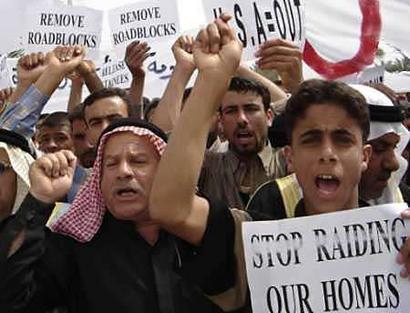 Shi'ite protestors demonstrate against the continued U.S. military presence in Iraq in Najaf on April 9, 2005. Tens of thousands of followers of a rebel Shi'ite cleric marched in Baghdad to denounce the U.S. presence in Iraq and demand a speedy trial of Saddam Hussein, on the second anniversary of his overthrow. Photo by Stringer/Iraq/Reuters - George W. Bush, April 4, 2005, President Welcomes President Yushchenko to the White House source: http://www.whitehouse.gov/news/releases/2005/04/20050404.html SEC. RUMSFELD: I'll start, and I'll let Pete correct me. How to characterize this? I don't -- I worry about being excessively optimistic, myself. I kind of like to deliver rather than promise. Fact number one. Fact number two. Everything I've read about the, quote, "generals," our generals, who you commented on, tended to be condition-based. They put in a comment that said "If this, if this, if that, then we ought to be able to do X, Y or Z." And I think that that's basically what Prime Minister Allawi has said, that's what the president has said. We want to be there while we're needed, we don't want to be there longer than we're needed, and the conditions on the ground will determine the pace. GEN. PACE: Sir, I think -- SEC. RUMSFELD: Speaking of pace. GEN. PACE: I think General Abizaid used the term "cautiously optimistic" as -- and the words that General Casey used were very similar. I think that's exactly right. There's a lot of things right now that make you hopeful about the way ahead in Iraq. But hope is not a plan. So we, as good military folks, do all the planning we should be doing to have the current levels, to have increased levels, and to have decreased levels, and to be able to execute any of those as is appropriate. But cautious optimism is a good phrase for right now. SEC. RUMSFELD: Yes. We'll make this the last question. Q Focusing -- yeah. Focusing on Iraq, what are the options, do you think, to end -- to end the insurgency in Iraq? And do you support or do you favor any negotiation with the leaders of the insurgency in Iraq? SEC. RUMSFELD: What are the options? It seems to me there are not a lot of options to end the insurgency. There are steps that one needs to take that will reduce the insurgency. Specifically, the -- in the last analysis it will be the Iraqi people that will defeat the insurgency, not the coalition. The coalition is going to be able to create an environment that's hospitable to the Iraqi people's success. And we can provide assistance of various kinds. We've provided some assistance from a political standpoint, because how the political scene evolves is going to either -- it should have the effect of reducing the insurgency. To the extent the Iraqi people feel that they own that country, they're a sovereign nation, they have a stake in it, a voice in it, then, in fact, that's a good thing, and it makes the insurgency less attractive to people. To the extent the economic reconstruction goes forward and people have jobs and the economy's growing, that, again, has the effect of reducing support for the insurgency and increasing support for the Iraqi government. So, too, to the extent that the Iraqi security forces are trained and equipped and well led and not jerked around with every change of government, but have a chain of command that works, all of that contributes to reducing the insurgency. That seems to me what -- the only option is to have those things move forward together in a way that persuades the Iraqi people that their stake in the future lies with the Iraqi government and not with the insurgents or not with a passive wait-and-see attitude. - Defense Department Briefing Presenter: Secretary of Defense Donald Rumsfeld; General Peter Pace, USMC, Vice Chairman, Joint Chiefs of Staff Tuesday, March 29, 2005 1:17 p.m. EST source: http://www.pentagon.gov/transcripts/2005/tr20050329-secdef2381.html (C) COPYRIGHT 2005, FEDERAL NEWS SERVICE, INC. - George W. Bush, March 29, 2005, Rose Garden Speech source: http://www.whitehouse.gov/news/releases/2005/03/20050329.html CASEY: We don't necessarily project out that far. Right now, we expect to continue with the number of troops. We have about 17 brigades here through the rest of this year. BLITZER: So you think you'll have about 138,000 for the rest of this year? CASEY: Roughly. BLITZER: And what about next year, what do you think? CASEY: By this time next year -- you know, you base all of your planning on assumptions. Assuming that the political process continues to go positively, and the Sunni are included in the political process, and the Iraqi army continues to progress and develop as we think it will, we should be able to take some fairly substantial reductions in the size of our forces. The specific number is going to be based on the conditions of the Iraqi security forces and the security situation. So I can't give you a specific number or a specific time. CNN's Wolf Blitzer interview with General George Casey, the head of the U.S. military and coalition forces in Iraq. March 27, 2005 source: http://transcripts.cnn.com/TRANSCRIPTS/0503/27/le.01.html © 2005 Cable News Network LP, LLLP. ABIZAID: Well, again, predictions are never a good thing for military leaders to make, other than to say I am confident that they have the leadership, the capacity and the desire to take the lead in the counter-insurgency fight. Right now, we're out in front; they're behind, forming. And in 2005, what General Casey will try to do is change that position so that the Iraqis are out in front and leading. They want to do that. But we've got to be smart about the way that we look at the Iraqi armed forces and interior ministry forces, specifically the police. They've got to have a strong chain of command. They've got to have a different attitude about serving the people, as opposed to serving themselves, which was the case during the previous regime. And they've got to have the confidence that they can stand up to the insurgents. And so, the institution-building that is required to make them effective is going to take some time. We've got to be patient. But I think in 2005, they'll make that move. And by the end of 2005, provided the political process continues to be successful, you'll see the Iraqis more and more in charge and, in some areas, completely in charge. - CNN's Wolf Blitzer interview with General John Abizaid, the head of the U.S. military's Central Command. March 27, 2005 © 2005 Cable News Network LP, LLLP. - George W. Bush, March 19, 2005 Radio Address source: http://www.whitehouse.gov/news/releases/2005/03/20050319.html "And we're making progress. I've talked to General Casey quite frequently. And he keeps us abreast of the progress being made. One of the things -- one of the issues in terms of Iraqi troops being able to defend their country is the ability to stand up chains of command. I think I've shared this with you before, and it's still an issue that they're working on. There's officer training schools, plus the ability for a command to go from a civilian government to a military chain of command, down to the lower ranks of troops. And there's positive signs that have taken place in the development of the Iraqi security forces, and there's still work to be done. Our allies understand that. "But I say 'anxious to come home,' every -- nobody -- people want their troops home, but they don't want their troops home if it affects the mission. We've gone -- we've made a lot of progress. It's amazing how much progress has been made, thanks in large part to the courage of the Iraqi people. And when I talk to people, most understand we need to complete the mission. And completing the mission means making sure the Iraqis can defend themselves." - George W. Bush, Press conference, March 16, 2005 source: http://www.whitehouse.gov/news/releases/2005/03/20050316-3.html "We will continue to build Iraqi divisions and brigades that are capable of independent counterinsurgency operations, so that the Iraqi armed forces themselves can take the leading role in fighting the insurgency, and the coalition forces can move to a supporting role. That will be our main effort here over the course of this year. "Now, that said, there remains much work to be done to build a constitution accepted by all Iraqis, to prepare for the constitutional elections, and to continue to attack and defeat the terrorists and insurgents who intend to unhinge Iraq's march to democracy. We're in a good position following the elections, but we have an awful -- we have a lot of work ahead to get to our final objective in Iraq. "So, to wrap up, we remain broadly on track in meeting our objectives. To be sure, the insurgency is still a force to be reckoned with, but it was not able to achieve its stated objectives on election day, nor was it able to hold its safe haven in Fallujah. We've lots more to do with both our embassy and Iraqi counterparts, but things in Iraq are heading in the right direction. "There's not a timetable. What I said was that there are 90-plus battalions that are operating with coalition forces. Okay? And some of those battalions are good enough so that they can operate independently. But there's not many of them. And over the period of the next year we will work with them to build their brigade and division level command structures so that you can have truly independent Iraqi operations. But it's going to take some months for that to happen. "But I mean, as you know, defeating insurgencies takes time. The average insurgency -- the average counterinsurgency in the 20th century was about nine years, so it takes time to snuff out the insurgency. And also, I think you know, most insurgencies are defeated by political means rather than necessarily by military means. "In terms of level of attacks, I mean, we are dealing with an insurgency that has sufficient ammunition, weapons, money and people to maintain a level of attacks of between 50, 60 a day in the Sunni area. They've demonstrated that capability. And that's not -- as I said, that's not something that we're ultimately going to defeat militarily. The people that are supporting and doing these attacks are going to be drawn into -- hopefully, drawn into the political process, and that will take some of the air out of the insurgency. "So it's a combination of the political, the military, the economic, and the communications that's ultimately going to defeat this." - Gen. George Casey, USA, Commander of U.S. Forces in Iraq. Tuesday, March 8, 2005 Press Conference COPYRIGHT 2005, FEDERAL NEWS SERVICE, INC. source: http://www.defenselink.mil/transcripts/2005/tr20050308-2241.html GEN. JOHN ABIZAID: This is primarily a political question. We give our military advice about sizes and shapes and force structures necessary to get the military job done. In the long-term it's clear that as Iraqi capacity builds up and also as Afghan capacity builds up in the other part of the theater that I'm responsible for, American forces will be able to come down in size; predicting when that might be or how that might be is difficult at this point. Primarily, in Iraq, it's difficult to say because you don't know how the political process is going to go. I mean, we have to seat the nationalist assembly. A prime minister has got to be chosen; a presidency council; a constitution has to be written; a constitution has to be ratified, and then another national election will happen; and that will all happen between now and December. That's a very politically charged atmosphere. It will undoubtedly cause a certain amount of concern within the country; it could lead to sporadic violence here and there. The insurgency in the Sunni areas is not completely defeated. The terrorists continue to exist. And so while we're optimistic about the road ahead, we should know that there's violence ahead. The progress of Iraqi security forces will certainly be shaped to a certain extent by the political process, so if the political process encourages people to stand up, be part of the future, to serve the armed forces of Iraq and the police services in a positive way, then I think it's possible we can think about bringing forces down. But, on the other hand, we need to be patient about the political process and I think we don't want to - we don't want to make too many predictions. Nothing in the Middle East moves in a straight line. There's all sorts of twists and turns that are unpredictable, and you have to understand that military forces provide the shield. And when I say military forces, I mean both Iraqi and American provide the shield by which politics will take place. Every now and then politics is liable to get out of control; it's liable to turn violent. It's not unusual for that to happen in this part of the world. But my view is one of cautious optimism; I think in 2005 we will see the Iraqis really wanting to move forward to take on more and more responsibility, to fight the insurgency as much as they can on their own, and our primary challenge will be that of building the institution of the military and the police services so that they can take on that task. JIM LEHRER: Why is that going so slowly, building the military institution for the Iraqis? GEN. JOHN ABIZAID: Well, Jim, I think that depends upon where you sit. JIM LEHRER: Sure. GEN. JOHN ABIZAID: Where I sit I think it's going remarkably well; when I look at what Gen. Petraeus and Gen. Casey have accomplished, both in terms of setting a security environment that was conducive to elections and at the same time building a more robust and capable Iraqi security service, I actually think that it's been a phenomenal success. If I look to our own history and I look to the Revolutionary War and I see how long it took our forces to develop, how many bumps on the head we had to take before we were successful, I'm actually encouraged that the Iraqis are moving in a pretty good direction. On the other hand, the worst thing we can do is build an institution, commit it to combat, put it in harm's way in such a manner that it breaks. We have to really solidify the chain of command, make sure that when the prime minister issues an order that it goes through a coherent chain of command that's responsible and loyal -- this is really more about loyalty and leadership than it is about numbers of troops trained and equipped. JIM LEHRER: And you're optimistic about this? GEN. JOHN ABIZAID: I'm very optimistic about it; I'm optimistic that at the end of the day the Iraqi armed forces will emerge as one of the best trained and equipped armed forces in the Middle East. JIM LEHRER: When will that be? GEN. JOHN ABIZAID: One that will be loyal to the political leadership, one that will serve the people, as opposed to what the previous Iraqi services did, which was feed upon the people. - PBS Newshour with Jim Lehrer, March 1, 2005 Copyright ©2005 MacNeil/Lehrer Productions. All Rights Reserved source: http://www.pbs.org/newshour/bb/middle_east/jan-june05/abizaid_3-1.html Asked if the US has an exit strategy for Iraq in the light of continued insurgency, the Secretary of State insisted that the positive effects of removing Saddam are already felt across the region. She said: "We don't talk about exit strategies. We think about success strategies. We think about what we went there to do – which was to remove one of the worst dictators in the region. The insurgency in Iraq has no political future because the Iraqi people have demonstrated by going to the polls in huge numbers that they believe their political future is in the process that will culminate in December 2005 with free and fair elections. The insurgents have no answer to that...It is a positive development that the Iraqis have taken to the politics this way and that they're moving their country towards a more democratic future. And that will have an effect on the rest of the region." March 1, 2005 Content © ITV Network Limited. All Rights Reserved source: http://www.itv.com/news/world_715788.html 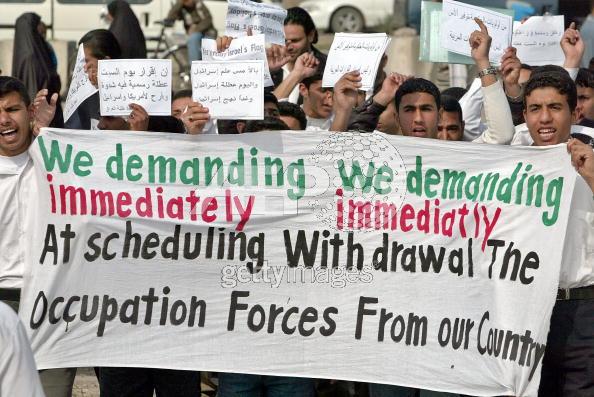 BAGHDAD, IRAQ: Students, holding banners, demonstrate at the Mustansiriyeh University, the oldest in Baghdad 28 February 2005. The students were demonstrating against having Saturday as an official day off, wanting Thursday instead. Friday is the official day off (weekend) in Iraq, as it is in many mainly Muslim countries. AFP PHOTO/AHMAD AL-RUBAYE (Photo credit should read AHMAD AL-RUBAYE/AFP/Getty Images) Copyright: 2005 AFP http://editorial.gettyimages.com/source/search/details_pop.aspx?iid=52254082&cdi=0 BEVERLY HILLS, Calif. - (Reuters) - The insurgency in Iraq is not likely to be put down in a year or even two since history shows such uprisings can last a decade or more, the United States' top military commander says. Air Force General Richard Myers says that in the past century, insurgencies around the world have lasted anywhere from seven to 12 years, making a quick fix to the problem in Iraq unlikely. "This is not the kind of business that can be done in one year, two years probably," Gen Myers said, chairman of the Joint Chiefs of Staff, in a speech to the Los Angeles World Affairs Council. - "Top US general sees lasting Iraq insurgency", Reuters, Feb. 26, 2005 © Reuters 2005. All Rights Reserved. source: http://www.abc.net.au/news/newsitems/200502/s1311637.htm "There are still challenges ahead, let there be no doubt ... The next task is to prepare Iraq security forces to have confidence to defeat the insurgency.... Once they have that confidence, our forces can go home... One day you'll see very clearly the history you made." source: http://www.cnn.com/2005/WORLD/asiapcf/02/11/iraq.rumsfeld/ © 2005 Cable News Network LP, LLLP. However, some leading Sunni groups have laid down tough conditions, including a demand for the United States to set a firm timetable for withdrawing its troops. The Americans have refused to set a deadline, saying they would leave when an Iraqi force was capable of providing security and defeating the insurgents. "Once they have that confidence, that capacity and capability, our forces, coalition forces, will be able to go home," Rumsfeld told U.S. troops in Mosul. "It is the Iraqis who will have to over time defeat the insurgency." "Rumsfeld In Iraq Amid New Violence" (CBS/AP), Feb. 11, 2005 source: http://www.cbsnews.com/stories/2005/02/12/iraq/main673658.shtml ©MMV, CBS Broadcasting Inc. - Dick Cheney, Fox News Sunday Interview, Feb. 6, 2005 source: http://www.foxnews.com/story/0,2933,146546,00.html Copyright 2005 FOX News Network, LLC "The president and I and anyone would dearly love to be smart enough and wise enough to know precisely when our troops could leave. It would be such a relief for people to know that. It's not knowable. The important thing to do is to see that we do not create a dependency, that we encourage them to take over that responsibility. And our forces are doing that. We're helping to train and equip the Iraqi security forces. And the president believes, and I agree with him, that we don't want to be there any longer than we have to, but we want to be there as long as we're needed. And it seems to me that the answer as to when our troops can come out is dependent upon the conditions on the ground and whether or not the Iraqis are capable of managing the security situation there. We're working very hard to see that they can." source: http://www.msnbc.msn.com/id/6923245/ "...millions of brave Iraqis defied the threats of terrorists, and cast votes to determine their nation's future. The whole world can now see that the assassins and car-bombers are doomed to fail, because they are fighting the desire of the Iraqi people to live in freedom. And when Iraq is democratic, at peace with its neighbors, and able to defend itself, our nation will be safer, and our troops will return home with the honor they have earned. The work ahead is not easy. But we go forward with confidence, knowing that America's best days are yet to come." source: http://www.whitehouse.gov/news/releases/2005/02/20050205.html At the recommendation of our commanders on the ground, and in consultation with the Iraqi government, we will increasingly focus our efforts on helping prepare more capable Iraqi security forces -- forces with skilled officers and an effective command structure. As those forces become more self-reliant and take on greater security responsibilities, America and its coalition partners will increasingly be in a supporting role. In the end, Iraqis must be able to defend their own country -- and we will help that proud, new nation secure its liberty. Recently an Iraqi interpreter said to a reporter, "Tell America not to abandon us." He and all Iraqis can be certain: While our military strategy is adapting to circumstances, our commitment remains firm and unchanging. We are standing for the freedom of our Iraqi friends, and freedom in Iraq will make America safer for generations to come. We will not set an artificial timetable for leaving Iraq, because that would embolden the terrorists and make them believe they can wait us out. We are in Iraq to achieve a result: A country that is democratic, representative of all its people, at peace with its neighbors, and able to defend itself. And when that result is achieved, our men and women serving in Iraq will return home with the honor they have earned. - George W. Bush, State of the Union speech, Feb. 2, 2005 source: http://www.whitehouse.gov/news/releases/2005/02/20050202-11.html - George W. Bush, Radio Address, January 29, 2005 source: http://www.whitehouse.gov/news/releases/2005/01/20050129.html - Condoleeza Rice, Confirmation Hearing, January 18, 2005 Copyright 2005 The New York Times Company - George W. Bush - Interview with Barbara Walters, January 14, 2005 source: http://abcnews.go.com/2020/Inauguration/story?id=406639&page=1 If you know of any other instances where a top official describes the exit strategy (or non-exit strategy) from Iraq, please email the information to me. In accordance with Title 17 U.S.C. Section 107, the material on this site is distributed without profit to those who have expressed a prior interest in receiving the included information for research and educational purposes. For more information go to: http://www.law.cornell.edu/uscode/17/107.shtml. If you wish to use copyrighted material from this site for purposes of your own that go beyond 'fair use', you must obtain permission from the copyright owner. What is the latest exit strategy from Iraq? What is the Iraq exit strategy? What is the exit strategy from Iraq? What is the Iraq war's exit strategy? What is the official exit strategy from the war in Iraq? What is the Iraq war's official exit strategy? Page created on February 7, 2005
|
| "To initiate a war of aggression, therefore, is not only an international crime; it is the supreme international crime differing only from other war crimes in that it contains within itself the accumulated evil of the whole." - Judgment of the International Military Tribunal for the Trial of German Major War Criminals - Nuremberg, Germany 1946 |
| In accordance with Title 17 U.S.C. Section 107, some of the material on this site is distributed without profit to those who have expressed a prior interest in receiving the included information for research and educational purposes. For more information go to: http://www.law.cornell.edu/uscode/17/107.shtml. If you wish to use copyrighted material from this site for purposes of your own that go beyond 'fair use', you must obtain permission from the copyright owner. |
|
|
|
|
|
|

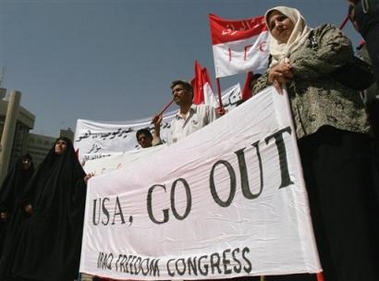
.jpg)