IRAQ EXIT STRATEGY early
2006
Here is the history of the Iraq war's exit strategy.
"What is the exit strategy from the war in Iraq?"
you may ask.
The answer depends on whom you ask, and when.
"Victory means exit strategy, and it's important for the
president to explain to us what the exit strategy is." - George W.
Bush, April 9, 1999.
Disclaimer: Some of these transcripts may not be exactly accurate. I have discovered that the White House often 'cleans up' what Mr. Bush actually says to make it more presentable and presidential, removing the 'umm's, 'uhh's, and 'you-know's.
Updated
May 09, 2022
Q General Schoomaker said
this morning that for planning
purposes, the Army is putting
together troop rotations at
current levels through 2010. And
I realize that planning is done
with a lot of uncertainty in
mind. My question to you is, can
you keep up that pace for that
long without loosening the
limitations on the use of
National Guard and Reserve, and
without wearing out the active
force?
SEC. RUMSFELD: You know, I saw
the Associated Press headline
that said, "Army: Troops to Stay
in Iraq Until 2010." Schoomaker
did not, of course, say anything
like that, and it's unfortunate
that stories go out
mischaracterizing what people
say.
The Army has the responsibility,
at the direction of General
Pace, and David Chu, and me, and
the president, to look out over
a period of time and do a series
of sensitivities as to what if
this, or what if that, and how
might they do it, and to then
undertake a planning process to
see if they were asked to do
this, what might they do. And
that's what the Army does.
General Schoomaker and the Army
does not set force levels in
Iraq. They're not the ones who
determine how many will be there
and until what year they'll be
there. That's a function of
General Casey and General
Abizaid reporting to me and to
the president.
- U.S. Secretary of Defense
Donald H. Rumsfeld, DoD Press
Briefing, October 11, 2006
source:
http://www.defenselink.mil/Transcripts/Transcript.aspx?TranscriptID=3755
(C) COPYRIGHT 2005, FEDERAL
NEWS SERVICE, INC
Now I'd like to remind
everybody of where that puts us
in the overall process. The
overall process of building the
Iraqi security forces is a
three-step process.
The first step: train and equip.
You organize them into units.
You give them the individual
training, and you equip them and
you put them in a position where
they are ready to go out and
conduct operations.
The second step: you make them
better. And for the army, that
means you put them in the lead.
And our strategy is to put the
Iraqis in the lead with our
continued support so that they
learn while doing rather than
learn while watching us.
And the third step is you make
them independent, and that's
what you'll see going on here
over the better part of the next
12 months. We've said all along
that we wanted to give the
Iraqis the capability to conduct
independent counterinsurgency
operations, and that is the
program that we are currently
on.
I would also say that we
continue to make progress with
the Ministry of Interior and
police forces. Now, the police
have a bad reputation in Iraq,
and from my view, that's
undeserved. Broadly, it's
undeserved. There are units
within the national police
forces that deserve that
reputation, and I think you just
saw recently where one of those
units was actually pulled off
line by the minister of Interior
for complicity in some sectarian
violence.
With respect to the Ministry of
Interior forces, two of the 18
Iraqi provinces now have already
assumed Iraqi control in their
province.
What that means is that the
police forces in that province
are capable of maintaining
domestic order without routine
coalition support, and in
Muthanna province and Dhi Qar
province that is happening. I
would expect to see six or seven
Iraqi provinces under provincial
Iraqi control by the end of the
year.
We are about 90 percent through
building the police and border
forces that we said we were
going to help the Iraqis build,
and we expect to complete that
by the end of the year. We've
also with the Iraqis started a
national police reform program,
where will take a whole Iraqi
national police brigade offline,
move them to a training base and
give them three weeks of police
training and loyalty training,
so that we change not only the
-- their abilities but the ethos
of the unit. That will go on at
about one brigade a month here
until it's completed in the
August timeframe.
Finally, we have -- because our
goals here are to help the
Iraqis over the long term, we
have instituted -- helped them
institute two professional
development courses for junior
and mid-level officers this
year, and we will put it -- and
help them put in place a course
for senior officers and
non-commissioned officers over
the course of next year.
And lastly, as some of you have
seen this, but the minister of
Interior himself has instituted
a ministry reform program. He
announced it at the Council of
Representatives. He emphasizes
loyalty, accountability and
operational performance. And as
part of this program, his
inspector general and his
internal affairs divisions have
already processed over 3,000
corruption cases -- are
investigating 3,000 corruption
cases and almost a thousand
human rights cases, and he's
taken action already in
relieving over 1,200 officers,
including a few general
officers.
So lots of work to do with the
police and still with the army,
but the progress you're seeing
there is heartening.
Now, another way to look at
progress to help you get some
perspective on this is take a
look at what one of our
divisions accomplishes in Iraq
over the course of a deployment.
In this case, I'll talk about
the 101st Airborne Division, who
was responsible for an area in
northwest Iraq, was there from
November 2005 until just this
last September.
Over that period, they detained
over 150 high-value individuals,
each one of these a painstaking
intelligence collection and
development effort that led to
the capture of an individual.
They secured over 200 polling
sites for the December elections
and allotted 1-1/2 million
Iraqis to vote in those
provinces.
They moved two Iraqi divisions,
nine brigades and 35 battalions
into the lead. They brought five
provincial and 11 district
police headquarters up to the
second-highest level of
preparation. They oversaw the
training integration of over
32,000 police. They supported
the development of two strategic
infrastructure brigades with 14
battalions.
They supervised the building of
a hundred police stations, 130
border forts and improved seven
international ports of entry in
the -- along the borders. And as
a result of that progress with
the Iraqi security forces, they
were able to reduce a two-star
headquarters, two coalition
brigades, a total of 10,000
coalition forces, and they
closed 25 bases over the course
of that time.
Looking back, it's not
insignificant what a division
can get done by taking small
steps every day. And that's what
we say. We make progress in Iraq
every day, small steps at a
time.
So bottom line? Tough situation
in Iraq. And I suspect that
through Ramadan and over the
next couple of months, it's
going to continue to be
difficult.
That said, we continue to make
progress across the country
every day. It's a tough
business, but the soldiers,
sailors, airmen and Marines of
the coalition and their Iraqi
colleagues are well up to the
task, and they do magnificent
job under difficult
circumstances.
In closing, I think it's
important for the American
people to know what a
magnificent job their servicemen
and -women are doing in a very,
very difficult environment. And
we and then the Iraqis continue
to move forward against very
divisive forces that are trying
to deny the Iraqi people the
prosperous future that they so
well deserve after 35 years
under Saddam Hussein. And we
will succeed in Iraq, but it
will take patience, and it will
take will.
- General George Casey,
Commander of Multi-National
Force-Iraq , DoD News Briefing,
October 11, 2006
source:
http://www.defenselink.mil/Transcripts/Transcript.aspx?TranscriptID=3755
(C) COPYRIGHT 2005, FEDERAL
NEWS SERVICE, INC
LONDON (Reuters) - Britain's
top army commander said British
troops in Iraq should be
withdrawn soon because their
presence was exacerbating
security problems in the
country, according to a British
newspaper.
General Sir Richard Dannatt
also told the Daily Mail in an
interview published on Friday
that Britain's Iraq venture was
aggravating the security threat
elsewhere in the world.
In unusually blunt comments for
a serving senior officer,
Dannatt said the troops should
"get ... out sometime soon
because our presence exacerbates
the security problems."
Britain, Washington's main ally
in Iraq, has around 7,000
soldiers deployed, mainly in the
Shi'ite south.
The March 2003 U.S.-led invasion
to oust former president Saddam
Hussein has come under heavy
criticism, as the civilian
death-toll mounts and British
and U.S. troops are increasingly
in the firing line. Britain has
lost 119 soldiers so-far.
Dannatt, who took over as Chief
of the General Staff in August,
suggested troops in Iraq had
out-stayed their welcome.
"The military campaign we fought
in 2003 effectively kicked the
door in. Whatever consent we may
have had in the first place, may
have turned to tolerance and has
largely turned to intolerance.
That is a fact. I don't say that
the difficulties we are
experiencing round the world are
caused by our presence in Iraq
but undoubtedly our presence in
Iraq exacerbates them."
Dannatt appeared to be
suggesting the presence of
British and U.S. troops in Iraq
was fanning Islamic militancy --
something British Prime Minister
Tony Blair has consistently
denied.
POST-WAR FAILINGS
Putting himself directly at odds
with Blair and President Bush,
the general criticised the
post-invasion planning by the
U.S.-led coalition.
"I think history will show that
the planning for what happened
after the initial successful war
fighting phase was poor,
probably based more on optimism
than sound planning."
He continued: "The original
intention was that we put in
place a liberal democracy that
was an exemplar for the region,
was pro-West and might have a
beneficial effect on the balance
within the Middle East. That was
the hope, whether that was a
sensible or naive hope history
will judge. I don't think we are
going to do that. I think we
should aim for a lower
ambition."
U.S.-led forces and the Iraqi
government face a challenge both
from insurgency and sectarian
fighting between Shi'ites and
Sunni Muslims that has brought
the country close to civil war.
A spokeswoman at Blair's office
issued a statement in response
to the Dannatt interview that
was echoed by the Ministry of
Defense.
"It's important that people
remember that we are in Iraq at
the express wish of the
democratically elected Iraqi
government, to support them
under the mandate of a U.N.
resolution," the Downing Street
statement said.
The opposition Conservatives'
defense spokesman, however,
welcomed the general's
intervention, while expressing
surprise at his bluntness.
"We need urgent clarification
now from ministers about whether
there has been any change in the
government's position," Liam Fox
said in a statement.
Blair has insisted that British
troops must remain in Iraq until
the Iraqi government is able to
take control of security.
Bush, however, said on Wednesday
he was open to adjusting the
U.S. strategy in the country
after two senior Republicans
suggested there were
alternatives to his policy,
described by critics as
"stay-the-course."
UK troops worsen problems in
Iraq: army chief - By
Deborah Haynes, Reuters, October
12, 2006
source:
http://abcnews.go.com/US/wireStory?id=2560666
Copyright © 2006 Reuters
Limited
The reason I bring this up,
these examples up, is that
there's a political process
that's going forward, and it's
the combination of security and
a political process that will
enable the United States to
achieve our objective, which is
an Iraq that can govern itself,
sustain itself, defend itself,
and be an ally in this war on
terror.
Iraq's government -- Iraq's
democratic government is just
four months old. Yet, in the
face of terrorist threats and
sectarian violence, Iraq's new
leaders are beginning to make
tough choices. And as they make
these tough decisions, we'll
stand with them, we'll help
them. It's in our interests that
Iraq succeed.
I fully understand the American
people are seeing unspeakable
violence on their TV screens.
These are tough times in Iraq.
The enemy is doing everything
within its power to destroy the
government and to drive us out
of the Middle East, starting
with driving us out of Iraq
before the mission is done. The
stakes are high. As a matter of
fact, they couldn't be higher.
If we were to abandon that
country before the Iraqis can
defend their young democracy the
terrorists would take control of
Iraq and establish a new safe
haven from which to launch new
attacks on America. How do I
know that would happen? Because
that's what the enemy has told
us would happen. That's what
they have said. And as
Commander-in-Chief of the United
States military, and as a person
working to secure this country,
I take the words of the enemy
very seriously, and so should
the American people.
We can't tolerate a new
terrorist state in the heart of
the Middle East, with large oil
reserves that could be used to
fund its radical ambitions, or
used to inflict economic damage
on the West. By helping the
Iraqis build a democracy -- an
Iraqi-style democracy -- we will
deal a major blow to terrorists
and extremists, we'll bring hope
to a troubled region, and we'll
make this country more secure.
- George W. Bush, Press
Conference, October 11, 2006
source:
http://www.whitehouse.gov/news/releases/2006/10/20061011-5.html
WASHINGTON - The U.S. Army
has plans to keep the current
level of soldiers in Iraq
through 2010, the top Army
officer said Wednesday, a later
date than Bush administration or
Pentagon officials have
mentioned thus far.
The Army chief of staff, Gen.
Peter J. Schoomaker, cautioned
against reading too much into
the planning, saying troops
levels could be adjusted to
actual conditions in Iraq. He
said it is easier to hold back
forces scheduled to go there
than to prepare and deploy units
at the last minute.
“This is not a prediction that
things are going poorly or
better,” Schoomaker told
reporters. “It’s just that I
have to have enough ammo in the
magazine that I can continue to
shoot as long as they want us to
shoot.”
Even so, his comments were the
latest acknowledgment by
Pentagon officials that a
significant withdrawal of troops
from Iraq is not likely in the
immediate future.
Currently there are 141,000
troops in Iraq, including
120,000 Army soldiers. Those
soldiers are divided among 15
Army combat brigades plus other
support units.
Comments as elections loom
Schoomaker’s comments come less
than four weeks before
congressional elections, in
which the unpopular war in Iraq
and the Bush administration’s
policies there are a major
campaign issue.
Last month, the top U.S.
commander in the Middle East,
Gen. John Abizaid, said the
military would likely maintain
or possibly even increase the
current force levels through
next spring.
In recent months the Army has
shown signs of strain, as
Pentagon officials have had to
extend the Iraq deployments of
two brigades in order to bolster
security in Baghdad and allow
units heading into the country
to have at least one year at
home before redeploying.
Schoomaker said he has received
no new guidance from commanders
in Iraq as to when the U.S. will
be able to begin reducing the
number of troops there. Last
year officials had hoped to be
down to about 100,000 by the end
of this year, but escalating
violence and sectarian tensions
have prompted military leaders
to increase forces.
He also said the Army will have
to rely on the National Guard
and Reserves to maintain the
current level of deployments.
When asked about concerns that
reserve units are struggling to
get the training and equipment
they need before going back to
Iraq, Schoomaker said that no
troops would be sent into war
without needed resources.
- Army plans current Iraq
troop levels until 2010, The
Associated Press via MSNBC,
October 11, 2006
source:
http://www.msnbc.msn.com/id/15220816/
© 2006 The Associated Press
As terrorists wage their
attacks, they know they cannot
beat us in a stand-up fight;
they never have. But they are
absolutely convinced they can
break the will of the American
people. And the only way they
can win is if we lose our nerve
and abandon our mission, but the
world can have confidence in the
resolve of the United States. We
will stand by our friends. We
will help Iraqis build a nation
that is free, secure, and able
to defend itself. We will
confront our enemies on this and
every other front in the war on
terror. And with good allies at
our side, we will prevail.
...
The mission of the United States
and our coalition will continue
to change as necessary, as it
has from the beginning. And all
Americans can be certain -- any
decisions about troop levels
will be driven by the conditions
on the ground and the judgment
of our commanders, not by
artificial timelines set by
politicians in Washington, D.C.
...
We are a democracy defended by
volunteers, who deserve all the
tools and all the support we can
possibly provide. Americans
appreciate our fellow citizens
who go out on long deployments
and endure the hardship of
separation from home and family.
We care about those who have
returned with injuries and who
face a hard road ahead. And our
nation grieves for the brave men
and women whose lives have ended
in freedom's cause. No one can
take away the sorrow that has
come to the families of the
fallen. We can only say, with
complete certainty, that these
Americans served in a noble and
a necessary cause, and we will
honor their memory forever.
We will honor their sacrifice by
completing the mission.
-
U.S. Vice President Richard
"Dick" Cheney, Remarks at a
Rally for the Troops, October 4,
2006
source:
http://www.whitehouse.gov/news/releases/2006/10/20061004-3.html
It's hard work. But it's
necessary work. Iraq is a
central part on the war on
terror, and we have a plan for
victory there. We have a
security plan that will chase
down those extremists and
radicals who would like to do us
harm, and enable the Iraqis to
defend themselves. We have a
political strategy, and that is
to stand squarely with the 12
million people who said loud and
clear: We want to be free.
You know, it must seem like an
eternity to you, when you think
about those elections last
December. It certainly does to
me, in some ways. Ultimately,
when this chapter of history
will be written, however, it's
going to be a comma -- the
Iraqis voted, comma, and the
United States of America
understood that Iraq was a
central front in the war on
terror and helped this young
democracy flourish so that a
generation of Americans wouldn't
have to worry about the
extremists emanating from that
country to hurt the American
people.
The stakes are high. The
Democrats are the party of cut
and run. Ours is a party that
has got a clear vision and says
we will give our commanders and
troops the support necessary to
achieve that victory in Iraq. We
will stay in Iraq, we will fight
in Iraq, and we will win in
Iraq.
Our strategy is to stay on the
offense, and we will do that.
You just got to know there's
some fine, fine, brave men and
women in uniform, and some not
in uniform in the intelligence
services, doing everything they
can to find the enemy every
single day. It's hard to plot
and plan when you're hiding in a
cave and are on the run. And
that's our strategy, and that's
the way we're going to keep it.
- George W. Bush, Remarks by
the President at Richard Pombo
for Congress Breakfast, October
3, 2006
source:
http://www.whitehouse.gov/news/releases/2006/10/20061003-3.html
RUMSFELD: ...And I
guess the short answer is that
insurgencies are historically
very difficult things. They take
time. They take anywhere from 5,
8,10,12,15 years.
And go back to the
Philippines or Algeria or any
number of other countries. The
United States does know how to
deal with them, but, there isn't
a silver bullet. There's not
something that you do that ends
it. Not a single big battle and
it takes the development of that
government because in that last
analysis that insurgency is
going to be dealt with in Iraq
by the Iraqi people, by the
success of that government and
over time it isn't going to be
dealt with by foreigners in my
view.
And our task is to see that they
have sufficient security forces
that they can in fact achieve
their goal of a, of a reasonably
stable environment so that they
can move forward as a country.
...
SESNO: You have talked about
this as a long war, that's going
to go on possibly as long as the
Cold War, that could be decades.
America could find itself in
Iraq for years to come.
RUMSFELD: No, no, no, no, no,
no, no, no, no, no, no. The long
war is not Iraq.
SESNO: No, I know that.
RUMSFELD: Just a minute. And
it's not keeping Americans in
Iraq for a long time. There is
no one with that intention.
- Frank Sesno's interview
with Secretary of Defense Donald
Rumsfeld, CNN, September 30,
2006
source:
http://www.cnn.com/2006/US/09/30/rumsfeld.transcript/index.html
© 2006 Cable News Network LP,
LLLP.
The only way to protect our
citizens at home is to go on the
offense against the enemy across
the world. When terrorists spend
their days working to avoid
capture, they are less able to
plot, plan, and execute new
attacks on our people. So we
will remain on the offense until
the terrorists are defeated and
this fight is won.
In my recent speeches, I've said
we are in the early hours of a
long struggle for civilization,
and that our safety depends on
the outcome of the battle in
Iraq. The National Intelligence
Estimate declares "perceived
jihadist success there would
inspire more fighters to
continue the struggle
elsewhere." It also says that
"Should jihadists leaving Iraq
perceive themselves, and be
perceived, to have failed, we
judge fewer fighters will be
inspired to carry on the fight."
Withdrawing from Iraq before the
enemy is defeated would embolden
the terrorists. It would help
them find new recruits to carry
out even more destructive
attacks on our Nation, and it
would give the terrorists a new
sanctuary in the heart of the
Middle East, with huge oil
riches to fund their ambitions.
America must not allow this to
happen. We are a Nation that
keeps its commitments to those
who long for liberty and want to
live in peace. We will stand
with the nearly 12 million
Iraqis who voted for their
freedom, and we will help them
fight and defeat the terrorists
there, so we do not have to face
them here at home.
- George W. Bush, Radio
Address, September 30, 2006
source:
http://www.whitehouse.gov/news/releases/2006/09/20060930.html
TIRANA, Sept. 27 (Reuters) -
U.S. Defense Secretary Donald
Rumsfeld said on Wednesday that
American operations in Iraq
would end when Iraqi security
forces were able to take over
the job, but he would not
estimate when that might be.
"Our view has been that it's for
the Iraqi people to provide for
their government, for the Iraqi
people to provide for their own
security, and our task has been
to assist them during this
period, the early days of their
free system, so they can develop
the security forces capable of
providing for security in the
country," he told reporters in
the Albanian capital Tirana.
He said Iraqi security forces
were making progress and
beginning to take on additional
responsibilities. But he would
not estimate when the transfer
of authority for security in all
provinces could happen.
"One can't predict with perfect
certainty the pace at which that
will happen," Rumsfeld said. "We
do know it is happening."
"Trying to set a specific date
just isn't manageable," he said,
speaking after a meeting of
southeast European defense
ministers.
Unrelenting violence in Iraq has
frustrated the Pentagon's
efforts to begin bringing home
the 142,000 U.S. troops there.
It is also a critical campaign
issue in the United States ahead
of November elections that will
determine control of Congress.
- Rumsfeld-unclear when Iraq
troops can replace U.S., By
Kristin Roberts, Reuters,
September 27, 2006
source:
http://www.alertnet.org/thenews/newsdesk/L27699613.htm
© 2006 Reuters Limited
(CNN) -- Seventy-one percent
of Iraqis responding to a new
survey favor a commitment by
U.S.-led forces in Iraq to
withdraw in a year.
The majority of respondents to
the University of Maryland poll
said that "they would like the
Iraqi government to ask for
U.S.-led forces to be withdrawn
from Iraq within a year or
less," according to the survey's
summary.
"Given four options, 37 percent
take the position that they
would like U.S.-led forces
withdrawn 'within six months,'
while another 34 percent opt for
'gradually withdraw(ing)
U.S.-led forces according to a
one-year timeline.' (Watch why
one analyst says U.S. strategy
is flawed -- 1:45)
"Twenty percent favor a two-year
timeline and just 9 percent
favor 'only reduc(ing) U.S.-led
forces as the security situation
improves in Iraq.'"
- Poll: Most Iraqis favor
U.S. pullout in a year, CNN,
September 27, 2006
source:
http://www.cnn.com/2006/WORLD/meast/09/27/iraq.poll/index.html
© 2006 Cable News Network LP,
LLLP.

Most Iraqis Favor Immediate U.S. Pullout, Polls Show
Leaders' Views Out of Step With Public
Breakdown of Iraqi Responses
A majority of Iraqis across the country say they want U.S.-led coalition forces to leave immediately, according to a new poll conducted by the U.S. State Department.
SOURCE: State Department | The Washington Post - September 27, 2006
By Amit R. Paley
Washington Post Staff Writer
Wednesday, September 27, 2006; A22
BAGHDAD, Sept. 26 -- A strong majority of Iraqis want U.S.-led military forces to immediately withdraw from the country, saying their swift departure would make Iraq more secure and decrease sectarian violence, according to new polls by the State Department and independent researchers.
In Baghdad, for example, nearly three-quarters of residents polled said they would feel safer if U.S. and other foreign forces left Iraq, with 65 percent of those asked favoring an immediate pullout, according to State Department polling results obtained by The Washington Post.
Another new poll, scheduled to be released on Wednesday by the Program on International Policy Attitudes at the University of Maryland, found that 71 percent of Iraqis questioned want the Iraqi government to ask foreign forces to depart within a year. By large margins, though, Iraqis believed that the U.S. government would refuse the request, with 77 percent of those polled saying the United States intends keep permanent military bases in the country.
The stark assessments, among the most negative attitudes toward U.S.-led forces since they invaded Iraq in 2003, contrast sharply with views expressed by the government of Prime Minister Nouri al-Maliki. Last week at the United Nations, President Jalal Talabani said coalition troops should remain in the country until Iraqi security forces are "capable of putting an end to terrorism and maintaining stability and security."
"Only then will it be possible to talk about a timetable for the withdrawal of the multinational forces from Iraq," he said.
Recent polls show many Iraqis in nearly every part of the country disagree.
"Majorities in all regions except Kurdish areas state that the Multi-National Force-Iraq (MNF-I) should withdraw immediately, adding that the MNF-I's departure would make them feel safer and decrease violence," concludes the 20-page State Department report, titled "Iraq Civil War Fears Remain High in Sunni and Mixed Areas." The report was based on 1,870 face-to-face interviews conducted from late June to early July.
The Program on International Policy Attitudes poll, which was conducted over the first three days of September for WorldPublicOpinion.org, found that support among Sunni Muslims for a withdrawal of all U.S.-led forces within six months dropped to 57 percent in September from 83 percent in January.
"There is a kind of softening of Sunni attitudes toward the U.S.," said Steven Kull, director of PIPA and editor of WorldPublicOpinion.org. "But you can't go so far as to say the majority of Sunnis don't want the U.S. out. They do. They're just not quite in the same hurry as they were before."
The PIPA poll, which has a margin of error of 3 percent, was carried out by Iraqis in all 18 provinces who conducted interviews with more than 1,000 randomly selected Iraqis in their homes.
Using complex sampling methods based on data from Iraq's Planning Ministry, the pollsters selected streets on which to conduct interviews. They then contacted every third house on the left side of the road. When they selected a home, the interviewers then collected the names and birth dates of everyone who lived there and polled the person with the most recent birthday.
Matthew Warshaw, a senior research manager at D3 Systems, which helped conduct the poll, said he didn't think Iraqis were any less likely to share their true opinions with pollsters than Americans. "It's a concern you run up against in Iowa or in Iraq," he said. "But for the most part we're asking questions that people want to give answers to. People want to have their voice heard."
The greatest risk, he said, was the safety of the interviewers. Two pollsters for another Iraqi firm were recently killed because of their work.
The State Department report did not give a detailed methodology for its poll, which it said was carried out by an unnamed Iraqi polling firm. Lou Fintor, a spokesman for the U.S. Embassy in Baghdad, said he could not comment on the public opinion surveys.
The director of another Iraqi polling firm, who spoke on condition of anonymity because he feared being killed, said public opinion surveys he conducted last month showed that 80 percent of Iraqis who were questioned favored an immediate withdrawal. Eight-five percent of Sunnis in that poll supported an immediate withdrawal, a number virtually unchanged in the past two years, except for the two months after the Samarra bombing, when the number fell to about 70 percent, the poll director said.
"The very fact that there is such a low support for American forces has to do with the American failure to do basically anything for Iraqis," said Mansoor Moaddel, a professor of sociology at Eastern Michigan University, who commissioned a poll earlier this year that also found widespread support for a withdrawal. "It's part of human nature. People respect authority and power. But the U.S. so far has been unable to establish any real authority."
Interviews with two dozen Baghdad residents in recent weeks suggest one central cause for Iraqi distrust of the Americans: They believe the U.S. government has deliberately thrown the country into chaos.
The most common theory heard on the streets of Baghdad is that the American military is creating a civil war to create an excuse to keep its forces here.
"Do you really think it's possible that America -- the greatest country in the world -- cannot manage a small country like this?" Mohammad Ali, 42, an unemployed construction worker, said as he sat in his friend's electronics shop on a recent afternoon. "No! They have not made any mistakes. They brought people here to destroy Iraq, not to build Iraq."
As he drew on a cigarette and two other men in the store nodded in agreement, Ali said the U.S. government was purposely depriving the Iraqi people of electricity, water, gasoline and security, to name just some of the things that most people in this country often lack.
"They could fix everything in one hour if they wanted!" he said, jabbing his finger in the air for emphasis.
Mohammed Kadhem al-Dulaimi, 54, a Sunni Arab who used to be a professional soccer player, said he thought the United States was creating chaos in the country as a pretext to stay in Iraq as long as it has stayed in Germany.
"All bad things that are happening in Iraq are just because of the Americans," he said, sipping a tiny cup of sweet tea in a cafe. "When should they leave? As soon as possible. Every Iraqi will tell you this."
Many Iraqi political leaders, on the other hand, have been begging the Americans to stay, especially since the February bombing of a Shiite Muslim shrine in Samarra, which touched off the current round of sectarian reprisal killings between Sunnis and Shiites.
The most dramatic about-face came from Sunni leaders, initially some of the staunchest opponents to the U.S. occupation, who said coalition forces were the only buffer preventing Shiite militias from slaughtering Sunnis.
Mahmoud al-Mashhadani, the outspoken Sunni speaker of parliament who this summer said that "the U.S. occupation is the work of butchers," now supports the U.S. military staying in Iraq for as long as a decade.
"Don't let them go before they have corrected what they have done," he said in an interview this month. "They should stay for four years. This is the minimum. Maybe 10 years."
Particularly in mixed neighborhoods here in the capital, some Sunnis say the departure of U.S. forces could trigger a genocide. Hameed al-Kassi, 24, a recent college graduate who lives in the Yarmouk district of Baghdad, worried that rampages by Shiite militias could cause "maybe 60 to 70 percent of the Sunnis to be killed, even the women, old and the young."
"There will be lakes of blood," Kassi said. "Of course we want the Americans to leave, but if they do, it will be a great disaster for us."
In a barbershop in the capital's Karrada district Tuesday afternoon, a group of men discussed some of the paradoxical Iraqi opinions of coalition troops. They recognized that the departure of U.S.-led forces could trigger more violence, and yet they harbored deep-rooted anger toward the Americans.
"I really don't like the Americans who patrol on the street. They should all go away," said a young boy as he swept up hair on the shop's floor. "But I do like the one who guards my church. He should stay!"
Sitting in a neon-orange chair as he waited for a haircut, Firas Adnan, a 27-year-old music student, said: "I really don't know what I want. If the Americans leave right now, there is going to be a massacre in Iraq. But if they don't leave, there will be more problems. From my point of view, though, it would be better for them to go out today than tomorrow."
He paused for a moment, then said, "We just want to go back and live like we did before."
|
|
By Amit R. Paley ,Washington
Post, September 26, 2006
source:
http://www.washingtonpost.com/wp-dyn/content/article/2006/09/26/AR2006092601721.html
© 2006 The Washington Post
Company
In my meeting with President
Talabani, I told him that
America will continue to support
Iraq's democratic government as
it makes the tough decisions
necessary to bring security and
prosperity to the Iraqi people.
I assured President Talabani
that America will not abandon
the Iraqi people in their
struggle to defeat the
terrorists and build a free
society in the heart of the
Middle East.
- George W. Bush, Radio
Address, September 23, 2006
source:
http://www.whitehouse.gov/news/releases/2006/09/20060923.html
KING: You are a great hero of
the Kurdish people, a long-time
fellow of Saddam Hussein who had
a death sentence on you for
years. But, do you see any end
to this?
TALABANI: Well, I'm proud that I
could participate in the
struggle of our people and the
Kurds and Iraqis for
overthrowing the worst kind of
dictatorship and I'm grateful to
the Americans, American people,
army who came to liberate us
from such a kind of
dictatorship.
KING: But how long does it last?
TALABANI: Well, it -- we -- I
spend all my life, when I'm a
child in this liberation, in
struggle, I spend more than 40
years in the mountains of
Kurdistan fighting against all
kind of dictatorships in Iraq.
KING: But do you ever see this,
40 years is a long time, but how
long -- how long do you think
the Americans will be there?
TALABANI: Americans, I will say
as much as necessary for
securing Iraq and preventing
foreign interference in the
internal affairs. I think it's a
matter of years, especially now
they help us to deal with our
armed forces, now 10 division
Iraqi forces are well- trained
and ready to defend the country
against terrorists. But we are
-- we need to rivet our forces.
KING: Are you aware, Mr.
President, of the
dissatisfaction, much
dissatisfaction in the United
States about the war?
TALABANI: Yes, we are sometimes
listening to radio and hearing
from the power of public opinion
that now the American people are
worried about what's going on in
Iraq.
KING: Do you worry about a
change of administrations that
might?
TALABANI: No. I think all -- any
kind of American administration
will be realistic and will
understand that the failure in
Iraq, meaning the failure of
democracy and the success of
terrorism in Arab words.
- Iraqi President Jalal
Talabani, Interview with Larry
King, September 20, 2006
source:
http://transcripts.cnn.com/TRANSCRIPTS/0609/20/lkl.01.html
© 2006 Cable News Network LP,
LLLP.
There is likely to be no
reduction in American forces in
Iraq until at least spring 2007,
and troop levels are expected to
remain the same until then, the
top U.S. commander in the Middle
East said Tuesday.
About 147,000 U.S. troops are in
the Middle East nation.
Army Gen. John Abizaid said the
troop strength is needed because
of the continuing sectarian
violence, especially in Baghdad.
The military had hoped to bring
two Army brigades, or about
10,000 troops, back to the
United States, but that appears
to be on hold.
The U.S. military shifted its
focus recently from Anbar
province, a Sunni stronghold
west of Baghdad, to the capital,
which has been beset by suicides
bombings and roadside attacks.
Abizaid said troop strength will
be re-evaluated based on how
successful the military is in
reining in violence in Baghdad.
- CNN Article , September 20,
2006
source:
http://www.cnn.com/2006/WORLD/meast/09/20/iraq.main/index.html
CNN's Jomana Karadsheh and
Barbara Starr contributed to
this report.
Copyright 2006 CNN
Q ... Mr. President, you've
often used the phrase "stand up,
stand down," to describe your
policy when it comes to troop
withdrawals from Iraq -- as
Iraqi troops are trained and
take over the fight, American
troops will come home. The
Pentagon now says they've
trained 294,000 Iraqi troops and
expect to complete their program
of training 325,000 by the end
of the year, but American troops
aren't coming home, and there
are more there now than there
were previously. Is the goal
post moving, sir?
THE PRESIDENT: No, no. The enemy
is changing tactics, and we're
adapting. That's what's
happening. I asked General Casey
today, have you got what you
need? He said, yes, I've got
what I need.
We all want the troops to come
home as quickly as possible. But
they'll be coming home when our
commanders say the Iraqi
government is capable of
defending itself and sustaining
itself and is governing itself.
And, you know, I was hoping we
would have -- be able to --
hopefully, Casey would come and
say, you know, Mr. President,
there's a chance to have fewer
troops there. It looked like
that might be the case -- until
the violence started rising in
Baghdad, and it spiked in June
and July, as you know -- or
increased in June and July.
And so they've got a plan now,
they've adapted. The enemy
moves; we'll help the Iraqis
move. So they're building a berm
around the city to make it
harder for people to come in
with explosive devices, for
example. They're working
different neighborhoods inside
of Baghdad to collect guns and
bring people to detention.
They've got a "clear, build and
hold" strategy.
The reason why there are not
fewer troops there, but are more
-- you're right, it's gone from
135,000 to about 147,000, I
think, or 140,000 something
troops is because George Casey
felt he needed them to help the
Iraqis achieve their objective.
And that's the way I will
continue to conduct the war.
I'll listen to generals. Maybe
it's not the politically
expedient thing to do, is to
increase troops coming into an
election, but we just can't --
you can't make decisions based
upon politics about how to win a
war. And the fundamental
question you have to ask -- and
Martha knows what I'm about to
say -- is: Can the President
trust his commanders on the
ground to tell him what is
necessary? That's really one of
the questions.
In other words, if you say, I'm
going to rely upon their
judgment, the next question is,
how good is their judgment; or
is my judgment good enough to
figure out whether or not they
know what they're doing? And I'm
going to tell you I've got great
confidence in General John
Abizaid and General George
Casey. These are extraordinary
men who understand the
difficulties of the task, and
understand there is a delicate
relationship between
self-sufficiency on the Iraqis'
part, and U.S. presence.
And this is not a science, but
an art form in a way, to try to
make sure that a unity
government is able to defend
itself, and at the same time not
be totally reliant upon
coalition forces to do the job
for them. And the issue is
complicated by the fact that
there are still al Qaeda or
Saddam remnants or militias that
are still violent. And so to
answer your question, the policy
still holds. The "stand up,
stand down" still holds, and so
does the policy of me listening
to our commanders to give me the
judgment necessary for troop
levels.
- George W. Bush, Press
Conference, September 15, 2006
source:
http://www.whitehouse.gov/news/releases/2006/09/20060915-2.html
...And now the challenge is
to help the Iraqi people build a
democracy that fulfills the
dreams of the nearly 12 million
Iraqis who came out to vote in
free elections last December.
Al Qaeda and other extremists
from across the world have come
to Iraq to stop the rise of a
free society in the heart of the
Middle East. They have joined
the remnants of Saddam's regime
and other armed groups to foment
sectarian violence and drive us
out. Our enemies in Iraq are
tough and they are committed --
but so are Iraqi and coalition
forces. We're adapting to stay
ahead of the enemy, and we are
carrying out a clear plan to
ensure that a democratic Iraq
succeeds.
We're training Iraqi troops so
they can defend their nation.
We're helping Iraq's unity
government grow in strength and
serve its people. We will not
leave until this work is done.
Whatever mistakes have been made
in Iraq, the worst mistake would
be to think that if we pulled
out, the terrorists would leave
us alone. They will not leave us
alone. They will follow us. The
safety of America depends on the
outcome of the battle in the
streets of Baghdad. Osama bin
Laden calls this fight "the
Third World War" -- and he says
that victory for the terrorists
in Iraq will mean America's
"defeat and disgrace forever."
If we yield Iraq to men like bin
Laden, our enemies will be
emboldened; they will gain a new
safe haven; they will use Iraq's
resources to fuel their
extremist movement. We will not
allow this to happen. America
will stay in the fight. Iraq
will be a free nation, and a
strong ally in the war on
terror.
We can be confident that our
coalition will succeed because
the Iraqi people have been
steadfast in the face of
unspeakable violence. And we can
be confident in victory because
of the skill and resolve of
America's Armed Forces. Every
one of our troops is a
volunteer, and since the attacks
of September the 11th, more than
1.6 million Americans have
stepped forward to put on our
nation's uniform. In Iraq,
Afghanistan, and other fronts in
the war on terror, the men and
women of our military are making
great sacrifices to keep us
safe. Some have suffered
terrible injuries -- and nearly
3,000 have given their lives.
America cherishes their memory.
We pray for their families. And
we will never back down from the
work they have begun.
- George W. Bush, President's
Address to the Nation, September
11, 2006
source:
http://www.whitehouse.gov/news/releases/2006/09/20060911-3.html
Q Mr. Vice President, the
President of the United States
said Hezbollah has killed more
Americans than any other
terrorist organization than al
Qaeda. The largest demonstration
in favor of Hezbollah was in
Iraq, hundreds of thousands of
Iraqis on the street supporting
Hezbollah. I asked the Foreign
Minister of Iraq, is Hezbollah a
terrorist organization? He said
I can't make that judgment. The
parliament, the Speaker of the
Parliament, "Dennis Hastert of
Iraq, Tip O'Neill of Iraq," said
it was, the Jews that were
causing the violence. What are
we creating in Iraq? I ask you
again, what is victory? What is
staying the course? What is
winning?
THE VICE PRESIDENT: Tim, victory
in Iraq will be a situation in
which there is a viable
government, representative of
the people of Iraq elected under
their constitution. We are part
way there. It will be an Iraq
that is not a threat to the
United States in terms of being
a safe haven for terrorists. It
will be an Iraq where al Qaeda
has been pretty well eliminated,
where, in fact, the Iraqis are
able to govern and deal with the
difficult political situations
obviously that exist inside Iraq
given their history. Those are
all things that need to happen.
But I think we are well under
way to do it...
-
U.S. Vice President Richard
"Dick" Cheney,
Interview of the Vice President
by Tim Russert, NBC News, Meet
the Press, September 10, 2006
source:
http://www.whitehouse.gov/news/releases/2006/09/20060910.html
These evil men know that a
fundamental threat to their
aspirations is a democratic Iraq
that can govern itself, sustain
itself, and defend itself. They
know that given a choice, the
Iraqi people will never choose
to live in the totalitarian
state the extremists hope to
establish. And that is why we
must not, and we will not, give
the enemy victory in Iraq by
deserting the Iraqi people.
- George W. Bush, President
Discusses Global War on Terror,
September 5, 2006
source:
http://www.whitehouse.gov/news/releases/2006/09/20060905-4.html
A vital part of our strategy
to defeat the terrorists is to
help establish a democratic
Iraq, which will be a beacon of
liberty in the region and an
ally in the global war on
terror. The terrorists
understand the threat a
democratic Iraq poses to their
cause, so they've been fighting
a bloody campaign of sectarian
violence, which they hope will
plunge that country into a civil
war. Our commanders and
diplomats on the ground believe
that Iraq has not descended into
a civil war. They report that
only a small number of Iraqis
are engaged in sectarian
violence, while the overwhelming
majority want peace and a normal
life in a unified country.
America will stand with the
Iraqi people as they protect
their new freedom -- and build a
democracy that can govern
itself, sustain itself, and
defend itself.
Working side-by-side with Iraqi
forces, we recently launched a
major new campaign to end the
security crisis in Baghdad. This
operation is still in its early
stages, yet the initial results
are encouraging. The people of
Baghdad are seeing their
security forces in the streets,
dealing a blow to criminals and
terrorists. According to one
military report, a Sunni man in
a diverse Baghdad neighborhood
said this about the Shia
soldiers on patrol: "Their image
has changed. Now you feel they
are there to protect you." Over
the coming weeks and months, the
operation will expand throughout
Baghdad -- until Iraq's
democratic government is in full
control of the capital. This
work is difficult and dangerous,
but Iraqi forces are determined
to succeed -- and America is
determined to help them.
Here at home, some politicians
say that our best option is to
pull out of Iraq, regardless of
the situation on the ground.
Many of these people are sincere
and patriotic -- but they could
not be more wrong. If America
were to pull out before Iraq can
defend itself, the consequences
would be disastrous. We would be
handing Iraq over to the
terrorists, giving them a base
of operations and huge oil
riches to fund their ambitions.
And we know exactly where those
ambitions lead. If we give up
the fight in the streets of
Baghdad, we will face the
terrorists in the streets of our
own cities. The security of the
civilized world depends on
victory in the war on terror,
and that depends on victory in
Iraq, so America will not leave
until victory is achieved.
- George W. Bush, Radio
Address, September 2, 2006
source:
http://www.whitehouse.gov/news/releases/2006/09/20060902.html
America has a clear strategy
to help the Iraqi people protect
their new freedom, and build a
democracy that can govern
itself, and sustain itself, and
defend itself. On the political
side, we're working closely with
Prime Minister Maliki to
strengthen Iraq's unity
government and develop -- and to
deliver better services to the
Iraqi people. This is a crucial
moment for the new Iraqi
government; its leaders
understand the challenge. They
believe that now is the time to
hammer out compromises on Iraq's
most contentious issues.
I've been clear with each Iraqi
leader I meet: America is a
patient nation, and Iraq can
count on our partnership, as
long as the new government
continues to make the hard
decisions necessary to advance a
unified, democratic and peaceful
Iraq. Prime Minister Maliki has
shown courage in laying out an
agenda to do just that -- and he
can count on an ally, the United
States of America, to help him
promote this agenda.
On the security side, we're
refining our tactics to meet the
threats on the ground. I've
given our commanders in Iraq all
the flexibility they need to
make adjustments necessary to
stay on the offense and defeat
the enemies of freedom. We've
deployed Special Operation
forces to kill or capture
terrorists operating in Iraq.
Zarqawi found out what they can
do. We continue to train Iraqi
police forces to defend their
own nation. We've handed over
security responsibility for a
southern province to Iraqi
forces. Five of Iraq's 10 army
divisions are now taking the
lead in their areas of
operation. The Iraqi security
forces are determined; they're
becoming more capable; and
together, we will defeat the
enemies of a free Iraq.
Recently, we also launched a
major new campaign to end the
security crisis in Baghdad. Side
by side, Iraqi and American
forces are conducting operations
in the city's most violent areas
to disrupt al Qaeda, to capture
enemy fighters, crack down on
IED makers, and break up the
death squads. These forces are
helping Iraq's national police
force undergo retraining to
better enforce law in Baghdad.
And these forces are supporting
the Iraqi government as it
provides reconstruction
assistance.
The Baghdad Security Plan is
still in its early stages. We
cannot expect immediate success.
Yet, the initial results are
encouraging. According to one
military report, a Sunni man in
a diverse Baghdad neighborhood
said this about the Shia
soldiers on patrol: "Their image
has changed. Now you feel
they're there to protect you."
Over the coming weeks and
months, the operation will
expand throughout Baghdad. until
Iraq's democratic government is
in full control of its capital.
The work is difficult and
dangerous, but the Iraqi
government and their forces are
determined to reclaim their
country. And the United States
is determined to help them
succeed.
Here at home we have a choice to
make about Iraq. Some
politicians look at our efforts
in Iraq and see a diversion from
the war on terror. That would
come as news to Osama bin Laden,
who proclaimed that the "third
world war is raging" in Iraq. It
would come as news to the number
two man of al Qaeda, Zawahiri,
who has called the struggle in
Iraq, quote, "the place for the
greatest battle." It would come
as news to the terrorists from
Syria, Saudi Arabia, Egypt,
Sudan, Libya, Yemen and other
countries, who have to come to
Iraq to fight the rise of
democracy.
It's hard to believe that these
terrorists would make long
journeys across dangerous
borders, endure heavy fighting,
or blow themselves up in the
streets of Baghdad, for a
so-called "diversion." Some
Americans didn't support my
decision to remove Saddam
Hussein; many are frustrated
with the level of violence. But
we should all agree that the
battle for Iraq is now central
to the ideological struggle of
the 21st century. We will not
allow the terrorists to dictate
the future of this century -- so
we will defeat them in Iraq.
Still, there are some in our
country who insist that the best
option in Iraq is to pull out,
regardless of the situation on
the ground. Many of these folks
are sincere and they're
patriotic, but they could be --
they could not be more wrong. If
America were to pull out before
Iraq can defend itself, the
consequences would be absolutely
predictable -- and absolutely
disastrous. We would be handing
Iraq over to our worst enemies
-- Saddam's former henchmen,
armed groups with ties to Iran,
and al Qaeda terrorists from all
over the world who would
suddenly have a base of
operations far more valuable
than Afghanistan under the
Taliban. They would have a new
sanctuary to recruit and train
terrorists at the heart of the
Middle East, with huge oil
riches to fund their ambitions.
And we know exactly where those
ambitions lead. If we give up
the fight in the streets of
Baghdad, we will face the
terrorists in the streets of our
own cities.
We can decide to stop fighting
the terrorists in Iraq and other
parts of the world, but they
will not decide to stop fighting
us. General John Abizaid, our
top commander in the Middle East
region, recently put it this
way: "If we leave, they will
follow us." And he is right. The
security of the civilized world
depends on victory in the war on
terror, and that depends on
victory in Iraq. So the United
States of America will not leave
until victory is achieved.
Victory in Iraq will be
difficult and it will require
more sacrifice. The fighting
there can be as fierce as it was
at Omaha Beach or Guadalcanal.
And victory is as important as
it was in those earlier battles.
Victory in Iraq will result in a
democracy that is a friend of
America and an ally in the war
on terror. Victory in Iraq will
be a crushing defeat for our
enemies, who have staked so much
on the battle there. Victory in
Iraq will honor the sacrifice of
the brave Americans who have
given their lives. And victory
in Iraq would be a powerful
triumph in the ideological
struggle of the 21st century.
From Damascus to Tehran, people
will look to a democratic Iraq
as inspiration that freedom can
succeed in the Middle East, and
as evidence that the side of
freedom is the winning side.
This is a pivotal moment for the
Middle East. The world is
watching -- and in Iraq and
beyond, the forces of freedom
will prevail.
- George W. Bush, President
Bush Addresses American Legion
National Convention, August 31,
2006
source:
http://www.whitehouse.gov/news/releases/2006/08/20060831-1.html
The top U.S. general in Iraq
said Wednesday he believes Iraqi
forces can take over security
with little coalition support
within a year to 18 months.
"I don't have a date, but I can
see over the next 12 to 18
months, the Iraqi security
forces progressing to a point
where they can take on the
security responsibilities for
the country, with very little
coalition support," Gen. George
Casey said in Baghdad.
That takeover would not mean
U.S. troops leaving immediately.
It is part of a U.S. military
plan to hand over
responsibilities, move into
large bases and provide support
while Iraqis take the lead. A
U.S. drawdown would start after
that occurred.
The coalition has been training
and equipping Iraqi forces, and
Casey said they are now "75
percent" along the path of being
able to operate independently.
Although the United States has
made its strategy public, U.S.
officials rarely mention dates
or details.
Prime Minister Nouri al-Maliki
has already said that Iraqi army
and police plan to take over
security for all of Iraq's
provinces within the next 18
months.
"We have been on a three-step
process to help build the Iraqi
security forces," Casey told a
small group of reporters.
He said the first was training
and equipping the Iraqi security
forces, the second was to "put
them in the lead, still with our
support."
"And when they're in the lead,
they're responsible for the
areas, and we still help them.
That process is almost 75
percent complete," he said.
Casey added that the last step
"is get them to the stage where
they independently provide
security in Iraq."
That, according to Casey, would
include building logistics,
intelligence, medical support
and other elements that "that
can support and sustain the
armed forces in place for a
longer period of time."
He said Iraqi forces were about
"75 percent of the way toward
the second step, toward
completing the second step.
There's still more work to do
for them to become independent."
He added that "they're going to
continue to get better within
the next 12 to 18 months. And
they will still, during that
process, ... have our support
and our substantial presence
here to assist them."
Asked if Iraqi forces were
capable of taking over after the
12 to 18 months, allowing
U.S.-led Coalition forces to
withdraw, Casey said that
depended on the situation on the
ground.
"I'm not sure yet," Casey said
of the Iraqi security
capability. "And we'll adjust
that as we go. But a lot of
that, in fact the future
coalition presence, 12-18 months
from now, is going to be decided
by the Iraqi government."
- General: Iraqi security needs
12-18 mos. By ELENA BECATOROS,
Associated Press Writer
Wed Aug 30, 1:03 PM ET
Copyright © 2006 The
Associated Press
source:
http://news.yahoo.com/s/ap/20060830/ap_on_re_mi_ea/iraq_casey
The terrorists have made Iraq
the central front in this war.
And we wage this fight with good
allies at our side, including an
Iraqi Security Force growing in
size and ability. We'll continue
to train the Iraqi forces so
they can defend their own
country and make it a source of
stability in an otherwise
troubled region. When it comes
to our own troop levels, the
President will listen to the
recommendations of commanders on
the ground. And he will make the
call based on what is needed for
victory, not according to the
polls, and not by artificial
timelines set by politicians in
Washington, D.C.
In our own country, we take
democratic values seriously --
so we always have a vigorous
debate on the issues. That's
part of the greatness of
America; we wouldn't have it any
other way. But there is a
difference between healthy
debate and self-defeating
pessimism. We have only two
options in Iraq -- victory or
defeat. And I want you to know,
as members of the United States
military, that the American
people do not support a policy
of retreat or defeat. We want to
complete the mission. We want to
get it done right. And we want
to return with honor.
...
-
U.S. Vice President Richard
"Dick" Cheney,
Remarks at a Rally for the
Troops at Offutt Air Force Base,
August 29, 2006
source:
http://www.whitehouse.gov/news/releases/2006/08/20060829-4.html
... And of course, in
Iraq, we see the same struggle
being played out daily, as
terrorists and sectarian
militias seek to strangle the
promise of peace and unity and
democracy.
I know that many of you here
today have friends and family
members who are serving in Iraq.
Some of you have served there
yourselves. We've all seen
stories about Iraq, some
positive and inspiring; others,
indeed many, that are
disheartening and frustrating to
hear. I know that Americans are
concerned about the course and
the future of Iraq. On the one
hand, Americans want desperately
to succeed in Iraq. They want to
do whatever it takes to achieve
victory.
But on the other hand, there
are unsettling questions. Is
success possible? Is it really
worth the effort? Do the Iraqi
people really want to live
together in peace and freedom,
the peace and freedom for which
our troops have sacrificed so
much. Or do they desire a darker
path, somehow, of violence?
Ladies and Gentlemen: I am
here today to tell you that I am
confident that Iraq, Iraqis, and
America will succeed.
When you speak with our
fellow citizens who are serving
in Iraq and when you ask them
why they fight, why they are
optimistic and inspired to
conduct their mission, I am sure
that most of them give you the
same answer that I hear from
troops when I speak to them, and
from members of our diplomatic
corps, and other civilians who
are there risking their lives in
Iraq. Most of these men and
women say that what motivates
them to do their job every day
is the overwhelming hope that
they witness in the Iraqi people
and the tremendous sacrifices
that Iraqis themselves are
bearing to realize that hope.
Most Iraqis want what all
people want. They want freedom
from coercion and oppression,
safety from violence and
injustice, opportunities for a
better life for themselves and
for their children. They what a
future of peace and moderation
for their country, as do the
leaders they freely elected in
December, who are now serving at
great personal risk in Iraq’s
national unity government.
To a small number of
extremists in Iraq, however,
this vision of a moderate,
democratic future is an
existential threat, because it
is one in which their ideology
of sectarian hatred will find no
support. So these terrorists and
these militias resort to
unthinkable acts of brutality to
drag the country into civil
strife and to destroy the hopes
of their fellow Iraqis. They
target innocent civilians making
a religious pilgrimage. They
murder people with a certain
first name, because it signifies
a sectarian difference. And they
lay bombs on soccer fields to
murder young children, because
games like soccer are deemed
"idolatrous."
Though the risks to their
lives are clear and present,
though, Iraqis of every sect and
every ethnicity, carried forward
in their hope -- and they are
pulling together to make a new
Iraq succeed. Despite rocket
attacks and campaigns of terror,
they are building water
treatment facilities and laying
new roads, and preparing to open
classrooms for the start of a
new school year. And of course,
despite intimidation and
assassination and the murder of
their friends and loved ones,
Iraqis volunteer by the tens of
thousands for the new Iraqi
Army. And when they find
themselves in a fight against
terrorists and militias, I am
told by our military people that
they do not cower and run; they
join the battle and they fight
until that battle is won.
One American soldier in Iraq,
-- Army Major Michael Jason,
tells the story of one Iraqi who
would wake up at 2 o’clock in
the morning, each morning. for
months, just to begin the long,
dangerous walk to Baghdad to
stand in line for an application
to the new Iraqi Army. And when
he was finally cleared to serve,
when he was asked one day why he
would risk his life and that of
his family to join up, his
response was, "I am a soldier
and my country needs me." All of
you understand that statement
and that desire because you have
felt it yourselves.
Ladies and Gentlemen, it is
that desire for freedom; it is
that belief in country and in
family that unites us with
people in Iraq and Afghanistan
and other parts of the Middle
East who simply want a better
future.
Now in Iraq, we are helping
them with a strategy of "clear,
hold, and build." It means that
with Iraqi forces in the lead
and with our strong support,
areas are cleared from
terrorists and militia control.
And this difficult, yet
promising work that you are
witnessing in Baghdad right now
is a part of that effort.
Second, we are helping the
Iraqi government to hold the
areas we have cleared together;
most importantly, by supporting
Prime Minister Al-Maliki’s plan
for national reconciliation.
That plan got a significant
boost over the weekend when 100
of Iraq’s tribal leaders signed
a "pact of honor," declaring
that they would do what they
could to stop the sectarian
killings that have plagued Iraq.
Finally, we are helping the
government and the people of
Iraq to rebuild their country.
The keystone of this effort is a
compact which will rally new
international support for Iraqi
reconstruction as the Iraqi
government proceeds with
democratic and political reform.
Ladies and gentlemen, this
strategy can succeed and it will
succeed, but if we quit before
the job is done, the cost of
failure will be severe; indeed,
immeasurable. If we abandon the
Iraqi people, before their
government is strong enough to
secure the country, then we will
show reformers across the region
that America cannot be trusted
to keep its word. We will
embolden extremist enemies of
moderation and of democratic
reform. We will leave the
makings of a failed state in
Iraq, like that one in
Afghanistan in the 1990s, which
became the base for al-Qaida and
the launching pad for the
September 11th hijackers. And we
should not assume for one minute
that those terrorists will not
continue to come after the
American homeland. That is why
President Bush calls Iraq a
central front in the war on
terror.
I know that the struggle
before us sometimes seems
daunting. I know. I feel it. I
see it in the challenged eyes of
Americans across this great
country. But I know too that
America has a proud tradition of
struggling with others and
helping them to secure their
freedom. This tradition is
embodied in the members of the
American Legion and I know many
of you, like me, can also
remember extraordinary times in
history when American leadership
and American perseverance and
American resolve were required.
We stood strong and we must
stand strong now.
...
I submit to you that if we
stay strong, if we stay
committed, if we remain true to
our values, that one day, people
will look back and they will
say, "Who could ever have
doubted that of course, the
universal values of democracy
and freedom would take hold in
the Middle East?" And they will
say, "Who could have ever
doubted that the people of Iraq
and Afghanistan would be free?"
And they will look back and they
will say, "Thank God that
America stayed the course."
- U.S. Secretary of State
Condoleezza Rice, Remarks at the
88th Annual American Legion
Convention, August 29, 2006
source:
http://www.state.gov/secretary/rm/2006/71636.htm
"But this is a new Iraq, and
inherited from the previous
regime who left unemployment and
destruction," said [Iraqi Prime
minister] al-Maliki, who won
power in December's elections.
Asked when coalition troops
might leave, the Iraqi leader
was equivocal.
"It could be a year or less, or
a few months," he said. "This
has to do with the -- with our
success of the democratic -- or
the political process in Iraq,
and to have the security
agencies to protect this
process."
- CNN news article, August
28, 2006
source:
http://www.cnn.com/2006/WORLD/meast/08/28/iraq.main/index.html
© 2006 Cable News Network LP,
LLLP.
The United States of America
must understand it's in our
interests that we help this
democracy succeed. As a matter
of fact, it's in our interests
that we help reformers across
the Middle East achieve their
objectives. This is the
fundamental challenge of the
21st century. A failed Iraq
would make America less secure.
A failed Iraq in the heart of
the Middle East will provide
safe haven for terrorists and
extremists. It will embolden
those who are trying to thwart
the ambitions of reformers. In
this case, it would give the
terrorists and extremists an
additional tool besides safe
haven, and that is revenues from
oil sales.
You know, it's an interesting
debate we're having in America
about how we ought to handle
Iraq. There's a lot of people --
good, decent people, saying,
withdraw now. They're absolutely
wrong. It would be a huge
mistake for this country. If you
think problems are tough now,
imagine what it would be like if
the United States leaves before
this government has a chance to
defend herself, govern herself,
and listen to the -- and answer
to the will of the people.
...
The strategy is to help
the Iraqi people achieve their
objectives and their dreams,
which is a democratic society.
That's the strategy. The tactics
-- now, either you say, yes, its
important we stay there and get
it done, or we leave. We're not
leaving, so long as I'm the
President. That would be a huge
mistake. It would send an
unbelievably terrible signal to
reformers across the region. It
would say we've abandoned our
desire to change the conditions
that create terror. It would
give the terrorists a safe haven
from which to launch attacks. It
would embolden Iran. It would
embolden extremists.
No, we're not leaving. The
strategic objective is to help
this government succeed. That's
the strategic -- and not only to
help the government -- the
reformers in Iraq succeed, but
to help the reformers across the
region succeed to fight off the
elements of extremism. The
tactics are which change. Now,
if you say, are you going to
change your strategic objective,
it means you're leaving before
the mission is complete. And
we're not going to leave before
the mission is complete. I agree
with General Abizaid: We leave
before the mission is done, the
terrorists will follow us here.
And so we have changed tactics.
Our commanders have got the
flexibility necessary to change
tactics on the ground, starting
with Plan Baghdad. And that's
when we moved troops from Mosul
into Baghdad and replaced them
with the Stryker Brigade, so we
increased troops during this
time of instability.
...
If I didn't think it would
work, I would change -- our
commanders would recommend
changing the strategy. They
believe it will work. It takes
time to defeat these people. The
Maliki government has been in
power for less than six months.
And, yes, the people spoke. I've
cited that as a part of -- the
reason I cite it is because it's
what the Iraqi people want. And
the fundamental question facing
this government is whether or
not we will stand with reformers
across the region. It's really
the task. And we're going to
stand with this government.
Obviously, I wish the violence
would go down, but not as much
as the Iraqi citizens would wish
the violence would go down. But,
incredibly enough, they show
great courage, and they want our
help. And any sign that says
we're going to leave before the
job is done simply emboldens
terrorists and creates a certain
amount of doubt for people so
they won't take the risk
necessary to help a civil
society evolve in the country.
This is a campaign -- I'm sure
they're watching the campaign
carefully. There are a lot of
good, decent people saying, get
out now; vote for me, I will do
everything I can to, I guess,
cut off money is what they'll
try to do to get our troops out.
It's a big mistake. It would be
wrong, in my judgment, for us to
leave before the mission is
complete in Iraq.
...
No question there's sectarian
violence, as well. And the
challenge is to provide a
security plan such that a
political process can go
forward. And I know -- I'm sure
you all are tired of hearing me
say 12 million Iraqis voted, but
it's an indication about the
desire for people to live in a
free society. That's what that
means.
And the only way to defeat this
ideology in the long-term is to
defeat it through another
ideology, a competing ideology,
one where government responds to
the will of the people. And
that's really -- really the
fundamental question we face
here in the beginning of this
21st century is whether or not
we believe as a nation, and
others believe, it is possible
to defeat this ideology.
Now, I recognize some say that
these folks are not
ideologically bound. I strongly
disagree. I think not only do
they have an ideology, they have
tactics necessary to spread
their ideology. And it would be
a huge mistake for the United
States to leave the region, to
concede territory to the
terrorists, to not confront
them. And the best way to
confront them is to help those
who want to live in free
society.
Look, eventually Iraq will
succeed because the Iraqis will
see to it that they succeed. And
our job is to help them succeed.
That's our job. Our job is to
help their forces be better
equipped, to help their police
be able to deal with these
extremists, and to help their
government succeed.
...
What all of us in this
administration have been saying
is that leaving Iraq before the
mission is complete will send
the wrong message to the enemy
and will create a more dangerous
world. That's what we're saying.
It's an honest debate and it's
an important debate for
Americans to listen to and to be
engaged in. In our judgment, the
consequences for defeat in Iraq
are unacceptable.
I fully understand that some
didn't think we ought to go in
there in the first place. But
defeat -- if you think it's bad
now, imagine what Iraq would
look like if the United States
leaves before this government
can defend itself and sustain
itself. Chaos in Iraq would be
very unsettling in the region.
Leaving before the job would be
done would send a message that
America really is no longer
engaged, nor cares about the
form of governments in the
Middle East. Leaving before the
job was done would send a signal
to our troops that the
sacrifices they made were not
worth it. Leaving before the job
is done would be a disaster, and
that's what we're saying.
...
What matters is that in this
campaign that we clarify the
different point of view. And
there are a lot of people in the
Democrat Party who believe that
the best course of action is to
leave Iraq before the job is
done, period. And they're wrong.
And the American people have got
to understand the consequence of
leaving Iraq before the job is
done. We're not going to leave
Iraq before the job is done, and
we'll complete the mission in
Iraq. I can't tell you exactly
when it's going to be done, but
I do know that it's important
for us to support the Iraqi
people, who have shown
incredible courage in their
desire to live in a free
society. And if we ever give up
the desire to help people who
live in freedom, we will have
lost our soul as a nation, as
far as I'm concerned.
- George W. Bush, Press
Conference, August 21, 2006
source:
http://www.whitehouse.gov/news/releases/2006/08/20060821.html
The war on terror is fought
in many theaters, and the
central front in the war on
terror now is Iraq. I say it's
the central front because that's
what the enemy, themselves, have
said, that they want to drive us
from the region; that they view
it as the central front, as
well. They've got objectives in
Iraq. They want the United
States to suffer a defeat in
Iraq. They want us to retreat
from Iraq. They want to create
such havoc on our TV screens by
killing innocent people that the
American people finally say,
we've had enough -- leaving Iraq
before the mission is complete.
And the mission is to have a
country, a free country that can
sustain itself, and govern
itself, and defend itself, and
serve as an ally in the war on
terror in the heart of the
Middle East. That's the mission.
And they want us to leave --
They want us to cut and run. And
there's some good people in our
country who believe we should
cut and run. They're not bad
people when they say that,
they're decent people. I just
happen to believe they're wrong.
And they're wrong for this
reason: This would be a defeat
for the United States in a key
battleground in the global war
on terror. It would create a --
leaving before we complete our
mission would create a terrorist
state in the heart of the Middle
East, a country with huge oil
reserves that the terrorist
network would be willing to use
to extract economic pain from
those of us who believe in
freedom.
If we were to leave before the
mission is complete, it would
hurt U.S. credibility. Who would
want to stand with the United
States of America if we didn't
complete the mission, and a
mission that can be completed
and will be completed? (If we
cut and run, if we don't
complete the mission, what would
that say to those brave men and
women who have volunteered to
wear the uniform of the United
States of America? If we
leave before the mission is
complete, if we withdraw, the
enemy will follow us home.
By defeating the enemy in Iraq,
jihadists who try to spread
sectarian violence through
brutal suicide bombings,
jihadists who have declared
openly that their mission is to
convert that country into a safe
haven for them to launch attacks
-- when we defeat them, there
will be a major defeat for the
terrorists. It will strengthen
the spread of democracy in the
Middle East.
Look, our strategy is this: We
will stay on the offense -- and
we are. Any time we get a hint
that somebody is going to hurt
us, we respond. And we're
keeping the pressure on the
enemy. By the way, anybody who
follows me should always
understand you must keep the
pressure on the enemy;
otherwise, they will put the
pressure on us. They still
exist. It's important to
understand this is a global war
on terror -- not an isolated
moment of law enforcement. This
is the first war of the 21st
century, and the United States
of America must lead that war.
And we must be firm, and we must
be resolved.
We will stay on the offense so
we don't have to face them here
in the United States of America.
The way to defeat this enemy in
the long-term is to defeat their
hateful ideology with a hopeful
ideology; is for the United
States of America to understand
the power of liberty to help
transform people's lives to the
better, and the power of liberty
to help spread the peace that we
want for our children and our
grandchildren.
- George W. Bush, Remarks by
the President at Lynn Swann for
Governor Reception, August 16,
2006
source:
http://www.whitehouse.gov/news/releases/2006/08/20060816-9.html
I know there
are calls in
some
quarters for
withdrawal
or arbitrary
timelines
for
withdrawals.
The enemies
hear those
words as
well.
We
need to be
realistic
about the
consequences.
If we left
Iraq
prematurely,
as the
terrorists
demand, the
enemy would
tell us to
leave
Afghanistan
and then
withdraw
from the
Middle East.
And if we
left the
Middle East,
they'd order
us and all
those who
don't share
their
militant
ideology to
leave what
they call
the occupied
Muslim lands
from Spain
to the
Philippines.
And then we
would face
not only the
evil
ideology of
these
violent
extremist,
but an enemy
that will
have grown
accustomed
to
succeeding
in telling
free people
everywhere
what to do.
We can
persevere in
Iraq or we
can withdraw
prematurely
until they
force us to
make a stand
nearer home.
But make no
mistake,
they're not
going to
give up
whether we
acquiesce in
their
immediate
demands or
not.
Decisions
about
conditions
for a
drawdown of
our forces
in Iraq are
best based
on the
recommendations
of the
commanders
in the field
and the
recommendations
of the
gentleman
sitting
beside me.
We should
strive to
think
through how
our words
can be
interpreted
by our
troops, by
the people
of
Afghanistan
and Iraq, by
our 42
allies in
our
coalition in
Afghanistan,
and our 34
allies in
our
coalition in
Iraq. And we
should
consider how
our words
can be used
by our
deadly
enemy.
The war
on terror is
going to be
a long
struggle.
It's not
something we
asked for,
but neither
is it
something we
can avoid.
But I remain
confident in
our mission,
in our
commanders,
in our
troops and
in our
cause. And I
remain
confident in
the good
common sense
of the
American
people.
Americans
didn't cross
oceans and
settle a
wilderness
and build
history's
greatest
democracy
only to run
away from a
bunch of
murderers
and
extremists
who try to
kill
everyone
that they
cannot
convert and
to tear down
what they
could never
build.
...
The Iraqi
security
forces are
now up to
something
like
275,000.
They are
headed
toward
325,000 by
the end of
the year,
unless the
prime
minister
makes an
adjustment
in those
numbers,
which, as a
new
government,
he has every
right to do
in a
sovereign
nation.
I guess the
issue of
drawdown
depends on
what you
think your
base is. We
were up at
160,000.
Today we're
at -- we've
gotten as
low as, I
think, about
127,000.
Today we're
at a
133,000.
And
certainly
everyone,
from the
Iraqis, the
troops and
the
president,
would hope
that those
troops could
be drawn
down as
conditions
permit.
The question
-- the only
difference
between the
way you
phrase it
and the
president
phrases it,
as he ends
by pointing
out that he
intends to
succeed here
and he
believes
that the
determinant
should be
the
conditions
on the
ground as
opposed to
some
timetable.
I do think
the point
you raise,
the core of
what you're
asking, is
important,
and that is
the tension
that exists
between
having too
many troops
and having
it feed an
insurgency,
as you, I
believe,
indicated
General
Conway may
have
referred to,
and having
too few so
that you
don't have a
sufficient
number to
allow the
security
situation to
permit the
political
and the
economic
activities
to go
forward.
And that's a
fair tension
that exists
there. And
it's an art,
not a
science;
there's no
guidebook
that says
how to do
that.
And so,
clearly, we
would all
hope that
there could
be drawdowns
on those
forces as
the
conditions
permit.
- U.S.
Secretary of
Defense
Donald
Rumsfeld,
U.S. Senate
Armed
Services
Committee
Hearing on
Iraq and
Afghanistan,
, August 3,
2006
source:
http://www.washingtonpost.com/wp-dyn/content/article/2006/08/03/AR2006080300802.html
Source:
CQ
Transcriptions
© 2006,
Congressional
Quarterly
Inc.
President: Iraqi forces to
take over by year's end
Wednesday, August 2, 2006;
Posted: 4:12 p.m. EDT (20:12
GMT)
Talabani: "We have optimism that
we will eliminate terrorism."
BAGHDAD, Iraq (CNN) -- President Jalal Talabani said Wednesday he foresees
Iraqi forces taking over
security in all 18 provinces by
the end of the year.
Talabani, who was speaking at a
news conference, said the
transition will be gradual and
multinational forces will be
playing a supportive role to the
Iraqi troops.
"The role of the multinational
forces is a role to help the
Iraqi armed forces, and, God
willing, the Iraqi armed forces
will at the end of the year take
over all of the security in all
the Iraqi provinces, little by
little, gradually, and, God
willing, we will be in a
position to do that," he said.
Also, he said, "We have optimism
that we will eliminate
terrorism."
...
Talabani's pronouncement on a
security transition is seen as
optimistic. The U.S. military is
largely in control of the
country's security, and the
British and Polish militaries
each head a division.
Those multi-national forces have
had their hands full for years,
facing obstacles from the Iraqi
insurgency and sectarian
hostilities in their efforts to
establish security in the
country.
U.S. officials indicated that
the sooner such a transition
could take place, the better.
But no one could say it would
occur quickly.
Defense Secretary Donald
Rumsfeld told reporters
Wednesday that while he didn't
see the context of the remarks
or the translation of it,
"obviously, the hope of the
Iraqis, the hopes of the
Americans, the hopes of the
troops is that the Iraqis will
continue to take over
responsibility for the security
of their country and that over
time we'll be able to draw down
our forces as conditions
permit."
A senior Bush administration
official told CNN the focus
should be on what Prime Minister
Nuri al-Maliki, not Talabani,
says.
The official wouldn't call
Talabani's comment premature but
said any formal announcement on
the matter would come from al-Maliki,
in consultation with the top
U.S. commander in Iraq, Gen.
George Casey.
In his address last week before
a joint meeting of the U.S.
Congress, al-Maliki didn't
provide a time frame for a
security leadership transition.
"The completion of Iraq's forces
form the necessary basis for the
withdrawal of multinational
forces. But it's only then, only
when Iraq's forces are fully
capable, will the job of the
multinational forces be
complete," he said.
"Our Iraqi forces have
accomplished much and have
gained a great deal of field
experience to eventually enable
them to triumph over the
terrorists and to take over the
security portfolio and extend
peace through the country."
Lt. Col. Michael J. Negard, a
public affairs officer from the
Multi-National Security
Transition Command-Iraq, reacted
to the remarks, saying "we are
confident we can accomplish our
task of training and equipping
Iraqi security forces by the end
of the year."
However, he said, "any handover
of security must come after" any
given unit "is fully trained and
equipped."
A senior coalition official said
that by September, five of the
Iraq's 10 army divisions will be
take control from coalition
forces in different regions
across the country. He didn't
specify the regions.
Sir Jock Stirrup, chief of
Britain's defense staff, told
BBC radio on Wednesday that
British forces were likely to
hand over control of the
southern port of Basra early
next year, The Associated Press
reported.
"We are now on a good path to
hand over provincial control of
Basra some time in the first
part of next year," Stirrup
said.
"But these are difficult issues
we are grappling with and I
can't forecast what will happen
over the next several months.
This is a dynamic situation and
we have to be able to react to
any changes that occur. At the
moment, we are making good
progress."
According to data from the
Brookings Institution's Iraq
Index, there were 269,600 Iraqi
security forces -- 154,500
police and 115,100 army -- as of
the end of July.
Of Iraq's provinces, only
Muthanna province is under Iraqi
security forces' control. Iraq
forces, however, do control
districts here and there
throughout the country.
source:
http://www.cnn.com/2006/WORLD/meast/08/02/iraq.talabani/index.html
Copyright 2006 CNN.
WASHINGTON (AFP) - The
Pentagon extended the tours of
about 3,500 US troops in Iraq
for 120 days, dashing hopes of
US force cuts this year in the
face of surging sectarian
violence.
The Pentagon also identified
army and marine units totaling
about 25,000 troops that have
been scheduled to deploy to Iraq
late this year and early next,
enough to maintain the US force
at about 130,000 troops for a
year.
"Additionally, the secretary of
defense approved a request by
the commander of Multi-National
Forces-Iraq (MNF-I) to extend
the deployment of the 172nd
Stryker Brigade Combat Team
operating in Iraq for up to 120
additional days," it said.
The move indicated that US
commanders have effectively
given up hopes for even a
gradual reduction in the US
force this year on account of a
bitter insurgency and spiraling
sectarian violence.
It boosted the size of the US
force from 14 brigades to 15
brigades, and from 127,000
troops to at least 130,000.
Army officials said that by the
end of August the US force
should increase to about 134,000
troops with the arrival of
another brigade from the 82nd
Airborne Infantry Division.
President George W. Bush,
meeting this week with Iraqi
Prime Minister Nuri al-Maliki,
said more US and Iraqi troops
will be sent into Baghdad to
quell waves of violence by
Shiite and Sunni death squads.
The plan to beef up security in
the capital reportedly will add
an extra 4,000 US troops and an
equal number of Iraqi troops to
those already there.
Pentagon officials said the
troops being extended will not
necessarily be used in Baghdad,
but they will free up other
troops for duty in the capital.
- "Rumsfeld extends tours of
3,500 US troops in Iraq", by Jim
Mannion, July 27, 2006
source:
http://news.yahoo.com/s/afp/20060728/wl_mideast_afp/usiraqmilitarytroops
Copyright © 2006 Agence
France Presse
We've got hard work to do
together, Mr. Prime Minister. We
were talking here at the table,
and I was commenting that it's
amazing, isn't it, where some
people decide to kill innocent
lives to stop freedom. And,
frankly, that's a hard concept
for some of us to understand.
But I understand this: that in
order for freedom to succeed,
those folks have got to be
brought to justice. They cannot
be allowed to kill the innocent.
And that's why we've sent some
of our finest citizens to help
you, Mr. Prime Minister. We want
you to succeed. It's in our
nation's interest that you
succeed. And I'm confident we
will succeed. The Prime Minister
came, and he didn't say this
directly to me but I could tell
by looking in my eyes he wanted
to make sure that this was a
President who kept his word.
I've told the Iraqi people we
stand with you, and that no
matter how tough it gets, we
will complete this mission. We
owe it to those who have served
in combat. We owe it to those
who have lost a limb. We owe it
to those who have lost a life.
Fort Belvoir lost a good man
recently in Sergeant First Class
Scott Smith. He was killed by an
IED. He helped save lives. He
helped lay that foundation for
peace. And in honor of his
memory, and in the memory of
others who have gone before him,
in honor of the thousands of
Iraqis who have died at the
hands of terrorists, we will
complete the mission. It's in
our interest, Mr. Prime
Minister, that we succeed
together.
- George W. Bush, President
Bush and Iraqi Prime Minister
Al-Maliki Visit with Military
Personnel and Families, July 26,
2006
source:
http://www.whitehouse.gov/news/releases/2006/07/20060726-1.html
PRESIDENT BUSH: Our
priority is to help this
government succeed. It's in the
national interest of the United
States that a unity government,
based upon a constitution that
is advanced and modern, succeed.
And that's what I told the Prime
Minister. He comes wondering
whether or not we're committed.
He hears all kinds of stories
here in the United States. And I
assured him that this government
stands with the Iraqi people.
We're impressed by your courage,
Mr. Prime Minister, and we're
impressed by the courage of the
Iraqi people. And we want to
help you.
We talked about security in
Baghdad. No question the
terrorists and extremists are
brutal. These are people that
just kill innocent people to
achieve an objective, which is
to destabilize his government.
The Prime Minister tells me that
he and his government are not
shaken by these actions. They're
concerned about them, they're
not shaken by them.
The Iraqi people want to
succeed. They want to end this
violence. Our strategy is to
remain on the offense, including
in Baghdad. Under the Prime
Minister's leadership, coalition
and Iraqi leaders are modifying
their operational concept to
bring greater security to the
Iraqi capital. Coalition and
Iraqi forces will secure
individual neighborhoods, will
ensure the existence of an Iraqi
security presence in the
neighborhoods, and gradually
expand the security presence as
Iraqi citizens help them root
out those who instigate
violence.
This plan will involve embedding
more U.S. military police with
Iraqi police units to make them
more effective. The Prime
Minister advised me that to
support this plan, he and
General Casey have agreed to
deploy additional American
troops and Iraqi security
personnel in Baghdad in the
coming weeks. These will come
from other areas of the country.
Our military commanders tell me
that this deployment will better
reflect the current conditions
on the ground in Iraq.
We also agreed that Iraqi
security forces need better
tools to do their job. And so
we'll work with them to equip
them with greater mobility, fire
power, and protection.
We still face challenges in
Baghdad, yet we see progress
elsewhere in Iraq. Iraqi
security forces are growing in
strength and capability, and
recently, a key province in
southern Iraq was transferred to
full Iraqi civilian control. In
the midst of all the violence in
Baghdad, sometimes a -- success
is obscured. And this transfer
of a key province is a beginning
of other provinces to be
transferred to full Iraqi
control. It's a sign of
progress. No question it's tough
in Baghdad, and no question it's
tough in other parts of Iraq.
But there are also places where
progress is being made, and the
Prime Minister and I talked
about that progress.
The Prime Minister and I agreed
to establish a joint committee
to achieve Iraqi self-reliance.
This new partnership will seek
to ensure the smoothest and most
effective assumption of security
responsibility by Iraqi forces.
Prime Minister Maliki was very
clear this morning; he said he
does not want American troops to
leave his country until his
government can protect the Iraqi
people. And I assured him that
America will not abandon the
Iraqi people.
Tomorrow, the Prime Minister and
I will travel to Fort Belvoir in
Virginia to visit with American
troops and their families so we
can thank them for their courage
and their sacrifice. And we in
the United States need to
recognize the enormous sacrifice
of the Iraqi people. The people
are suffering hardships. These
terrorists and killers are
trying to shake the will of the
Iraqi people. But despite large
casualties, both civilian and
military, the Iraqi people
continue to stand for public
office, enlist in their security
forces, and, through their
actions, demonstrate every day
that they want to raise their
families and live their lives
like other free people around
the world. And I'm impressed by
the courage of the Iraqi
citizens, Mr. Prime Minister.
Citizens continue to believe in
the future of their country and
to subscribe to the notion upon
which America is also founded,
that the freedom of their
country is worth fighting for.
America is proud to be allied
with such people. It's important
the Iraqi people hear of our
pride and our determination, Mr.
Prime Minister.
We also discussed several new
initiatives we're undertaking to
create opportunity for the Iraqi
people, and one of them is
called the Iraqi Leaders
Initiative. And starting next
summer, 200 high school and
university students from all
regions of Iraq and all sectors
of Iraqi society will come to
America to study at local
institutions and build personal
friendships with the people of
our country. This is going to be
the largest program of its kind,
and it will help build the next
generation of leaders for a free
and democratic Iraq.
...
Q Mr. President, and Mr.
Prime Minister, why should one
expect this new security
crackdown in Baghdad to succeed
when all previous ones have
failed? And, Mr.
President, you've said before
that withdrawal of U.S. troops
would depend on conditions on
the ground. What do conditions
on the ground now in Baghdad
suggest in terms of whether
there can be a significant
withdrawal of American forces by
the end of the year?
...
PRESIDENT BUSH: One of the
things that's important is for
-- and one of the reasons why
you trust the commanders on the
ground is because there needs to
be flexibility. And I explained
to the Prime Minister that I'll
be making my decisions based
upon the recommendations of
General Casey. And, obviously,
the violence in Baghdad is still
terrible, and, therefore, there
needs to be more troops. In
other words, the commanders
said, what more can we do; how
best to address the conditions
on the ground. And they have
recommended, as a result of
working with the Prime Minister,
based upon his recommendation,
that we increase the number of
U.S. troops in Baghdad,
alongside of Iraqi troops. And
we're going to do that.
The second request that the
Prime Minister made was that he
needs more equipment for his
troops. And General Dempsey,
along with General Casey have
reviewed his requests and his
ideas. And I told the Prime
Minister if this is what these
generals recommend, it's what I
support.
Conditions change inside a
country, Tom. And the question
is, are we going to be facile
enough to change with -- will we
be nimble enough; will we be
able to deal with the
circumstances on the ground? And
the answer is, yes, we will.
- George W. Bush, President
Bush and Prime Minister Maliki
of Iraq Participate in Press
Availability, July 25, 2006
source:
http://www.whitehouse.gov/news/releases/2006/07/20060725.html
We maintain forces in those
countries because we're a nation
that keeps its word, and because
we understand what is at stake
in that part of the world. The
terrorists understand it, as
well. The terrorists know that
as freedom takes hold, the
ideologies of hatred and
resentment will weaken, and the
advance of free institutions in
the broader Middle East will
produce a safer world for our
children and grandchildren. The
war on terror is a battle for
the future of civilization. It's
a battle worth fighting. And it
is a battle we are going to win.
The terrorists have made Iraq
the central front in this war.
And we wage this fight with good
allies at our side, including an
Iraqi Security Force growing in
size and ability. We'll continue
to train the Iraqi forces so
they can defend their own
country and make it a source of
stability in a troubled region.
When it comes to our own troop
levels, the President will
listen to the recommendations of
commanders on the ground. And
he'll make the call based on
what is needed for victory, not
according to the polls, and not
by artificial time lines set by
politicians in Washington, D.C.
In our own country, we take
democratic values seriously --
and so we always have a vigorous
debate on the issues. That's
part of the greatness of
America. We wouldn't have it any
other way. But there is a
difference between healthy
debate and self-defeating
pessimism. We have only two
options in Iraq -- victory or
defeat. And I want you to know,
as members of the United States
military, that the American
people do not support a policy
of retreat or defeatism.
We want to complete the mission,
to get it done right, and return
with honor.
-
U.S. Vice President Richard
"Dick" Cheney, Vice
President's Remarks at a Rally
for the Troops at Fort Stewart,
Georgia, July 21, 2006
source:
http://www.whitehouse.gov/news/releases/2006/07/20060721-6.html
"There's a vigorous debate
taking place right now about the
way forward in Iraq. A number of
well-known Democrats have been
talking about setting a firm
deadline for withdrawal," Cheney
said.
"That's a bad idea. Americans
and our Iraqi allies need to
know that decisions about troop
levels will be driven by
conditions on the ground and by
the judgments of our military
commanders, not artificial
timelines set by politicians in
Washington," he said.
- U.S.
Vice President Richard "Dick"
Cheney, at an Iowa
fund-raiser for Republican
congressional candidate Jeff
Lamberti, July 17, 2006
source:
http://news.yahoo.com/s/nm/20060717/ts_nm/cheney_dc_1
Copyright © 2006 Reuters
Limited
We maintain forces in
Afghanistan and Iraq because
we're a nation that keeps its
word, and because we understand
what is at stake in that part of
the world. The terrorists
understand it, as well. The
terrorists know that as freedom
takes hold, the ideologies of
hatred and resentment will
weaken, and the advance of free
institutions in the broader
Middle East will produce a safer
world for our children and
grandchildren. The war on terror
is a battle for the future of
civilization. It's a battle
worth fighting. It's a battle
we're going to win.
The terrorists have made Iraq
the central front in this war.
And we wage this fight with good
allies at our side, including an
Iraqi Security Force growing in
size, ability, and
effectiveness. We'll continue to
train the Iraqi forces so they
can defend their own country and
make it a source of stability in
a troubled part of the world. As
always, decisions about American
troop levels will be driven by
the conditions on the ground and
the judgment of our military
commanders -- not by artificial
timelines set by politicians in
Washington, D.C.
- U.S. Vice
President Richard "Dick" Cheney,
Vice President's Remarks at a
Rally for the Iowa Air and Army
National Guard, July 17, 2006
source:
http://www.whitehouse.gov/news/releases/2006/07/20060717-9.html
There is
a vigorous debate going on right
now about the way forward in
Iraq. A number of well-known
Democrats have been talking
about setting a firm deadline
for withdrawal. That's a bad
idea. Americans and our Iraqi
allies need to know that
decisions about troop levels
will be driven by conditions on
the ground and by the judgments
of our American military
commanders, not by artificial
timelines set by politicians in
Washington, D.C.
- U.S. Vice
President Richard "Dick" Cheney,
Cheney speaks at Hotel Utica,
July 14, 2006
source:
http://news10now.com/content/top_stories/default.asp?ArID=72876
Copyright ©2006 TWEAN News
Channel of Syracuse, LLC
The same is true for the men
and women serving in Iraq.
Americans understand what is at
stake in that country -- and so
do the terrorists. That's why
they commit acts of random
horror, calculated to shock and
intimidate the civilized world.
The terrorists know that as
freedom takes hold, the
ideologies of hatred and
resentment will weaken, and the
advance of free institutions in
the Middle East will produce a
much safer world for our
children and grandchildren. The
war on terror is a battle for
the future of civilization. It's
a battle worth fighting. It's a
battle we're going to win.
Iraq is the central front in
that war. Having removed a
dictator, our coalition is
working with Iraq's leaders
toward the same goal: a
democratic country that can
defend itself, that will not be
a safe haven for terrorists,
that will be a model for freedom
in a troubled part of the world.
By voting in free elections, by
ratifying a constitution, by
going to the polls with an
amazing turnout rate of more
than 70 percent, Iraqis have
shown they value their own
liberty and are determined to
choose their own destiny. Iraq
today has the most progressive
constitution in the entire Arab
world, and a unity government
committed to a future of freedom
for all Iraqis. Our strategy in
Iraq is clear; our tactics will
remain flexible. Progress has
not come easily and we can
expect further attacks from the
enemies of freedom. Yet there is
no denying the hopeful signs,
and we can look to the future
with confidence. All of us live
in a better world because
Zarqawi is dead, Saddam Hussein
is on trial, and Iraq is free.
Our coalition has also put great
effort into standing up the
Iraqi security forces. As those
forces gain strength and
experience, and as the political
process advances, we'll be able
to decrease troop levels without
losing our capacity to defeat
the terrorists. And as always,
decisions about troop levels
will be made by the President --
driven by the conditions on the
ground and the judgment of our
military commanders, not by
artificial timelines set by
politicians in Washington, D.C.
- U.S.
Vice President Richard "Dick"
Cheney, Vice President's Remarks
at a Rally for the Michigan
National Guard and Joint
Services, July 10, 2006
source:
http://www.whitehouse.gov/news/releases/2006/07/20060710-7.html
The central front in the war
on terror is Iraq. And I know
Iraq is on the minds of a lot of
people here in Chicago. It's
hard work. It's hard work
because we face an enemy that
will keep innocent people in
order to achieve an objective,
and their objective is to drive
us out of Iraq so they can have
safe haven from which to launch
attacks against modern Muslim
nations, so they can spread
their ideology of hate. They
want us to -- they believe
capitalist societies and
democracies are inherently weak.
They do not believe that we've
got the capacity to do the hard
work necessary to help the
Iraqis succeed.
And they're mistaken. They're
just wrong. Success in Iraq is
vital for the security of the
United States, and success in
Iraq is vital for long-term
peace. And so, therefore, we'll
complete the mission.
But we've got good partners. And
Zal Khalilzad came in the other
day, who is our Ambassador to
Iraq. And he, like me, has
confidence in Prime Minister
Maliki. He's a guy who can set
goals and follow through on
those goals. He understands what
needs to be done in order to
succeed. And he represents the
will of 12 million people who
went to the polls. That's a
pretty interesting sign that the
Iraqi people want to live in
freedom.
...
Q Yes, sir. Thank you. Mr.
President, three Illinois
National Guard units left this
week for Iraq, at a time when
there's discussion about
withdraw or draw-down of troops.
What are the families of these
Illinois National Guardsmen to
expect?
THE PRESIDENT: They expect that
their loved one will be
participating in a noble and
important cause. If I didn't
think it was important, I
wouldn't have put out the orders
to have people go there. And if
I didn't think we could win, I
wouldn't be there. That's what
they can expect. They can expect
tough work, tough sledding, and
they can expect a grateful
Commander-in-Chief and a
grateful nation for the
sacrifices.
In terms of troop levels, those
decisions will be made by
General Casey. There's a debate
in Washington as to whether or
not we set an artificial
timetable for withdrawal. That's
what it's about in Washington,
D.C. And the answer is,
absolutely not. You can't win a
war if you have an artificial
timetable for withdrawal. You
can't have people making troop
decisions based upon political
considerations. It just won't
work. It's unfair to those
families that were sending -- of
the kids we're sending over, and
it's unfair to the troops.
Artificial timetable for
withdrawal send the wrong
message to the Iraqis, they're
seeing it's not worth it.
There's a lot of Iraqis over
there determined -- trying to
make up their mind whether they
want to be a part of democracy,
or whether or not they're going
to take to the hills and see
what happens. Artificial
timetable for withdrawal, an
early withdrawal before this
finishes sends the message to
the enemy, we were right about
America. That's what they said.
Al Qaeda has said it's just a
matter of time before America
withdraws. They're weak, they're
corrupt, they can't stand it,
and they'll withdraw. And all
that would do is confirm what
the enemy thinks.
And getting out before we finish
the job would send a terrible
message to the troops who
sacrificed. We'll win. We'll
achieve our objective, which is
a free that can govern itself,
defend itself, and sustain
itself, and will be an ally in
the war on terror. And we're
making progress toward that
goal.
The problem is that the enemy
gets to define success better
than we do. See, they'll kill
innocent people like that (snaps
his fingers), they don't care.
Life is not precious to them.
And they're willing to kill
women and children in order to
achieve a tactical objective.
And it gets on our TV screens.
And people mourn the loss of
life. This is a compassionate
nation that cares about people,
and when they see people die on
their TV screens, it sends a
signal, well, maybe we're not
winning.
We occasionally are able to pop
in with great success, like
Zarqawi or 12 million people
voting. But increasing
electricity in Baghdad is not
the kind of thing that tends to
get on the news, or small
business formation is not the
kind of thing to get -- or new
schools or new hospitals, the
infrastructure being rebuilt
that had been torn apart. And
I'm not being critical. I'm just
giving you a fact of something I
have to deal with in order to
make it clear to the American
people that the sacrifice of
those families is worth it. We
are winning. And a free Iraq is
an essential part of changing
the conditions which causes the
terrorists to be able to recruit
killers in the first place.
For a long period of time, our
foreign policy was just kind of
excuse tyranny and hope for the
best. It didn't work. The world
may have seemed placid, it may
have seemed calm, but beneath
the surface was resentment and
hatred, out of which came an
attack that killed 3,000 of our
citizens.
And so I am committed to the
spread of liberty. It's, after
all, how we were founded. And
there's a debate here in the
United States that says, well,
maybe it's too much for the
United States to insist others
live in a free world. Maybe
that's just too unilateral. I
view that as cultural elitism
for people who say that. It's
like saying, we're okay to be
free, but you're not.
I believe freedom is universal,
and I believe etched in the soul
of every person on the face of
the Earth is the desire to be
free. And I know that freedom
has got the capacity to change
regions of the world for the
better.
Our press corps is bored with
this story, but I'm going to
tell it anyway -- the Koizumi
story. (Laughter.) That's what
you get when you get familiar
with people -- they can
anticipate your remarks.
I hope you thought it was
interesting that Prime Minister
Koizumi and I went to Graceland.
It was really a lot of fun,
wasn't it? It's an interesting
part of the development of our
relationship, from one in which
Japan was the enemy of the
United States, and today, the
son of a person who fought the
Japanese, and the son of a
person who resented the United
States are close friends. We
talk about keeping the peace. We
talk about working together to
change the world for the better:
What do we do? How do we feed
people who are hungry? How do we
build roads in Afghanistan? What
do we do?
And so what happened? What
happened was, is that Japan
adopted a Japanese-style
democracy after World War II,
and the conditions of our
relationship -- the condition of
the country changed, the
attitude changed, and our
relationship changed.
The Far East was a pretty
difficult place. I know we spend
a lot of time talking about the
Far East today because of North
Korea, but if you really look at
the development in the Far East,
it's pretty remarkable, isn't
it? South Korea has emerged into
a vibrant capitalist society.
Japan has still got a little
hangover from their previous
activities in the region, but
nevertheless, is a thriving
partner in peace. Taiwan is
making progress. China has got
opening markets. Their economy
is growing. Their
entrepreneurial class is strong.
They need to -- the political
needs to evolve. But
nevertheless, the region is
relatively peaceful except for
one outpost; one system that's
not open and transparent; one
system that doesn't respond to
the will of the people; one
system that's dark, and that's
North Korea.
It took a while for that
peaceful evolution to occur. And
that's what's going to happen in
the Middle East. It is. And it's
hard work. And I want those
parents to know that. These are
historic times. We will lose if
we leave too early. The stakes
of success are vital, but a free
Iraq is going to help inspire
others to demand what I believe
is a universal right of men and
women.
General Casey will make the
decisions as to how many troops
we have there. And that's
important for the families to
know. It's really important.
General Casey is a wise and
smart man who has spent a lot of
time in Baghdad recently,
obviously. And it's his judgment
that I rely upon. He'll decide
how best to achieve victory and
the troop levels necessary to do
so.
I spent a lot of time talking to
him about troop levels, and I
told him this,; I said, you
decide, General. I want your
judgment, your advice. I don't
want these decisions being made
by the political noise, by the
political moment. It's just
unfair to our troops and it's
unfair to their families. It's
the reasoned judgment of our
military commanders that the
President must count on in order
to achieve a victory that is
necessary to help make this
country more secure. And that's
exactly how I'm going to make my
decision.
So if the people are listening,
they need to know I'm proud of
their -- proud of their
families. The cause is noble and
necessary. And the size of the
troops that will be there will
depend upon the sound judgment
of our military commanders.
- George W. Bush, Press
Conference, July 7, 2006
source:
http://www.whitehouse.gov/news/releases/2006/07/20060707-1.html
LARRY KING: You've often said
to me that options -- you always
hold options open. Is one of
those options to go in first?
G. BUSH: We want to solve all
problems diplomatically. That's
our first option. But, of
course, the president has got
other options.
LARRY KING: Was Iraq then a
diplomatic failure?
G. BUSH: Well, you could say
that, after 17 U.N. resolutions.
LARRY KING: Concerning Iraq, do
you ever have doubts about it?
Do you ever say, you know, "The
country obviously turns one way.
Things don't look great
sometimes. People are kind of
down?" Does it ever get to you
to say -- and this is for both
of you. Does it ever get to you
to say, "Maybe, maybe it was
wrong?"
G. BUSH: The decision to remove
Saddam Hussein was the right
decision and I'm absolutely
convinced it was.
Where I get down is when I, you
know, that some grieving mom or
wife or dad has lost their loved
one and that's the agony of war.
And I've met with enough
families to know how it's broken
their heart to lose a loved one.
But I made the right decision
and we will succeed in Iraq,
unless we decide to quit. And
success in Iraq will be really
important for the world. It's
important for there to be a
democracy in the heart of the
Middle East.
Things don't happen quickly when
it comes to helping a nation go
from a tyranny to a democracy.
But the Iraqi people were given
a chance to vote and they did
overwhelmingly. And now we're
working with a new unity
government, to help succeed.
And when we succeed, I think
they'll look back at this moment
in history and say it's the
beginning of changing the
conditions that caused there to
be such resentment that people
would be willing to commit
suicide, acts of suicide against
U.S. citizens.
...
KING: We're back with
President Bush and Mrs. Bush. A
couple more things on Iraq. You
-- you the other day mentioned
the amount of casualties. You
did, too, at Fort Bragg.
G. BUSH: Yes.
KING: You definitely previously
had refrained from that. Any
reason?
G. BUSH: No, I mentioned it a
couple of times before, because
I want the American people to
know that this is costly. But I
also want those who've lost a
loved one to know that we honor
their sacrifice and their
service.
One of the interesting things
about my meetings with the loved
ones of the fallen is, almost to
a person, they have said, "Don't
let my son or daughter die in
vain."
KING: You ever go to funerals?
G. BUSH: No, I don't.
KING: Why?
G. BUSH: Because it's hard.
Whose do you go to and whose do
you don't go to? I mean, I want
to honor all of them, all those
who sacrificed. I think the best
way for me to honor them is to
complete the mission -- that
we're in there to achieve a
victory in Iraq. And to meet
with families.
KING: So there is no doubt, if
you had it to do over again,
knowing the WMDs weren't there,
you'd still go in?
G. BUSH: Yes. This is -- we
removed a tyrant, who was a
weapon -- he was an enemy of the
United States who harbored
terrorists and who had the
capacity, at the very minimum,
to make weapons of mass
destruction. And he was a true
threat. And yes, I would have
done the same thing.
- George W. Bush on CNN's
Larry King Live, July 6, 2006
source:
http://transcripts.cnn.com/TRANSCRIPTS/0607/06/lkl.01.html
© 2006 Cable News Network LP,
LLLP.
When I spoke here a
year ago, Iraqis still had a
transitional government that was
operating under administrative
law issued before the
restoration of sovereignty.
Today, Iraqis have a permanent
government chosen in free
elections under a democratic
constitution that they wrote and
they approved. And the Iraqi
people have a courageous leader
in Prime Minister Maliki, who
has formed the cabinet and laid
out a clear agenda for the
people of Iraq.
I met the Prime Minister. I met
with his team. I was impressed
by them. I was impressed by his
strength. I was impressed by his
character. I was impressed by
his determination to succeed.
He's laid out an ambitious plan
to improve its economy and
deliver essential services and
to defeat the enemies of a free
Iraq. And I told him this, that
as he stands up for freedom, the
United States of America will
stand with him.
There's more work to be done in
Iraq. The Iraqi people face
deadly enemies who are
determined to stop Iraq's new
unity government from
succeeding. They can't stand the
thought of liberty. Our strategy
is clear, our goals are easy to
understand: We will help Iraq's
new leaders, we will help the
people of Iraq build a country
that can govern itself and
sustain itself and defend itself
as a free nation. Our troops
will help the Iraqi people
succeed because it's in our
national interests. A free Iraq
in the heart of the Middle East
will make America and the world
more secure.
I'm going to make you this
promise: I'm not going to allow
the sacrifice of 2,527 troops
who have died in Iraq to be in
vain by pulling out before the
job is done.
General Casey is working with
the Iraqi government on a path
forward. But we're not going to
set an artificial timetable for
withdrawal. Setting an
artificial timetable would be a
terrible mistake. At a moment
when the terrorists have
suffered a series of significant
blows, setting an artificial
timetable would breathe new life
into their cause. Setting an
artificial timetable would
undermine the new Iraqi
government and send a signal to
Iraq's enemies that if they wait
just a little bit longer,
America will just give up.
Setting an artificial timetable
would undermine the morale of
our troops by sending the
message that the mission for
which you've risked your lives
is not worth completing. We're
not going to set an artificial
timetable to withdraw from Iraq.
I will make decisions about
troop levels in Iraq based on
the advice that matters most --
the measured judgment of our
military commanders.
I'll make you another pledge:
We're going to make sure you
have the resources you need to
defeat our enemies in Iraq and
secure the peace for generations
to come. I believe in you, and I
believe in all the men and women
who are serving in the cause of
freedom with such courage and
such determination. You're
winning this war -- and enemies
understand that, too.
We get all kinds of evidence
when we raid these safe houses,
about their concerns. They
bemoan the fact that we're
keeping the pressure on them.
They see the successes we're
having in training. They know
we're damaging their cause. This
moment when the terrorists are
suffering from the weight of
successive blows is not the time
to call retreat. We will stay,
we will fight, and we will
prevail.
Prevailing in Iraq is going to
require more tough fighting;
it's going to require more
sacrifice. And when the job in
Iraq is done, it will be a major
victory in the battle against
the terrorists. By achieving
victory in Iraq, we will deny
the terrorists a safe haven from
which to plot and plan new
attacks on America and other
free nations. By achieving
victory in Iraq, we will send a
signal to our enemies that
America's resolve is firm and
that our country will not run in
the face of thugs and assassins.
By achieving victory in Iraq, we
will help Iraqis build a free
nation in the heart of a
troubled region, and inspire
those who desire liberty --
those democratic reformers from
Damascus to Tehran. By achieving
victory in Iraq, we will honor
the sacrifice of the brave men
and women who have risked their
lives and given their lives for
a just and noble cause.
Victory in Iraq will not, in
itself, end the war on terror.
We're engaged in a global
struggle against the followers
of a murderous ideology that
despises freedom and crushes all
dissent, and has territorial
ambitions and pursues
totalitarian aims. This enemy
attacked us in our homeland on
September the 11th, 2001.
They're pursuing weapons of mass
destruction that would allow
them to deliver even more
catastrophic destruction to our
country and our friends and
allies across the world. They're
dangerous. And against such
enemy there is only one
effective response: We will
never back down, we will never
give in and we will never accept
anything less than complete
victory.
- George W. Bush, President
Bush Thanks Military on
Independence Day at Fort Bragg,
North Carolina, July 4, 2006
source:
http://www.whitehouse.gov/news/releases/2006/07/20060704.html
KING: The Democrats will put
on the floor of the Senate today
a proposal. They don't have the
votes, but they say this
administration's policy in Iraq
has failed, and the leading
Democratic proposal would say
let's have a partial withdrawal
-- they call it a redeployment
-- and then require the
administration to put forward a
plan. Now, they say this is not
cut and run, it's not retreat.
But they say three years and
three months later, it is time
for the administration to tell
the Iraqi government: You cannot
have this indefinite American
security blanket. You need to do
a better job of preparing your
own people to take over
security. What's wrong with
that?
CHENEY: Well, it's wrong in many
respects, John. First of all,
they're wrong; we're making
significant progress. We've had
major success on the political
front in terms of three national
elections last year by the
Iraqis. They've stood up a brand
new government under a new
constitution for the first time
ever. We've got a quarter of a
million Iraqis now in uniform,
equipped, trained, in the fight.
So there has been significant
progress made with respect to
what's going on in Iraq.
What the Democrats are
suggesting, basically, about a
withdrawal -- you can call it
redeployment, whatever you want
to call it. Basically, it in
effect validates the terrorists'
strategy. You've got to remember
that the Osama bin Laden-types,
the al Qaeda-types, the Zarqawi-types
that have been active in Iraq
are betting that ultimately they
can break the United States'
will. There's no way they can
defeat us militarily. Their
whole strategy, if you look at
what bin Laden's been saying for
10 years, is they believe they
can, in fact, force us to quit,
that ultimately we'll get tired
of the fight, that we don't have
the stomach for a long, tough
battle and that we'll pack it in
and go home.
If we were to do that it would
be devastating from the
standpoint of the global war on
terror. It would affect what
happens in Afghanistan. It would
make it difficult for us to
persuade the Iranians to give up
their aspirations for nuclear
weapons. It would threaten the
stability of regimes like
Musharraf in Pakistan and the
Saudis in Saudi Arabia. It is
absolutely the worst possible
thing we could do at this point.
It would be to validate and
encourage the terrorists by
doing exactly what they want us
to do, which is to --
KING: You say -- excuse me for
interrupting -- you say validate
and encourage the terrorists.
The Democrats say they're tired
of validating what they view as
a failed policy. And as you
know, some Democrats want to go
even further -- Senator Kerry
wants to have a complete
withdrawal within a year or so.
Jack Murtha, an old friend of
yours with whom you have sparred
recently in the House, he says,
look, when President Reagan
realized the policy in Beirut
was failing, he withdrew the
troops. Call it cut and run, if
you will. When President Clinton
realized the policy in Somalia
was failing, he withdrew the
troops. Again, some might say
cut and run.
He says this war is costing $8
billion a month, $300 million a
day. There's no end in sight.
And, forgive me, but he says you
don't have a plan. So, let's not
have more kids killed.
CHENEY: He's wrong. I like Jack
Murtha. He's a friend. We did a
lot of business together in the
past when I was secretary of
defense and he was chairman of
the defense appropriation
subcommittee. But the instances
he cites, Beirut in '83 and
Somalia in '93, is what bin
Laden cited back in 1997 or '98.
He made speeches where he, in
effect, argued that the
Americans didn't have the
stomach for a fight, that
ultimately the terrorists would
win. Al Qaeda would win. And he
cited as evidence of that what
happened in Beirut in 1983 and
Somalia in 1993. That's my
point.
The fact of the matter is that
we are in a global conflict.
It's not just about Iraq. It's
-- we've seen attacks around the
world, from New York and
Washington all the way around to
Jakarta and Indonesia over the
course of the last five years.
Our strategy that we adopted
after 9/11 -- of progressively
going after the terrorists,
going after states that sponsor
terror, taking the fight to
enemy -- has been crucial in
terms of our being able to
defend the United States.
I think one of the reasons we
have not been struck again in
five years -- and nobody can
promise we won't -- but is
because we've taken the fight to
them. And if Jack Murtha is
successful in persuading the
country that somehow we should
withdraw now from Iraq, then you
have to ask what happens to all
of those people who've signed up
with the United States, who are
on our side in this fight
against these radical, extremist
Islamic types of bin Laden and
al Qaeda.
What happens to the 12 million
Iraqis who went to the polls
last December and voted in spite
of the attacks and the car
bombs? What happens to the
quarter of a million Iraqis who
have gotten into the fight to
take on the terrorists? The
worst possible thing we could do
is what the Democrats are
suggesting. And no matter how
you carve it -- you can call it
anything you want, but because
it is packing it in, going home,
persuading and convincing and
validating the theory that the
Americans don't have the stomach
for this fight.
'We do have a plan'
KING: You disagree with the
Democrats' plan. But they are
stepping in to a political
environment which the American
people clearly -- some have
anger, some have
dissatisfaction, some have
doubts about this war and the
administration's plan for this
war.
Fifty-four percent of the
American people say it's a
mistake; 55 percent say things
are going badly in Iraq; 53
percent in our polling say the
American people actually support
a timetable. Why is it that the
administration has failed to
articulate to the American
people that -- the American
people don't think you have a
plan, sir.
CHENEY: Well, they're wrong. We
do have a plan. It's there for
anybody who wants to take a look
at it. The Democrats have
repeatedly made this charge.
It's simply not the case.
There's a good plan in place. We
are making significant progress.
This is a long-term fight. I
think there are a lot of people
out there ...
KING: ... You say it's wrong to
publicly set a timetable. And I
understand the argument for
that. You'd cue off -- cue the
terrorists to what you're going
to do. Has the Iraqi government
been told, privately: You need
to meet certain benchmarks,
training your troops, improving
security, by a date certain,
because the American people are
not going to pay for this
forever?
CHENEY: No. I think they know
full well that we're expecting
them to take on more and more
responsibility. It's one of the
reasons the president went to
Baghdad recently. And all of
conversations with them, they
know what we're trying to do and
they've stepped up to that task
and that responsibility. Fact of
the matter is that, obviously,
we've lost a lot of people. Wish
we hadn't lost anybody. But the
heavy casualties are being taken
by the Iraqis. There are a lot
more Iraqis being -- become
casualties in this conflict at
present, because they are now in
a fight.
Again, I come back to the basic
proposition. What happens, in
the global war on terror, if the
United States bails out on Iraq?
And that's exactly what
withdrawal is. You know, you're
going to take your troops before
the conflict is over with.
You're not going to complete the
mission if we follow the
Democrats' advice. And, in fact,
we will have set up the
situation in which the al Qaeda
types can win. They have a plan
to establish a caliphate that
stretches from Spain all the way
around to Indonesia, to kick the
Americans out of the Middle
East, to destroy Israel, to take
down most of those regimes in
that part of the world. And they
will do anything they can to
achieve that objective.
But, ultimately, what they're
betting on is that we don't have
the stomach for the fight, and
we can not afford to validate
that strategy. We can win -- we
are winning -- but we've got to
stay at it.
No regrets
KING: In the political debate
over the war, even your friends
say that you have given the
Democrats a couple of doozies by
saying early on we would be
greeted as liberators, by saying
about a year ago the insurgency
was in its last throes. I know
factually you have said you
stand by those statements based
on the circumstances at that
time. You're not new to this
game; you've been in national
politics for 30-something years.
In the political environment, do
you wish you could take those
words back?
CHENEY: No, I think that in fact
we're making very significant
progress. There's no doubt in my
mind that we're going to win. We
will prevail in Iraq. We will
prevail in Afghanistan. And I
think the evidence is there for
anybody who wants to look at it.
With respect to the overall
course of the campaign, I think
it's been very successful. With
respect to this question of
liberation, we have indeed
liberated 50 million people: 25
million in Afghanistan under the
rule of the Taliban; 25 million
in Iraq under the rule of Saddam
Hussein, two of the worst
regimes in modern times, very,
very significant achievement.
But we have to stay the course.
It does not make any sense for
people to think that somehow we
can retreat behind our ocean,
leave the Middle East, walk away
from Iraq and we'll be safe and
secure here at home. 9/11 put
the lie to that. We lost 3,000
people that day. Nineteen
people, armed terrorists armed
with box cutters, came to the
United States and did enormous
damage to us. If we pull out
they'll follow. It doesn't
matter where we go. This is
global conflict. We've seen them
attack in London, Madrid,
Casablanca, Istanbul and Mombasa
in East Africa. They've been on
a global basis involved in this
conflict. And it will continue
whether we complete the job or
not in Iraq. Only it will get
worse. Iraq will become a safe
haven for terrorists. They'll
use it in order to launch
attacks against our friends and
allies in other parts of the
world.
KING: You acknowledged this past
week that the administration and
you personally underestimated
the strength of the insurgency.
As you know, even friends of the
administration, supportive of
this war, have criticized the
administration, saying that not
enough troops would be sent in
at the beginning. You have a
unique perspective on this. You
were the defense secretary in
the first Gulf War, you're the
vice president now. In the first
Gulf War it was the [Gen. Colin]
Powell doctrine: you're going to
put U.S. troops at risk, so go
in in overwhelming numbers with
overwhelming force so that there
is no doubt. Secretary [of
Defense Donald] Rumsfeld prefers
the leaner force, more mobile
force.
As history looks at this, is one
early lesson that the Powell
doctrine trumps the Rumsfeld
doctrine?
CHENEY: I don't think so. I
think you've got to look at each
individual circumstance and
figure out what makes sense in
terms of the kind of forces
you'll need to bring to bear,
what your enemy's capable of,
what your goals and objectives
are. I think you have to be very
careful about generalizing from
one conflict to the next.
- Vice President Dick Cheney
sat down Thursday morning with
CNN's John King, June 22, 2006
source:
http://www.cnn.com/2006/POLITICS/06/22/cheney.access/index.html
© 2006 Cable News Network LP,
LLLP.
Rumsfeld: Sources wrong about
troop reduction
Top general says Iranians have
increased support of insurgents
BAGHDAD, Iraq (CNN) -- Defense
Secretary Donald Rumsfeld said
Thursday that the commanding
general in Iraq will recommend
when to cut U.S. troop levels,
in consultation with the
nation's new government and
other officials.
Speaking at a Pentagon news
conference in Washington,
Rumsfeld quashed earlier
indications from military
sources that Gen. George Casey
was considering a gradual force
reduction in Iraq.
The sources had told CNN that
Casey was considering cuts that
would amount to as many as two
brigades -- an estimated 6,000
to 10,000 troops. The United
States has about 127,000 troops
in Iraq. (Watch U.S. general
suggest scaling back -- 1:50 )
"As the Iraqi forces continue to
take over bases and provinces
and areas of responsibility and
move into the lead, we expect
that General Casey will come
back and make a recommendation
after he's had those
discussions," Rumsfeld said.
Casey told reporters at the
Pentagon briefing he opposes
setting a timetable for
withdrawing forces.
"I don't like it. I feel it
would limit my flexibility,"
Casey said. "I think it would
give the enemy a fixed
timetable, and I think it would
give a terrible signal to a new
government of national unity in
Iraq, which is trying to stand
up and get its legs underneath
it."
- CNN, June 22, 2006
source:
http://www.cnn.com/2006/WORLD/meast/06/22/iraq.main/index.html
Copyright 2006 CNN
Senate reject calls for
withdrawal from Iraq
WASHINGTON (AP) -- The
GOP-controlled Senate Thursday
rejected Democratic calls to
start withdrawing U.S. troops
from Iraq by year's end, as the
two parties sought to define
their election-year positions on
a war that has grown
increasingly unpopular.
"Withdrawal is not an option.
Surrender is not a solution,"
declared Senate Majority Leader
Bill Frist of Tennessee, who
characterized Democrats as
defeatists wanting to abandon
Iraq before the mission is
complete.
Senate Democratic leader Harry
Reid of Nevada, in turn,
portrayed Republican leaders as
blindly following President
Bush's "failed" stay-the-course
strategy. "It is long past time
to change course in Iraq and
start to end the president's
open-ended commitment," he said.
(Watch how Democrats tried to
put the GOP on the spot -- 2:27)
In an 86-13 vote, the Senate
turned back a proposal from some
Democrats that would require the
administration to withdraw all
combat troops from Iraq by July
1, 2007, with redeployments
beginning this year. No
Republicans voted in favor of
the plan.
The amendment that would have
established a withdrawal
timetable was offered by Sens.
John Kerry, D-Massachusetts;
Russ Fiengold, D-Wisconsin;
Barbara Boxer, D-California; and
Patrick Leahy, D-Vermont. (Watch
CNN's Bill Schneider on how '08
Democratic contenders voted --
1:52).
Minutes later, the Senate
rejected by 60-39 the proposal
more popular with Democrats, a
nonbinding resolution authored
by Sens. Carl Levin of Michigan
and Jack Reed of Rhode Island
that would call for the
administration to begin
withdrawing troops but with no
timetable for the war's end.
That vote was mostly along party
lines.
Siding with all but one
Republican were six Democrats --
Sens. Mark Dayton of Minnesota,
Mary Landrieu of Louisiana, Mark
Pryor of Arkansas, and three
running for re-election this
fall: Joe Lieberman of
Connecticut, Bill Nelson of
Florida and Ben Nelson of
Nebraska.
Sen. Lincoln Chafee, who also is
up for re-election, was the only
Republican supporter of the
troop withdrawal resolution.
The votes come a week after both
houses of Congress soundly
rejected withdrawal timetables
for the 127,000 troops in Iraq,
and as polls show voters are
weary about the war in its
fourth year.
Republicans argued the United
States must stay put to help the
fledgling Iraqi government,
while Democrats demanded that
the Bush administration make
clear that American forces won't
be in Iraq forever.
"We must give them that support
and not send a signal that we're
going to pull possibly the rug
out from under them," Sen. John
Warner, a Virginia Republican,
said.
"The United States, with our
Iraqi partners, has the
responsibility to see this
through," Sen. John McCain, an
Arizona Republican, added.
But Feingold said, "It is time
to tell the Iraqis that we have
done what we can do militarily."
"Maintaining the status quo ...
is a recipe for continuing
instability and failure," Levin
said.
Republicans and Democrats on
Capitol Hill have staged bitter
partisan debates on Iraq for two
weeks, with both sides
maneuvering for the political
upper-hand in a midterm election
year.
GOP hopes to exploit divisions
This week, Senate Republicans
welcomed the
Democratic-engineered debate
because it highlighted divisions
in the Democratic Party little
more than four months before
Election Day and as the GOP is
trying to overcome polls showing
the public favors a power shift
in Congress to Democrats.
Democrats, for their part, tried
to deflect attention from
differences in their party on
Iraq, even though the debate was
over two separate Democratic
proposals on the fate of U.S.
troops.
The other proposal, supported by
most Democrats and their
leadership, would have called
for the administration to begin
"a phased redeployment of U.S.
forces" by year's end. The
nonbinding resolution would not
have set a deadline for when all
forces must be withdrawn.
The Bush administration says
U.S. troops will stay in Iraq
until Iraqi security forces can
defend the country against a
lethal insurgency that rose up
after the U.S.-led invasion in
2003 that toppled dictator
Saddam Hussein.
Senate Republicans opposed any
timeline. They said a premature
pullout and a public
pronouncement of any such plan
would risk all-out civil war,
tip off terrorists, threaten
U.S. security and cripple the
Iraqi government.
In turn, almost all Democrats
chastised Republicans for
walking in lockstep with Bush
and they accused him of failing
to articulate a plan for the way
ahead in Iraq. Democrats said it
is time for troops to start
coming home and for Congress to
send a clear signal that the
U.S. presence is not indefinite.
- CNN, June 22, 2006
source:
http://www.cnn.com/2006/POLITICS/06/22/iraq.senate.ap/index.html
Copyright 2006 The Associated
Press.
During my trip, I was
impressed with the Prime
Minister, the team he has
assembled, and the plan he has
set for his government. I
appreciate his determination,
and the determination of his
Cabinet, to make his agenda
work. I told them that the
future of Iraq is in their
hands. And I told them that
America is a nation that keeps
its word, and America will stand
with them as we work toward our
shared goal: a free Iraq that
can govern itself, sustain
itself, and defend itself. By
seizing this moment of
opportunity, we will defeat our
common enemies and build a
lasting democracy in the heart
of the Middle East, and that
will make Americans, Iraqis, and
the world more secure.
I traveled to Baghdad to
personally show our Nation's
commitment to a free Iraq,
because it is vital for the
Iraqi people to know with
certainty that America will not
abandon them after we have come
this far. The challenges that
remain in Iraq are serious. We
face determined enemies who
remain intent on killing the
innocent, and defeating these
enemies will require more
sacrifice and the continued
patience of our country. But our
efforts in Iraq are well worth
it, the mission is necessary for
the security of our country, and
we will succeed.
- George W. Bush, Radio
Address, June 17, 2006
source:
http://www.whitehouse.gov/news/releases/2006/06/20060617.html
I was impressed with the
Prime Minister [of Iraq], and
I'm impressed by his team. I
told him that America is a
nation that meets its
commitments and keeps its word.
And that's what we're going to
do in Iraq. It's in our interest
that Iraq succeed. More
importantly, it's in the
interest of the Iraqi people.
The challenges that remain are
serious, and they will require
more sacrifice and patience. And
our efforts are well worth it.
By helping this new government
succeed, we'll be closer to
completing our mission, and the
mission is to develop a country
that can govern itself, sustain
itself, and defend itself, and a
country that is an ally in the
war on terror. We'll seize this
moment of opportunity to help
the Prime Minister. We'll defeat
our common enemies. We'll help
build a lasting democracy in the
heart of the Middle East, and
that will make Americans and
Iraqis and the world more
secure.
I'll now take your questions.
Nedra.
Q Thank you, Mr. President. You
said yesterday that a standard
of no violence in Iraq is an
impossible standard to meet, but
do you believe that there needs
to be a reduction in violence
for U.S. troops to begin to draw
down? And if so, how much?
THE PRESIDENT: Yes, I said that
if people say, well, there's got
to be no violence in order for
this to be a successful
experience, then it's not going
to happen. All that does is give
the power of -- a handful of
murderers to determine success.
Obviously, we'd like violence to
go down, and that's what the
operation in Baghdad is
intending to do, starting in the
capital, is to reduce violence.
And the reason why it's
important for violence to be
reduced, obviously, is, one, to
save lives, but, two, give
confidence to the Iraqi people
that their government will be
able to sustain itself and
govern itself, and meet the
needs of the people.
This is a tough struggle, and
the reason why is because the
rules of warfare as we used to
know them are out the window. I
mean, there's no rule of
warfare. It's just, if you can
kill innocent life in order to
shake somebody's will or create
consternation in a society, just
go ahead and do it. And so it's
a tough task, no question about
it.
But I'm confident that this
government will succeed in
meeting that task. And the
reason why I said that we
shouldn't use the level of --
have a zero-violence expectation
is because there are other
measures to determine success,
starting with political
measures.
I mean, this is a government
which is now a unity government,
formed under a constitution that
the people voted for. That's
success. The question is, can
this government sustain itself,
and that -- one way to measure
whether it can defend itself is
through the strength of their
army and their police. So that's
what I said.
And the second part of your
question?
Q Do you have a specific target
for how much you want that
violence to be reduced?
THE PRESIDENT: Enough for the
government to succeed. In other
words, the Iraqi people have got
to have confidence in this unity
government, and reduction in
violence will enable the people
to have confidence.
And you said something about
troop levels. Our policy is
stand up/stand down; as the
Iraqis stand up, we'll stand
down. But if we stand down too
soon, it won't enable us to
achieve our objectives. And we
will support this Iraqi
government -- that's what I went
to tell them. We'll do what it
takes to support them. And part
of that support is the presence
of coalition forces.
...
Q Good morning, Mr.
President. You seem quite
energized by this moment of
opportunity.
THE PRESIDENT: No, I'm just
fighting off fatigue.
Q I know the feeling, sir. I'm
wondering, though, if there are
ever moments of doubt about your
decisions and strategy in Iraq.
Do you ever have a moment where
you feel this just won't end
well, that no matter how many
Zarqawis are killed, the
insurgents are just never going
to give up?
THE PRESIDENT: Well, one of the
reasons I went to Iraq was to be
able to sit down with an Iraqi
government to determine whether
or not they have the will to
succeed.
Success in Iraq depends upon the
Iraqis. If the Iraqis don't have
the will to succeed, they're not
going to succeed. We can have
all the will we want, I can have
all the confidence in the
ability for us to bring people
to justice, but if they choose
not to take the -- make the hard
decisions and to implement a
plan, they're not going to make
it. And so, one of the things I
went to Iraq to do was to, as
best as I possibly can, expel
any doubt in my mind as to
whether or not we have a partner
that is going to do the hard
work.
One of the interesting things
that -- and by the way, I
believe we will have a partner
to do the hard work. I made it
clear to the government there
that it's up to them to succeed.
It's really up to them to put a
plan in place and execute it.
We'll help, but it's -- they
were elected by the people,
they're living under a
constitution that the people
endorsed, and they have to
follow through.
And that's why I was most
interested in hearing the Prime
Minister's plans on electricity
and energy and security. As I
mentioned to you, there's an
operation now going on in
Baghdad that he helped put
together, that we're helping him
on. He recognizes that the
capital city of a country sends
important signals to the rest of
the country -- the security of
the capital city -- to the
country and the world. He knows
that. And that's why he has
worked out a robust plan, with
our help.
And so doubts about whether or
not this government can -- has
got the will to go forward was
expelled. That's why I went. In
other words, sitting here in
America, wondering whether or
not these people have got what
it takes can create uncertainty.
I've eliminated that
uncertainty. I was able to sit
with the man and talk to him.
I was also pleased to meet with
his cabinet. You might remember,
it wasn't all that long ago that
there were some doubts in
people's minds as to whether or
not this government had the
capacity to put a unity
government -- as a matter of
fact, there was doubts after the
first election as to whether or
not a portion of the population
would even participate in the
elections. And last December a
lot of folks voted, from all
different aspects of society,
and the government reflects
that. And that was important for
me to see firsthand, as well.
The enemy has an advantage in
this war, because they can get
on our TV screens every day.
And, of course, it upsets me
when I see the loss of innocent
life, and it upsets me to know
that our servicemen and women
are losing their lives. I'm like
most Americans, it is -- death
affects my way of thinking. But
I also understand the stakes of
this war, see. I understand how
important it is to defeat the
enemy. Now, I recognize some in
the country don't feel that same
sense of urgency I do. But al
Qaeda is real; their philosophy
is a real philosophy; they have
ambitions. Their stated goal is
to drive us out of Iraq before a
government can defend itself and
govern itself and sustain
itself, so they can have safe
haven from which to launch
further attacks. And my most
important job is to protect the
American people from harm. And I
understand the stakes of this
war. And I understand this
battlefront in Iraq.
And I want to repeat something:
Iraq is not the only part of
this war. It's an essential
part, but it's not the only part
of the war on terror. And so the
decisions I make are all aimed
at protecting the American
people, and understanding the
vast stakes involved. If the
United States of America leaves
before this Iraqi government can
defend itself and sustain itself
and govern itself, it will be a
major blow in the war on terror.
Al Qaeda will benefit. And make
no mistake about it, they still
want to do innocent people harm,
whether it be in the Middle
East, or whether it be here in
the United States of America.
The stakes are high in Iraq.
And my trip over there gave me
confidence that we have a
partner that is capable of
setting priority and developing
a plan to meet those priorities,
and then following through to
see that those priorities are
met. And my assurances to him
were, you get good plans and you
have the desire to follow
through, we'll help you, we'll
help you. We will do what it
takes to help you succeed. It's
in our national interest to do
so.
Let's see here. Brett.
Q Thank you, Mr. President.
Could you characterize the worry
you heard from Iraqi leaders
about U.S. troop levels that you
first mentioned on the flight
home from Iraq? And here in the
Rose Garden a week ago, you said
that Zarqawi's death is an
opportunity for Iraq's new
government to turn the tide in
this struggle. After your visit,
do you truly believe that the
tide is turning in Iraq?
THE PRESIDENT: First part of the
question? I'm sorry.
Q About the worry that you --
THE PRESIDENT: Yes. No question,
there are concerns about whether
or not the United States will
stand with this government. And
I can understand why. You know,
ours is a society that
encourages debate and people are
free to express themselves. And
they do so; they say, look, this
is my view of how we ought to go
forward, this is what I think.
And the willingness of some to
say that if we're in power we'll
withdraw on a set timetable
concerns people in Iraq, because
they understand our coalition
forces provide a sense of
stability, so they can address
old wrongs and develop their
strategy and plan to move
forward. They need our help and
they recognize that. And so they
are concerned about that.
And I'm concerned that an enemy
will hear the wrong message. And
then I'm also concerned that
there are people inside Iraq who
have yet to make up their mind
as to whether or not they want
to help this government succeed,
or maybe, or just maybe America
will lose its nerve and,
therefore, something else, a new
team may show up. And so I made
it very clear to the Iraqis, and
I'm going to make it clear to
them again right here that we're
going -- we'll stay with them
and help them succeed.
I know there is a lot of
discussion about troop levels.
Those troop levels will be
decided upon by General Casey.
He will make the
recommendations, in consultation
with an Iraqi government. But
whatever decision General Casey
makes, the message is going to
be, we stand with you. In other
words, if you're more capable it
requires less troops, but
nevertheless, we're still with
you.
Other part?
Q Is the tide turning in Iraq?
THE PRESIDENT: I think -- tide
turning -- see, as I remember --
I was raised in the desert, but
tides kind of -- it's easy to
see a tide turn -- did I say
those words?
Q (Inaudible) --
THE PRESIDENT: Yes, I probably
ought to then reflect on those
words and think that -- I sense
something different happening in
Iraq. The progress will be
steady toward a goal that has
clearly been defined. In other
words, I hope there's not an
expectation from people that,
all of a sudden, there's going
to be zero violence -- in other
words, it's just not going to be
the case. On the other hand, I
do think we'll be able to
measure progress. You can
measure progress in capacity of
Iraqi units. You can measure
progress in megawatts of
electricity delivered. You can
measure progress in terms of oil
sold on the market on behalf of
the Iraqi people. There's ways
to determine whether or not this
government's plans are
succeeding.
But I know there's a tangible
difference between the
government that is now in place
and previous governments, and
the reason why is because this
is a government that's formed
under elections and a
constitution. And it's a unity
government. And so people have a
sense of -- they're pulling for
their government to succeed. And
the reason why is, by far, the
vast majority of Iraqis want a
normal life. They want their
children to be able to go out in
the street and play. They want
there to be a good education
system. They want to be able to
have their business -- their
little storefront business
flourish without fear of
bombing. That's what they want.
And so they're pulling for this
government to succeed. And it's
a government that they elected.
It's not a government that we
appointed, it's a government
that they elected. They have a
vital stake in the future of
this government. And so there is
a noticeable change. And whoever
said it's a tide turning, and
all that needs -- never mind.
(Laughter.)
...
Q Thank you, sir. You just
mentioned that you think the
United States will be able to
measure progress in terms of
electricity and oil and
violence. And I'm wondering if
you can say how you're going to
measure that in terms of time.
In other words, are you going to
put a six-month time frame on
this, or a 12-month time frame
on this?
THE PRESIDENT: John, I know --
look, I understand the pressures
to put timetables out there on
everything. And my answer to you
is, is that we will work with
the Iraqi government to do
what's realistic. And the people
on the ground will help me
understand what is realistic. We
will know whether or not the
government is capable of
following through because we're
going to help them follow
through.
The answer to electricity is,
sooner the better. It's hot over
there, and it would be helpful
if people had the capacity to
cool their homes. It would be a
pretty good signal that the
government is making a
difference in somebody's life.
There are certain projects that
are easier to achieve than
others. Fixing the
infrastructure of the northern
Iraq oil fields is going to be
more difficult to do. It's old,
it's tired, it's been destroyed
by an enemy, and it's going to
take a while to get that done.
And so we've got to be realistic
with this government. There is a
-- but, nevertheless, I do
believe that it makes sense to
develop with them benchmarks, so
we can measure progress. And
once those are in place, and to
the extent they are, we'll be
glad to share them with you.
...
Q Thank you, Mr. President.
Yesterday while you were gone,
Senator Kerry, who was your
challenger in the last election
--
THE PRESIDENT: I remember that.
Q You remember that. (Laughter.)
He said he now regrets his votes
on the war. And, actually, I
think Senator Clinton at the
same meeting, actually heard
some boos when she said that she
did not support a timetable for
withdrawal. Do you see, as some
of your critics do, a parallel
between what's going on in Iraq
now and Vietnam?
THE PRESIDENT: No.
Q Why?
THE PRESIDENT: Because there's a
duly-elected government; 12
million people voted. They said,
we want something different from
tyranny, we want to live in a
free society. And not only did
they vote for a government, they
voted for a constitution.
Obviously, there is sectarian
violence, but this is, in many
ways, religious in nature, and I
don't see the parallels.
You know, look -- I thought you
were going to ask, do I regret
what I did. Absolutely not. I
made the right decision in Iraq.
It's the right thing to get rid
of Saddam Hussein. And now it's
the right thing to stand with
this government when they build
a new democracy. And I reminded
the Iraqi people, their
democracy doesn't have to look
like us. It's their country, and
the government ought to reflect
their traditions and their
history. All we expect is people
to be treated with respect and
there to be self-governance in a
way that tolerates differences
of opinion.
...
Q Mr. President, the death of
Zarqawi and the formation of the
new government in Iraq has given
you a chance to re-engage the
American people on Iraq. A
majority of the people still say
that the war was a mistake. Do
you think that the people have
turned off on Iraq? Or do you
think they're still winnable
back, to consider it was worth
it?
THE PRESIDENT: I think the
people want to know, can we win?
That's what they want to know.
Listen, admittedly, there are a
group of people in our country
that say, it wasn't worth it,
get out now. And that opinion is
being expressed. As these
campaigns start approaching
you'll hear more people say, I
suspect, it's a mistake, Bush
shouldn't have done what he did,
pull out. And that's a
legitimate debate to have in
America, and I look forward to
the debate. I will remind the
America people if we pull out
before we achieve our objective,
the world will be a lot more
dangerous and America will be
more at risk.
Then there are some in the
country that say, we understand
the stakes, but do they have a
plan to win, can they possibly
win. And I will continue to
explain to the American people
winning means a government that
can sustain itself, defend
itself and govern itself, and an
ally in the war on terror, and
we will help this government do
that. And one of the reasons I
went to Iraq was to determine
whether or not we have a partner
which is capable of making the
tough decisions necessary to
achieve our objective.
The American people have got to
understand that Iraq is a part
of the war on terror. Now,
Richard, I fully understand how
people might have made the
decision that America is no
longer under threat, or the
lessons of September the 11th
were just momentary lessons. I
can understand that. But I have
a responsibility to lay out what
I believe, and the lessons
learned from September the 11th
are still an integral part of my
thinking, and I'll continue to
make decisions based upon the
lessons.
And I know there is an
international jihadist movement
that desires to do us harm and
they have territorial ambitions.
The reason I know that is that's
what they've told us. And part
of their territorial ambition is
to have safe haven in Iraq.
That's what they've said. That's
what the enemy has clearly said.
And it seems like to me that the
Commander-in-Chief ought to
listen to what the enemy says.
And they believe capitalists and
democratic societies are soft
and it's a matter of time before
we pull out.
And that's why one message that
I will continue to send to the
enemy is, don't count on us
leaving before the message is
complete. Don't bet on it; don't
bet on American politics forcing
my hand, because it's not going
to happen. I'm going to make
decisions not based upon
politics, but based upon what's
best for the United States of
America.
But I understand why people,
Richard, are concerned, because
progress is hard to see. You
know, it's one thing to say,
we've got Zarqawi, that's
progress; it's another thing to
say, I met with the man and I
believe he can make the right
decisions. And so somebody is
going to say, sure, well, show
me. And I understand that. And I
understand how tough it is for
the American people to reconcile
death on their TV screens with
the President saying we're
making incremental progress
toward an important goal. But I
hope they understand is how
important it is we succeed in
Iraq, that the country is more
dangerous if we don't -- the
world is more dangerous if we
don't succeed.
And so I'm going to keep talking
about it, and talking about --
because I believe passionately
we're doing the right thing. And
I've told the American people
this: If I didn't think we could
succeed, and if I didn't think
it was worth it, I'd pull our
troops out. And I mean that.
And one reason I went to Iraq
yesterday, no matter how
secretive the trip was, was to
get a firsthand feel for how
those people are thinking over
there, what are they like. I
understand leadership.
Leadership requires
determination. You've got to be
determined to do something in
order to be able to lead,
particularly in difficult
circumstances. You've got to
have will. You've got to have
desire to succeed. You've got to
have a plan. And that's what I
found in Iraq.
It's really important that the
Iraqi people have no doubt in
their mind that we will help
this government succeed. It's
important for them to understand
that. And I know there's going
to be different voices, and
there should be different voices
out of America. That's where
we're great. That's what makes
us interesting and great; people
can say whatever they want to
say, as they try to attract
votes. But my voice, what you
hear from me, no matter what
these polls and all the business
look like, is that it's worth
it, it is necessary, and we will
succeed.
- George W. Bush, Press
Conference, June 14, 2006
source:
http://www.whitehouse.gov/news/releases/2006/06/20060614.html
Q: [Inaudible] see a
return of US troops from Iraq
this year or will it be 2007?
SECRETARY RUMSFELD:
[Inaudible] We just repeated
what the President has said.
That is we are there to complete
the mission and the Iraqi
government intends to see it
completed to success. They are
improving and strengthening
their Security Forces. And as
they do so, we will continue to
pass off responsibility to them.
There will be meetings with
General Casey and the Minister
of Defense and the Prime
Minister in the weeks ahead
discussing at what pace we’ll be
able to draw down our forces and
it will all be done in a very
orderly way.
Q: [Inaudible]
SECRETARY RUMSFELD: The
conditions on the ground will
determine it and to the extent
that it requires an increase as
it did during the stand up the
government, General Casey
brought more some troops in. We
are now down from a high of
160,000 to 129,000. We will have
a force level that will be
appropriate.
You have got to remember that
the Iraqi Security Forces now
are 263,000. They are vastly
larger than we are and they are
increasing every day, every week
in both size and capability and
experience.
- Press Availability with
Secretary Rumsfeld at the Senate
Ops Intell, June 13, 2006
source:
http://www.defenselink.mil/transcripts/2006/tr20060613-13242.html
BLITZER: This is what the new
prime minister, Nouri al-Maliki,
said on May 24th. He said:
"Our forces will be able to take
over the security file in all
Iraqi provinces in a year and a
half." That sounds like a
very ambitious schedule that he
has in mind, because if Iraqi
forces can take over security in
all the provinces, that means
U.S. and other coalition forces
can leave within a year and a
half. Is that realistic?
AL-RUBAIE: Let me tell you
something, Wolf. We have what we
call a condition-based agreement
with the coalition forces, with
the coalition in Iraq.
Basically, the more our Iraqi
security forces, our police, our
army, the more they grow in
number, in training and are
ready and able to perform and to
protect our people, then the
less we need of the
multinational forces. I
believe, by the end of the year,
of this year, I believe that the
number of the multinational
forces will be probably less
than 100,000 in this country.
And by the end of next year,
most of the multinational forces
will have gone home. And by the
middle of 2008, we will not see
a lot of visibility, neither in
the cities or in the towns, of
the multinational forces.
So the overwhelming majority of
the multinational forces will
leave, probably before the
before the middle of 2008.
BLITZER: That's a very ambitious
schedule. And it falls in line
with what Prime Minister al-Maliki
said. As you know, President
Bush is convening his national
security team at Camp David on
Monday. On Tuesday, he'll have a
video conference with the
leadership of Iraq, with Prime
Minister al-Maliki. Is
this what you expect to be
discussed, an eventual troop
withdrawal, U.S. and coalition
forces, during these two days of
meetings?
AL-RUBAIE: Wolf, there are so
many things we need to discuss
with the American administration
and with the U.S. government.
There is the long-term and the
strategic relationship between
Iraq and the United States.
There is the president's ordered
departure of the troops, and
this is conditions-based, as I
said. And also, we need to work
out what are there logistical
support, what other support,
financial support, military
support, the guarantees after
the departure of the
multinational forces.
There are a whole list of things
we need -- we will need to
discuss with the American
administration. So I
believe it's going to be a very
important meeting, and we
certainly need more. I
mean, we'll need to work out
what sort of financial help we
need for next year, Iraq needs,
what sort of training we need,
what the level of troops is
going to be for the next year in
Iraq and the number of
multinational forces, and so on
and so forth.
Iraq's national security
adviser, Mowaffak al Rubaie, on
CNN's Late Edition with Wolf
Blitzer, June 11, 2006
source:
http://transcripts.cnn.com/TRANSCRIPTS/0606/11/le.01.html
© 2006 Cable News Network LP,
LLLP.
SCHIEFFER: General, I know
you wouldn't want to talk about
deadlines, but do you think that
the Iraqi government, the police
force, the army, is it anywhere
close to being able to taking
over all of this responsibility
that so much of is being carried
out now by American troops?
Gen. CASEY: Actually, there
has been a great shift in
the--what's being carried out by
Americans over the last year,
Bob. Last year around this time,
we had less than a handful of
Iraqi units, army units, that
were actually in the lead
providing security around the
country. Today, we have two
Iraqi divisions, 16--15 Iraqi
brigades and over 60 Iraqi
battalions that are in the lead.
And this process is continuing
to go forward. We think by the
end of the summer, some 75
percent of the Iraqi brigades
will be in the lead, and we
think by the end of the year
almost all the Iraqi divisions
will be capable of
leading. Now if I could,
what I mean by in the lead
doesn't mean that they're able
to operate independently. It
means that they can operate with
our transition team support and
with our enabling support.
Logistics, intelligence, medical
evacuation, those kinds of
things. But they are the ones
that are directing the fight
with our support, and that's a
very good thing. On the police
side, the development continues,
but I think you know there are
greater challenges with the
police because they are
recruited locally and often
their loyalties are more toward
a local leader than it is to the
chief of police. And that is
problematic for us, and they are
more vulnerable to infiltration
by militias. And so we will
work--we will work very hard
with the new minister of
interior to address that
challenge.
SCHIEFFER: General, when can
you start to bring American
troops out of there? When
is it going to be to the point
that you can begin to do that?
Again, I'm not asking you for a
deadline here, I'm just asking
in a general sense, when do you
think you can start drawing down
American forces in--in Iraq?
Gen. CASEY: Bob, we started
drawing down American forces
last December. Right before
Christmas, we announced that we
were not going to bring two
brigades into Iraq and
we--that's--that was about 7500
soldiers that didn't come in.
And then our--I've gone from
about 160,000 US forces here at,
at around the time of the
election down to under 130,000
now. And as I've said
several times, that I will make
assessments periodically, and I
was waiting until we got a
government seated before I gave
the president another
recommendation, that we have
some sense of what we've got.
And so, we've already begun, and
I think as long as the Iraqi
security forces continue to
progress and as long as this
national unity government
continues to operate that way
and move the country forward, I
think we're going to be able to
see continued gradual reductions
of coalition forces over the
coming the months and into next
year.
- U.S. General George Casey,
commander of the multinational
force in Iraq, CBS News, FACE
THE NATION, June 11, 2006
source:
http://www.cbsnews.com/htdocs/pdf/face_061106.pdf
©MMVI, CBS Broadcasting Inc.
Zarqawi is dead, but the
difficult and necessary mission
in Iraq continues. In the weeks
ahead, violence in Iraq may
escalate. The terrorists and
insurgents will seek to prove
that they can carry on without
Zarqawi. And Coalition and Iraqi
forces are seizing this moment
to strike the enemies of freedom
in Iraq at this time of
uncertainty for their cause. The
work ahead will require more
sacrifice and the continued
patience of the American people.
I'm encouraged by Prime Minister
Maliki's determination to defeat
our common enemies and bring
security and rule of law to all
Iraqis. This week he took
another major step toward this
objective when he completed the
formation of his cabinet --
naming a new Minister of
Defense, a new Minister of the
Interior, and a new Minister of
State for National Security.
These new leaders will help the
government address its top
priorities: reconciliation,
reconstruction, and putting an
end to the kidnappings,
beheadings, and suicide
bombings.
As they pursue these goals, they
will have America's full
support. On Monday, I will
convene my national security
team and other key members of my
Cabinet at Camp David to discuss
the way ahead in Iraq. On
Tuesday, Iraq's new Ambassador
to the United States will join
us, and we will have a
teleconference discussion with
Prime Minister Maliki and
members of his cabinet. Together
we will determine how to best
deploy America's resources in
Iraq and achieve our shared goal
of an Iraq that can govern
itself, sustain itself, and
defend itself.
There's still difficult work
ahead in Iraq. Yet this week,
the ideology of terror has
suffered a severe blow. Al Qaida
has lost its leader in Iraq, the
Iraqi people have completed a
democratic government that is
determined to defend them, and
freedom has achieved a great
victory in the heart of the
Middle East.
- George W. Bush, Radio
Address, June 10, 2006
source:
http://www.whitehouse.gov/news/releases/2006/06/20060610.html
SCHIEFFER: Talking about
moving those new troops in, I
would just note that on the very
day that the Pentagon was
planning to move those troops
in, General Casey was telling
Harry Smith of "The Early Show"
that we were going to draw down
troops. He didn't get around to
mentioning that part. Do you
think there is any way that
American troop levels can be
reduced this year, Madame
Secretary?
Dr. RICE: Well, it's very
clear that Iraqis are getting
better and they're taking more
of the fight. It's also very
clear that they're taking large
portions of territory. But as
the president has said many
times, whatever is going to
happen with American troop
levels is going to relate
directly to what's going on on
the ground. And therefore, when
General Casey felt that he
needed to reinforce Anbar--and
indeed, even before there, some
hundreds of forces had gone into
Baghdad to--to deal with the new
security plan for Baghdad. When
General Casey has needed and
wanted to do that, he's been
supported in the Pentagon and
he's been supported by the
president. So these are
decisions that will be made on
the ground. But as Iraqi forces
get better--and they are getting
better, they are taking more of
the fight--American forces will
clearly have fewer
responsibilities and ultimately
be able to come out.
SCHIEFFER: But you're not
prepared to say this morning
when they will be better, when
that's going to happen.
Dr. RICE: It's all got to be
conditions-based. It--it's also
a case, Bob, that we have a new
prime minister and we need to
sit with that prime minister and
his team and talk about what
security challenges there are
and who is going to play what
part in meeting those security
challenges. And so any talk
about what American forces would
look like at any point in time,
I think, has to await a
discussion with the Iraqi
leadership.
- U.S. Secretary of State
Condoleezza Rice, CBS News, FACE
THE NATION, June 4, 2006
source:
http://www.cbsnews.com/htdocs/pdf/face_060406.pdf
©MMVI, CBS Broadcasting Inc.
Today, at the start of a new
century, we are again engaged in
a war unlike any our nation has
fought before -- and like
Americans in Truman's day, we
are laying the foundations for
victory. The enemies we
face today are different in many
ways from the enemy we faced in
the Cold War. In the Cold War,
we deterred Soviet aggression
through a policy of mutually
assured destruction. Unlike the
Soviet Union, the terrorist
enemies we face today hide in
caves and shadows -- and emerge
to attack free nations from
within. The terrorists have no
borders to protect, or capital
to defend. They cannot be
deterred -- but they will be
defeated. America will
fight the terrorists on every
battlefront, and we will not
rest until this threat to our
country has been removed.
While there are real
differences between today's war
and the Cold War, there are also
many important similarities.
Like the Cold War, we are
fighting the followers of a
murderous ideology that despises
freedom, crushes all dissent,
has territorial ambitions, and
pursues totalitarian aims. Like
the Cold War, our enemies are
dismissive of free peoples,
claiming that men and women who
live in liberty are weak and
lack the resolve to defend our
way of life. Like the Cold War,
our enemies believe that the
innocent can be murdered to
serve a political vision. And
like the Cold War, they're
seeking weapons of mass murder
that would allow them to deliver
catastrophic destruction to our
country. If our enemies succeed
in acquiring such weapons, they
will not hesitate to use them,
which means they would pose a
threat to America as great as
the Soviet Union.
Against such an enemy, there is
only one effective response: We
will never back down, we will
never give in, and we will never
accept anything less than
complete victory.
Like previous generations,
history has once again called
America to great
responsibilities, and we're
answering history's call with
confidence. We're confronting
new dangers with new
determination, and laying the
foundations for victory in the
war on terror.
...
Now the Class of 2006 will
enter the great struggle -- and
the final outcome depends on
your leadership. The war began
on my watch -- but it's going to
end on your watch. Your
generation will bring us victory
in the war on terror. My call to
you is this: Trust in the power
of freedom, and be bold in
freedom's defense. Show
leadership and courage -- and
not just on the battlefield.
Take risk, try new things, and
challenge the established way of
doing things. Trust in your
convictions, stay true to
yourselves -- and one day the
world will celebrate your
achievements.
- George W. Bush,
Commencement Address at the
United States Military Academy
at West Point, May 27, 2006
source:
http://www.whitehouse.gov/news/releases/2006/05/20060527-1.html
The formation of a democratic
government in Iraq marks a
victory for the cause of freedom
in the Middle East. It is a
victory for millions of Iraqis
who defied the terrorists and
cast their ballots in three
elections last year. It is a
victory for the Iraqi Security
Forces, who fought and bled for
this moment, and now have a
democracy worthy of their
sacrifice. And it is a victory
for the American, British, and
other coalition forces who
removed a murderous dictator who
threatened the world. Because of
their courage and sacrifices,
Iraq has a free government that
will be a strong and capable
ally in the global war on
terror.
The new government in Iraq is
also a defeat for the
terrorists, who fought the
arrival of a free and democratic
Iraq with all the hateful power
they could muster. Now, a day
that they feared has arrived.
The terrorists can kill the
innocent, but they cannot stop
the advance of freedom. We can
expect the terrorists to
continue bombing and killing,
but something fundamental has
changed: The terrorists are now
fighting a free and
constitutional government. They
are at war with the people of
Iraq. The Iraqi people and their
new leaders are determined to
defeat this enemy, and so is the
United States of America.
This Memorial Day weekend, we
remember First Lieutenant Seidel
and the brave Americans of every
generation who have given their
lives for freedom, liberated the
oppressed, and left the world a
safer and better place. And the
best way to honor America's
fallen heroes is to carry on
their fight, defend our freedom,
and complete the mission for
which they gave their lives.
- George W. Bush, Radio
Address, May 27, 2006
source:
http://www.whitehouse.gov/news/releases/2006/05/20060527.html
But not everything
since liberation has turned out
as the way we had expected or
hoped. We've learned from our
mistakes, adjusted our methods,
and have built on our successes.
From changing the way we train
the Iraqi security forces to
rethinking the way we do
reconstruction, our commanders
and our diplomats in Iraq are
constantly adapting to the
realities on the ground. We've
adapted our tactics, yet the
heart of our strategy remains
the same: to support the
emergence of a free Iraq that
can govern itself, sustain
itself, and defend itself.
All our efforts over the past
three years have been aimed
towards this goal. This past
weekend, the world watched as
Iraqis stood up a free and
democratic government in the
heart of the Middle East. With
our help, Iraq will be a
powerful force for good in a
troubled region, and a steadfast
ally in the war on terror.
With the emergence of this
government, something
fundamental changed in Iraq last
weekend. While we can expect
more violence in the days and
weeks ahead, the terrorists are
now fighting a free and
constitutional government.
They're at war with the people
of Iraq, and the Iraqi people
are determined to defeat this
enemy, and so are Iraq's new
leaders, and so are the United
States and Great Britain.
It is vital that Iraq's new
government seize this
opportunity to heal old wounds
and set aside sectarian
differences and move forward as
one nation. As Prime Minister
Maliki has made his priorities
clear, we have learned they're
the right priorities. He's said
he will focus on improving the
security situation in Baghdad
and other parts of the country.
He has declared he will use
maximum force to defeat the
terrorists. He's vowed to
eliminate illegal militias and
armed gangs. He wants to
accelerate the training of the
Iraqi security forces so they
can take responsibility from
coalition forces for security
throughout Iraq. He wants to
improve health care and housing
and jobs, so the benefits of a
free society will reach every
Iraqi citizen.
Our coalition will seize this
moment, as well. I look forward
for continued in-depth
discussions with Tony Blair, so
we can develop the best approach
in helping the new Iraqi
government achieve its
objectives. The new government
of Iraq will have the full
support of our two countries and
our coalition, and we will work
to engage other nations around
the world to ensure that
constitutional democracy in Iraq
succeeds and the terrorists are
defeated.
...
Q Mr. President, Pentagon
officials have talked about
prospects for reducing American
forces in Iraq to about 100,000
by year's end. Does the
formation of a unity government
in Iraq put you on a sound
footing to achieve that number?
And Mr. Prime Minister, is it
realistic to think that Iraqi
forces will be able to take
control of all Iraq by the end
of next year as Mr. Malaki
suggests?
PRESIDENT BUSH: First of all,
we're going to work with our
partners in Iraq, the new
government, to determine the
best way forward in achieving an
objective, which is an Iraq that
can govern itself and sustain
itself and defend itself.
I have said to the American
people, as the Iraqis stand up,
we'll stand down. But I've also
said that our commanders on the
ground will make that decision.
And I have -- we'll talk to
General Casey once he is --
conferred with the new
government of Iraq. They don't
have a defense minister yet;
they're in the process of
getting a defense minister. So
it probably makes a lot of sense
for our commander on the ground
to wait until their defense
structure is set up before we
discuss with them, and he with
me, the force levels necessary
to achieve our objective.
Q So the 100,000 --
PRESIDENT BUSH: That's some
speculation in the press that I
-- they haven't talked to me
about. And as the
Commander-in-Chief, they
eventually will talk to me about
it. But the American people need
to know that we'll keep the
force level there necessary to
win. And it's important for the
American people to know that
politics isn't going to make the
decision as to the size of our
force level. The conditions on
the ground will make the
decision. And part of the
conditions on the ground, Terry,
is a new government, and we
believe the new government is
going to make a big difference
in the lives of the Iraqi
people.
I told you earlier that when you
attack an Iraqi now, you're at
war with an Iraqi government
that's constitutionally elected.
And that's a different attitude
from the way it's been in the
past.
...
Q Mr. President, you have
said time and time again, and
again tonight, when Iraqi forces
stand up, coalition forces can
start standing down.
PRESIDENT BUSH: Right.
Q But the fact is, you have been
standing up Iraqi forces in
great numbers. The
administration says you have
hundreds of thousand trained and
equipped, tens of thousand
leading the fight. And yet,
during the same period they've
been standing up there has not
been a substantial decrease in
U.S. and coalition forces. So
what does that tell us about how
meaningful the figures are on
Iraqi troops? And what does that
tell us about a potential for a
draw-down?
PRESIDENT BUSH: It tells you
that the commanders on the
ground are going to make the
decision, that's what that tells
you. And when they feel
comfortable in recommending to
me fewer troops, I will accept
that. But they're going to make
that recommendation based upon
the conditions on the ground. I
know I keep saying that, and it
probably bores you that I keep
giving the same answer, but I
haven't changed my opinion.
I talk to our commanders all the
time. They feel strongly that
the Iraqi army is getting
better. It's hard to have a
command and control system with
an Iraqi army when you don't
have a defense minister. And so
Mr. Maliki is going to have to
pick one soon. And then our
commanders will gauge as to
whether or not the command and
control structure is sufficient
to be able to enable the Iraqis
to take more of the fight. They
are taking more of the fight, by
the way. They're in more
provinces than ever before.
They're taking over more
territory. They're taking over
more missions. There are some
gaps that we need to continue to
work on to fill -- the
transportation issue is going to
need to be dealt with over time.
All I can report to you is what
General Casey -- in whom I have
got a lot of confidence -- tells
me, and that is the Iraqis are
becoming better and better
fighters. And at some point in
time, when he feels like the
government is ready to take on
more responsibility and the
Iraqi forces are able to help
them do so, he will get on the
telephone with me and say, Mr.
President, I think we can do
this with fewer troops. We've
been up to 165,000 at one point;
we're at about 135,000 now.
Q (Inaudible.)
PRESIDENT BUSH: Hold on for a
second. Actually, he moved some
additional troops from Kuwait
into Baghdad. Conditions on the
ground were such that we needed
more support in Baghdad, to
secure Baghdad, so he informed
me, through Donald Rumsfeld,
that he wanted to move troops
out of Kuwait into Baghdad.
So these commanders, they need
to have flexibility in order to
achieve the objective. You don't
want politicians making
decisions based upon politics.
You want the Commander-in-Chief
making decisions based upon what
the military thinks is the right
way to achieve the objective.
I've set the objective, it's
clear for everybody -- a country
that can sustain itself, defend
itself and govern itself. And
we're making progress on all
fronts. But as to how many
troops we have there will depend
upon the generals and their
commanders saying, this is what
we need to do the job, Mr.
President, and that's the way
it's going to be so long as I'm
standing here as the
Commander-in-Chief, which is
two-and-a-half more years.
...
PRESIDENT BUSH: One thing,
Martha, is that we want to make
sure we complete the mission,
that we achieve our objective. A
loss in Iraq would make this
world an incredibly dangerous
place. Remember there is not
only sectarian violence, a
hangover from Saddam's era, but
there is an al Qaeda presence,
in the form of Zarqawi, who
wants to sow as much havoc as
possible to cause us to leave
before the mission is complete.
Listen, I want our troops out,
don't get me wrong. I understand
what it means to have troops in
harm's way. And I know there's a
lot of families making huge
sacrifices here in America. I'll
be going to a Memorial Day
ceremony next Monday paying
tribute to those who have lost
their life. I'm sure I will see
families of the fallen. I fully
understand the pressures being
placed upon our military and
their families. But I also
understand that it is vital that
we -- that we do the job, that
we complete the mission. And it
has been tough, it's been really
tough, because we're fighting an
unconventional enemy that is
willing to kill innocent people.
There are no rules of war for
these people. But make no
mistake about it, what you're
seeing in Iraq could happen all
over the world if we don't stand
fast and achieve the objective.
...
Q Perhaps I can change the
mood. Mr. President, you talk
about setting the objective. But
our people, my colleagues on the
ground in Iraq, say that when
they talk to American troops,
the rank and file, they say they
don't believe that they've had
enough to do the job. They say
further that while the Iraqi
army may be improving, there is
absolutely no way to depend upon
the police, who they say are
corrupt and aligned with
militias. All of this going on
-- what reason is there to
believe that the new government
can do any better with these
people than we've been able to
do so far?
PRESIDENT BUSH: There are
several tracks, Bill. One is the
political track. I think it's
very important for the Iraqi
people to have a government that
has been elected under a
constitution they approved. In
other words, the political track
has been a vital part of having
a country that can govern itself
and defend itself.
There's a security track. And
there's no question that there
are a lot of Iraqis trained to
fight, and many of them are good
fighters -- 117,000 have been
trained and equipped. There
needs to be more equipment; no
question about that. The Iraqis
-- I think if you were get a --
at least the assessment I get,
is that the Iraqi army is moving
well along and they're taking
more and more of the territory
over in order to defend their
country.
No question we've got a lot of
work to do on the police.
General Casey has said publicly
that the year 2006 is -- is the
year that we'll train the police
up and running. Perhaps the
place where there needs to be
the most effective police force
is in Baghdad. I just told you
we're moving more troops in.
There's a -- General Casey met
today with the Prime Minister to
talk about how to secure
Baghdad. It's really important
that Baghdad -- that a capital
city become more secure. And
there's plans to deal with the
contingencies on the ground. All
I can tell you is, is that we're
making progress toward the goal.
- George W. Bush, Press
Conference, May 25, 2006
source:
http://www.whitehouse.gov/news/releases/2006/05/20060525-12.html
KING: What's your read on the
Bush-Blair visit?
RUMSFELD: Well, they're close
associates. They respect each
other. And Prime Minister Blair
has, of course, just been in
Iraq and wanted to come and
visit with the president. And
they will have some talks, and
they'll have a press conference
and discuss the way ahead.
They're both very pleased with
the progress that's being made
with respect to the new
government, the prime minister
designate, Maliki.
KING: We taped this before the
press conference this afternoon
here at the Pentagon. But you
don't imagine they were making
any big announcements of any
special kind, rumors of troop
withdrawals?
RUMSFELD: No. They're not going
to make a big announcement on
troop withdrawals. And the
reason is obvious. The reason is
that the new government has not
yet been put in place in terms
of the minister of defense or
the minister of interior.
When they are in place, they
will then get briefed up by
General Casey and his people.
And then they will begin the
discussions about how we can
continue to transfer over
responsibility for the security
aspects of the government's job.
KING: How close are we to
bringing a number back?
RUMSFELD: Well, we had hit a
high of 160,000, and we're now
down to 130,000. We have gone
back up from time to time when
there was an event, for example,
the elections in December. We
beefed up some of the forces.
But the Iraqi security forces
are now over 263,000, you know.
They've passed a quarter of a
million security forces. And
they're gaining more experience
all the time. They're better
equipped all the time.
They're taking over more
responsibility every week, every
month. And we feel very good
about their progress,
particularly in the ministry of
defense forces, as opposed to
the ministry of interior.
KING: So can you say maybe
mid-2007 a lot will be coming
back?
RUMSFELD: Oh, you know, once you
start doing that, then you're
stuck with a number, a date, and
it just doesn't do any good.
It's based on conditions on the
ground. There's no question that
it's our desire to reduce the
forces and we intend to and the
Iraqis intend for us to.
And the question is what -- at
what pace can we continue to go
up towards the 325,000 Iraqi
security force target goal and
what's the intensity of the
insurgency and how fast can they
take over that responsibility?
As far as we're concerned, the
faster the better and I'm sure
that's the case of the Iraqi
people.
...
KING: We're back with
Secretary Rumsfeld. Retired
General Barry McCaffrey, I want
to get it right, spent time
interviewing top U.S. and Iraqi
officers and the memo saying in
part, "We need at least two to
five more years of U.S.
partnership and combat back up
to get the Iraqi army ready to
stand on its own." That long?
RUMSFELD: I don't know. He just
came back. He was over there,
spent a lot of time, issued a
report that I found interesting.
I read it, sent it over to the
president. I'm sure the
president read it. He had a lot
of positive things and some
concerns which is -- that's
about what happens when you
visit over there as I did last
month with Condi Rice when we
went over to meet with the new
government leadership.
But it's hard to tell. It
depends on, for example, so many
variables that no one can know
the answer to. What's going to
be the behavior of the Syrians?
What's going to be the behavior
of the Iranians? How much
difficulty are they going to
cause in Iraq?
How successful will Zarqawi and
those people be in raising
money? To what extent will the
international community lean
forward and help Iraq and be
supportive?
This is not a security problem
only. It is a governance problem
and as that government gets in
place, if they engage in a
reconciliation process that is
successful and bring people in
to support that government then
I think that the future will be
much brighter.
KING: The president talks about
United States troops standing
down and Iraqi forces standing
up. What does that mean?
RUMSFELD: Well, it means that
as we go through each week,
month, we now have either closed
or passed over 30 bases to the
Iraqis, 30 locations to the
Iraqi security forces.
In the January election a year
ago, our security forces were
very much involved. In the
October referendum, the Iraqi
security forces were in the lead
and we were kind of in the back.
And in the December election we
were very much in the back and
the Iraqi security forces for
all practical purposes provided
the security.
Now, what it means is as the
Iraqi security forces can take
over those responsibilities, we
will continue to pass them over
to them and leave -- be able to
reduce down coalition forces.
KING: If the new Iraqi
leadership said go would we go?
RUMSFELD: Oh, they're a
sovereign country, I mean but
they're not going to say that.
They've already -- Maliki has
already said that he looks out
and he sees a year and a half or
something like that.
So everyone has a somewhat
different view but what we're
going to do is engage in
discussions with the new
government and come to some
understandings at the pace at
which we think we can pass over
responsibility to them.
...
KING: Who will ultimately
decide when Iraq is ready to
handle their own security? Will
you make that decision? Will you
tell them they're ready?
RUMSFELD: It will be General
Casey will meet with the
government and Ambassador
Khalilzad and they will discuss
the situation and then lay out a
plan going forward and
ultimately the president of the
United States is going to decide
at what pace U.S. forces come
home.
KING: Do you envision -- we said
before about 2007 you don't like
to put a timetable on it, but in
your own thinking is it sooner
rather than later?
RUMSFELD: You know, I've been
around so long and I've watched
people put timetables on things
and tell you when a war was
going to end and how much it was
going to cost and how many
people would die. They have all
been wrong. Why? Because they're
so many variables involved; you
simply cannot do that and I
mentioned three or four of the
variables in the case of Iraq.
The Iraqis would like us to come
home. We would like to have our
troops come home. Our troops
would like to come home.
KING: So?
RUMSFELD: And the question is we
all agree that the last thing we
want to do is to come home
prematurely, toss in the towel
and turn that country over to
the terrorists. It would be
terrible consequences for our
country, for the American
people, for that region and
that's not an acceptable
outcome. Quitting is not an exit
strategy.
KING: No matter what public
opinion says or anything?
RUMSFELD: Well, public
opinion -- the American people
are going to figure this out.
- CNN LARRY KING LIVE,
Interview With Donald Rumsfeld,
Aired May 25, 2006
source:
http://transcripts.cnn.com/TRANSCRIPTS/0605/25/lkl.01.html
© 2006 Cable News Network LP,
LLLP
A battlefront in the war on
terror is, of course, Iraq. And
people in our country are
unsettled because of the war,
and I understand that. I fully
understand why people in America
are disquieted about what
they're seeing on their TV
screens. There's a concern about
whether or not we can win.
There's no doubt in my mind we
will win. And our objective is
to have an Iraq that can govern
itself, sustain itself and
defend itself, an ally in the
war on terror, and an example
for others in a region that is
desperate for freedom.
The enemy cannot defeat us on
the battlefield, but what they
can do is put horrible images on
our TV screens. And it's really
important for those who wear our
uniform, and the enemy, and the
people of Iraq to know that the
United States of America will
complete the mission, and in so
doing, will make our country
more secure and will be laying
the foundation for peace.
- George W. Bush, President
Attends Pennsylvania
Congressional Victory Committee
Dinner, May 24, 2006
source:
http://www.whitehouse.gov/news/releases/2006/05/20060524-9.html
BAGHDAD, Iraq (CNN) -- Iraqi troops will be able to handle
security in all 18 provinces by the end of 2007 with additional
training and equipment, the country's new prime minister said
Wednesday.
Prime Minister Nuri al-Maliki offered that forecast during a meeting
with Denmark's prime minister, according to a statement from the
Iraqi leader's office.
It is the second time in a week that al-Maliki has discussed a
timeline for the handover of security responsibilities to Iraqi
troops -- a development that President Bush has said would enable
U.S. troops to leave.
With more training and better equipment "our security forces will be
capable of taking over the security portfolio in all Iraqi provinces
within one year and a half," al-Maliki said during the meeting with
Danish Prime Minister Anders Fogh Rasmussen.
Denmark has about 500 troops in Iraq, based in the south.
More than 130,000 U.S. troops and more than 7,000 British troops
remain in Iraq to provide security for al-Maliki's fledgling
government, the first permanent administration since the U.S.-led
invasion in March 2003.
During a joint appearance with British Prime Minister Tony Blair on
Monday, al-Maliki said his government could take over security for
16 of Iraq's 18 provinces by the end of this year. The exceptions
were Baghdad and the sprawling western province of Anbar, where U.S.
troops are battling a stubborn insurgency.
The conflict has become increasingly unpopular in both Britain and
the United States, where solid majorities of Americans in published
polls say they disapprove of Bush's management of the war.
Blair is scheduled to meet with Bush on Thursday in Washington, and
the president said Wednesday that U.S. commanders will be making "a
new assessment" of the need for American troops now that the
permanent government led by al-Maliki has taken power.
The U.S. ambassador to Iraq, Zalmay Khalilzad, said Tuesday that the
three remaining Cabinet positions -- Defense, Interior and National
Security -- would be filled by al-Maliki within a few days. But he
acknowledged "there is a challenge in getting the right ministers"
for the sensitive posts.
White House spokesman Tony Snow tried to dampen expectations that
Bush and Blair would announce any troop withdrawals, but he said
U.S. and allied troops would increasingly take on a supporting role
for Iraqi forces.
"I do not believe that you're going to hear the president or the
prime minister say we're going to be out in one year, two years,
four years," Snow said.
- "PM: Iraqi troops battle ready in 2007", CNN, May 24, 2006
source:
http://www.cnn.com/2006/WORLD/meast/05/24/iraq.main/index.html
© 2006 Cable News Network LP, LLLP
British troops face up to four more years of service in Iraq, as
the country's newly-elected government struggles to establish
territorial control. The grim admission that soldiers' lives could
still be at risk in Basra in 2010 was made privately by a senior
official during a surprise six- hour visit by Tony Blair to Baghdad
yesterday.
The Prime Minister was the first Western leader to arrive in the
Iraqi capital in what was a public show of solidarity with the new
Iraqi leader, Nouri Kamil al-Maliki. Mr Blair declared the formation
of the country's first elected administration to be a "new
beginning" for Iraq.
But, as the level of inter-ethnic strife continues to rise across
the country, it has emerged that the prospect of a swift withdrawal
of all 7,200 British troops is negligible. Senior officials
travelling with the Prime Minister indicated that 2010 could be the
target date for ending Britain's peacekeeping role. Even after that
date, military personnel could still be in Iraq helping advise and
train government forces.
One senior member of Mr Blair's entourage said: "My guess is that
during the next four years the present role and structure of the
multinational force will change. We might well need the
multinational force to continue in the Green Zone in a training or
development role, but the sort of scale of force that we have today
will change over that four year period.
"If the judgement is that the province is reasonably secure and calm
then we should be able to withdraw."
The UK holds four out of Iraq's 18 provinces. Maysan and Muthanna
provinces are relatively free of insurgency and sectarian violence,
giving rise to the hope that British troops stationed there can be
pulled out during the summer. But withdrawal from the other British
held provinces, Basra and Dhi Kar, is expected to take far longer.
The issue of how and when the multinational force can leave was a
major item in the private talks yesterday in Mr Maliki's Baghdad
office. Afterwards, the two Prime Ministers issued an upbeat
statement saying: "The Iraqi Prime Minister said that his Government
will, in the weeks ahead, work with the multinational force on the
details of the transition to Iraqi control."
- Four more years: UK troops to stay in Iraq until 2010, By Andy
McSmith, in Baghdad, Published: 23 May 2006
source:
http://news.independent.co.uk/world/middle_east/article570218.ece
© 2006 Independent News and Media Limited
MR. RUSSERT: With this new prime minister, this new government,
will there now be significant reductions of American troops by this
fall?
DR. RICE: Well, we are going to sit with the prime minister and his
team and make a determination on how the security situation is going
to best be addressed. But clearly larger numbers of Iraqis are being
trained, clearly they’re taking on more security responsibility. And
it has always been the plan that as they take these
responsibilities, we will have less to do. I think it’s already the
case that we spend a great deal more of our time on training, but
there are still some difficult places to deal with, and we want to
make sure that we have the forces there that are needed. That’s why
the president talks about conditioned-based withdrawals.
MR. RUSSERT: But you’re optimistic we’ll be able to have some
withdrawals by this year?
DR. RICE: Well, I’m, I’m optimistic that the Iraqis are taking more
security responsibility and are better trained. I, I think it would
be premature before we’ve had a chance to talk with the new Iraqi
government to start talking about precisely what’s going to happen
in terms of our own forces.
- U.S. Secretary of State, Condoleezza Rice, Meet The Press, May
21, 2006
source:
http://www.msnbc.msn.com/id/12851815/
© 2006 MSNBC.com
BAGHDAD (AFP) - US ambassador to Iraq Zalmay Khalilzad welcomed
the inauguration of the new Iraqi government and predicted that it
could lead to a reduction in US troop levels in Iraq.
"With the political change that has taken place, with the
emphasis on unity and reconciliation, with effective ministers, with
associated activities, conditions are likely to move in the right
direction and that would allow adjustments in terms of the size
composition and mission of our forces," he said.
The ambassador, speaking to journalists following the inauguration,
anticipated that further cuts would be possible if "things move in
the right direction".
"Strategically we are going to be moving in the direction of
downsizing our forces," he said, making allowances for minor
tactical adjustments in either direction.
"Fundamentally, the country is now on the right track with the
participation of all communities in Iraq," he said.
- "Iraq government could bring US troop levels down: envoy" , AFP,
Sat May 20, 2006
source:
http://news.yahoo.com/s/afp/20060520/ts_alt_afp/iraqpoliticsuskhalilzad_060520153816
Copyright © 2006 Agence France Presse.
Rep. John Murtha, a Vietnam veteran first elected in the anti-war
fever of 1974, says American troops will be brought home from Iraq
by 2007.
...
Murtha said he thinks President Bush would have to bring more
than half the troops in Iraq back to the United States before
election day for it to start to make a difference to voters.
"If that happens, he would have to admit he made mistakes," Murtha
said. "The biggest problem he has had is admitting he made a mistake
in going in there in the first place."
-Murtha predicts U.S. pullout from Iraq, By KIMBERLY
HEFLING, ASSOCIATED PRESS WRITER, May 11, 2006
source:
http://seattlepi.nwsource.com/national/1153AP_Murtha_Interview.html
©1996-2006 Seattle Post-Intelligencer
The new Iraqi army is "real, growing and willing to fight," but
lacks basic equipment and will need up to five more years before it
can wage war without U.S. military help, says a new report by a
retired four-star general who toured Iraq in April.
Perhaps just as important, Sunni Muslims -- the minority sect who
dominated Iraq under dictator Saddam Hussein but now find themselves
at a political disadvantage -- are joining the army in large
numbers, reports retired Gen. Barry McCaffrey in a seven-page memo
written for his colleagues at the U.S. Military Academy.
Gen. McCaffrey also warns that "there is a rapidly growing
animosity" among U.S. troops toward the press.
"The reason it bothers me is shades of Vietnam," Gen. McCaffrey said
in an interview. "It took my generation 20 years to get over
Vietnam, the sense that the press had been against us as soldiers."
Much of his April 25 memo focuses on the Iraqi army and police.
"The battalion-level formation are in many cases excellent. Most
are adequate," Gen. McCaffrey says. "However, they are very badly
equipped with only a few light vehicles, small arms, most with body
armor and one or two uniforms. They have almost no mortars, heavy
machine guns, decent communications equipment, artillery, armor, or
[Iraqi] air transport, helicopter and strike support."
The assessment from Gen. McCaffrey -- a Vietnam combat veteran,
division commander in Desert Storm and President Clinton's
counterdrug czar -- is more evidence that Iraq's 250,000-strong
security force, which includes the army, is much improved compared
with 18 months ago.
The U.S. has sunk $8.7 billion to date into building the Iraqi
force and has embedded teams of seasoned American officers and
noncommissioned officers to guide newly created battalions.
"This is simply a brilliant success story," Gen. McCaffrey
writes. "We need at least two to five more years of U.S. partnership
and combat backup to get the Iraqi army ready to stand on its own.
The interpersonal relationships between Iraqi army units and their
U.S. trainers are very positive and genuine."
...
"The police are heavily infiltrated by both the [anti-Iraq
forces] and the Shia militia," Gen. McCaffrey says, predicting a
turnaround will take 10 years. "They are widely distrusted by the
Sunni population. They are incapable of confronting local armed
groups. They inherited a culture of inaction, passivity, human
rights abuses and deep corruption."
"General says Iraq army is 'willing,' but not ready" By Rowan
Scarborough, THE WASHINGTON TIMES, May 3, 2006
source:
http://www.washingtontimes.com/national/20060502-110459-2311r.htm
Copyright © 2006 News World Communications, Inc.
|
This new government is going to represent a new start for the
Iraqi people. It's a government that understands they've got serious
challenges ahead of them. And the three leaders spoke to Secretary
Rice and Secretary Rumsfeld about their need to deploy the growing
strength of the Iraqi security forces in such a way as to defeat the
terrorists and the insurgents. And we will continue to support them
in that effort. That they talked about the need to establish control
over the militias and other unauthorized armed groups and enforce
the rule of law. And we will support them in these efforts to
achieve that important objective.
They talked about the need to rebuild infrastructure and strengthen
their economy, and we agree with that assessment.
And, finally, they talked about the need to make sure that all
Iraqis share in the benefits of this new democracy. A new Iraqi
government represents a strategic opportunity for America -- and the
whole world, for that matter. This nation of ours and our coalition
partners are going to work with the new leadership to strengthen our
mutual efforts to achieve success, a victory in this war on terror.
This is a -- we believe this is a turning point for the Iraqi
citizens, and it's a new chapter in our partnership.
The Secretaries began building this new partnership during their
trip. In other words, the Iraqi leaders saw that we are committed to
helping them succeed. They need to know that we stand with them. And
the Iraqi people need to know that we stand with them, that we
understand the strategic importance of a free Iraq in the Middle
East, and that we understand the need to deny safe haven to the
terrorists who have caused such turmoil and havoc inside of Iraq.
There's going to be more tough days ahead. These Secretaries know
that, they're realistic people. They have brought an assessment of
what they saw on the ground, and some of it's positive and,
obviously, there's some difficult days ahead because there's still
terrorists there who are willing to take innocent life in order to
stop the progress of democracy. But this government is more
determined than ever to succeed, and we believe we've got partners
to help the Iraqi people realize their dreams.
Last December the Iraqi people voted to have a free government. I
know it seems like a long time ago for the American people. But what
we have begun to see now is the emergence of a unity government to
represent the wishes of the Iraqi people. Last December millions of
people defied the terrorists and killers, and said, we want to be
free, we want a unity government. And now what has happened is,
after compromise and politics, the Iraqis have come together to form
that government. And our Secretaries went over there to tell them
that we look forward to working with them as partners in peace.
So I want to thank you all for going. I appreciate your dedication
to the cause of peace. Thank you.
- George W. Bush, President Discusses Recent Visit to Iraq by
Secretary of State Rice and Defense Secretary Rumsfeld, May 1, 2006
source:
http://www.whitehouse.gov/news/releases/2006/05/20060501.html
|
AMERICAN troops will probably be gone from Iraq by mid-2008 as
the Iraqi forces they are training take over from them, Iraq's
national security adviser Muwaffaq al-Rubaie said.
He expected the 133,000 US troops to be cut to less than 100,000 by
the end of the year and an "overwhelming majority" to have left by
the end of 2007 under a US-Iraqi plan for progressively handing over
security. "We have a road map, a condition-based agreement where, by
the end of this year, the number of coalition forces will probably
be less than 100,000," he said on Friday.
"By the end of next year the overwhelming majority of coalition
forces would have left the country and probably by the middle of
2008 there will be no foreign soldiers in the country."
- US troops in Iraq 'home by 2008', By Ibon Villelabeitia,
Baghdad, April 30, 2006
source:
http://www.theage.com.au/news/world/us-troops-in-iraq-home-by-2008/2006/04/29/1146198390632.html
Copyright © 2006. The Age Company Ltd.
|
Last weekend, the people of Iraq formed a national unity
government. This is an important milestone on the road to democracy
in Iraq, and it marks the beginning of a new chapter in America's
involvement. Last Sunday, I talked to the President, Prime
Minister-designate, and Speaker of the new government. And this
week, I sent Secretary of State Rice and Secretary of Defense
Rumsfeld to Baghdad to meet face-to-face with the new Iraqi
leadership. We've all been impressed by the Iraqi leaders'
commitment to maintain the unity of their country and effectively
represent the Iraqi people.
The new Iraqi government will face many challenges. Iraqi leaders
agree that the new government must continue to build up the Iraqi
Security Forces to defeat the terrorists and must establish control
over militias. They also agree that the new government must rebuild
critical infrastructure, strengthen the Iraqi economy, and ensure
that all Iraqis benefit as their nation grows in security and
prosperity.
During their meetings in Baghdad, Secretaries Rice and Rumsfeld made
clear that Iraq will have the continued support of America and our
coalition partners, as we begin the new chapter in our relationship.
We will help the new Iraqi government assume growing responsibility
for the nation's security. And as Iraqis continue to make progress
toward a democracy that can govern itself, defend itself, and
sustain itself, more of our troops can come home with the honor they
have earned.
The terrorists clearly recognize the threat that the new unity
government poses to their dark plans for Iraq and the broader Middle
East. This week the terrorist Zarqawi, leader of al Qaeda in Iraq,
released a video in which he denounced the new government and
promised further acts of terrorist violence. Zarqawi lashed out at
what he called "this rotten play of democracy" and declared that
Iraq's new government will become "a poisoned dagger" in the heart
of his plans for the Muslim world.
On Wednesday, Iraq's leaders united to strongly condemn Zarqawi's
statements. One Iraqi official declared that the terrorists and
insurgents, quote, "are feeling this might be the last chance they
have to survive. They're fighting everyone in Iraq -- every Iraqi. I
think that shows how weak they are." End quote. A newly appointed
first Deputy Speaker of the Iraqi parliament said that Zarqawi fears
the new government will unify Shiites and Sunnis and Kurds. He said,
quote, "I believe that Zarqawi was caught off guard by the new
government taking shape because it will be a very strong one
representing all Iraqis." End quote.
The new leaders of Iraq are showing great courage in the face of
terrorist threats. In recent weeks, terrorists have assassinated
three siblings of top Iraqi politicians -- but the new leaders of
Iraq remain determined to lead their nation toward a future of
democracy and peace. These brave leaders deserve our continued
support -- and I have told them they can count on America to stand
with them.
The enemy is resorting to desperate acts of violence because they
know the establishment of democracy in Iraq will be a double defeat
for them. First, it will deny the terrorists their immediate aim of
turning Iraq into what Afghanistan was under the Taliban -- a safe
haven where they can plot and plan more attacks against free
nations. Second, in the long term, a democratic Iraq will be a major
blow to the terrorists' hateful ideology because it will send a
powerful message across the region that the future of the Middle
East belongs to freedom.
There will be more tough fighting ahead in Iraq and more days of
sacrifice and struggle. Yet the enemies of freedom have suffered a
real blow in recent days, and we have taken great strides on the
march to victory. Iraq's leaders now have laid the foundations for a
democratic government of, by, and for the Iraqi people. By helping
the Iraqi people build their democracy, America will deal the
terrorists a crippling blow and establish a beacon of liberty in the
Middle East -- and that will make our Nation and the world more
secure.
- George W. Bush, Radio Address, April 29, 2006
source:
http://www.whitehouse.gov/news/releases/2006/04/20060429.html
|
Officials: U.S. hopes to pull 30,000 troops
Rumsfeld, Rice visit Iraq, encourage formation of government
Wednesday, April 26, 2006; Posted: 8:50 p.m. EDT (00:50 GMT)
BAGHDAD, Iraq (CNN) -- Gen. George Casey, the top U.S.
commander in Iraq, has tentative plans to reduce U.S. troops levels
in Iraq by about 30,000 by the end of the year, senior military
officials said Wednesday.
Casey said he is still on his "general timeline" for recommending
further U.S. troop reductions.
The officials said that Casey is considering reducing troop levels
from 15 brigades to about 10 brigades.
That would mean U.S. troop levels could be under 100,000 by year's
end, officials said. About 160,000 U.S. troops were in Iraq in
December, when security was tightened for the country's
parliamentary elections. About 130,000 are in the country now.
Casey met Wednesday with U.S. Defense Secretary Donald Rumsfeld, who
along with Secretary of State Condoleezza Rice was in Baghdad on an
unannounced mission to show support for Iraq's move toward a new
government.
The visit came a day after al Qaeda in Iraq leader Abu Musab al-Zarqawi
surfaced in a lengthy Web video scorning the coalition and the Iraqi
government, and urging unity among militants.
Roadside bombings, a tactic seen almost daily in Iraq, killed four
civilians and wounded 15 others in central Iraq on Wednesday.
After meeting with Casey, Rumsfeld told reporters that "the question
of our forces' levels here will depend on conditions on the ground
and discussions with the Iraqi government, which will evolve over
time."
Military officials familiar with troop-level planning told CNN that
reductions would happen by attrition: Some units would not be
replaced when they rotate home later this year.
The officials said the U.S. plan is to consolidate forces at several
large "super-bases," to lower their profile and move them out of the
line of fire.
The possibility of reducing troops in Iraq comes as some retired top
military generals are openly expressing dismay at the way the
administration has been conducting the war.
source:
http://www.cnn.com/2006/WORLD/meast/04/26/iraq.main/index.html
© 2006 Cable News Network LP, LLLP
|
Today I -- this morning I was -- had three phone calls I think
that you might find of interest. I spoke to the President of Iraq,
the Speaker of the Iraqi Assembly, and the Prime Minister-designate.
It was a remarkable phone call. First, they expressed their deep
appreciation for the United States of America and our soldiers. They
understand the sacrifices that you are making on their behalf, and
they are grateful for those sacrifices. And the reason why they are
is because they represent the 12 million people who went to the
polls in the face of incredible terrorist threats, and said, we want
to be free; we desire to live in a free society.
I told them -- I said that they have awesome responsibilities to
their people. They have the responsibility of improving the lives of
men and women, regardless of their religious status and nature; they
have responsibilities to defeat the terrorists; they have a
responsibility to unite their country, and I believe they will.
The formation of this government is an important milestone toward
our victory in Iraq. A lot of times people ask me about my attitude
about things, and here's my attitude -- the only way we can lose in
Iraq is if we lose our nerve. And I'm not losing my nerve, and
I know that the United States Marine Corps will not lose their
nerve, either.
Yesterday was an important day, but I recognize we still have more
work to do. Democracy in Iraq will be a major blow for the
terrorists who want to do us harm. Democracy in Iraq will deny them
safe haven. Democracy in Iraq will set a powerful example for people
in a part of the world who are desperate for freedom.
- George W. Bush, President Visits with Marine Corps and Navy
Families in Twentynine Palms, California, April 23, 2006
source:
http://www.whitehouse.gov/news/releases/2006/04/20060423-1.html
|
The past three years since liberation, the Iraqi people have
begun the difficult process of recovering from Saddam's repression.
They're beginning to build a democracy on the rubble of his tyranny.
They still face brutal and determined enemies: members of the
deposed regime who dream of returning to power, other insurgents and
foreign terrorists who dream of turning Iraq into what Afghanistan
was under the Taliban -- a safe haven from which to plot and plan
new attacks against America and our allies. The enemies of a free
Iraq are determined to ignite a civil war, put the Iraqi people --
to pit the Iraqi people against one another, and to stop the
country's democratic progress. Yet the Iraqi people are determined
to live in freedom -- and America is determined to defeat the
terrorists and we're determined to help the Iraqi people succeed.
America is doing its part to help the Iraqis build a democracy. Our
nation can be proud of what our courageous men and women in uniform
have accomplished in the past three years. Since liberation, our
forces have captured or killed thousands of al Qaeda terrorists and
other enemy fighters; we've freed Fallujah and Tal Afar and other
Iraqi cities from the grip of the terrorists and the insurgents;
we've trained Iraqi security forces so they increasingly can take
the lead in the fight -- and eventually assume responsibility for
the security of their country.
We have learned from our mistakes. We've adjusted our approach to
meet the changing circumstances on the ground; we've adjusted
depending upon the actions of the enemy. By pursuing a clear and
flexible strategy in Iraq, we helped make it possible for Iraqis to
choose their leaders and begin to assume the responsibilities of
self-government and self-defense. In the past three years, our
troops in Iraq have done everything expected of them, and more.
They've brought freedom to Iraq, security to our country, and pride
to the uniform -- and they have the gratitude of all Americans.
In the past three years, the Iraqi people have done their part. They
defied death threats from the terrorists to cast ballots not one
time, not twice, but three times -- and each election saw larger and
broader turnout than the one that came before. Iraqis chose a
transitional government, drafted the most progressive constitution
in the Arab world, approved that constitution in a nationwide
referendum, and voted for a new government under the new
constitution. And in December elections for this government, despite
the threats of violence and efforts to discourage Sunni
participation, nearly 12 million Iraqis -- that's more than 75
percent of eligible voters -- turned out at the polls.
The Iraqi people have begun building a free society -- with a
thriving free press, and hundreds of independent newspapers and
magazines and talk radio shows where Iraqis openly debate the future
course of their country. The Iraqi people have begun building a free
economy -- with an independent central bank, and thousands of small
businesses and a relatively stable currency. Iraqi people have
stepped forward to fight for their freedom, as well. Despite
repeated attacks on military and police recruiting stations, more
than 250,000 Iraqis have volunteered to wear their country's
uniform. These brave Iraqis are increasingly taking the lead in the
fight against the terrorists and the insurgents. Today, there are
more than 130 Iraqi Army and police combat battalions in the fight
-- with more than 70 Iraqi battalions taking the lead. Iraqi units
have assumed primary responsibility for more than 30,000 square
miles of Iraq. We expect that Iraqi units will control more
territory than the coalition by the end of 2006.
Iraqis are fighting bravely -- and many have given their lives in
the battle for freedom for their country. And by their courage and
sacrifice, the Iraqi soldiers and civilians have shown that they
want to live in freedom -- and they're not going to let the
terrorists take away their opportunity to live in a free society.
Now it's time for the Iraqi leaders to do their part and finish the
job of forming a unity government. The people of Iraq have made
their intentions clear. At great personal risk, they went to the
polls to choose leaders in free elections. And now the leaders
they've elected have a responsibility to come together to form a
government that unifies all Iraqis. Secretary Rice was just in
Baghdad, where she delivered a strong message from me: Iraq leaders
need to rise to the moment, to put aside their personal agendas, and
take charge of their destiny.
Iraqi leaders have taken some important steps forward. They have
agreed to an agenda for the new government to take up once it
assumes office -- including tough issues such as demobilization of
the militias, protecting the rights of women, restoring Iraq's
infrastructure, and building national institutions that will
effectively represent all Iraqis. Iraqi leaders have also agreed to
form a new national security council that includes all major
political groups and representatives of the executive and
legislative branches. And now they must take the next step and fill
key leadership posts, so that a new government can begin its
essential work.
I understand that putting aside differences to form a government is
difficult. It was pretty hard for our country. Our first governing
charter, the Articles of Confederation, failed, and it took us eight
years before we adopted our Constitution and elected our first
president under that Constitution. Iraqis are going to make
mistakes, as well. They are undertaking a difficult process with
little democratic experience and with the scars of nearly three
decades of Saddam Hussein still fresh on their mind. Moving beyond
past divisions to build a strong democracy requires strong
leadership -- and now is the time for Iraqis to step up and show the
leadership.
The Iraqi people have a right to expect it, and so do the American
people. Americans have made great sacrifices to help Iraq get to
this point. Iraqi voters risked their lives to go to the polls.
Iraqi soldiers and police have given their time to make this moment
possible. And so Americans and Iraqis alike are waiting and watching
to see what this sacrifice will produce -- and we both expect
results. In the words of one Iraqi newspaper, "The time has come for
our politicians to save people from their suffering and crises. The
Iraqi people are more sacred than government positions."
Forming a unity government is critical to defeating the terrorists
and securing the peace. The terrorists and insurgents thrive in a
political vacuum -- and the delay in forming a government is
creating a vacuum that the terrorists and insurgents are working to
exploit. The enemies of a free Iraq blew up the Golden Mosque in
Samarra in the hope that this outrageous act would provoke reprisals
and drag the nation into a civil war. This past Friday, suicide
bombers blew up another Shia mosque in northern Baghdad. The longer
Iraq's leaders delay in forming a unity government, the greater the
risk that the terrorists and former regime elements will succeed in
their efforts to foment division and to stop the progress of an Iraq
democracy.
The terrorists know that the greatest threat to their aspirations is
Iraqi self-government. And we know this from the terrorists' own
words. In 2004, we intercepted a letter from Zarqawi to Osama bin
Laden. In it, Zarqawi expressed his concern about "the gap that will
emerge between us and the people of the land." He declared
"democracy is coming." He went on to say, this will mean
"suffocation" for the terrorists. Zarqawi laid out his strategy to
stop democracy from taking root in Iraq. He wrote, "If we succeed in
dragging the Shia into the arena of sectarian war, it will become
possible to awaken the inattentive Sunnis as they feel imminent
danger ... the only solution for us is to strike the religious,
military, and other cadres among the Shia with blow after blow."
The advance of democracy is the terrorists' greatest fear. That's an
interesting question, isn't it -- why would they fear democracy?
What is it about freedom that frightens these killers? What is it
about a liberty that causes these people to kill innocent women and
children? To defeat them, Iraq needs a democratic government that
represents all Iraq, that reins in illegal militias, and earns the
trust and confidence of all Iraqi communities. When Iraqis have such
a government to lead and unite them, they will be in a stronger
position to defeat their enemies and secure the future with a free
country. When Iraqis have a democratic government in place, it will
be a major victory for the cause of freedom. It will be a major
defeat for the terrorists' aspirations to dominate the region and
advance their hateful vision.
Once a government is formed, the international community must also
do its part to help this young democracy succeed. Iraq needs greater
international support -- particularly from its Arab neighbors. Arab
leaders need to recognize that the choice in Iraq is between
democracy and terrorism, and there is no middle ground. Success of
Iraqi democracy is in their vital interests -- because if the
terrorists prevail in Iraq, they will target other Arab nations.
The broader international community has responsibilities as well. So
far, other nations and international organizations have pledged more
than $13 billion in assistance to Iraq. Iraqis are grateful for the
promised aid -- and so is the United States. Yet many nations have
been slow to make good on their commitments. I call on all
governments that have pledged assistance to follow through with
their promises as quickly as possible -- so that the people across
the Middle East will see that democracy leads to a better life and a
brighter future. The success of a free Iraq is in the interests of
all free nations -- and none can afford to sit on the sidelines.
The formation of a unity government is a critical step -- but it's
not going to bring an immediate end to the violence Americans are
seeing on their TV screens. The terrorists are going to continue to
spread chaos and carnage in Iraq, because they know the images of
car bombs and beheadings horrify the American people. They know they
can't defeat us on the battlefield -- and that the only way to win
in Iraq is to break our will, and force us into an early retreat.
Our enemies know what's at stake, and they are determined to stop
the rise of a democratic Iraq -- and I am equally determined to stop
them.
The decision to go to war is one of the most difficult a President
can make. And in three years since our forces liberated Iraq, we've
seen many contradictory images that are difficult for Americans to
reconcile. On the one hand, we have seen images of great hope --
boys and girls back in school, and millions of Iraqis dipping their
fingers in purple ink, or dancing in the streets, or celebrating
their freedom. On the other hand, we have seen images of
unimaginable despair -- bombs destroying hospitals, and hostages
bound and executed. And this raises the question in the minds of
many Americans -- which image will prevail? I'll give you my
opinion: I believe that freedom will prevail in Iraq. I believe moms
and dads everywhere want their children to grow up in safety and
freedom. I believe freedom will prevail because the terrorists have
nothing to offer the Iraqi people. I believe freedom will prevail
because once people have tasted freedom, they will not accept a
return to tyranny.
It's important for Americans to understand the stakes in Iraq. A
free Iraq will be an ally in the war on terror. A free Iraq will be
a partner in the struggle for peace and moderation in the Muslim
world. A free Iraq will inspire democratic reformers from Damascus
to Tehran, and send a signal across the broader Middle East that the
future belongs not to terrorism but to freedom. A free Iraq will
show the power of liberty to change the world. And as the Middle
East grows in liberty and prosperity and hope, the terrorists will
lose their safe havens and recruits, and America and other free
nations will be more secure.
Today Iraq is free and sovereign -- and that freedom and sovereignty
has come at a great price. Because Americans and Iraqis and troops
from 17 other nations gave up their own futures so the Iraqi people
could have a future of freedom, this world is better off, because of
their sacrifice. America will honor their sacrifice by completing
the mission in Iraq -- and Iraqi leaders have a responsibility to
the fallen as well. By working together, we'll build a future of
freedom for both our people. We're laying the foundation of peace
for generations to come.
- George W. Bush, President Bush Discusses Global War on Terror,
April 10, 2006
source:
http://www.whitehouse.gov/news/releases/2006/04/20060410-1.html
|
Iraq is now the central front on the war on terror. The war on
terror is broader than Iraq, but Iraq is the key battlefield right
now. And the enemy has made it so.
The advance of democracy frightens the totalitarians that oppose us.
Mr. Zarqawi, who is there in Iraq, is al Qaeda. He's not Iraqi, by
the way. He is there representing the al Qaeda network, trying to
stop the advance of democracy. It's an interesting question, isn't
it, why would somebody want to stop democracy -- like, what's wrong
with democracy; Mister, why are you afraid of it? Are you threatened
by the fact that people get to speak and you don't get to dictate?
Are you threatened by the fact that people should be able to worship
the Almighty freely? What about democracy that bothers -- I think
it's a legitimate question we all ought to be asking.
But nevertheless, he's tough, and he's mean, and he'll kill innocent
people in order to shake our will. They have stated, clearly stated
-- they being al Qaeda -- that it's just a matter of time for the
United States to lose its nerve. They recognize they cannot beat us
on the battlefield, they cannot militarily defeat the United States
of America, but they can affect our conscience. And I can understand
why. Nobody likes to see violence on the TV screens. Nobody wants to
see little children blown up when a U.S. soldier is trying to give
them candy. Nobody likes to see innocent women die at the hands of
suicide bombers. It breaks our heart.
The United States of America is an incredibly compassionate nation.
We value human life, whether it be here at home, or whether it be
abroad. It's one of the really noble features of our country, I
think. Nobody likes to see that, and the enemy understands that,
however. They know that if we lose our nerve and retreat from Iraq,
they win.
We've got a strategy for victory in Iraq. It's important for you to
know that victory will be achieved with a democracy that can sustain
itself, a country that will be able to defend itself from those who
will try to defeat democracy at home, a country that will be an ally
in the war on terror, and a country that will deny al Qaeda and the
enemies that face America the safe haven they want. Those are the
four categories for victory. And they're clear, and our command
structure and our diplomats in Iraq understand the definition of
victory.
And we're moving that way, we're moving that way. We've got a plan
to help rebuild Iraq. You know, when we first went in there -- by
the way, every war plan or every plan is fine, until it meets the
enemy. But you've got to adjust. You've got to be able to say on the
ground, well, this is working, this isn't working. The enemy is not
a -- they think differently, they make different decisions, they
come up with different tactics to try to defeat us. And it's very
important for us -- for me to say to our commanders and our
diplomats, devise that strategy on the ground; keep adjusting, so
that we achieve the victory that we want.
So when we first got into Iraq, we went with big rebuilding
projects. You know, we're going to help them do this, and help them
do that, big electricity projects. And the enemy blew them up. And
so what we've done now is we've gone to a more rational strategy to
provide money for local folks, including our military, to help
smaller projects, but projects that are able to connect with the
people on the ground. You know, jobs helps a lot, if you're trying
to say, democracy is worth it.
Second aspect of our plan was to promote democracy. And I know four
months in the way these news cycles work seems like a decade -- at
least it does to me at times, you know? (Laughter.) Four months ago,
12 million people went to the polls. It was an amazing event, wasn't
it, I mean, really think about it. You can project back to the
amazement, surprise, exhilaration that happened when, given a chance
to vote for the third time in one year, the Iraqi people having had
suffered under the tyranny of Saddam Hussein said, I want to be
free. That's what we want to be. That's what they said. Twelve
million people, in the face of incredible threats and potential
suicide bombers -- and ugly words coming out of those who fear
democracy -- said, give me a chance. It was an amazing experience.
It was a -- in my judgment, a moment that is historic.
Part of the task now is to say to the Iraqis -- leaders, the people
said something, now you need to get -- you need to act. You need to
get a unity government together. And that's what we're watching
right now. It takes a while for people to overcome the effects of
tyranny, and there's just a lot of politics happening in Iraq. It's
a little different from what used to be the place. It's a little
different from other countries in that part of the world where one
person makes a decision, and everybody kind of either likes it or
doesn't like it, but you keep your mouth shut if you don't like it.
Here you're watching people kind of edging for responsibility and
working it, and we're very much involved. I know you know Condi went
over there the other day, and her message was, let's get moving. The
people want there to be a unity government. The people want there to
be a democracy, and it requires leadership for people to stand up
and take the lead. And so we're working with them to get this unit
government up and running.
And then there's the security side. You can't have a democracy
unless the people are confident in the capacity of the state to
protect them from those who want to stop the advance of democracy.
The enemy for a while tried to shake our nerve. They can't shake my
nerve. They just can't shake it. So long as I think I'm doing the
right thing, and so long as we can win, I'm going to leave our kids
there because it's necessary for the security of this country. If I
didn't think that we could win, I'd pull them out. You just got to
know that. I cannot sit with the mothers and fathers of our troops
in harm's way and not feel like victory is necessary and victory
will be achieved.
Part of my decision-making process about whether they're there is
based upon whether or not the goal is necessary and attainable. It's
necessary to protect this country. I'm going to talk about it a
little later. And it is attainable. It's attainable because the
Iraqis on the political side have said, you bet. Give us a chance.
They wrote a constitution; they ratified the constitution. Twelve
million went to the polls. That's a high voter turnout, by the way.
On the security side, our goal, our mission is to let the Iraqis
take the fight. And as I -- I've always been saying, they stand up,
we stand down. That means, we train the Iraqis to take the fight to
those who want to disrupt their country.
And we're making good progress on the military side. By the way, we
had to change our tactics. When we first got there, we said, why
don't we train us an army that will be able to protect from an
outside threat. It turned out there wasn't much of an outside threat
compared to the inside threat. And so now the training mission has
adapted to the tactics of the enemy on the ground. We're embedding
our guys with the Iraqi army. They're becoming more efficient.
There's over 200,000 trained. And we're constantly monitoring the
quality of effort. And as the quality of the forces improves, they
take over more territory. The idea is to have the Iraqi face in
front, making the -- helping the folks get the confidence in their
government.
We lagged in police training. And so General Casey, as he -- who is
our General on the ground there, told me, he said, you know, this is
going to be the year of training the police so they can bring
confidence to people.
The enemy shifted its tactics, as you know, and has tried to create
a civil war. And they blew up the -- one of the holiest sites in
Samara, trying to get the Sunnis to get after the Shia, and vice
versa. It's been an objective for awhile. First it was go after
coalition troops. They're still danger for our troops, don't get me
wrong. But they really tried to incite a civil war. And what was
interesting to watch is to watch the reaction for the -- by the
government. The government, including many of the religious leaders,
stood up and said, no, we don't want to go there; we're not
interested in a civil war.
The Iraqi troops did a good job of getting between some mosques and
crowds, and they got in between competing elements and stood their
ground. And as I put it awhile ago, they said, the Iraqi people
looked into the abyss and didn't like what they saw. And it's still
troublesome, of course. There's still sectarian violence. You can't
have a free state if you've got militia taking the law into their
own hands.
Now remember, this is a society adjusting to being free after a
tyranny. And Saddam Hussein's tactics to keep the country in check
was to pit one group of people against another and say, I'm the only
stabilizing force for you. He was brutal on Shia, he destroyed with
chemical weapons many Kurds, and he was tough on Sunnis, too. But he
created a kind of -- this sense of rivalry.
And so you can understand why there's revenge after years of this
kind of tension he created. Our job, and the job of rational Iraqi
leaders is to prevent these sectarian reprisal attacks from going
on. And it's tough work, but I want you to know, we understand the
problem. More importantly, General Casey understands the problem.
We're adjusting our tactics to be able to help these Iraqis secure
their country so that democracy can flourish. They want democracy.
That's what they've said. The troops, time and time again, have
shown that they're better trained than before. And we've got more
work to do on that, I readily concede. There's a lot of debate and a
lot of questions about what's happening, I understand that.
Again, I repeat to you, I know what violence does to people. First
of all, I'm confident -- people are saying, I wonder if these people
can ever get their act together and self-govern. The answer is, I'm
confident they can if we don't lose our nerve.
One of the decision -- principles -- a principle on which I made
decisions is this: I believe that freedom is universal. America was
founded on the natural rights of men and women, which speaks to the
universality of freedom. And if you believe in the universality of
freedom, then you have confidence that if given a chance, people
will seize that opportunity. No question the Iraqis need help after
living under the thumb of a tyrant.
But freedom is embedded, I believe, in the souls of men and women
all over the earth. You know, you don't demand freedom just -- more
than Methodists demand freedom, let me put it to you that way. I'm a
Methodist. (Laughter.) There's an interesting debate -- is it
imposing one's values to encourage others to live in freedom? I
argue the answer to that question is, absolutely not, if you believe
in the universality of freedom.
And so while thrilled to see the vote, I was -- I wasn't shocked.
People want to be free. I know you're thinking about, well, when's
he going to get our troops out of there? There's a debate going on
in Washington, D.C., which it should, and it's an important debate
about our troop levels. Here's my answer to you: I'm not going to
make decisions based upon polls and focus groups. I'm going to make
my decisions based upon the recommendations of our generals on the
ground. They're the ones who decide how to achieve the victory I
just described. They're the ones who give me the information.
I remember coming up in the Vietnam War and it seemed like that
there was a -- during the Vietnam War, there was a lot of
politicization of the military decisions. That's not going to be the
case under my administration. They say, well, does George Casey tell
you the truth? You bet he tells me the truth. When I talk to him,
which I do quite frequently, I've got all the confidence in the
world in this fine General. He's a smart guy, he's on the ground,
he's making incredible sacrifices for our country, and he -- if he
says he needs more troops, he'll get them, and if he says he can
live with fewer troops because the Iraqis are prepared to take the
fight, that's the way it's going to be.
There are some in
Washington, D.C. and around the
country who are good folks,
legitimate, decent folks,
saying, pull the troops out.
That would be a huge mistake. It
would be a huge -- it would be a
huge -- hold on a second -- it would be a huge mistake
for these reasons: The enemy has said that they want us to leave
Iraq in order to be able to regroup and attack us. If the American
people -- the American government, not the people -- were to leave
prematurely before victory is achieved, it would embolden the enemy.
Now, I recognize some don't see the enemy like I do. There's kind of
a different view of the enemy. That's a good thing about America,
people can have different points of view, you know? And people
should be allowed to express them, which is great.
I see an enemy that is totalitarian in nature, that's clearly stated
they want to attack us again, and they want safe haven from which to
do so. That's why they're trying to stop democracy in Iraq. If we
were to pull out our troops early, it would send a terrible signal
to the Iraqis. Twelve million people said, I want to be free. And
they need our help. We're helping the Iraqis achieve freedom. They
watch these deals. They listen carefully to the debate in America.
They need to watch -- by the way -- they need to watch this debate,
which is good. It's what free societies do, they debate. But they're
also listening very carefully about whether or not this country has
got the will necessary to achieve the objective.
Thirdly, if we left before the mission was complete, what would it
say to our troops and the families, particularly those who have lost
a loved one? I spend -- let me say this about our military -- the
volunteer army is a necessary part of our society. We need to
maintain the volunteer army. It is a really -- we've got a
magnificent group of men and women who serve our country. Do you
realize most people who served, are serving today, volunteered after
9/11? They saw the stakes, and they said, I want to join the United
States military. The retention rate is high, which means we've got
people serving in uniform who not only volunteered and saw the
stakes, but have been involved in this conflict and said, I'd like
to stay in the military.
It is a -- the military is a vital part of securing this country in
the war on terror. Now, if you don't think we're at war, then it
probably doesn't matter that much. I not only think we're at war, I
know we're at war. And it's going to require diligence and strength
and a really -- and a military that's well paid, well housed, well
trained, where morale is high. And pulling out before the mission is
complete would send a terrible signal to the United States military.
I welcome the debate, but I just want people here to know, we're
going to complete the mission. We'll achieve victory. And I want to
say this to the Iraqi people: We want to help you achieve your
dreams. And the United States of America will not be intimidated by
thugs and assassins.
I got one more thing to say, then I -- I got one more thing to say.
I know I'm getting a little windy. I want to talk to people about
why it's important for us to succeed in Iraq, and Afghanistan, for
that matter. I told you there's a short-term reason -- deny safe
haven and help get allies in the war on terror to prevent this
totalitarian movement from gaining a stronghold in places from which
they can come hit us.
There's a longer term reason, as well, and that is, you defeat an
ideology of darkness with an ideology of hope and light. And freedom
and liberty are part of an ideology of light. Our foreign policy in
the past has been one that said, well, if the waters look calm in
parts of the world, even though there may not be freedom, that's
okay. The problem with that foreign policy is below the surface
there was resentment and anger and despair, which provided a fertile
ground for a totalitarian group of folks to spread their poisonous
philosophy and recruit.
The way to defeat this notion of -- their notion of society is one
that is open, that is democratic, that is based upon liberty. This
doesn't have to be an American-style democracy. It won't be.
Democracy has got to reflect the tradition and the history of the
countries in which it takes hold. I understand that. And nobody in
the Middle East should think that when the President talks about
liberty and democracy, he's saying you got to look just like
America, or act like America. Nobody is saying that.
I am saying, though, trust your people; give them a chance to
participate in society. I believe a society is a whole society in
which women are free and are given equal rights. I believe there's a
whole society in which young girls are given a chance to go to
school and become educated. I believe it's a whole society when
government actually responds to people not dictates to people.
That's what I believe. And I believe that it's the best way in the
long run to defeat an ideology that feels the opposite way. And
we've seen it happen in our history before. It's happened in some of
your lifetimes.
...
I believe that one day an American President will be talking
about the world in which he is making decisions, or she is making
decisions, and they'll look back and say, thank goodness a
generation of Americans understood the universality of liberty and
the fact that freedom can change troubled parts of the world into
peaceful parts of the world.
Is it worth it in Iraq? You bet it is. It's worth it to protect
ourselves in the short-run, but it's necessary and worth it to lay
the foundation of peace for generations to come. And that's what's
on my mind these days.
- George W. Bush, President Bush Discusses Global War on Terror,
April 6, 2006
source:
http://www.whitehouse.gov/news/releases/2006/04/20060406-3.html
|
Finally, some Americans are asking if it's time to pull out our
troops and leave the Iraqis to settle their own differences. I know
the work in Iraq is really difficult, but I strongly feel it's vital
to the security of our country. The terrorists are killing and
maiming and fighting desperately to stop the formation of a unity
government because they understand what a free Iraq in the heart of
the Middle East means for them and their ideology. They know that
when freedom sets root in Iraq, it will be a mortal blow to their
aspirations to dominate the region and advance their hateful vision.
So they're determined to stop the advance of a free Iraq, and we
must be equally determined to stop them.
The irony is that the enemy seems to have a much clearer sense of
what's at stake than some of the politicians here in Washington,
D.C. One member of Congress who has proposed an immediate withdrawal
of American forces in Iraq recently explained that what would happen
after American forces pulled out was this: He said, "They'll fight
each other, somebody will win, they'll settle it for themselves."
While it might sound attractive to some, it would have disastrous
consequences for American security. The Iraqi government is still in
transition, and the Iraqi security forces are still gathering
capacity. If we leave Iraq before they're capable of defending their
own democracy, the terrorists will win. They will achieve their
stated goal. This is what the terrorists have told us they want to
achieve. They will turn Iraq into a safe haven. They will seek to
arm themselves with weapons of mass destruction. They will use Iraq
as a base to overthrow moderate governments in the Middle East. They
will use Iraq as a base from which to launch further attacks against
the United States of America.
...
If we leave Iraq before the job is done, the terrorists will move
in and fill the vacuum, and they will use that failed state to bring
murder and destruction to freedom-loving nations.
I know some in our country disagree with my decision to liberate
Iraq. Whatever one thought about the decision to remove Saddam from
power, I hope we should all agree that pulling our troops out
prematurely would be a disaster. If we were to let the terrorists
drive us out of Iraq, we would signal to the world that America
cannot be trusted to keep its word. We would undermine the morale of
our troops by betraying the cause for which they have sacrificed. We
would cause the tyrants in the Middle East to laugh at our failed
resolve and tighten their repressive grip. The global terrorist
movement would be emboldened and more dangerous than ever. For the
security of our citizens and the peace of the world, we will not
turn the future of Iraq over to the followers of a failed dictator,
or to evil men like bin Laden and Zarqawi.
America will leave Iraq, but we will not retreat from Iraq. We will
leave because Iraqi forces have gained in strength, not because
America's will has weakened. We will complete the mission in Iraq
because the security of the American people is linked to the success
in Iraq.
We're pursuing a clear strategy for victory. Victory requires an
integrated strategy: political, economic and security. These three
elements depend on and reinforce one another. By working with Iraqi
leaders to build the foundations of a strong democracy, we will
ensure they have the popular support they need to defeat the
terrorists. By going after the terrorists, coalition and Iraqi
forces are creating the conditions that allow the Iraqi people to
begin rebuilding their lives and their country. By helping Iraqis
with economic reconstruction, we're giving every citizen a real
stake in the success of a free Iraq. And as all this happens, the
terrorists, those who offer nothing but death and destruction, are
becoming isolated from the population.
I wish I could tell you the violence in Iraq is waning and that all
the tough days in the struggle are behind us. They're not. There
will be more tough fighting ahead with difficult days that test the
patience and the resolve of our country. Yet, we can have faith in
the final outcome because we've seen freedom overcome the darkness
of tyranny and terror and secure the peace before. And in this
century, freedom is going to prevail again.
...
- George W. Bush, President Discusses Democracy in Iraq with
Freedom House, March 29, 2006
http://www.whitehouse.gov/news/releases/2006/03/20060329-6.html
|
QUESTION: The President said this week that whether there'll be
troops in Iraq for the unforeseeable future will be determined by
the next President, meaning we're going to have troops in Iraq at
least through January of '09.
SECRETARY RICE: The President was asked this question in a
particular way, and he answered that some American troops may well
be there for the next president. But I would just point to what the
President has said continually, which is that American forces are
going to come down commencement with the need as Iraqi forces stand
up, and they are indeed standing up.
General Casey has talked about a significant reduction of
American forces over the next year. And that significant reduction
is because Iraqi forces are taking and holding territory now,
because during this most recent uptake in sectarian violence the
Iraqi army behaved very, very well, so Iraqi forces are getting
better. American forces are ceding territory and I think it's
entirely probable that we will see a significant drawdown of
American forces over the next year. That's what General Casey
believes.
QUESTION: This year?
SECRETARY RICE: It's all dependent on the ground -- on events on
the ground. But as General Casey said, we see the progress of Iraqi
forces. We see the progress of the political process and there's
every reason to believe that American forces can start to drawdown.
QUESTION: And is the insurgency in its last throes?
SECRETARY RICE: Well, the insurgency politically is certainly in
danger, because the Sunnis who stood outside of the political
process --
QUESTION: But in terms of violence, is it in its last throes?
SECRETARY RICE: Well, the insurgency is still able to pull off
violence and kill innocent children or kill an innocent
schoolteacher, yes, they're able to do that and they might be able
to do that for some time. But what they've not been able to do is to
disrupt the political process. What they've not been able to do is
to set Iraqis one against another in the political process. They've
not been able to stop free elections. They're not able to stop the
formation of the government. A few violent people can always grab
headlines and can always kill innocent people.
QUESTION: But it's more than a few.
SECRETARY RICE: Well, it's a few in terms of the population of
Iraqis.
QUESTION: But it could not exist without being enabled by the
population.
SECRETARY RICE: Well, the population is less and less enabling.
Every day there are reports that Zarqawi and al-Qaida meet stiff
resistance, indeed, violent resistance from Iraqi tribes. Sunnis are
now a part of the political process. And I know that people wonder
when will the government formation finish. It seems to be dragging
on after the elections. But I would just note, I read the other day,
someone said, well, they're dividing up the spoils of the offices.
That's not what they're doing in this process. They are writing a
government program on which the national unity will govern. They are
writing the rules by which they will govern and they're determining
who will take key positions.
So this is an extraordinary matter, an extraordinary scene with
Iraqi Sunni and Shia and Kurds all working together toward a unity
government.
U.S. Secretary of State Condoleezza Rice, Interview on NBC's Meet
the Press with Tim Russert, March 26, 2006
source:
http://www.state.gov/secretary/rm/2006/63703.htm
|
Q: Mr. Secretary, President Bush this week indicated that he
expected U.S. troops to be in Iraq through at least the beginning of
2009.
SEC. RUMSFELD: I saw that.
Q: Are you planning for that contingency? And what strain, if
any, do you think will be placed on the military by maintaining
troop rotations to Iraq for that extended period of time?
SEC. RUMSFELD: I think the stress on our military, interestingly,
is being eased by the way the force is being managed. We have moved
thousands of military people out of civilian positions and back into
military positions, where they belong. We -- the Army -- has been
aggressively modularizing their force and increasing the number of
combat brigades that are available. We've been successful in
reducing the extent to which the Guard and the Reserve are being
called upon. From something in excess of 40 percent of the deployed
force, today it's down around 20 percent of the deployed force.
ADM. GIAMBASTIANI: Nineteen, actually.
SEC. RUMSFELD: Nineteen percent. That's close to 20.
ADM. GIAMBASTIANI: Yes, sir.
SEC. RUMSFELD: Yeah. And it is -- good progress is being made. So
I would anticipate, as we've said, that as the Afghan and Iraqi
security forces continue to take over more and more responsibility,
we'll continue to reduce down our forces, and that any stress on the
force would be eased rather than increased.
Q: Just to follow up, sir. The first part of the question: Are
you planning for troops to be in Iraq until the beginning of 2009?
SEC. RUMSFELD: Oh, I think the way the president's repeated it --
first of all, I don't think that's what he said. But in any event --
Q: That future presidents would make the decision on the presence
of U.S. troops.
SEC. RUMSFELD: Yeah. I've avoided predicting timing. I remember
when a secretary of defense announced that they were putting troops,
I think it was in Bosnia or Kosovo and they'd be out in six or eight
months, by Christmas, I think, and --
Q: That was a president, Mr. Secretary.
SEC. RUMSFELD: President.
And they were there 10 years later.
And I think guessing about things like that -- I mean, you'd have
to define it. It would take a lot of time. I mean, we may be helping
to train and equip some forces in Iraq in 2009. Are we making plans
to do that? We're making plans to assist the Iraqis and the Afghans
in training and equipping their forces so that they can take over
the responsibility. And as the president said, it's conditions
based. I'm not going to get into speculating about specific numbers
or on specific dates. It just isn't fruitful.
...
Q: Mr. Secretary, given the performance of the Iraqi security
forces, as the admiral just talked about, are you still confident
that the size of the U.S. force in Iraq can be brought down
significantly this year?
SEC. RUMSFELD: Jim, I don't know how many times I have to answer
this. The level of the forces -- we'll try it one more time. All
together: The level of the forces in Iraq will depend on the
conditions on the ground and the recommendations of the commander.
And if you can predict precisely what the conditions on the ground
will be and what the recommendations of the commander will be, I can
tell you precisely what the trajectory, up or down or level, might
be of those troops.
We anticipate that they'll go down. And the reason we anticipate
they'll go down is because we think the government will be formed
and it will meet with reasonable acceptance and that the Iraqi
security forces will continue to be performing well and that we will
continue to pass over battle space, bases and responsibility to the
Iraqi security forces.
Q: Have you received any recommendations through your commanders?
SEC. RUMSFELD: No, except the one I announced, which does -- was
that we took one of the call forward battalions, brought it into
Baghdad, because General Casey felt it would be desirable to have it
there during the Arba'in pilgrimage period and for the -- until the
formation of the new government.
And since that latter condition has not occurred, it's still
there doing a good job.
- DoD News Briefing with Secretary Rumsfeld and Adm. Giambastiani,
March 23, 2006
source:
http://www.defenselink.mil/transcripts/2006/tr20060323-12695.html
COPYRIGHT 2005, FEDERAL NEWS SERVICE, INC
Now the fundamental question is: Can we win in Iraq? And that's
what I want to talk about. First of all, you got to understand that
I fully understand there is deep concern among the American people
about whether or not we can win. And I can understand why people are
concerned. And they're concerned because the enemy has got the
capacity to affect our thinking. This is an enemy who will kill
innocent people in order to achieve an objective. And Americans are
decent, honorable people, they care. We care about human life. We
care about human dignity. We value life. We value the life of our
own citizens, and we value the life of other citizens. And so it's
easy for an enemy that is willing to kill innocent people to affect
us.
The enemy has told us their objectives in Iraq. And I think it's
important for the Commander-in-Chief to take the words of the enemy
very seriously. They have said that they want to spread their
philosophy to other parts of the Middle East. They have said that.
They have said they want to attack us again. They believe that
democracies are soft, that it's just a matter of time for the United
States to lose our will and create a vacuum in Iraq so they can use
their terror techniques and their willingness to kill to develop a
safe haven from which to launch attacks. That's what the enemy has
said. This is -- I hope the citizens of this country understand that
we have intercepted documents and we put them out for people to see.
I take the words very seriously.
Iraq is a part of the global war on terror. In other words, it's a
global war. We're dealing with a group of folks that want to spread
an ideology, and they see a problem developing in Iraq, and so
they're heading into Iraq to fight us, because they can't stand the
thought of democracy. Democracy trumps their ideology every time.
Freedom and democracy represent hope; their point of view represents
despair. Freedom represents life and the chance for people to
realize their dreams; their philosophy says, you do it my way or
else. And so they're trying to fight us in Iraq.
And we have a strategy for victory in Iraq. It's a three-pronged
strategy, starting with -- it's politics, it is a -- it's security,
and it's economy. On politics, was to get the people to the polls to
see if they even cared about democracy, give them a chance to vote,
see what the people thought. And you might remember the elections --
it probably seems like an eternity. It was just a year ago that they
started voting -- a little more than a year, in January of last
year. And the first election round came off okay, but the Sunnis
didn't participate. They were a little disgruntled with life there.
They liked their privileged status and they were boycotting the
elections. Then they wrote a constitution, which is a good
constitution. It's a progressive constitution for that part of the
world. More people came out to vote then last December. About 75
percent of the eligible voters said, I want to be free; I want
democracy; I don't care what Mr. Zarqawi and his al Qaeda killers
are trying to do to me, I'm going to defy them, and go to the polls.
And the people have spoken. And now it's time for a government to
get stood up. There's time for the elected representatives -- or
those who represent the voters, the political parties, to come
together and form a unity government. That's what the people want;
otherwise they wouldn't have gone to the polls, would they have?
I spoke to our Ambassador today, and General Casey, via video
conferencing, and we talked about the need to make it clear to the
Iraqis, it's time; it's time to get a government in place that can
start leading this nation and listening to the will of the people.
It's a little hard. You can imagine what it's like coming out of the
-- having been ruled by a tyrant. People are -- when you spoke out
before, no telling what was going to happen to you. It generally
wasn't good. And now people are beginning to realize democracy has
taken hold.
By the way, if you look at our own history, it was a little bumpy on
our road, too. You might remember the Articles of Confederation.
They didn't work too well. It took us a while from the moment of our
revolution to get our Constitution written, the one that we now live
by.
The second part is to help people with their economy. And we had to
change our strategy there. We first went in there and said, let's
build some big plants. The problem was the big plants served as big
targets for those who are disgruntled, the terrorists who are going
into Iraq to use it as a safe haven, plus some of their allies, the
Saddamists. These were Saddam's inner-circle buddies and stuff like
that that had received special privileges. They weren't happy that
they were no longer in privileged status. And so they were
destroying some of the infrastructure we were building. So we
changed our strategy and said, look, why don't we go with smaller
projects, particularly in the provinces, so people can begin to see
the benefits of what it means to have a democracy unfold.
And the third aspect is security. When we got in there, it became
apparent to our troops on the ground that we had a lot of training
to do. We had to really rebuild an army to make sure that people had
the skills necessary to be able to fight off those who want to stop
the march of democracy. First we trained the army for threats from
outside the country. But we realized the true threats were inside
the country, whether it be the Saddamists, some Sunni rejectionists,
or al Qaeda that was in there torturing and killing and maiming in
order to get their way.
And we're making progress when it comes to training the troops. More
and more Iraqis are taking the fight. Right after the bombing of the
Golden Mosque, for example, is an interesting indication as to
whether or not the Iraqi troops are getting better.
The enemy can't defeat us militarily, by the way. They can't beat us
on the field of battle. But the only thing they can do is they can
either try to stop democracy from moving -- they failed on that.
Last year, they failed. Their stated objective was just not to let
democracy get going, and they flunked the test. Now they're trying
to foment a civil war. See, that's the only way they can win. And
they blew up the mosque. And there was some awful violence, some
reprisals taking place. And I can understand people saying, man,
it's all going to -- it's not working out. But the security forces
did a pretty good job of keeping people apart.
In other words, it was a test. It was a test for the security
forces, and it was a test for the Iraqi government. The way I like
to put it is they looked into the abyss as to whether or not they
want a civil war or not, and chose not to. That's not to say we
don't have more work to do, and we do -- But it's important
for me to continue -- look, I'm an optimistic guy. I believe we'll
succeed. Let me tell you this -- put it to you this way: If I didn't
think we'd succeed, I'd pull out troops out. I cannot look mothers
and dads in the eye -- -- I can't ask this good Marine to go into
harm's way if I didn't believe, one, we're going to succeed; and,
two, it's necessary for the security of the United States.
And it's tough fighting. It's tough fighting, because we got an
enemy that's just cold-blooded. They can't beat us militarily, but
they can try to shake our will. See, remember, I told you, they have
said that it's just a matter of time, just a matter of time before
the United States loses its nerve. I believe we're doing the right
thing, and we're not going to retreat in the face of thugs and
assassins. Thank you.
It's the Iraqis' fight. Ultimately, the Iraqis are going to have to
determine their future. They made their decision politically; they
voted. And these troops that we're training are going to have to
stand up and defend their democracy. We got work, by the way, in '06
to make sure the police are trained as adequately as the military,
the army. It's their choice to make. And I like to put it this way:
As they stand up, we'll stand down.
But I want to say something to you about troop levels, and I know
that's something that people are talking about in Washington a lot.
I'm going to make up my mind based upon the advice of the United
States military that's in Iraq. I'll be making up my mind about the
troop levels based upon recommendations of those who are on the
ground. I'm going to make up my mind based upon achieving a victory,
not based upon polls, focus groups or election-year politics.
- George W. Bush, President Discusses War on Terror, Progress in
Iraq, March 22, 2006
source:
http://www.whitehouse.gov/news/releases/2006/03/20060322-3.html
Yesterday I delivered a -- the second in a series of speeches on
the situation in Iraq. I spoke about the violence that the Iraqi
people had faced since last month's bombing of the Golden Mosque in
Samarra. I also said that for every act of violence there is
encouraging progress in Iraq that's hard to capture on the evening
news.
Yesterday I spoke about an important example of the gains we and the
Iraqis have made, and that is in the northern city of Tal Afar. The
city was once under al Qaeda control, and thanks to coalition and
Iraqi forces, the terrorists have now been driven out of that city.
Iraqi security forces are maintaining law and order. We see the
outlines of a free and secure Iraq that we and the Iraqi people have
been fighting for. As we mark the third anniversary of the launch of
Operation Iraqi Freedom, the success we're seeing in Tal Afar gives
me confidence in the future of Iraq.
Terrorists haven't given up; they're tough-minded, they like to
kill. There's going to be more tough fighting ahead. No question
that sectarian violence must be confronted by the Iraqi government
and a better-trained police force. Yet we're making progress. And
that's important for the American people to understand.
We're making progress because of -- we've got a strategy for
victory, and we're making progress because the men and women of the
United States military are showing magnificent courage and they're
making important sacrifices that have brought Iraq to an historic
moment -- the opportunity to build a democracy that reflects its
country's diversity, that serves its people, and is an active
partner in the fight against the terrorists.
Now Iraq's leaders must take advantage of the opportunity. I was
encouraged by the announcement Sunday the Iraqi leaders -- that the
Iraqi leaders made -- are making progress toward a council that
gives each of the country's main political factions a voice in
making security and economic policies. It's an indicator that Iraq's
leaders understand the importance of a government of national unity.
Our Ambassador to Iraq, Zal Khalilzad, is very much involved in the
process and will encourage the Iraqi leaders to put aside their
differences, reach out across sectarian lines and form a unity
government.
...
We have a plan for victory and it's important we achieve that
plan. Democracy -- first of all, this is a global war on terror and
Iraq is a part of the war on terror. Mr. Zarqawi and al Qaeda, the
very same people that attacked the United States, have made it clear
that they want to drive us out of Iraq so they can plan, plot, and
attack America again. That's what they have said; that's their
objective. I think it is very important to have a President who is
realistic and listens to what the enemy says.
Secondly, I am confident -- I believe, I'm optimistic we'll succeed.
If not, I'd pull our troops out. If I didn't believe we had a plan
for victory I wouldn't leave our people in harm's way. And that's
important for the woman to understand.
Thirdly, in spite of the bad news on television -- and there is bad
news. You brought it up; you said, how do I react to a bombing that
took place yesterday -- is precisely what the enemy understands is
possible to do. I'm not suggesting you shouldn't talk about it. I'm
certainly not being -- please don't take that as criticism. But it
also is a realistic assessment of the enemies capability to affect
the debate, and they know that. They're capable of blowing up
innocent life so it ends up on your TV show. And, therefore, it
affects the woman in Cleveland you were talking to. And I can
understand how Americans are worried about whether or not we can
win.
I think most Americans understand we need to win. But they're
concerned about whether or not we can win. So one of the reasons I
go around the country, to Cleveland, is to explain why I think we
can win. And so I would say, yes, I'm optimistic about being able to
achieve a victory, but I'm also realistic. I fully understand the
consequences of this war. I understand people's lives are being
lost. But I also understand the consequences of not achieving our
objective by leaving too early. Iraq would become a place of
instability, a place from which the enemy can plot, plan and attack.
I believe that they want to hurt us again. And, therefore, I know we
need to stay on the offense against this enemy. They've declared
Iraq to be the central front and, therefore, we've got to make sure
we win that. And I believe we will.
...
And one of the reasons why it's important for me to continue to
speak out and explain why we have a strategy for victory, why we can
succeed. And I'm going to say it again, if I didn't believe we could
succeed, I wouldn't be there. I wouldn't put those kids there. I
meet with too many families who's lost a loved one to not be able to
look them in the eye and say, we're doing the right thing. And we
are doing the right thing. A democracy in Iraq is going to affect
the neighborhood. A democracy in Iraq is going to inspire reformers
in a part of the world that is desperate for reformation.
Our foreign policy up to now was to kind of tolerate what appeared
to be calm. And underneath the surface was this swelling sense of
anxiety and resentment, out of which came this totalitarian movement
that is willing to spread its propaganda through death and
destruction, to spread its philosophy. Now, some in this country
don't -- I can understand -- don't view the enemy that way. I guess
they kind of view it as an isolated group of people that
occasionally kill. I just don't see it that way. I see them bound by
a philosophy with plans and tactics to impose their will on other
countries.
The enemy has said that it's just a matter of time before the United
States loses its nerve and withdraws from Iraq. That's what they
have said. And their objective for driving us out of Iraq is to have
a place from which to launch their campaign to overthrow modern
governments -- moderate governments -- in the Middle East, as well
as to continue attacking places like the United States. Now, maybe
some discount those words as kind of meaningless propaganda. I
don't, Jim. I take them really seriously. And I think everybody in
government should take them seriously and respond accordingly. And
so it's -- I've got to continue to speak as clearly as I possibly
can about the consequences of success and the consequences of
failure, and why I believe we can succeed.
...
First of all, I have no idea whether or not a -- how Americans
are going to react to a unity government. There will be a unity
government formed, then there could be an attack the next day, and
so it's hard for me to predict. I do know a unity government,
though, is necessary for us to achieve our objective. I do know that
the Iraqi people -- 11 million of them -- voted in an election in
December, which was, like, four months ago. And the message I
received from that is I hope the same message that those who have
been in charge with forming a unity government receive, and that is
the people have spoken and they want democracy. That's what they
said. Otherwise, they wouldn't have participated. They expect there
to be a democracy in place that listens to their demands.
And so I'm -- most importantly, I believe a unity government will
begin to affect the attitudes of the Iraqis. And that's important
for them to get confidence not only in a government, but in a
security force that will provide them security. It's -- confidence
amongst the Iraqis is what is going to be a vital part of achieving
a victory, which will then enable the American people to understand
that victory is possible. In other words, the American people will
-- their opinions, I suspect, will be affected by what they see on
their TV screens. The unity government will affect, first and
foremost, the Iraqi people, and that's a very important part of
achieving success.
We do have a plan for victory and victory is clearly stated, and
that is that Iraq is not a -- becomes a safe haven. And that's
important for the American people, that Iraq not be a safe haven for
terrorists. Their stated objective is to turn Iraq into a safe haven
from which they can launch attacks.
Secondly, part of the plan for victory is for there to be security
forces capable of defending and providing security to the Iraqi
citizens. And, thirdly, that democracy, the government take root to
the extent that it can't be overturned by those who want to stop
democracy from taking hold in Iraq. These are clear objectives and
they're achievable objectives.
...
Q Sir, you said earlier today that you believe there's a plan for
success; if you did not, you would pull the troops out. And so my
question is, one, is there a point at which having the American
forces in Iraq becomes more a part of the problem than a part of the
solution? Can you say that you will not keep American troops in
there if they're caught in the cross-fire in a civil war? And can
you say to the American people, assure them that there will come a
day when there will be no more American forces in Iraq?
THE PRESIDENT: Bob, the decisions about our troop levels will be
made by General Casey and the commanders on the ground. They're the
ones who can best judge whether or not the presence of coalition
troops create more of a problem than a solution -- than be a part of
the solution.
Secondly, I've answered the question on civil war. Our job is to
make sure the civil war doesn't happen. But there will be -- but if
there is sectarian violence, it's the job of the Iraqi forces, with
coalition help, to separate those sectarian forces.
Third part of your question?
Q Will there come a day -- and I'm not asking you when, not asking
for a timetable -- will there come a day when there will be no more
American forces in Iraq?
THE PRESIDENT: That, of course, is an objective, and that will be
decided by future Presidents and future governments of Iraq.
Q So it won't happen on your watch?
THE PRESIDENT: You mean a complete withdrawal? That's a timetable. I
can only tell you that I will make decisions on force levels based
upon what the commanders on the ground say.
- George W. Bush, Press Conference, March 21, 2006
source:
http://www.whitehouse.gov/news/releases/2006/03/20060321-4.html
In the war on
terror we face a global enemy -- and if we were not fighting this
enemy in Iraq, they would not be idle. They would be plotting and
trying to kill Americans across the world and within our own
borders. Against this enemy, there can be no compromise. So we will
fight them in Iraq, we'll fight them across the world, and we will
stay in the fight until the fight is won.
...
In the Middle
East, freedom is once again contending with an ideology that seeks
to sow anger and hatred and despair. And like fascism and communism
before, the hateful ideologies that use terror will be defeated.
Freedom will prevail in Iraq; freedom will prevail in the Middle
East; and as the hope of freedom spreads to nations that have not
known it, these countries will become allies in the cause of peace.
The security of our country is directly linked to the liberty of the
Iraqi people -- and we will settle for nothing less than victory.
Victory will come when the terrorists and Saddamists can no longer
threaten Iraq's democracy, when the Iraqi security forces can
provide for the safety of their citizens on their own, and when Iraq
is not a safe haven for terrorists to plot new attacks against our
nation. There will be more days of sacrifice and tough fighting
before the victory is achieved. Yet by helping the Iraqis defeat the
terrorists in their land, we bring greater security to our own.
As we make progress toward victory, Iraqis will continue to take
more responsibility for their own security, and fewer U.S. forces
will be needed to complete the mission. But it's important for the
Iraqis to hear this: The United States will not abandon Iraq. We
will not leave that country to the terrorists who attacked America
and want to attack us again. We will leave Iraq, but when we do, it
will be from a position of strength, not weakness. Americans have
never retreated in the face of thugs and assassins, and we will not
begin now.
- George W. Bush, President Discusses War on Terror and Operation
Iraqi Freedom, March 20, 2006
http://www.whitehouse.gov/news/releases/2006/03/20060320-7.html
In recent weeks, Americans have seen horrific images from Iraq:
the bombing of a great house of worship in Samarra, sectarian
reprisals between Sunnis and Shias, and car bombings and
kidnappings. Amid continued reports about the tense situation in
parts of that country, it may seem difficult at times to understand
how we can say that progress is being made. But the reaction to the
recent violence by Iraq's leaders is a clear sign of Iraq's
commitment to democracy.
I'm encouraged to see that Iraqi political leaders are making
good progress toward forming a unity government, despite the recent
violence. Our Ambassador to Iraq, Zal Khalilzad, reports that the
violence has created a new sense of urgency among these leaders to
form a national unity government as quickly as possible. I urge them
to continue their work to put aside their differences, to reach out
across political, religious, and sectarian lines, and to form a
government that can confront the terrorist threat and earn the trust
and confidence of all Iraqis.
I also remain optimistic because slowly but surely our strategy is
getting results. This month I'm giving a series of speeches to
update the American people on that strategy. I'm discussing the
progress we are making, the lessons we have learned from our
experience, and how we are fixing what has not worked. This past
week, I discussed the security element of our strategy. I spoke
about our increasingly successful efforts to train Iraqi security
forces to take the lead in the fight against the terrorists. And I
described our strengthened efforts to defeat the threat of
improvised explosive devices, or IEDs.
On Monday, I will give a speech discussing how we are working with
all elements of Iraqi society to remove the terrorists and restore
order in Iraqi cities, to rebuild homes and communities, and to
achieve the stability that can come only from freedom. I will also
share some concrete examples of how this approach is succeeding --
evidence of real progress that is too often lost amid the more
dramatic reports of violence.
Sunday marks the third anniversary of the beginning of Operation
Iraqi Freedom. The decision by the United States and our Coalition
partners to remove Saddam Hussein from power was a difficult
decision -- and it was the right decision. America and the world are
safer today without Saddam Hussein in power. He is no longer
oppressing the Iraqi people, sponsoring terror, and threatening the
world. He is now being tried for his crimes, and over 25 million
Iraqis now live in freedom. This is an achievement America and our
allies can be proud of.
These past three years have tested our resolve. We've seen hard days
and setbacks. After the fall of Saddam Hussein, the terrorists made
Iraq the central front in the war on terror, in an attempt to turn
that country into a safe haven where they can plan more attacks
against America. The fighting has been tough. The enemy has proved
brutal and relentless. We have changed our approach in many areas to
reflect the hard realities on the ground. And our troops have shown
magnificent courage and made tremendous sacrifices.
These sacrifices by our Coalition forces -- and the sacrifices of
Iraqis -- have given Iraq this historic opportunity to form a
democratic government and rebuild itself after decades of tyranny.
In the past three years, Iraqis have gone from living under a brutal
tyrant, to liberation, sovereignty, free elections, a constitutional
referendum, and last December, elections for a fully constitutional
government. By their courage, the Iraqi people have spoken and made
their intentions clear: They want to live in a democracy and shape
their own destiny.
In this fight, the American and Iraqi people share the same enemies
because we stand for freedom. The security of our country is
directly linked to the liberty of the Iraqi people, and we will
settle for nothing less than complete victory. Victory will come
when the terrorists and Saddamists can no longer threaten Iraq's
democracy, when the Iraqi security forces can provide for the safety
of their own citizens, and when Iraq is not a safe haven for the
terrorists to plot new attacks against our nation.
More fighting and sacrifice will be required to achieve this
victory, and for some, the temptation to retreat and abandon our
commitments is strong. Yet there is no peace, there's no honor, and
there's no security in retreat. So America will not abandon Iraq to
the terrorists who want to attack us again. We will finish the
mission. By defeating the terrorists in Iraq, we will bring greater
security to our own country. And when victory is achieved, our
troops will return home with the honor they have earned.
- George W. Bush, Radio Address, March 18, 2006
source:
http://www.whitehouse.gov/news/releases/2006/03/20060318.html
Next week, we will mark the three-year anniversary of the start
of Operation Iraqi Freedom. In less than three years, the Iraqi
people have gone from living under the boot of a brutal tyrant, to
liberation, to sovereignty, to free elections, to a constitutional
referendum, and last December, to elections for a fully
constitutional government. In those December elections, over 11
million Iraqis -- more than 75 percent of the Iraqi voting age
population -- defied the terrorists to cast their ballots.
Americans were inspired by the images of Iraqis bringing elderly
relatives to the polls, holding up purple ink-stained fingers,
dancing in the streets and celebrating their freedom. By their
courage, the Iraqi people have spoken and made their intentions
clear: they want to live in democracy -- and they are determined to
shape their own destiny.
The past few weeks, the world has seen very different images from
Iraq -- images of violence, and anger, and despair. We have seen a
great house of worship -- the Golden Mosque of Samarra -- in ruins
after a brutal terrorist attack. We've seen mass protests in
response to provocation. We've seen reprisal attacks by armed
militias on Sunni mosques -- and random violence that has taken the
lives of hundreds of Iraqi citizens.
The terrorists attacked the Golden Mosque for a reason: They know
that they lack the military strength to challenge Iraqi and
coalition forces directly -- so their only hope is to try and
provoke a civil war. So they attacked one of Shia Islam's holiest
sites, hoping to incite violence that would drive Iraqis apart and
stop their progress on the path to a free society.
Immediately after the attack, I said that Iraq faced a moment of
choosing -- and in the days that followed, the Iraqi people made
their choice. They looked into the abyss and did not like what they
saw. After the bombing, most Iraqis saw what the perpetuators [sic]
of this attack were trying to do: The enemy had failed to stop the
January 2005 elections, they failed to stop the constitutional
referendum, they failed to stop the December elections, and now
they're trying to stop the formation of a unity government. By their
response over the past two weeks, Iraqis have shown the world they
want a future of freedom and peace -- and they will oppose a violent
minority that seeks to take that future away from them by tearing
their country apart.
The situation in Iraq is still tense and we're still seeing acts of
sectarian violence and reprisal. Yet out of this crisis, we've also
seen signs of a hopeful future. We saw the restraint of the Iraqi
people in the face of massive provocation. Most Iraqis did not turn
to violence, and many chose to show their solidarity by coming
together in joint Sunni and Shia prayer services. We saw the
leadership of Sunni and Shia clerics who joined together to denounce
the bombing and call for restraint. Ayatollah Sistani issued a
strong statement denouncing what he called "sectarian sedition," and
he urged all Iraqis -- in his words -- "not to be dragged into
committing acts that would only please the enemies." We saw the
capability of the Iraqi security forces, who deployed to protect
religious sites, enforce a curfew, and restore civil order. We saw
the determination of many of Iraq's leaders, who rose to the moment,
came together, and acted decisively to diffuse the crisis.
Iraq's leaders know that this is not the last time they will be
called to stand together in the face of an outrageous terrorist
attack. Iraq's leaders know that they must put aside their
differences, reach out across political, religious, and sectarian
lines, and form a unity government that will earn the trust and the
confidence of all Iraqis. Iraqis now have a chance to show the world
that they have learned the lesson of Samarra: A country that divides
into factions and dwells on old grievances risks sliding back into
tyranny. The only path to a future of peace is the path of unity.
Soon the new parliament will be seated in Baghdad, and this will
begin the process of forming a government. Forming a new government
will demand negotiation and compromise by the Iraqis; it will
require patience by America and our coalition allies.
In the weeks ahead, Americans will likely see a good deal of
political maneuvering in Iraq -- as different factions and leaders
advance competing agendas and seek their share of political power.
Out of this process, a free government will emerge that represents
the will of the Iraqi people -- instead of the will of one cruel
dictator.
The work ahead in Iraq is hard -- and there will be more difficult
moments. The Samarra attack was a clear attempt to ignite a civil
war. And we can expect the enemy will try again -- and they will
continue to sow violence and destruction designed to stop the
emergence of a free and democratic Iraq.
The enemies of a free Iraq are determined -- yet so are the Iraqi
people. And so are America and coalition partners. We will not lose
our nerve. We will help the Iraqi people succeed. Our goal in Iraq
is victory -- and victory will be achieved when the terrorists and
Saddamists can no longer threaten Iraq's democracy, when the Iraqi
security forces can provide for the safety of their own citizens,
and when Iraq is not a safe haven for terrorists to plot new attacks
against our nation.
We have a comprehensive strategy for victory in Iraq -- a strategy I
laid out in a series of speeches last year. Our strategy has three
elements: On the political side, we are helping Iraqis build a
strong democracy, so that old resentments will be eased, and the
insurgency marginalized. On the economic side, we are continuing
reconstruction efforts and helping Iraqis build a modern economy
that will give all its citizens a stake in a free and peaceful Iraq.
And on the security side, we are striking terrorist targets and
training the Iraqi security forces -- which are taking
responsibility for more Iraqi territory and becoming increasingly
capable of defeating the enemy.
In the coming weeks, I will update the American people on our
strategy -- the progress we are making, the lessons we have learned
from our experiences, and how we are fixing what hasn't worked.
Today, I will discuss the third element of our strategy -- the
progress of our efforts to defeat the terrorists and train the Iraqi
security forces so they can take the lead in defending their own
democracy.
At the end of last year, I described in detail many of the changes
we have made to improve the training of Iraqi security forces -- and
we saw the fruits of those changes in recent days in Iraq. After the
Samarra bombings, it was the Iraqi security forces -- not coalition
forces -- that restored order. In the hours after the attack, Iraqi
leaders put the Iraqi security forces on alert -- canceling all
leaves, and heightening security around mosques and critical sites.
Using security plans developed for the December elections, they
deployed Iraqi forces in Baghdad and other trouble spots.
Iraqi police manned checkpoints, increased patrols, and ensured that
peaceful demonstrators were protected -- while those who turned to
violence were arrested. Public order brigades deployed as rapid
reaction forces to areas where violence was reported. The 9th
Mechanized Division of the Iraqi Army, which was in the midst of a
major training event, regrouped and entered the Baghdad City Gates
-- taking up assigned positions throughout the city with T-72 tanks
and armored infantry vehicles. During the past two weeks, Iraqi
security forces conducted more than 200 independent operations --
each of them Iraqi-planned, Iraqi-conducted, and Iraqi-led.
Having Iraqi forces in the lead has been critical to preventing
violence from spinning out of control. For example, on the day of
the Samarra bombing, the Iraqi national police responded to an armed
demonstration in an area immediately adjacent to Sadr City -- where
an angry Shia crowd had surrounded the Sunni Al Quds Mosque. The
Iraqi Brigade Commander placed his troops -- who were largely Shia
-- between the crowd and the mosque, and talked to the crowd using
megaphones, and calling for calm and urging them to disperse. After
a two-hour standoff, the crowd eventually left without incident --
and the national police remained in position overnight to guard the
Mosque until the threat was over. The fact that Iraqis were in the
lead and negotiating with their own countrymen helped diffuse a
potential confrontation -- and prevented an escalation of violence.
In another Baghdad neighborhood, a similar situation unfolded: a
group of armed militia members had gone in and occupied the Al Nida
Mosque. An Iraqi Army brigade quickly arrived on the scene -- and
the Brigade Commander negotiated with the group and secured their
peaceful departure. Once again, because Iraqi forces spoke their
language and understood the culture, they were able to convince the
Iraqi militia to leave peacefully.
Not all Iraqi units performed as well as others -- and there were
some reports of Iraqi units in Eastern Baghdad allowing militia
members to pass through checkpoints. But American commanders are
closely watching the situation, and they report these incidents
appear to be the exception, not the rule. In the weeks since the
bombing, the Iraqi security forces turned in a strong performance.
From the outset, Iraqi forces understood that if they failed to
stand for national unity, the country would slip into anarchy. And
so they have stood their ground, and defended their democracy, and
brought their nation through one of its most difficult moments since
liberation.
General Marty Dempsey, our top commander responsible for training
the Iraqis' security forces, says this about their performance:
"They were deliberate, poised, even-handed, and professional. They
engaged local tribal, political, and religious leaders. They
patiently, but deliberately confronted armed groups to let them know
that they had control of the situation." He went on to say, "I'm
sure we will find instances where they could have performed better,
but in the face of immense pressure, they performed very, very
well." As a result of their performance, the Iraqi security forces
are gaining the confidence of the Iraqi people. And as the Iraqi
security forces make progress against the enemy, their morale
continues to increase.
When I reported on the progress of the Iraqi security forces last
year, I said that there were over 120 Iraqi and police combat
battalions [sic] in the fight against the enemy -- and 40 of those
were taking the lead in the fight. Today the number of battalions in
the fight has increased to more than 130 -- with more than 60 taking
the lead. As more Iraqi battalions come on line, these Iraqi forces
are assuming responsibility for more territory. Today, Iraqi units
have primary responsibility for more than 30,000 square miles of
Iraq -- an increase of roughly 20,000 square miles since the
beginning of the year. And Iraqi forces are now conducting more
independent operations throughout the country than do coalition
forces.
This is real progress, but there is more work to be done this year.
Our commanders tell me that the Iraqi police still lag behind the
Army in training and capabilities -- so one of our major goals in
2006 is to accelerate the training of the Iraqi police. One problem
is that some National Police units have been disproportionately Shia
-- and there have been some reports of infiltration of the national
police by Shia militias. And so we're taking a number of steps to
correct this problem:
First, we have begun implementing a program that has been effective
with the Iraqi Army -- partnering U.S. battalions with the Iraqi
national police battalions. These U.S. forces are working with their
Iraqi counterparts -- giving them tactical training so they can
defeat the enemy. And they are also teaching them about the role of
a professional police force in a democratic system, so they can
serve all Iraqis without discrimination.
Second, we are working with the Iraqi leaders to find and remove any
leaders in the national police who show evidence of loyalties to
militia. For example, last year there were reports that the Second
Public Order Brigade contained members of an illegal militia, who
were committing abuses. So last December, the Interior Ministry
leadership removed the Second Brigade Commander, and replaced him
with a new commander -- who then dismissed more than a hundred men
with suspected militia ties. Today, this Iraqi police brigade has
been transformed into a capable, professional unit -- and during the
recent crisis after the Samarra bombing, they performed with courage
and distinction.
Finally, we are working with Iraqis to diversify the ranks of the
national police, by recruiting more Sunni Arabs. For example, the
basic training class for the National Police Public Order forces
that graduated last October was less than one percent Sunni. The
class graduating in April will include many, many more Sunnis. By
ensuring the Public Order forces reflect the general population,
Iraqis are making the National Police a truly national institution
-- one that is able to serve, protect, and defend all the Iraqi
people.
As more capable Iraqi police and soldiers come on line, they will
assume responsibility for more territory -- with the goal of having
the Iraqis control more territory than the coalition by the end of
2006. And as Iraqis take over more territory, this frees American
and Coalition forces to concentrate on training and on hunting down
high-value targets like the terrorist Zarqawi and his associates. As
Iraqis stand up, America and our coalition will stand down. And my
decisions on troop levels will be made based upon the conditions on
the ground, and the recommendations of our military commanders --
not artificial timetables set by politicians here in Washington,
D.C.
These terrorists know they cannot defeat us militarily -- so they
have turned to the weapon of fear. And one of the most brutal
weapons at their disposal are improvised explosive devices, or IEDs.
IEDs are bombs made from artillery shells, explosives, and other
munitions that can be hidden and detonated remotely. After the
terrorists were defeated in battles in Fallujah and Tall Afar, they
saw that they could not confront Iraqi or American forces in pitched
battles and survive. And so they turned to IEDs -- a weapon that
allows them to attack us from a safe distance, without having to
face our forces in battle.
The principal victims of IED attacks are innocent Iraqis. The
terrorists and insurgents have used IEDs to kill Iraqi children
playing in the streets, shoppers at Iraqi malls, and Iraqis lining
up at police and army recruiting stations. They use IEDs to strike
terror in the hearts of Iraqis, in an attempt to break their
confidence in the free future of their country.
The enemy is also using IEDs in their campaign against U.S. and
coalition forces in Iraq -- and we are harnessing every available
resource to deal with this threat. My administration has established
a new high-level organization at the Department of Defense, led by
retired four-star General Montgomery Meigs. On Saturday, General
Meigs, along with the Secretary of Defense, briefed me at the White
House on our plan to defeat the threat of IEDs. Our plan has three
elements: targeting, training, and technology.
The first part of our plan is targeting and eliminating the
terrorists and bomb makers. Across Iraq, we are on the hunt for the
enemy -- capturing and killing the terrorists before they strike,
uncovering and disarming their weapons before they go off, and
rooting out and destroying bomb making cells so they can't produce
more weapons.
Because the Iraqi people are the targets, primarily the targets of
the bombers, Iraqis are increasingly providing critical intelligence
to help us find the bomb-makers and stop new attacks. The number of
tips from Iraqis has grown from 400 last March to over 4,000 in
December. For example, just three weeks ago, acting on tips provided
by local citizens, coalition forces uncovered a massive IED arsenal
hidden in a location northwest of Baghdad. They found and
confiscated more than 3,000 pieces of munitions -- in one of the
largest weapons caches discovered in that region to date. Just two
weeks ago, acting on intelligence from Iraqis, coalition forces
uncovered a bomb-making facility northeast of Fallujah. They
captured 61 terrorists at the facility and confiscated large numbers
of weapons.
In all, during the past six months, Iraqi and coalition forces have
found and cleared nearly 4,000 IEDs, uncovered more than 1,800
weapons caches and bomb-making plants, and killed or detained
hundreds of terrorists and bomb-makers. We're on the hunt for the
enemy -- and we're not going to rest until they've been defeated.
The second part of our plan is to give our forces specialized
training to identify and clear IEDs before they explode. Before
arriving in Iraq and Afghanistan, our combat units get training on
how to counter the threat of IEDs. And to improve our training, last
month we established a new IED Joint Center of Excellence
headquartered at Fort Irwin, California -- where we're taking
lessons learned from the IED fight in Iraq, and sharing them with
our troops in the field and those preparing to deploy. This new
initiative will ensure that every Army and Marine combat unit headed
to Afghanistan and Iraq is prepared for the challenges that IEDs
bring to the battlefield.
Before deploying, our troops will train with the equipment they will
use in the IED fight, they'll study enemy tactics, and experience
live fire training that closely mirrors what they will see when they
arrive in the zone of combat. Our goal with this training is to
ensure that when our forces encounter the enemy, that they're ready.
The third part of our plan is to develop new technologies to defend
against IEDs. We are putting the best minds in America to work on
this effort. The Department of Defense recently gathered some --
gathered 600 leaders from industry and academia, the national
laboratories, the National Academy of Sciences, all branches of the
military, and every relevant government agency to discuss technology
solutions to the IED threat. We now have nearly a hundred projects
underway. For security reasons, I'm not going to share the details
of the technologies we're developing. The simple reason is, the
enemy can use even the smallest details to overcome our defenses.
Earlier this year, a newspaper published details of a new anti-IED
technology that was being developed. Within five days of the
publication -- using details from that article -- the enemy had
posted instructions for defeating this new technology on the
Internet. We cannot let the enemy know how we're working to defeat
him. But I can assure the American people that my administration is
working to put the best technology in the hands of our men and women
on the front lines -- and we are mobilizing resources against the
IED threat.
I assured General Meigs that he will have the funding and personnel
he needs to succeed. In 2004, the administration spent $150 million
to fight the IED threat. This year, we're providing $3.3 billion to
support our efforts to defeat IEDs. These investments are making a
difference. Today, nearly half of the IEDs in Iraq are found and
disabled before they can be detonated. In the past 18 months, we've
cut the casualty rate per IED attack in half. More work needs to be
done. Yet by targeting the bomb-makers, and training our forces, and
deploying new technologies, we will stay ahead of the enemy, and
that will save Iraqi and American lives.
Some of the most powerful IEDs we're seeing in Iraq today includes
components that came from Iran. Our Director of National
Intelligence, John Negroponte, told the Congress, "Tehran has been
responsible for at least some of the increasing lethality of
anti-coalition attacks by providing Shia militia with the capability
to build improvised explosive devises" in Iraq. Coalition forces
have seized IEDs and components that were clearly produced in Iran.
Such actions -- along with Iran's support for terrorism and its
pursuit of nuclear weapons -- are increasingly isolating Iran, and
America will continue to rally the world to confront these threats.
We still have difficult work ahead in Iraq. I wish I could tell you
that the violence is waning and that the road ahead will be smooth.
It will not. There will be more tough fighting and more days of
struggle -- and we will see more images of chaos and carnage in the
days and months to come. The terrorists are losing on the field of
battle, so they are fighting this war through the pictures we see on
television and in the newspapers every day. They're hoping to shake
our resolve and force us to retreat. They are not going to succeed.
The battle lines in Iraq are clearly drawn for the world to see, and
there is no middle ground. The enemy will emerge from Iraq one of
two ways: emboldened or defeated. The stakes in Iraq are high. By
helping Iraqis build a democracy, we will deny the terrorists a safe
haven to plan attacks against America. By helping Iraqis build a
democracy, we will gain an ally in the war on terror. By helping
Iraqis build a democracy, we will inspire reformers across the
Middle East. And by helping Iraqis build a democracy, we'll bring
hope to a troubled region, and this will make America more secure in
the long-term.
Since the morning of September the 11th, we have known that the war
on terror would require great sacrifice -- and in this war we have
said farewell to some very good men and women. One of those
courageous Americans was Sergeant William Scott Kinzer, Jr., who was
killed last year by the terrorists while securing polling sites for
the Iraqi elections. His mom, Debbie, wrote me a letter. She said:
"These words are straight from a shattered but healing mother's
heart. ... My son made the decision to join the Army. He believed
that what he was involved in would eventually change Iraq and that
those changes would be recorded in history books for years to come.
... On his last visit home... I asked him what I would ever do if
something happened to him in Iraq. He smiled at me with -- his blue
eyes sparkled, as he said, 'Mom, I love my job...If I should die I
would die happy, does life get any better than this?'" His mom went
on: "Please do not let the voices we hear the loudest change what
you and Scott started in Iraq. Please do not... let his dying be in
vain. ... Don't let my son have given his all for an unfinished job.
... Please...complete the mission."
I make this promise to Debbie, and all the families of the fallen
heroes: We will not let your loved ones dying be in vain. We will
finish what we started in Iraq. We will complete the mission. We
will leave behind a democracy that can govern itself, sustain
itself, and defend itself. And a free Iraq, in the heart of
the Middle East, will make the American people more secure for
generations to come.
- George W. Bush, President Discusses Freedom and Democracy in
Iraq, March 13, 2006
source:
http://www.whitehouse.gov/news/releases/2006/03/20060313-3.html
This month will mark the three-year anniversary of the start of
Operation Iraqi Freedom, which liberated Iraq from the tyranny of
Saddam Hussein. As this milestone approaches, I will be giving a
series of speeches to update the American people on our strategy for
victory in Iraq. I will discuss the progress we are making, the
lessons we've learned from our experiences, and how we're fixing
what has not worked.
On Monday, I will give the first of these speeches, focusing on the
security element of our strategy: the task of defeating the
terrorists and training Iraqi security forces so they can take the
lead in the fight and defend their own democracy.
The Iraqi security forces have made great strides in the past year,
and they performed well after the recent bombing of the Golden
Mosque of Samarra. This mosque is one of Shia Islam's holiest sites,
and after it was bombed, bands of armed militia began exacting
revenge, with reprisal attacks on Sunni mosques and random violence
that took the lives of hundreds of innocent Iraqis.
Immediately after the attack, Iraq's leaders came together and acted
to restore calm and end the violence. They deployed Iraqi security
forces to Baghdad and other areas threatened by violence. These
forces moved rapidly and effectively to protect religious sites,
enforce a curfew, and re-establish civil order where necessary. We
commend them for their good work.
The situation in Iraq is still tense. Reports of kidnappings and
executions are being taken very seriously. The Iraqi government has
made clear that such violent attacks cannot be tolerated. The vast
majority of Iraqis have shown they want a future of freedom and
peace.
By their response over the past two weeks and their participation in
three successful elections last year, the Iraqi people have made
clear they will not let a violent minority take that future away by
tearing the country apart. And the Iraqi security forces have shown
that they are capable of rising above sectarian divisions to protect
the unity of a free Iraq.
The effective performance of the Iraqi security forces during this
crisis showed that our hard work to build up and train these forces
is paying off. In the coming months, we will help prepare more Iraqi
battalions to take the lead in battle, and Iraqi forces will assume
responsibility over more territory. Our goal is to have the Iraqis
control more territory than the Coalition forces by the end of this
year. And as Iraqis assume responsibility over more territory, this
frees American and Coalition forces to concentrate on hunting down
high-value targets like the terrorist Zarqawi and his associates.
As we take the fight to the terrorists, they realize they cannot
defeat us directly in battle, so they have resorted to brutal
attacks against innocent Iraqis and American forces using improvised
explosive devices, or IEDs. IEDs are homemade bombs that can be
hidden in cars or by the side of a road and detonated remotely,
using everyday devices like garage door openers and cordless phones.
These weapons are now the principal threat to our troops and to the
future of a free Iraq -- and to defeat this threat, my
Administration has established a new high-level command at the
Department of Defense, led by retired four-star General Montgomery
Meigs. This weekend, General Meigs is briefing me at the White House
on our plan to defeat the threat of IEDs. We're harnessing every
available resource, the ingenuity of our best scientists and
engineers, and the determination of our military to defeat this
threat -- and we're not going to rest until this danger to our
troops has been removed.
In the coming days, there will be considerable reflection on the
removal of Saddam Hussein from power and our remaining mission in
Iraq. The last three years have tested our resolve. The fighting has
been tough. The enemy we face has proved to be brutal and
relentless. We have changed our approach in many areas to reflect
the hard realities on the ground. And the sacrifice being made by
our young men and women who wear the uniform has been heartening and
inspiring.
Amid the daily news of car bombs and kidnappings and brutal
killings, I can understand why many of our fellow citizens are now
wondering if the entire mission was worth it. I strongly believe our
country is better off with Saddam Hussein out of power. Under Saddam
Hussein, Iraq was an enemy of America who shot at our airplanes, had
a history of pursuing and using weapons of mass destruction,
threatened and invaded his neighbors, ordered the death of thousands
of his citizens, and supported terrorism.
After the liberation of the Iraqi people, al Qaida and their
affiliates have made Iraq the central front on the war on terror. By
helping the Iraqi people build a free and representative government,
we will deny the terrorists a safe haven to plan attacks against
America. The security of our country is directly linked to the
liberty of the Iraqi people. This will require more difficult days
of fighting and sacrifice, yet I am confident that our strategy will
result in victory, and then our troops can come home with the honor
they have earned.
- George W. Bush, Radio Address, March 11, 2006
source:
http://www.whitehouse.gov/news/releases/2006/03/20060311.html
VARGAS: But what is the plan if the sectarian violence continues?
I mean, do the U.S. troops take a larger role? Do they step in more
actively to stop the violence?
BUSH: No. The troops are chasing down terrorists. They're
protecting themselves and protecting the people, and — but a major
function is to train the Iraqis so they can do the work. I mean the
ultimate success in Iraq — and I believe we're going to be
successful — is for the Iraqi citizens to continue to demand unity.
And remember, one of the things that's lost during this troubled
week — and there's no question it's a troubled week — was the fact
that 11 million Iraqis, about two months ago, went to the polls and
said, "We want to have a democratic government." So there's still a
will of the people there that are interested in a unified
government. Secondly, we're working with the leaders to form
this unity government, and we'll see how it goes. We're making
pretty good progress though. And I think the bombers really caused
the leaders to say, "Wait a minute. We now have got to project civil
war or civil strife or sectarian violence." And the other side
of the equation has got to be to train the Iraqis to fight so that
the people feel like there is a unified security force that's
interested in protecting them from a few people who are trying to
sow violence and discord.
VARGAS: But there is a concern that when you talk to these
political leaders that they don't wield the real power in Iraq, that
it's the clerics that wield the power and the clerics who are
controlling these militias, the militias who were responsible for
most of the violence in the last few days.
BUSH: Well, Ayatollah Sistani, who is by far — not by far — is
one of the most revered clerics, has made it very clear that this
type of violence is not acceptable, and that he calls for a unified
government. And matter of fact, many of the clerics have spoken out
for a peaceful unified future for Iraq. And there's no — look,
these are — there are people that don't want to see democracy, and
the reason why is because it defeats their vision of a totalitarian
type government from which they can launch either attacks on America
or future instability in the Middle East. You're witnessing this
ideological struggle that's taking place, and Iraq happens to be the
battle front for that struggle right now. And I believe we're
— we will prevail, and the definition of prevailing is an Iraq that
can govern itself, sustain itself and defend itself, an Iraq that is
not a safe haven for people like Zarqawi or al Qaeda and its
affiliates, an Iraq which becomes an ally in the war on terror.
VARGAS: So let me make sure I understand you. No matter what
happens with the level of sectarian violence, the U.S. troops will
stay there?
BUSH: The U.S. troops will stay there so long as — until the
Iraqis can defend themselves. I mean, my policy has not changed. To
summarize it, as the Iraqis stand up, we will stand down. And
as you know, we've reduced troop levels this year, and that's
because our commanders on the ground have said that the security
situation in Iraq is improving because the Iraqis are more capable
of taking the fight.
VARGAS: And if in fact the violence continues, will the Americans
be forced to take a more active role in suppressing it?
BUSH: Well, the Americans are very active right now taking a role
in suppressing it.
VARGAS: But as I said at the beginning, there's a lot of
criticism from both the Sunnis and the Shiites that they weren't
doing enough to stop the killing, and it was a lot of killing that
happened after the upset attack.
BUSH: Well, I understand the criticism. It's also difficult
sometimes to stop suicide bombers, and — but the Americans are — as
well as coalition forces, and more importantly, the Iraqis
themselves are patrolling and trying to keep neighborhoods safe.
- George W. Bush, Interview with ABC News' Elizabeth Vargas,
February 28, 2006
source:
http://abcnews.go.com/WNT/story?id=1671087&page=1
Copyright © 2006 ABC News Internet Ventures
Our own strategy in the conflict is clear: We're hunting down
high-value targets like al Zarqawi and his lieutenants. Our soldiers
and Marines are conducting smart, focused, aggressive,
counterterrorism operations in the areas where the terrorists are
known to be concentrated. And our coalition continues to train more
Iraqi forces to assume increasing responsibility for their nation's
security. As more and more Iraqi security forces complete their
training, they're taking on greater responsibility in these efforts.
Iraqi troops are increasingly taking the lead in joint operations,
conducting independent operations, and expanding the reach and the
effectiveness of our own forces.
And as Iraqi security forces grow in size and capability, we're
becoming better able to keep urban centers out of the hands of
terrorists. One of the challenges we faced was that after clearing
out terrorists, there have not always been enough trained Iraqi
forces to maintain control. So when coalition forces moved on,
terrorists would try to move back in. More and more, however, we're
able to leave Iraqi troops in charge because they are increasingly
well equipped, properly trained, familiar with the territory, and
often can tell who the terrorists are, therefore are able to
maintain control. Meanwhile, coalition forces are able to go forward
and deal with the threat in other parts of the country, as well as
to strengthen security at the borders.
At present, Iraqi personnel are collecting good intelligence,
working with civic and religious leaders, and gaining greater
confidence among the Iraqi people. This is an ongoing process,
obviously, and standing up a capable, effective military requires a
patient and a sustained effort. Yet the progress is steady. It is
moving in the direction we want, and the people in charge of the
effort are doing a superb job. The goal we share with Iraq's
government is a full transition to security and to self-reliance, a
nation with a constitutionally elected government and capable
security forces, an Iraq that is at peace with neighbors and an ally
for us in the war on terror.
Going forward, as the Iraqi security forces grow in strength and the
political process continues to advance, we'll be able to reduce
troop levels without losing our capacity to defeat the terrorists.
And in the months ahead, any decisions about troop levels will be
driven by the conditions on the ground and the judgment of our
commanders -- not by artificial time lines set by politicians in
Washington, D.C.
The terrorists understand what is at stake in Iraq. That's why they
commit acts of horror, calculated to shock and to intimidate the
civilized world -- beheading men, murdering mothers and children,
and killing innocent Iraqis in police stations, mosques, buses,
restaurants, stores and on street corners.
Last week terrorists attacked the Golden Mosque in Samarra, one of
the holiest sites for Shiite Muslims, in a clear attempt to ignite a
civil war. We can expect further acts of violence and destruction by
the enemies of freedom. Yet the Iraqi people have expressed their
own desire for liberty by voting in free elections three different
times over the last year, and we remain optimistic that Iraq's
political factions will work together in forming a stable, viable
representative government. We expect, as well, that as freedom takes
hold, the ideologies of hatred and resentment will lose their
appeal, and the advance of democracy in Iraq will inspire reformers
across the broader Middle East.
And as this region experiences new hope and progress, we will see
the power of freedom to change our world, and a terrible threat will
be removed from the lives of our children and grandchildren.
I know that most of you have heard the political debates that have
been going on here in Washington. Some have suggested this war is
not winnable, and a few seem almost eager to conclude that the
struggle is already lost. They are wrong. The only way to lose this
fight is to quit -- and quitting is not an option.
Some of the comments heard in Washington have sent mixed signals to
our troops in the field. Our military has at times been unfairly
criticized, as when one prominent senator said on national
television that American soldiers were, "terrorizing" Iraqi women
and children in their homes. Just before Christmas, I went to Iraq
and had a chance to meet with some of our men and women serving
there. I told them that we're proud of them, and of the progress
they're making every day. I assured them that the American people do
not support a policy of resignation and defeatism in a time of war.
Here in Washington, if any believe America should suddenly withdraw
from Iraq and stop fighting al Qaeda in the very place they have
gathered, let them say so clearly. If any believe that America
should break our word and abandon our Iraqi allies to death and
prison, let them make it known. If any believe that America should
be safer -- or would be safer with men like bin Laden and Zarqawi in
charge of Iraq, let them try to make that case.
The reality is that bin Laden and Zarqawi regard Iraq as the central
front in the war on terror. We must do the same. And this nation has
made a decision: We will stand by our friends, and engage our
enemies with the goal of victory. As the President said in the State
of the Union, "We are in this fight to win, and we are winning."
- U.S. Vice President Richard "Dick" Cheney, Vice President's
Remarks at the 46th Annual American Legion Conference, February 28,
2006
source:
http://www.whitehouse.gov/news/releases/2006/02/20060228-2.html
We're carrying out our clear strategy of victory in Iraq. On the
political side, we're helping Iraqis build a strong democracy so old
resentments will be eased and the insurgency marginalized. On the
economic side, we're continuing reconstruction efforts and helping
Iraqis build a modern economy so all Iraqi citizens can experience
the benefits of freedom.
And on the security side, we're striking terrorist targets, and at
the same time, training Iraqis which are becoming increasingly
capable of carrying the fight to the enemy. Our strategy in Iraq is,
as the Iraqis stand up, we'll stand down. Troop levels on the ground
will be decided by commanders on the ground -- not by politicians in
Washington, D.C.
In all aspects of our strategy, we've learned from experience. We've
learned from the good advice of people like Chairman Warner. We're
fixing what hadn't worked. We'll continue to make changes as
necessary to complete the mission, to meet the objective, and that
is a country which can sustain itself, defend itself, protect
itself, and serve as a strong ally in the war on terror.
- George W. Bush, President Addresses American Legion, Discusses
Global War on Terror, February 24, 2006
http://www.whitehouse.gov/news/releases/2006/02/20060224.html
And we have a plan to achieve victory. Victory is a state -- a
democracy that can sustain itself and defend itself and join America
in fighting the war on terror. That's the goal of victory. That's
the definition of victory.
First part of our strategy is a political strategy. I try to tell
people how I make decisions, and part of making good decisions is
you've got to believe something. You have a belief system that, by
the way, can't alter because of politics, or polls, or focus groups,
or what somebody wants you to think. And I believe that freedom is
universal. I believe that deep in everybody's soul is the desire to
be free. That's what I believe. I don't believe freedom or liberty
is confined here to Methodists from Texas. I believe everybody wants
to be free -- white, black, brown, Muslim, Jew, Christian, agnostic.
I believe there is a deep desire for people to be free.
And if you believe that, then you have faith in people demanding
freedom, if given a chance. And the Iraqis proved that theory right.
Eleven million people went to the polls in the face of unbelievable
terror, terrorist threats, and said, I want to be free; let me vote;
let me decide my future. And so on the political front, they're
making progress because of the courage of the Iraqis.
And now the task at hand is to work with those who won votes in the
new parliament to set up a unity government; one that is -- can help
deal with the grievances of the past; one that unites under the
fabric of democracy. And that's what we're doing. I talked to the
Ambassador, Zal Khalilzad, there yesterday. He's spent a lot of time
working with making our position known that we want the government
to be a unified government.
Secondly, we're helping the country rebuild itself after years of
neglect, so that people can see the benefits of democracy. And we
started off initially with kind of these grand projects. We got the
Congress to appropriate money, and we tried to build some great
electricity-type renovations, and the enemy kept blowing them up.
And so we've altered our strategy. One of the things that you've got
to do in a situation like this is constantly adjust. You can't just
get stuck in one kind of response mode. You've got to think and
watch the enemy and adjust to the enemy in order to achieve an
objective. And we're doing that. And so now we've got much
smaller-scale projects that are yielding instant results for the
people on the ground, so people say, wait a minute, this democracy
deal is a pretty good thing, you know.
Businesses are flourishing in Iraq. Freedom is coming, freedom is
coming. There's a determined enemy trying to stop it, of course.
They can't stand freedom. I told you, they think the exact opposite
we do. They don't believe that everybody desires to be free. They
want everybody to live under their totalitarian thumb. That's what
they want. Not America and our coalition. We want governments to be
responsible and responsive to the people. That's what we believe in.
Thirdly, in order to achieve our objective, the Iraqis are going to
have to fight the enemy. They've proven their worth, in terms of
defying the terrorists when it comes to making the vote, and they're
proving their desire to defend themselves against the enemy, too.
You know how I know? I'm listening to the people on the ground. I
talk to our commanders a lot. They're the ones who are giving me the
appraisal about how well these Iraqis are being trained.
An interesting measurement, right off the bat, however, was how the
Iraqis responded to these attacks on the police stations and the
recruiting stations. You remember they had a series of attacks on
the recruiting stations? Guess what my question was to them out
there -- are there still people lining up to join up? If you're
getting blown up standing in line, are they still coming? And the
answer was, absolutely. And we're training them, and there's a
command structure -- command and control structure getting in place.
And this military is getting better and better. We're turning over a
lot of territory to the Iraqis. They now have two divisions, which
is a lot of folks, that are capable of taking the fight nearly on
their own. The training mission is working.
So on the security side, we're on the hunt. We're after Zarqawi.
See, he wants us to leave. He believes we'll lose our nerve so he
can establish a safe haven in Iraq. And we're not going to let him
do it. And so we've got great special operators and U.S. forces and
coalition forces on the hunt. And at the same time, we're training
the Iraqis.
There's a big debate in Washington about who gets to decide the
troop levels. Well, those troop levels will be decided by this
administration. And this administration is going to listen not to
politicians, but to the commanders on the ground, about what we need
on the ground in order to win this deal.
After I leave here, I'm going to go visit with a family of one of
the fallen troops. I have to be able to look that person in the eye,
and say, the cause is just. I believe it is just and necessary. And
I have to look that person in the eye and say that the sacrifice of
your loved one will not go in vain, that we will complete the
mission. And that's what I want to assure my fellow citizens. No
matter what it looks like in Washington, D.C., I'm committed to
victory in Iraq so to achieve peace.
And so in the short-term, we're going to succeed in Iraq. We'll deny
them safe haven. We'll stay on the hunt. But there has to be a
long-term strategy, as well, to win. And that long-term strategy is
to liberate people and give them the chance to live under the
greatest system of government ever, and that's democracy -- because
democracies respond to people.
You know, our foreign policy in the broader Middle East for a long
period of time was just kind of tolerate the status quo and hope for
the best. It didn't work. The surface looked placid, but beneath the
surface was brewing resentment and anger and fertile recruiting
opportunities for those who have got a dark vision of the future.
And so we're working to help the Iraqis develop a democracy.
- George W. Bush, President Discusses Global War on Terror
Following Briefing at CENTCOM, February 17, 2006
source:
http://www.whitehouse.gov/news/releases/2006/02/20060217-4.html
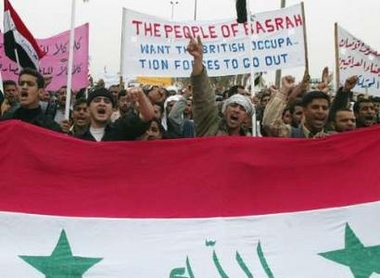
[The Sign Reads: "THE PEOPLE OF BASRAH WANT THE BRITISH
OCCUPATION FORCES TO GO OUT"]
Iraqis shout slogans as they hold up their national flag during a
protest against the British forces in Basra, 550 km (341miles) south
of Baghdad February 14, 2006. Local officials in southern Iraq have
voted to maintain a boycott of British-led forces after the release
of a video apparently showing British troops beating Iraqi teenagers
in 2004, officials said on Tuesday.
Photo by REUTERS/Atef Hassan
We're carrying out a clear strategy for victory in Iraq. First,
we're helping Iraqis build an inclusive government, so that old
resentments will be eased, and the insurgency marginalized. Second,
we're continuing reconstruction efforts and helping Iraqis build a
modern economy, so all Iraq's citizens can experience the benefits
of freedom. And, third, we're striking terrorist targets, we're
after the terrorists; and at the same time we're training Iraqi
forces which are becoming increasingly capable of defeating the
enemy. The Iraqi forces show courage every day. We are proud to be
the allies in the cause of freedom. As Iraqis stand up, America and
our coalition will stand down.
Many of you are concerned about troop levels in Iraq. Those
decisions will be made based upon conditions on the ground, based
upon the recommendations of our military commanders -- not based
upon politics in Washington, D.C.
- George W. Bush, President Discusses Progress in War on Terror
to National Guard, February 9, 2006
source:
http://www.whitehouse.gov/news/releases/2006/02/20060209-2.html
We're on the offensive in Iraq, with a clear plan for victory.
First, we're helping Iraqis build an inclusive government, so that
old resentments will be eased and the insurgency will be
marginalized.
Second, we're continuing reconstruction efforts, and helping the
Iraqi government to fight corruption and build a modern economy, so
all Iraqis can experience the benefits of freedom. And, third, we're
striking terrorist targets while we train Iraqi forces that are
increasingly capable of defeating the enemy. Iraqis are showing
their courage every day, and we are proud to be their allies in the
cause of freedom.
Our work in Iraq is difficult because our enemy is brutal. But that
brutality has not stopped the dramatic progress of a new democracy.
In less than three years, the nation has gone from dictatorship to
liberation, to sovereignty, to a constitution, to national
elections. At the same time, our coalition has been relentless in
shutting off terrorist infiltration, clearing out insurgent
strongholds, and turning over territory to Iraqi security forces. I
am confident in our plan for victory; I am confident in the will of
the Iraqi people; I am confident in the skill and spirit of our
military. Fellow citizens, we are in this fight to win, and we are
winning.
The road of victory is the road that will take our troops home. As
we make progress on the ground, and Iraqi forces increasingly take
the lead, we should be able to further decrease our troop levels --
but those decisions will be made by our military commanders, not by
politicians in Washington, D.C.
Our coalition has learned from our experience in Iraq. We've
adjusted our military tactics and changed our approach to
reconstruction. Along the way, we have benefitted from responsible
criticism and counsel offered by members of Congress of both
parties. In the coming year, I will continue to reach out and seek
your good advice. Yet, there is a difference between responsible
criticism that aims for success, and defeatism that refuses to
acknowledge anything but failure. Hindsight alone is not
wisdom, and second-guessing is not a strategy.
With so much in the balance, those of us in public office have a
duty to speak with candor. A sudden withdrawal of our forces from
Iraq would abandon our Iraqi allies to death and prison, would put
men like bin Laden and Zarqawi in charge of a strategic country, and
show that a pledge from America means little. Members of Congress,
however we feel about the decisions and debates of the past, our
nation has only one option: We must keep our word, defeat our
enemies, and stand behind the American military in this vital
mission.
- George W. Bush, State of the Union Address, January 31, 2006
source:
http://www.whitehouse.gov/news/releases/2006/01/20060131-10.html
It's very important for those who didn't agree with the decision,
though, to understand the consequences of success in Iraq. It's
really important we succeed, for a lot of reasons.
And the definition of success, by the way, is for there to be a
country where the terrorists and Saddamists can no longer threaten
the democracy, and where Iraqi security forces can provide for the
security of their people, and where Iraq is not a safe haven from
which the terrorists -- al Qaeda and its affiliates -- can plot
attacks against America.
We got a strategy, and I'm going to keep talking about the strategy
-- it will yield a victory. And the strategy is political security
and economic in nature. In economic, we're going to help them
rebuild their country, help secure their oil supply so they'll have
cash flow in order to invest in their people.
On the political front, you've seen it -- you've seen what happened
in one year's time. It's just amazing, I think. I guess, we take it
for granted -- some of us do. I don't. The fact that people have
gone from living under the clutches of a tyrant who ordered the
murder of thousands of his own citizens, to a society in which
people last year started voting -- voting for an interim government,
voting for a constitution, and then voting for a permanent
government under the new constitution. The government is now --
they're beginning to form.
In other words, you're seeing a lot of sharp elbows, probably kind
of like American politics seem to some people, a lot of throwing of
sharp elbows. You didn't see a lot of elbows, political elbows being
thrown under the tyrant, did you? That's because tyrants don't allow
for the political process to evolve. But we're watching the
political process evolve, made complicated by the fact that the
terrorists still want to cause destruction and death as this
government is forming to try to stop it.
We got to step back and ask why. Why would they want to stop
democracy? And the answer, because democracy stands for the exact
opposite of their vision. Liberty is not their credo. And they
understand a defeat to their ideology by the establishment of a free
Iraq will be a devastating blow for their vision.
And so the Iraqis are showing incredible courage. When somebody
says, if you vote, I'm going to get you, sometimes people maybe say,
well, maybe I don't want to vote. Eleven million or so Iraqis went
to the polls in defiance of these killers. It's a magical
moment in the history of liberty.
And then on the security front, our strategy can be summed up this
way: As the Iraqis stand up, we'll stand down. Look, we want the
Iraqis to be prepared to take the fight to the enemy. Let me talk
about the enemy real quick in Iraq. There are what we call "rejectionists."
These are Sunnis that kind of like the fact that they -- even though
a minority inside the country -- had the upper hand for a long
period of time with Saddam. And they're worried about whether or not
a constitution that says it will protect minority rights actually
will protect minority rights. But the good news is, more and more
Sunnis started to vote. And if you watch the news, they're beginning
to negotiate, they're beginning to see a better way. In other words,
the political process is beginning to marginalize the remaining
elements of those who are trying to stop the progress.
One of those elements is Saddamists. These are the thugs that kind
of control the country. They loved power; they don't want to give it
up. And they'd like to return to the good old days, which isn't
going to happen.
And the other group of course, is the al Qaeda types, Mr. Zarqawi,
who wants us to leave Iraq. They want us to get out of Iraq so Iraq
can be a safe haven. It is their stated objective: Don't worry, take
your time, keep killing the innocent because America will lose its
will. That's what the enemy has said. That's their words.
The way to defeat the enemy is for the political process to
marginalize the rejectionists, and for us to train the Iraqi forces
so they can find the few that want to dash the hopes of the many,
and that's what we're doing.
Our strategy is twofold: We're on the hunt for the terrorists, and
we're training Iraqis. And we're making decent progress. There are
more and more Iraqi units in the fight. There's more and more
country being turned over to the Iraqis. We got a lot of bases
around Iraq, and more of those bases are being given to the Iraqi
troops.
This is the year that we'll not only continue to focus on the
troops, we'll continue to train Iraqi police. We've seen some
problems about what it means to have lived in a society where people
want to seek revenge. In other words, they use their police --
status as a police person to take it out on others because of past
grievances. That's not acceptable to the United States of America.
And it's not acceptable to most Iraqis, either.
And so part of the training for police is not only to give them the
capacity to handle the enemy, but to make sure they understand human
rights and ethics involved with police work. And so that's what
you'll be seeing. You're going to see more Iraqi troops in the
fight, and more police providing security. And as a result, our
commanders on the ground informed me that they thought we could
reduce our troop level from the 168,000 that were there -- 165,000,
more or less, that were there for the election -- below 138,000.
Now, I want to emphasize something to you, you heard me say, "our
commanders on the ground said," you see, sometimes in the political
process people feel beholden to polls and focus groups. You don't
have to worry about me. I'm going to be listening to the people that
know what they're talking about, and that's the commanders on the
ground in Iraq. They'll make the decisions. They will give the
advice. Conditions on the ground will dictate our force levels over
the next year, but the strategy is what I said it is: We'll stay on
the offense, and we'll give these brave Iraqis the skills and
training necessary to defend their own democracy.
Look, this enemy cannot beat us. They cannot defeat us militarily.
There's no chance. The one weapon they have, which is a lethal
weapon, is the willingness to kill people. I remember the story --
and it just broke my heart to think about the young soldier that was
giving candy to a kid, and they set off the car bomb next to the
kids. I mean, it's just -- I cannot describe to you how brutal these
people are. And they understand that their scenes will get on TV.
And I don't know if they can adequately understand the compassion of
the American people. But we're compassionate.
I told you one of the great beliefs of our country is every life
matters, every person counts -- whether it be a child here in
America, or a child in Iraq. And they understand. And so part of my
decision-making process is to understand the strength of the enemy
-- the only strength they have -- and continue to remind the people
that is their only strength, and the only way we can lose is if we
lose our nerve and our will. The American people are resolute. They
are strong. And we're not going to lose our will to these thugs and
murderers.
- George W. Bush, President Discusses Global War on Terror at
Kansas State University, January 23, 2006
source:
http://www.whitehouse.gov/news/releases/2006/01/20060123-4.html
Powell: US will pull troops out this year
Former Bush aide who urged caution over Iraq signals start of
withdrawal by end of 2006
Ned Temko
Sunday January 22, 2006
The Observer
Colin Powell, who warned President Bush on the eve of the Iraq war
that US forces would have to stay for the long haul after toppling
Saddam, yesterday predicted that troop withdrawals would begin by
the end of this year.
He spoke as final results of the elections for a new Iraqi
government left the Shia Muslim alliance 10 seats short of an
outright parliamentary majority - boosting US and British hopes of a
coalition including Sunni and Kurdish groups. Britain's ambassador
to Iraq, William Patey, said after the results were announced that
an 'inclusive government of national unity' would help chances of a
'significant' withdrawal of the UK's 8,000 troops.
Powell, the former Secretary of State, told The Observer that, while
the 'characteristics of the new government' would be clearer in the
weeks ahead, the US role was to 'make sure the process [of
transition] unfolds successfully'.
During his policy battles with Donald Rumsfeld's Pentagon hawks in
the run-up to the Iraq war, Powell at one point reportedly cautioned
Bush: 'If you break it, you own it.' Since stepping down as the
administration's senior diplomat after the 2004 presidential
election, he has reiterated his view that America must not cut and
run.
But asked whether his 'break-it-and-own it' remark implied staying
for as long as it takes to get a fully functioning and stable Iraq,
Powell replied: 'No. It means fixing it to the point where we can
give ownership back,' - a process which he suggested had taken a
major step forward with the election of the new Iraqi government.
'We did break that [Saddam] government and I'm glad we broke it,' he
said. 'It was a rotten government and something that should be
broken. But we then immediately assumed ownership - and we've been
working hard for the past two-plus years to return that ownership.'
Powell, who also served as America's military chief-of-staff, said
the specific numbers and pace of US troop pull-outs would be decided
by 'my junior officers', generals whom he said he had trained as
lieutenants. But he said: 'I think we'll probably see some drawdown
in numbers in 2006.
'I hope we'll see a reduction in forces as the Iraqi forces become
more competent and the Iraqi political system begins to take hold,'
he added.
His remarks came amid growing pressure on Bush's administration over
Iraq, where 160,000 US troops form by far the largest share of the
international military force and where more than 2,000 American
soldiers have been killed.
Recent media reports have suggested the Pentagon has plans in place
to begin to reduce the number of US troops, but Bush has emphasised
that he remains committed to ensuring that a democratic government
in Baghdad and Iraq's own security forces can exert control before
any full-scale pull-out.
Powell was speaking after a visit to Britain last week to address a
series of fundraising dinners for the JNF, a British Jewish charity.
In remarks during his visit, he said that in retrospect he felt the
Americans should have committed more troops to the Iraqi invasion
and ensured that law, order and a functioning government were in
place when Saddam's regime collapsed. In an interview with the
Jewish Chronicle, he added that 'when the insurgency started, we
didn't act quickly enough to try to stop it'. But, he added, 'that's
all history... the more important issue is what we do now'.
Speaking to The Observer, Powell was generally upbeat about the
prosects [sic] for early progress in the move to hand over ownership to
the Iraqis.
- The Observer, Sunday January 22, 2006
source:
http://www.guardian.co.uk/Iraq/Story/0,2763,1692158,00.html
© Guardian Newspapers Limited 2006
I brought that same message to our people serving in Iraq. These
Americans in uniform have been absolutely relentless in their duties
-- going out every day, striking the enemy, conducting raids,
training Iraqi forces, countering attacks, seizing weapons,
capturing killers. They have faced long deployments, the hardship of
separation from home and family, the loss of comrades. Their efforts
are bringing us closer to the goal we share with Iraq's leaders: a
democratic country that can defend itself; a nation that will never
again be a safe zone for terrorists; and a model for peaceful
democratic reform in a troubled region. When that goal is achieved,
all of us will live in a safer world.
Our strategy in Iraq is clear, our tactics will remain flexible;
we'll keep at the work until we finish the job. Progress has not
come easily, but it has been steady.
A short time ago, the Iraqi people had an appointed government, no
popularly elected legislature, no permanent constitution, no recent
experience with free national elections. In less than a year they
have drafted a progressive, democratic constitution; then approved
the document in a national referendum; and elected a new government
under its provisions. And in each successive election in Iraq going
back to January a year ago there's been less violence, broader
participation, and bigger voter turnout. Iraqis have shown they
value their own liberty and that they are determined to choose their
own destiny.
Our coalition has also put great effort into standing up the Iraqi
Security Forces, and we've come a great distance over the past year.
We're helping to build an Iraqi force that is well equipped and
trained, and that was vital in the success of last month's
elections. As the security force grows in strength and as the
political process advances, we will eventually be able to decrease
troop levels without losing any capacity to do battle with the
terrorists.
Going forward, any decisions about troop levels will be driven by
the conditions on the ground and by the judgment of our commanders
-- not by artificial timelines set by politicians in Washington,
D.C.
...
Lately our forces in Iraq have been receiving some mixed signals
out of Washington, and they might have been wondering whether
America has what it takes to stay in the fight. When I visited Iraq
and Afghanistan, I assured our forces that the American people do
not support a policy of passivity, resignation, and defeatism in the
face of terror. This nation made a decision: We will never go back
to the false comforts of the world before September 11th, 2001. We
will engage these enemies with the goal of victory. And with the
American military in the fight, that victory is certain.
...
- U.S. Vice President Richard "Dick" Cheney, Vice President's
Remarks on Iraq and the War on Terror at the Manhattan Institute for
Policy Research, January 19, 2006
source:
http://www.whitehouse.gov/news/releases/2006/01/20060119-5.html
The Italian government has announced that it will pull its troops
out of Iraq by the end of the year.
Defence Minister Antonio Martino's statement marked the first
official confirmation of a timetable.
Prime Minister Silvio Berlusconi had recently hinted that Italy's
2,500 contingent could return home in 2006.
The country's involvement in the war, which has been deeply
unpopular among Italians, is likely to be a key issue in April's
general election.
'Mission accomplished'
Mr Martino said troops would be withdrawn gradually throughout the
year and replaced with a civilian force.
He told a parliament committee the pull-out timetable had been
agreed in conjunction with coalition forces in Iraq.
"The military operation Antica Babilonia [Ancient Babylon] will end
its mandate gradually over the course of the year 2006 and the
mission will be considered over and accomplished at the end of the
year," said Mr Martino.
The main opposition parties had said they would bring the troops
home immediately if they won the 9 April election.
Italy, a staunch ally of the Bush administration, sent about 3,000
soldiers to Iraq to help with the reconstruction in the south after
the fall of Saddam Hussein in 2003.
The force has come under several attacks, the worst being in
November 2003 when 19 Italians, mostly police officers, were killed
in a suicide attack in Nasiriya.
A majority of Italians oppose the war in Iraq.
- Italy to pull out of Iraq in 2006, BBC, January 19, 2006
source:
http://news.bbc.co.uk/2/hi/europe/4628500.stm
(C) BBC MMVI
Q Secondly, Walter Cronkite, the noted CBS anchor, former anchor
has landed apparently in the same position as John Murtha, saying
that we should withdraw our troops from Iraq. Does the President
feel as Lyndon Johnson felt in the early 1970s, when Cronkite made
his statements at that time that he has lost the support of middle
America in this --
MR. McCLELLAN: Well, I think the American people clearly understand
the importance of winning in Iraq. And we have a clear strategy to
prevail in Iraq. And that's what the President has been talking to
the American people about. People want our troops to come home, and
the way to get our troops home is to be successful.
And I think if we look at recent comments from a videotape of al
Qaeda's number two man, Zawahiri, it only underscores the importance
of winning in Iraq, and it underscores that the terrorists recognize
the stakes involved there. They know that when we are successful in
Iraq, it will be a major blow to their ambitions. Iraq is the
central front in the war on terrorism, and that's why it's so
critical that we continue moving forward on our strategy for
victory. And that's exactly what we'll do. Withdrawal would be a
disaster.
U.S. White House spokesman Scott McClellan, Press Briefing,
January 17, 2006
source:
http://www.whitehouse.gov/news/releases/2006/01/20060117-3.html
But let me talk real quick about the goals in Iraq. The goal is
victory, nothing short of victory. When you put these kids in harm's
way, we owe them the best equipment, the best training, and a
strategy for victory. And victory is a country that -- where the
Saddamists and the terrorists can't unwind the democracy. Victory is
when Iraq is no longer a safe haven for the terrorists. Victory is
-- will be achieved when the Iraqis are able to defend their
democracy.
In the last couple of weeks, I've been talking about the strategy to
achieve victory. It's one thing to say we want victory; the other
thing is, can you get there? And the answer is, absolutely, we can
get there. And the strategy is threefold. One, there's a political
strategy. First let me make sure you understand the enemy. The enemy
is, in our judgment, my judgment, three types of people. One, we
call them rejectionists -- these are Sunnis who had privileged
status under Saddam Hussein, even though they were in the minority
the country. They had a pretty good deal because the tyrant was a
Sunni, and made sure that the Sunnis got special treatment, as
opposed to the Shia or the Kurds. And they liked that kind of
special treatment. They liked privileged status.
The second group is the Saddam loyalists. These are the thugs and
people that basically robbed the country blind, and not only got
privilege status, but they were the all-powerful. And needless to
say, they don't like it with their man sitting in prison and them no
longer being able to exploit the people of Iraq. They're irritated.
Finally, the third group, and this is a dangerous group -- it's al
Qaeda and its affiliates. A guy named Zarqawi is the chief operating
officer in Iraq on behalf of al Qaeda. Al Qaeda has made it very
clear their intentions in Iraq, which is to drive the United States
out so they will have a base from which to operate to spread their
ideology. That's what they have said. This is what Mr. Zawahiri
said. It's important for those of us involved in trying to protect
you to take the enemy seriously, to listen to their words closely.
In other words, al Qaeda has made Iraq a front in the war on terror.
And that's why we've developed a strategy for victory.
The first part of it is to have a political process that
marginalizes the rejectionists and isolates the dissenters. And it's
happening. Under any objective measurement, what took place last
year in Iraq was remarkable, when you think about it. This country
is a country that lived under the brutal dictatorship of Saddam
Hussein, and last year they had elections for a transitional
government, they wrote a constitution and got the constitution
approved, and then had elections for a permanent government under
the new constitution -- all in one year. And every election
had more participants. And most importantly, in the last election,
the rejectionists who had sat out the first couple of elections --
many Sunnis had sat out; they said, we're not going to be involved
in the political process -- got involved. Slowly but surely, those
who were trying to stop the advance of democracy are becoming
marginalized.
Secondly, this is a country, obviously, that has got brutal action
-- this enemy we face has got no conscience. They will kill innocent
people in a heartbeat in order to achieve their objectives. And it's
hard for Americans to deal with that. I understand that. It's hard
for me to believe that there is such brutality in the world where
people going to a funeral to mourn the dead, and a suicider shows up
and kills people. It's hard for me to believe that we've got
soldiers passing out candy to young kids, and a killer comes and
kills the kids and the soldiers. It is beyond the imagination of
most Americans, but it should say something about this enemy. They
will go to no ends to defeat us. But they can't beat us on the
battlefield. The only thing they can do is create these brutal
scenes.
And they're trying to drive us out of Iraq, as I mentioned. And the
best way to deal with them is train Iraqis so they can deal with
them. And that's what's happening. There are two aspects of our
training. And, listen, the training hasn't gone smoothly all the
time. I mean, this is a war. And you're constantly adjusting your
strategies and tactics -- not strategies -- tactics on the ground to
meet an enemy which is changing.
And so the army is getting on its feet. We've turned over a lot of
territory to the army. And they're good fighters, they really are. I
spent a great deal of time with General Abizaid and General Casey --
they were in Washington this past week -- these are generals, you'd
be happy to hear, who tell me the way it is, not the way they think
I would like it to be. I can't tell you how good the caliber of our
military brass -- and those in the field, by the way, all the way up
and down the line, are good, they are good people, better trained,
not just numbers, I'm talking about capacity to take the fight and
stay in the fight. And as I've said, as the Iraqis stand up, we'll
stand down. So the strategy, the security strategy is to let the
Iraqis do the fighting. It's their country. The people have shown
they want democracy. Millions voted. And now part of the mission is
to give this government a security force which will help fight off
the few who are trying to stop the hopes of the many.
One of the places where we've lagged is training police. There are
three types of police. There's a national police force, kind of like
a swat team, a national swat team, that can move -- they're pretty
well trained. They need some human rights training. In other words,
part of the problem in Iraq is you've got people that are plenty
irritated at what took place in the past and they're going to use
their positions of power to take revenge. You can't have a democracy
in which the police don't enforce the rule of law, but enforce their
view of revenge. And so you got ethics training, rule of law
training -- all done by good troops who are embedded -- who are
side-by-side with this Iraqi police force. And it's getting better,
it really is.
Secondly, you've got the border patrol. The reason why the border is
necessary is because there's suiciders coming in from Syria into
Iraq. And the Iraqis have got to be able to enforce their border in
order to be able to protect their democracy.
And thirdly, you've got local police, and we're lagging in the local
police. And the local police -- it's just that, local. And so what
we're going to do is use what worked in the Balkans and embed people
in the local police units to teach them how to -- effective
enforcements of the law. And so, 2006 you're going to see a lot of
police training and a lot of police focus.
Finally, there's the economic and reconstruction front. We started
up grand projects in Iraq when we first got there, said we're going
to build some grand projects. It turns out a more effective use of
reconstruction money was localize projects to empower those who were
willing to take a risk for democracy with the capacity to say,
follow me, your life is going to be better. By the way, democracy
works in Iraq just like it does here -- you're going to vote for
somebody who thinks that they can bring character to the office and
they're going to help your life. Same anywhere else. You're out
there campaigning; they want to know what are you going to do for
me. And so part of the reconstruction effort was to focus on local
reconstruction projects.
The Iraqi economy has got a great chance to succeed. They got oil
and gas revenues. They had been having trouble getting some oil and
gas revenues up to the levels we anticipated because of the
infrastructure damage -- done by Saddam Hussein, by the way, and
because the terrorists, every time there's some progress, tend to
blow things up. Now, having said that, they got these surveys -- and
I must confess I'm not much of a survey guy, but they got them, and
most Iraqis are optimistic about the future. And as I said
yesterday, they're willing to live with intermittent darkness, as
opposed to the darkness -- and freedom -- as opposed to the darkness
of tyranny. That's what you're seeing.
But this economy is going. Small businesses are flourishing. They
got a -- they had to deal with gasoline subsidies. Saddam Hussein,
in order to make sure people kept him around and thought he was all
right -- they didn't have much choice, by the way, because he had a
force behind him -- but nevertheless, he subsidized gasoline, which
meant a lot of the central budget was going for subsidization of
fuel, as opposed to education and health. And so the new government
made a difficult decision, they started floating that price of
gasoline up a little higher, to take the pressure off their budget
and to introduce markets, market-based forces into the economy.
It's not going to happen overnight. You can't go from a tightly
controlled economy to an open market overnight, but it's happening.
In other words, the government is making difficult choices to help
the entrepreneurial spirit begin to flourish.
And so things are good. I'm confident we'll succeed. And it's tough,
though. The enemy has got one weapon -- I repeat to you -- and
that's to shake our will. I just want to tell you, whether you agree
with me, or not, they're not going to shake my will. We're doing the
right thing.
A couple of quick points, then I'll answer your questions. You hear
a lot of talk about troop levels. I'd just like to give you my
thinking on troop levels. I know a lot of people want our troops to
come home -- I do, too. But I don't want us to come home without
achieving the victory. We owe that to the mothers and fathers
and husbands and wives who have lost a loved one. That's what I
feel. I feel strongly that we cannot let the sacrifice, we can't let
their sacrifice go in vain.
Secondly, I -- these troop levels will be decided by our commanders.
If you run a business, you know what I'm talking about when I say --
it's called delegating. You count on people to give you good advice.
The best people to give any politician advice about whether or not
we're achieving a military objective is the people you put out there
on the ground. I told you I've got good confidence in these generals
and the people who report to them. These are honest, honorable,
decent, very capable, smart people, and they'll decide the troop
levels. They hear from me: Victory. And I say to them: What do you
need to achieve victory?
I don't know if you've noticed recently, but we're beginning to
reduce presence in Iraq based upon the recommendation of our
commanders. We've gone from 17 to 15 battalions. We kept up to about
60,000 -- 160,000 troops in Iraq for the elections. We held over
about 25,000 or so on a -- that were to rotate out to help in the
elections. Those 25,000 are coming back, plus the reduced
battalions. And people say, well, how about more for the rest of the
year? And the answer to that is, I'm going to do what they tell me
to do. And that depends upon the capacity of the Iraqis to help us
achieve victory.
And why is victory important? Let me just conclude by this point.
You know, it's hard for some to -- in our country to connect the
rise of democracy with peace. This is an ideological struggle, as
far as I'm concerned, and you defeat an ideology of darkness with an
ideology of light and hope. History has proven that democracies
yield the peace. If you really look at some of the past struggles
where -- in which the United States has been involved, the ultimate
outcome, the final product, was peace based upon freedom. Europe is
whole, free, and at peace because of democracy.
One of the examples I like to share with people in order to make the
connection between that which we're doing in Iraq today, and laying
-- what I call, laying the foundation of peace, is my relationship
with Prime Minister Koizumi of Japan. And the reason I like to bring
up this story is I find it amazing that my dad -- old number 41 --
at the age of 18, fought the Japanese. They were the sworn enemy of
the United States. Many in this audience, I know, had relatives in
that war. They were the bitter enemy. They had attacked us, just
like we were attacked on September the 11th. People in America said,
we'll do everything we can to defeat this enemy, and thousands of
people lost their lives.
Laura and I were over in the Far East recently. I was sitting down
at the table with the Prime Minister of our former enemy talking
about how to keep the peace. We were talking about the spread of
democracy in Iraq and in the Middle East as a way to counter an
ideology that is backwards and hateful. We were talking about North
Korea, how to keep the peace on the Korean Peninsula.
Isn't it amazing -- at least it is to me -- that some 60 years after
an 18-year-old fighter pilot joined the Navy to fight the Japanese,
his son is talking with the Prime Minister of the former enemy about
keeping the peace. Something happened. And what happened was Japan
adopted a Japanese-style democracy. Democracies yield the peace. And
I firmly believe -- I firmly believe that years from now people are
going to look back and say, thank goodness the new generation of
Americans who rose to the challenge of a war against terror had
faith in the capacity of freedom to help change the world. And
someday an American President is going to be talking to a duly
elected leader from Iraq, talking about how to keep the peace for a
generation to come.
- George W. Bush, President Participates in Discussion on the
Global War on Terror, January 11, 2006
source:
http://www.whitehouse.gov/news/releases/2006/01/20060111-7.html
Like earlier struggles for freedom, the war on terror is being
fought on many battlefronts. Yet the terrorists have made it clear
that Iraq is the central front in their war against humanity. And so
we must recognize Iraq as the central front in the war against the
terrorists.
Our goal in Iraq is victory. And in a series of speeches
last December, I described the enemy we face in that country, our
strategy to defeat them, and how we have adapted our tactics to meet
changing conditions on the ground. Today, I've come before you to
discuss what the American people can expect to see in Iraq in the
year ahead. We will see more tough fighting and we will see more
sacrifice in 2006, because the enemies of freedom in Iraq continue
to sow violence and destruction. We'll also see more progress toward
victory. Victory will come when the terrorists and Saddamists can no
longer threaten Iraq's democracy. Victory will come when the Iraqi
security forces can provide for the safety of their own citizens.
Victory will come when Iraq is not a safe haven for terrorists to
plot new attacks on our nation.
And when victory comes and democracy takes hold in Iraq, it will
serve as a model for freedom in the broader Middle East.
History has shown that free nations are peaceful nations. And by
helping Iraqis build a lasting democracy, we spread the hope of
liberty across a troubled region, we will gain new allies in the
cause of freedom. By spreading democracy and freedom, we're laying
the foundation of peace for generations to come.
Our work in Iraq in 2006 will be focused on three critical areas. On
the political side, we will help Iraqis consolidate the democratic
gains they made last year, and help them build democratic
institutions, a unified government, and a lasting free society. On
the security side, we will stay on the offense against the
terrorists and Saddamists. We will continue to strengthen the Iraqi
security forces -- with an emphasis on improving the capabilities of
the Iraqi police, so that over the next 12 months, Iraqi forces can
take control of more territory from our coalition and take the lead
in the fight.
And on the economic side, we will continue reconstruction efforts,
and help Iraq's new government implement difficult reforms that are
necessary to build a modern economy and a better life. In all three
aspects of our strategy -- democracy and security and reconstruction
-- we're learning from our experiences, and we're fixing what hasn't
worked. And in the year ahead, we will continue to make every change
that will help us complete the mission and achieve the victory we
all want.
On the political side, we've witnessed a transformation in Iraq over
the past 12 months that is virtually without precedent. Think back
to a year ago. At this time last year, the Iraqi people had an
appointed government, no elected legislature, no permanent
constitution and no recent experience with free national elections.
Just one year later, they have completed three successful nationwide
elections.
Iraqis voted for a transitional government, drafted the most
progressive, democratic constitution in the Arab world, approved
that constitution in a national referendum and elected a new
government under their new constitution. Each successive election
has seen less violence, bigger turnouts, and broader participation
than the one before. One Iraqi voter in Tal Afar described the
December elections this way: "We want democracy. This is our answer
to the decades of slavery we had before."
When the final election results come in, Iraqi leaders will begin
working to form a new government. And in the weeks ahead, Americans
will likely see a good deal of political turmoil in Iraq as
different factions and leaders compete for position and jockey for
power. Our top commander in the region, General John Abizaid, has
said he expects the coming weeks to produce "some of the hardest
bare-knuckle politics ever in the Arab world." We should welcome
this for what it is -- freedom in action.
Dictatorships seem orderly -- when one man makes all the decisions,
there is no need for negotiation or compromise. Democracies are
sometimes messy and seemingly chaotic, as different parties advance
competing agendas and seek their share of political power. We've
seen this throughout our own history. We've seen this in other
democracies around the world. Yet out of the turmoil in Iraq, a free
government will emerge that represents the will of the Iraqi people
-- instead of the will of one cruel dictator.
Iraqis are undertaking this process with just a year's experience
in democratic politics -- and the legacy of three decades under one
of the world's most brutal tyrannies still hangs over them. Many of
the institutions and traditions we take for granted in America --
from our party structures, to our centuries' experience with
peaceful transitions of power -- are new to Iraq. So we shouldn't be
surprised if Iraqis make mistakes and face setbacks in their effort
to build a government that unites the Iraqi people.
Despite the obstacles they face, Iraqis have shown that they can
come together for the sake of national unity. Think about what
happened after the January 2005 elections -- Shia and Kurdish
leaders who did well at the polls reached out to Sunni Arabs who
failed to participate, giving them posts in the government, and a
role in fashioning the constitution. Now Iraqis must reach out once
again across political and religious and sectarian lines and form a
government of national unity that gives a voice to all Iraqis.
Because Sunni Arabs participated in large numbers in the December
elections, they will now have a bigger role in the new parliament --
and more influence in Iraq's new government. It's important that
Sunnis who abandoned violence to join the political process now see
the benefits of peaceful participation. Sunnis need to learn how to
use their influence constructively in a democratic system to benefit
their community and the country at large. And Shia and Kurds need to
understand that successful free societies protect the rights of a
minority against the tyranny of the majority.
The promise of democracy begins with free elections and majority
rule -- but it is fulfilled by minority rights, and equal justice,
and an inclusive society in which every person belongs. A country
that divides into factions and dwells on old grievances cannot move
forward -- and risks sliding back into tyranny. Compromise and
consensus and power-sharing are the only path to national unity and
lasting democracy. And, ultimately, the success of Iraqi democracy
will come when political divisions in Iraq are driven not by
sectarian rivalries, but by ideas, and convictions, and a common
vision for the future.
When the new Iraqi government assumes office, Iraq's new leaders
will face some tough decisions on issues such as security and
reconstruction and economic reform. Iraqi leaders will also have to
review and possibly amend the constitution to ensure that this
historic document earns the broad support of all Iraqi communities.
If the new parliament approves amendments, these changes will be
once again taken to the Iraqi people for their approval in a
referendum before the end of the year. By taking these steps, Iraqi
leaders will bring their nation together behind a strong democracy
-- and help to defeat the terrorists and the Saddamists.
America and our coalition partners will stand with the Iraqi people
during this period of transition. We will continue helping Iraqis
build an impartial system of justice, so they can replace the rule
of fear with the rule of law. We'll help Iraqi leaders combat
corruption by strengthening Iraq's Commission on Public Integrity --
so Iraqis can build a transparent, accountable government. And we
will help Iraq's new leaders earn the confidence of their citizens,
by helping them build effective government ministries.
It's especially important in the early months after Iraq's new
government takes hold that its leaders demonstrate an ability to
deliver measurable progress in the lives of the Iraqi people. So we
will continue helping the new government to develop their
ministries, to ensure they can lead effectively and produce real
results for the Iraqi people.
The foreign terrorists and Saddamists will continue to fight this
progress by targeting the citizens and institutions and
infrastructure of a free Iraq. An enemy that sends suicide bombers
to kill mourners at a funeral procession is an enemy without
conscience. These killers will stop at nothing to undermine
the new government, divide the Iraqi people, and try to break their
will. Yet with the recent elections, the enemies of a free Iraq have
suffered a real defeat. The Saddamists and rejectionists are finding
themselves increasingly marginalized, as Sunni Arabs who once
rejected the political process are now participating in the
democratic life of their country.
And as democracy takes hold in Iraq, the terrorists like Zarqawi and
his al Qaeda associates are suffering major defeats. Zarqawi tried
to stop the elections throughout the year 2005, and he failed. He
tried to stop the writing and ratification of a new constitution,
and he failed. The advance of freedom is destroying his and al
Qaeda's greatest myth: These terrorists are not fighting on behalf
of the Iraqi people against a foreign occupation -- they are
fighting the will of the Iraqi people expressed in free elections.
In the face of these thugs and terrorists and assassins, the
Iraqi people have sent a clear message to the world: Iraqis will not
cower before the killers -- and the terrorists and regime loyalists
are no match for millions of Iraqis determined to live in liberty.
As we help Iraqis strengthen their new government, we're also
helping them to defend their young democracy. We're going to train
the security forces of a free Iraq. We have been doing so and we
will continue to do so in 2006. Last November, I described many of
the changes we made over the past year to improve the training of
the Iraqi army and the police. And we saw the fruits of those
changes during the December elections. Iraqi forces took the lead in
the election security. They were in the lead; we were there to help.
They protected over 6,000 polling centers, they disrupted attacks,
and they maintained order across the country.
Thanks in large part to their courage and skill, the number of
attacks during the elections declined dramatically compared with
last January's vote. One Iraqi General put it this way on election
day: "All the time and money you have spent in training the Iraqi
army -- you harvest it today."
The Iraqi security forces are growing in strength and in size, and
they're earning the trust and confidence of the Iraqi people. And as
Iraqis see their own countrymen defending them against the
terrorists and Saddamists, they're beginning to step forward with
needed intelligence. General Casey reports that the number of tips
from Iraqis has grown from 400 in the month of March of 2005 to over
4,700 last month -- and that some of the new intelligence is being
passed by Iraqi civilians directly to Iraqi soldiers and police.
Iraqis are gaining confidence that their security forces can defeat
the enemy, and that confidence is producing intelligence that is
helping to turn the tide in freedom's way.
There's more work to be done in the year ahead. Our commanders tell
me that the Iraqi army and police are increasingly able to take the
lead in the fight. Yet the Iraqi police still lag behind the army in
training and capabilities --and so one of our major goals in 2006 is
to accelerate the training of the Iraqi police. We'll focus our
efforts on improving the performance of three categories of the
Iraqi police. First, we will work to improve the Special Police
under the Ministry of Interior, who are fighting alongside the Iraqi
army against the terrorists and Saddamists. Second, we will expand
and strengthen the border police charged with securing Iraq's
frontiers. And, third, we will increase our focus on training local
station police, so they can protect their communities from the
criminals and terrorists.
The Interior Ministry's Special Police are the most capable of the
Iraqi police forces. There are now about 19,000 Iraqi Special Police
trained and equipped -- which is near our goal for a complete force.
Many of these Special Police forces are professional, they represent
all aspects of society. But recently some have been accused of
committing abuses against Iraqi civilians. That's unacceptable.
That's unacceptable to the United States government; it's
unacceptable to the Iraqi government, as well. And Iraqi leaders are
committed to stopping these abuses. We must ensure that the police
understand that their mission is to serve the cause of a free Iraq
-- not to address old grievances by taking justice into their own
hands.
To stop abuses and increase the professionalism of all the Iraqi
Special Police units, we're making several adjustments in the way
these forces are trained. We're working with the Iraqi government to
increase the training Iraqi Special Police receive in human rights
and the rule of law. We're establishing a new Police Ethics and
Leadership Institute in Baghdad that will help train Iraqi officers
in the role of the police in a democratic system -- and establish
clear lesson plans in professional ethics for all nine Iraqi police
academies. To improve their capability, we will soon begin
implementing a program that has been effective with the Iraqi army
-- and that is partnering U.S. battalions with Iraqi Special Police
battalions. These U.S. forces will work with and train their Iraqi
counterparts, helping them become more capable and professional, so
they can serve and protect all the Iraqi's without discrimination.
Second, we're working to increase the number of border police that
can defend Iraq's frontiers and stop foreign terrorists from
crossing into that country. Iraqis now have 18,000 border police on
the job, manning land and sea and air ports across the country. Our
goal is to have a total of 28,000 Iraqi border police trained and
equipped by the end of this year.
To better train Iraqi police, we've established a new customs
academy in Basra. We're embedding border police transition teams
with Iraqi units, made up of coalition soldiers and assisted by
experts from our Department of Homeland Security. The Iraqi border
police are growing increasingly capable and are taking on more
responsibility. In November, these forces took the lead in
protecting Iraq's Syrian border, with coalition forces playing a
supporting role. In other words, they're beginning to take the lead
and take responsibility for doing their duty to protect the new
democracy. And as more skilled border police come on line, we're
going to hand over primary responsibility for all of Iraq's borders
to Iraqi border police later on this year.
Finally, we're helping Iraqis build the numbers and capabilities of
the local station police. These are the Iraqi police forces that
need the most work. There are now over 80,000 local police officers
across Iraq -- a little more than halfway toward our goal of
135,000. To improve the capabilities of these local police, we're
taking a concept that worked well in the Balkans and applying it to
Iraq -- partnering local Iraqi police stations with teams of U.S.
military police and international police liaison officers, including
retired U.S. police officers.
These officers will work with provincial police chiefs across Iraq,
and focus on improving local police forces in nine key cities that
have seen intense fighting with the terrorists. By strengthening
local police in these cities, we can help Iraqis provide security in
areas cleared of enemy forces and make it harder for these thugs to
return. And by strengthening Iraqi local police in these cities,
we'll help them earn the confidence of the local population, which
will make it easier for local leaders and residents to accelerate
reconstruction and rebuild their lives.
The training of the Iraqi police is an enormous task and, frankly,
it hasn't always gone smoothly. Yet we're making progress -- and our
soldiers see the transformation up close. Army Staff Sergeant Dan
MacDonald is a Philadelphia cop who helped train Iraqi police
officers in Baghdad. He says this of his Iraqi comrades: "From where
they were when we got here to where they are now, it's like two
different groups of peoplea. They're hyped-up, they look sharp,
they're a lot better with their weapons . I'd take these guys out
with me back home." If he's going to take them back home in
Philadelphia, they must be improving.
As we bring more Iraqi police and soldiers online in the months
ahead, we will increasingly shift our focus from generating new
Iraqi forces to preparing Iraqis to take primary responsibility for
the security of their own country. At this moment, more than 35
Iraqi battalions have assumed control of their own areas of
responsibility -- including nearly half of the Baghdad province, and
sectors of south-central Iraq, southeast Iraq, western Iraq, and
north-central Iraq. And in the year ahead, we will continue handing
more territory to Iraqi forces, with the goal of having the Iraqis
in control of more territory than the coalition by the end of 2006.
As Iraqi forces take more responsibility, this will free up
coalition forces to conduct specialized operations against the most
dangerous terrorists, like Zarqawi and his associates, so we can
defeat the terrorists in Iraq so we do not have to face them here at
home. We will continue to hand over territory to the Iraqis so
they can defend their democracy, so they can do the hard work, and
our troops will be able to come home with the honor they have
earned.
I've said that our strategy in Iraq can be summed up this way: As
the Iraqis stand up, we will stand down. And with more Iraqi forces
demonstrating the capabilities needed to achieve victory, our
commanders on the ground have determined that we can decrease our
combat forces in Iraq from 17 to 15 brigades by the spring of 2006.
That's what they've decided. And when they decide something, I
listen to them. This adjustment will result in a net decrease of
several thousand troops below the pre-election baseline of 138,000
U.S. troops in Iraq. This decrease comes in addition to the
reduction of about 20,000 troops who were in Iraq largely to assist
with the security during the December elections.
Later this year, if Iraqis continue to make progress on the security
and political sides, we expect to discuss further possible
adjustments with the leaders of Iraq's new government. Having said
this, all of my decisions will be based upon conditions on the
ground, not artificial timetables set by Washington politicians.
Our commanders on the ground will have the forces they need to
complete the mission and achieve victory in Iraq.
As we help Iraqis defend their democracy, we will continue to help
Iraqis build their infrastructure and economy in the coming year.
Iraqis face real challenges from the long-term economic damage
caused by Saddam Hussein's regime. They face challenges because of
acts of sabotage by the enemies of a free Iraq. Yet despite these
challenges, our coalition and Iraqi leaders have made progress in a
number of areas. Iraq now has a stable currency, an independent
stock exchange, an independent Central Bank. Iraqis have new
investment laws to welcome foreign capital, tax and commercial laws
to encourage private sector growth, and a low-tariff trade regime
that has opened Iraq's economy to the world. Under Saddam, private
property was not protected. Today, Iraq's new constitution
guarantees private property rights that are the foundation of any
free society.
Iraqi leaders are also beginning to make the tough choices necessary
to reform their economy -- such as easing gasoline subsidies. Until
recently, government subsidies put the price of fuel in Iraq at
artificially low prices -- really low prices. And that created
incentives for black-market corruption and crime -- and changing
these subsidies is a necessary step on the path for economic reform.
So Iraqi leaders have begun a series of price increases aimed at
dismantling the gas subsidy system. That's hard political work. But
gasoline subsidies, along with other subsidies, consume over half of
Iraq's annual budget; it diverts critical resources from health care
and education and infrastructure and security. Addressing these
subsidies will allow Iraqi leaders to better provide for their
people and build a modern economy.
One of the biggest challenges facing Iraq is restoring the country's
oil and electric power infrastructure. These sectors were devastated
by decades of neglect. And since liberation, terrorists have
targeted these areas for destruction. As a result, oil and power
production are below pre-war levels. To help increase production,
we're helping Iraqis better maintain their refineries, build their
oil supply and transportation capabilities, improve their capacity
to generate power, and better protect their strategic
infrastructure.
The struggles with oil production and the shortage of electricity
remain sources of frustration for the Iraqi citizens. Yet they're
putting these challenges in perspective. Today, seven in 10 Iraqis
say their lives are going well; nearly two-thirds expect things to
improve even more in the next year. The vast majority of Iraqis
prefer freedom with intermittent power to life in the permanent
darkness of tyranny and terror. Iraqis are optimistic about the
future, and their optimism is justified.
To realize their dreams, the Iraqi people still need help. And in
the coming year, the international community must step up and do its
part. So far, other nations and international organizations have
pledged more than $13 billion in assistance to Iraq. Iraqis are
grateful for this promised aid. So is the United States. Yet many
nations have been slow to make good on their commitments.
I call on all governments that have pledged assistance to follow
through with their promises as quickly as possible, so the Iraqis
can rebuild their country and provide a better future for their
children. Many nations have still not returned all the Iraqi assets
frozen during the regime of Saddam Hussein. I call on all nations to
return these assets to their rightful owners: The free people of
Iraq own those assets, not the foreign governments.
Many of the world's smallest nations have been among the most
generous. Last month, for example, Slovakia announced that it plans
to forgive a hundred percent of Iraq's $145 million debt. This makes
Slovakia only the third country, along with the United States and
Malta, to write off Iraqi debt completely. More nations should do
the same so the Iraq people are not held back by the crushing burden
of debt accumulated by Saddam Hussein.
International lending institutions are also stepping forward with
needed assistance. Last month, the International Monetary Fund
approved Iraq's request for a $680 million loan to carry out
economic reforms. The World Bank recently approved its first loan to
Iraq in over 30 years, lending the Iraqi government $100 million to
improve the Iraqi school system, and making up to $400 million
available to fund water, electricity, roads and sanitation projects.
The international community must meet its responsibilities in Iraq
-- and here in America we have responsibilities, as well. The coming
year will test the character of our country, and the will of our
citizens. We have a strategy for victory -- but to achieve that
victory, we must have the determination to see this strategy
through. The enemy in Iraq knows they cannot defeat us on the
battlefield -- and so they're trying to shake our will with acts of
violence, and force us to retreat. That means that our resolve in
2006 must stay strong. We must have patience as Iraqis struggle to
build democracy in a volatile region of the world. We must not allow
the images of destruction to discourage us, or obscure the real
progress our troops are making in Iraq. And we must continue to
provide these troops with all the resources they need to defend our
nation and prevail in the global war on terror.
We face an added challenge in the months ahead: The campaign season
will soon be upon us -- and that means our nation must carry on this
war in an election year. There is a vigorous debate about the war in
Iraq today, and we should not fear the debate. It's one of the great
strengths of our democracy that we can discuss our differences
openly and honestly -- even in times of war. Yet we must remember
there is a difference between responsible and irresponsible debate
-- and it's even more important to conduct this debate responsibly
when American troops are risking their lives overseas.
The American people know the difference between responsible and
irresponsible debate when they see it. They know the difference
between honest critics who question the way the war is being
prosecuted and partisan critics who claim that we acted in Iraq
because of oil, or because of Israel, or because we misled the
American people. And they know the difference between a loyal
opposition that points out what is wrong, and defeatists who refuse
to see that anything is right.
When our soldiers hear politicians in Washington question the
mission they are risking their lives to accomplish, it hurts their
morale. In a time of war, we have a responsibility to show that
whatever our political differences at home, our nation is united and
determined to prevail. And we have a responsibility to our men and
women in uniform -- who deserve to know that once our politicians
vote to send them into harm's way, our support will be with them in
good days and in bad days -- and we will settle for nothing less
than complete victory.
We also have an opportunity this year to show the Iraqi people what
responsible debate in a democracy looks like. In a free society,
there is only one check on political speech -- and that's the
judgment of the people. So I ask all Americans to hold their elected
leaders to account, and demand a debate that brings credit to our
democracy -- not comfort to our adversaries.
Support for the mission in Iraq should not be a partisan matter. VFW
members come from all over the country, and both sides of the
political aisle -- yet your position on the war is clear. In a
recent resolution, the VFW declared, "it is critical that the United
States succeed in Iraq, which will result in stability and security
in the region." I appreciate your support for the mission in Iraq,
and so do our troops in the fight. Your lives of service, from the
first time you put on the uniform to this day, are a credit to our
country and an inspiration to our military. A new generation of
soldiers, and sailors, airmen, Marines and Coast Guardsmen is now
carrying out an urgent and noble mission -- and they're doing so
with the same determination and courage as you who came before them.
Some of our finest men and women have given their lives in freedom's
cause. Others have returned home with wounds that the best medicine
cannot heal. We hold all who sacrificed and their families in our
thoughts and in our prayers. And I'm going to make you this pledge:
We will not waver, we will not weaken, and we will not back down in
the cause they served. By their sacrifice, we are laying the
foundation of freedom in a troubled part of the world. And by laying
that foundation, we're laying the foundation of peace for
generations to come.
- George W. Bush, President Addresses Veterans of Foreign Wars on
the War on Terror, January 10, 2006
source:
http://www.whitehouse.gov/news/releases/2006/01/20060110-1.html
Americans understand what is at stake in that country [Iraq] --
and so do the terrorists. That is why they commit acts of random
horror, calculated to shock and to intimidate the civilized world.
The terrorists know that as freedom takes hold, the ideologies of
hatred and resentment will lose their appeal, and the advance of
democracy will inspire reformers across the broader Middle East. And
as that region experiences new hope and progress, we will see the
power of freedom to lift up whole nations, and the spread of liberty
will produce a much safer world for our children and for our
grandchildren.
The war on terror is a battle for the future of civilization; it's a
battle worth fighting -- it's a battle we are going to win.
Our strategy in Iraq is clear, our tactics will remain flexible, and
we'll work at the job until we finish it. Progress has not come
easily, but it has been steady, and we can be confident going
forward. By voting in free elections, by ratifying a constitution,
by electing a government last month, Iraqis have shown they value
their own liberty and are determined to choose their own destiny.
Our Coalition has also put great effort into standing up the Iraqi
Security Forces, and we've come a great distance over the past year.
We're helping to build an Iraqi force that is sharp and well
equipped, and this was vital to the success of last month's
elections. Gradually, Iraqi forces are taking control of more Iraqi
territory -- and as they undertake further missions on their own,
confidence is growing within the country and more and more
intelligence tips are being provided by the Iraqi population.
As the ISF gains strength and experience, and as the political
process advances, we'll be able to transfer more and more
responsibility to the Iraqis, and eventually decrease troop levels
without losing our capacity to defeat the terrorists. And I assure
you: Any decisions about troop levels will be driven by conditions
on the ground and by the judgment of our commanders -- not by
artificial timelines set by politicians in Washington, D.C.
Recently there have been some prominent voices advocating a sudden
withdrawal of our forces from Iraq. Some have suggested the war is
not winnable, a few seem almost eager to conclude that the struggle
was already lost. But they are wrong. The only way to lose this
fight is to quit -- and that is not an option.
- U.S. Vice President Richard "Dick" Cheney, Vice President's
Remarks at a Rally for the Troops, January 6, 2006
http://www.whitehouse.gov/news/releases/2006/01/20060106-9.html
We have a dual track strategy for victory. On the one hand, we
will work to have a political process that says to all Iraqis, the
future belongs to you. And on the other hand, we'll continue to work
on the security situation there. The main thrust of our success will
be when the Iraqis are able to take the fight to the enemy that
wants to stop their democracy, and we're making darn good progress
along those lines.
- George W. Bush, President Meets with Current & Former
Secretaries of State and Defense, January 5, 2006
source:
http://www.whitehouse.gov/news/releases/2006/01/20060105.html
Our coalition has also put tremendous effort into standing up the
Iraqi security forces, and we've come a great distance over the past
year. More and more, coalition forces have Iraqis at their side,
helping to clear out terrorists, and then staying in the area to
maintain the peace. We're helping build an Iraqi force that is sharp
and well equipped, and this was vital to the success of last month's
elections. There are over 100 Iraqi combat battalions fighting the
terrorists, along with our forces today. More than a dozen military
bases our coalition used to occupy have been turned back to the
Iraqis. Gradually, Iraqi forces are taking control of more and more
territory, and as they undertake further missions on their own,
confidence is growing within the country and more intelligence tips
are coming in from the Iraqi people themselves.
As the Iraqi army gains strength and experience, and as the
political process advances, we'll be able to decrease troop levels
without losing our capacity to defeat the terrorists. And as
President Bush has made very clear, any decisions about troop levels
will be driven by conditions on the ground and by the judgment of
our commanders -- not by artificial timelines set by politicians
here in Washington, D.C.
We will stand firmly with Iraq's leaders as they establish the
institutions of a unified and a lasting democracy. On the political
track, every benchmark has been met successfully -- starting with
the turnover of sovereignty a year and a half ago, national
elections last January, the drafting of the constitution last
summer, and the ratification of that constitution by voters in
October, and, of course, most recently, the election of a new
government under that constitution in December. The political
leaders of Iraq are steady. They're courageous, and the citizens,
police and soldiers of that country have proudly stepped forward as
active participants and guardians in a new democracy -- running for
office, speaking out, voting and sacrificing for their country. When
I met with Prime Minister Jaafari in Baghdad, he pointed the voter
turnout figures for the national elections, three of them in 2005 --
around 59 percent in January, some 63 percent in October, and
approximately 70 percent turnout in December. Iraqi citizens have
done all of this despite threats from terrorists who offer no
political agenda for Iraq's future, and wage a campaign of mass
slaughter against the Iraqi people themselves, the vast majority of
whom are fellow Muslims.
Day after day, month after month, Iraqis have proven their
determination to live in freedom, to chart their own destiny, and to
defend their country. And they can know that the United States will
keep our commitment to them. We will continue the work of
reconstruction. Our forces will keep going after the terrorists, and
continue training the Iraqi military, so that Iraqis can eventually
take the lead in their country's security and our men and women can
come home. We will succeed in this mission, and when it is
concluded, we will be a safer country here in the United States, as
well.
...
Lately our forces in Iraq have been receiving some mixed signals
out of Washington, and they might have been wondering whether
America has what it takes to stay in the fight. I assured them that
the American people do not support a policy of passivity,
resignation, or defeatism in the face of terror. If we have learned
anything in the last 25 years -- from Beirut, to Somalia, to the USS
Cole -- it is that terrorist attacks are not caused by the
projection of force; they are invited by the perception of weakness.
And this nation made a decision: We will never go back to the false
comforts of the world before September 11th, 2001. We will engage
these enemies with the goal of victory. And with the American
military in the fight, that victory is certain.
- U.S. Vice President Richard "Dick" Cheney, Remarks by the Vice
President on Iraq and the War on Terror, January 4, 2006
source:
http://www.whitehouse.gov/news/releases/2006/01/20060104-2.html
In Iraq, 2005 was a year of progress toward meeting our goal of
victory. If you really think about it, there was three important
elections that took place, and in an atmosphere that some predicted
wouldn't yield democracy. We had the January elections, we had the
constitution elections, we had elections last December when nearly
11 million people defied the terrorists to vote. The turnout in that
country was 70 percent. Part of our strategy for defeating the enemy
in Iraq is for there to be a viable political process. And when 70
percent of the people show up to vote, that's a good sign. See,
people are saying, I want to participate in the democratic process.
The Iraqis showed great courage.
Now, we look forward to the process, obviously, moving on. The
formation of a unity government is going to be important to the
stability of the future of Iraq. Before that happens, obviously
you've got to finish counting the votes. And that's going to happen
over the next couple of weeks. And then the government -- they're
beginning to form the government under their new constitution. It
takes a two-third vote of the parliament for certain top officials
to assume office. And to form this inclusive government, the Iraqi
leaders must compromise and negotiate and build consensus, and this
is going to take some time.
What the American people will see during the weeks ahead is a
political process unfold; that people will be making decisions not
based upon who has got the biggest gun, but who has got the capacity
to rally the will of the people. And that's positive. Democracies
are an important part of our winning the war on terror. Democracies
yield an ideology that is based on an ideology that says, people are
free -- free to choose. The ideology of the enemy says, a few people
will choose, and if you don't like what we tell you to believe in,
we'll kill you, or -- or treat you harshly.
And I want the American people to remember what life was like for
the poor people in Afghanistan under the Taliban. The Taliban had no
hopeful vision. They're vision was, if you don't agree with us,
we'll take you in the public square and whip you. They're vision
was, women don't have rights. They're vision was a dark and dim
vision, which stands in stark contrast to the vision based upon
freedom and democracy.
The second part of our strategy is to -- in Iraq, a strategy for
victory, is to train the Iraqis so they can take the fight against
the few who would stop the progress of many. And during this
election, we were briefed about the security forces during the
election. The commanders talked about more than 215,000 Iraqi
soldiers and police that secured the country. That was an increase,
by the way, of 85,000 since January of 2005. General Casey labeled
the performance of the troops as superb.
Before the elections there was a number of joint operations to lay
the groundwork for a peaceful election. The Iraqis were in the lead
on election day. In other words, they were responsible for the
security of the elections. We were in a position to help them, but
they were responsible for securing the voting booths. And they did a
fine job. The number of attacks during the election were down
dramatically. They performed. And that's part of our calibrating
whether or not the Iraqi troops are becoming more capable. Numbers
are one thing, but the ability to perform is another. And during
these elections, the Iraqi troops showed our commanders on the
ground and showed the American people that they're becoming more and
more capable of performing their duty to provide security to the
Iraqi people.
Now, you've got to understand that just because the elections went
forward that doesn't mean these Saddamists, Zarqawi types are going
to lay down their arms. They're not. There will still be violence.
And there will still be some who believe that they can affect the
political outcome of Iraq through violent means. We understand that.
And we're going to stay on the offense against these - "we" being
coalition forces, as well as the Iraqi forces. But the recent
elections have served as a real defeat for the rejectionists, and
the Saddamists and al Qaeda types. Sunni Arabs who had boycotted the
process, joined the process. And as they did so, those who want to
stop the progress of freedom are becoming more and more marginalized
inside of Iraq.
So in 2006, the mission is to continue to hand over more and more
territory and more and more responsibility to Iraqi forces. A year
ago there was only a handful of Iraqi army and police battalions
ready for combat, ready to take the lead; today, there are more than
125 Iraqi combat battalions fighting the enemy, and 50 of those are
in the lead. That's progress. And it's important progress, and it's
an important part of our strategy to win in Iraq. And as these
forces become more battle-hardened and take the lead, we're going to
see continued confidence in the Iraqi people of the Iraqis being
able to defend themselves, and that's important. And as we see more
of these Iraqi forces in the lead, we'll be able to continue with
our desire, our stated strategy that says as Iraqis stand up, we'll
stand down.
The commanders have recently determined that we can reduce our
combat forces in Iraq from 17 to 15 brigades. And the reason they
were able to do so is because the Iraqis are more capable. The
adjustment is underway. This adjustment will result in a net
decrease of several thousand troops below the pre-election baseline
of 138,000 U.S. troops in Iraq. The decrease comes in addition to a
reduction of about 20,000 troops who were in Iraq to assist with
security during the December elections.
Later this year, if Iraqis continue to make progress on the security
and political sides that we expect, we can discuss further possible
adjustments with the leaders of a new government in Iraq. But my
decisions will be based upon conditions on the ground and the
recommendation of our commanders, not based by false political
timetables in Washington, D.C. I'm not going to let politics get in
the way of doing the right thing in Iraq, and the American people
have got to understand that.
We've also got the opportunity to change our composition of our
forces inside Iraq. In 2006, we expect Iraqis will take more and
more control of the battle space, and as they do so, we will need
fewer U.S. troops to conduct combat operations around that country.
More of our forces will be dedicated to training and supporting the
Iraqi units. In the coming year, we will continue to focus on
helping Iraqis improve their logistics and intelligence capabilities
so more Iraqi units can take the fight and can sustain themselves in
the fight.
We're also going to spend a lot of time on police training. An
important part of our strategy is not only to have a competent Iraqi
army, but police forces that are capable of earning the confidence
of the Iraqi citizens. To restore security, Iraq has got to have
capable police forces. And the recent reports of abuses by some of
the Iraqi police units are troubling, and that conduct is
unacceptable. Our commanders understand that, the Secretary
understands that, and I know that.
To stop such abuses and increase the professionalism of the Iraqi
police, General Dempsey, who is in charge of training, and others
are working with the Iraqis to continue making adjustments in the
way the forces are trained. First, we're going to work with the
Iraqi government to increase the training Iraqi police recruits
receive in human rights and the rule of law, so they understand the
role of the police in a democratic society.
Second, we're training Iraqi police with a program that has been
effective with the Iraqi army. In other words, when we find
something that works, we'll do it. And if we find something that's
not working, we change -- and that is to embed coalition transition
teams inside Iraqi special police units. Embedding our folks inside
Iraqi army units has worked. One reason why these Iraqi units are
better able to take the lead is because they've worked side-by-side
with American specialists and experts, some of our best troops. So
we're going to embed these type of soldiers with the Iraqi police
forces, as well.
These transition teams will be made up of our officers, as well as
noncommissioned officers. The coalition teams will go in the field
with the police; they'll provide real-time advice and important
assistance on patrol and during operations. And between operations
they're going to train the Iraqi officers; they're going to help
them become increasingly capable and professional so they can serve
and protect all the Iraqi people without discrimination.
As we train not only the soldiers, but the police, our special units
will continue hunting down al Qaeda and their affiliates. See, al
Qaeda thinks they can use Iraq as a safe haven from which to launch
attacks. That's their stated objective. I'm not making this up.
Nobody in -- this is what Zawahiri and Zarqawi discussed. They said,
let's drive America out of Iraq so we can use Iraq as a safe haven.
We're going to train Iraqis, we'll train their army and train their
police, and at the same time, we've got some of the finest soldiers
ever on the hunt to bring Zarqawi and his buddies to justice.
...
During the past year we lost some really good folks who wore the
uniform of the United States of America. We pray for their loved
ones. We pray for the comfort of those who had a sorrowful holiday
season because a seat at the table was empty. And we vow to those
that we will complete our mission: We will lay that foundation of
peace for generations to come; that we'll do our duty to protect
this country by not only bringing justice to an enemy that wants to
do us harm, but by spreading freedom and democracy.
- George W. Bush, President Discusses War on Terror Following
Pentagon Briefing, January 4, 2006
source:
http://www.whitehouse.gov/news/releases/2006/01/20060104.html
If you know of any other instances where a top official describes the exit strategy (or non-exit strategy) from Iraq, please
email the information to me.
In accordance with Title 17 U.S.C. Section 107, the material on this site is distributed without profit to those who have expressed a prior interest in receiving the included information for research and educational purposes. For more information go to:
http://www.law.cornell.edu/uscode/17/107.shtml. If you wish to use copyrighted material from this site for purposes of your own that go beyond 'fair use', you must obtain permission from the copyright owner.
What is the latest exit strategy from Iraq?
What is the Iraq exit strategy?
What is the exit strategy from Iraq?
What is the Iraq war's exit strategy?
What is the official exit strategy from the war in Iraq?
What is the Iraq war's official exit strategy?
Page created on February 7, 2005


