THE LATEST
EXIT STRATEGY FROM THE IRAQ
WAR
Archive:
2003 |
2004 |
2005
|
early 2006
| late 2006
The Iraq war's exit strategy.
"What is the exit strategy from the war in Iraq?"
you may ask.
The answer depends on whom you ask, and when.
"Victory means exit strategy, and it's important for the
president to explain to us what the exit strategy is." - George W.
Bush, April 8, 1999.
"I think it’s also important
for the president to lay out a
timetable as to how long [U.S.
military forces] will be
involved and when they will be
withdrawn." - George W. Bush,
June 4, 1999
Disclaimer: Some of these
transcripts may not be exactly
accurate. I have discovered that
the White House sometimes 'cleans up'
transcripts of what Mr. Bush
actually said to make it more presentable and presidential, removing the 'umm's, 'uhh's,
'I mean's, and 'you-know's.
Updated
May 09, 2022
|
Twelve weeks ago, I asked the
Congress to pass an emergency
war spending bill that would
provide our brave men and women
in uniform with the funds and
flexibility they need.
Instead, members of the House
and the Senate passed a bill
that substitutes the opinions of
politicians for the judgment of
our military commanders. So a
few minutes ago, I vetoed this
bill.
Tonight I will explain the
reasons for this veto -- and my
desire to work with Congress to
resolve this matter as quickly
as possible. We can begin
tomorrow with a bipartisan
meeting with the congressional
leaders here at the White House.
Here is why the bill Congress
passed is unacceptable. First,
the bill would mandate a rigid
and artificial deadline for
American troops to begin
withdrawing from Iraq. That
withdrawal could start as early
as July 1st. And it would have
to start no later than October
1st, regardless of the situation
on the ground.
It makes no sense to tell the
enemy when you plan to start
withdrawing. All the terrorists
would have to do is mark their
calendars and gather their
strength -- and begin plotting
how to overthrow the government
and take control of the country
of Iraq. I believe setting a
deadline for withdrawal would
demoralize the Iraqi people,
would encourage killers across
the broader Middle East, and
send a signal that America will
not keep its commitments.
Setting a deadline for
withdrawal is setting a date for
failure -- and that would be
irresponsible.
Second, the bill would impose
impossible conditions on our
commanders in combat. After
forcing most of our troops to
withdraw, the bill would dictate
the terms on which the remaining
commanders and troops could
engage the enemy. That means
American commanders in the
middle of a combat zone would
have to take fighting directions
from politicians 6,000 miles
away in Washington, D.C. This is
a prescription for chaos and
confusion, and we must not
impose it on our troops.
Third, the bill is loaded with
billions of dollars in
non-emergency spending that has
nothing to do with fighting the
war on terror. Congress should
debate these spending measures
on their own merits -- and not
as part of an emergency funding
bill for our troops.
The Democratic leaders know that
many in Congress disagree with
their approach, and that there
are not enough votes to override
a veto. I recognize that many
Democrats saw this bill as an
opportunity to make a political
statement about their opposition
to the war. They've sent their
message. And now it is time to
put politics behind us and
support our troops with the
funds they need.
Our troops are carrying out a
new strategy with a new
commander -- General David
Petraeus. The goal of this new
strategy is to help the Iraqis
secure their capital, so they
can make progress toward
reconciliation, and build a free
nation that respects the rights
of its people, upholds the rule
of law, and fights extremists
and radicals and killers
alongside the United States in
this war on terror.
In January, General Petraeus was
confirmed by a unanimous vote in
the United States Senate. In
February, we began sending the
first of the reinforcements he
requested. Not all of these
reinforcements have arrived. And
as General Petraeus has said, it
will be at least the end of
summer before we can assess the
impact of this operation.
Congress ought to give General
Petraeus' plan a chance to work.
In the months since our military
has been implementing this plan,
we've begun to see some
important results. For example,
Iraqi and coalition forces have
closed down an al Qaeda car bomb
network, they've captured a Shia
militia leader implicated in the
kidnapping and killing of
American soldiers, they've
broken up a death squad that had
terrorized hundreds of residents
in a Baghdad neighborhood.
Last week, General Petraeus was
in Washington to brief me, and
he briefed members of Congress
on how the operation is
unfolding. He noted that one of
the most important indicators of
progress is the level of
sectarian violence in Baghdad.
And he reported that since
January, the number of sectarian
murders has dropped
substantially.
Even as sectarian attacks have
declined, we continue to see
spectacular suicide attacks that
have caused great suffering.
These attacks are largely the
work of al Qaeda -- the enemy
that everyone agrees we should
be fighting. The objective of
these al Qaeda attacks is to
subvert our efforts by
reigniting the sectarian
violence in Baghdad -- and
breaking support for the war
here at home. In Washington last
week, General Petraeus explained
it this way: "Iraq is, in fact,
the central front of all al
Qaeda's global campaign."
Al Qaeda -- al Qaeda's role
makes the conflict in Iraq far
more complex than a simple fight
between Iraqis. It's true that
not everyone taking innocent
life in Iraq wants to attack
America here at home. But many
do. Many also belong to the same
terrorist network that attacked
us on September 11th, 2001 --
and wants to attack us here at
home again. We saw the death and
destruction al Qaeda inflicted
on our people when they were
permitted a safe haven in
Afghanistan. For the security of
the American people, we must not
allow al Qaeda to establish a
new safe haven in Iraq.
We need to give our troops all
the equipment and the training
and protection they need to
prevail. That means that
Congress needs to pass an
emergency war spending bill
quickly. I've invited leaders of
both parties to come to the
White House tomorrow -- and to
discuss how we can get these
vital funds to our troops. I am
confident that with goodwill on
both sides, we can agree on a
bill that gets our troops the
money and flexibility they need
as soon as possible.
The need to act is urgent.
Without a war funding bill, the
military has to take money from
some other account or training
program so the troops in combat
have what they need. Without a
war funding bill, the Armed
Forces will have to consider
cutting back on buying new
equipment or repairing existing
equipment. Without a war funding
bill, we add to the uncertainty
felt by our military families.
Our troops and their families
deserve better -- and their
elected leaders can do better.
Here in Washington, we have our
differences on the way forward
in Iraq, and we will debate them
openly. Yet whatever our
differences, surely we can agree
that our troops are worthy of
this funding -- and that we have
a responsibility to get it to
them without further delay.
Thank you for listening. May God
bless our troops.
- George W. Bush, President
Bush Rejects Artificial
Deadline, Vetoes Iraq War
Supplemental, May 1, 2007
source:
http://www.whitehouse.gov/news/releases/2007/05/20070501-6.html
WASHINGTON (CNN) -- President
Bush is warming up his veto
muscles after the Senate passed
a war funding bill Thursday that
sets a deadline for withdrawal
of U.S. combat forces from Iraq
by next April.
The 51 votes cast for the bill
are nowhere near the 67 needed
to override a veto, which Bush
says he will deliver swiftly.
The House passed the same
measure on a 218-208 vote
Wednesday night.
Senate Majority Leader Harry
Reid, D-Nevada, said the measure
funds U.S. troops in the field
while acknowledging that the
four-year-old war needs a
political, not military,
solution.
"No one wants this nation to
succeed in the Middle East more
than I do," Reid said. "But I
know that after four years of
mismanagement and incompetence
by this administration in the
war in Iraq, there is no magic
formula, no silver bullet that
will lead us to the victory we
all desire."
But Minority Leader Mitch
McConnell said demanding a
withdrawal while U.S. commanders
are claiming progress in
pacifying the Iraqi capital
would hand a victory to the al
Qaeda terrorist network, which
has taken root in Iraq. (Watch
Republicans tell what would fix
the bill )
"We must give the plan for
winning the military component
of the war in Iraq a real chance
to succeed," said McConnell,
R-Kentucky. "Without it, there
is no political solution."
Thursday's vote was 51-46.
Republican Sens. Chuck Hagel of
Nebraska and Gordon Smith of
Oregon joined Democrats in
supporting the bill. Connecticut
independent Joe Lieberman, who
caucuses with the Democrats,
voted with Republicans opposing
it.
Two supporters of Bush's Iraq
policy -- Republican Sens. John
McCain of Arizona and Lindsey
Graham of South Carolina -- did
not vote. Sen. Tim Johnson,
D-South Dakota, who is
recovering from a brain
hemorrhage, also didn't vote.
The White House quickly
denounced the outcome.
"The Senate has now joined the
House in passing defeatist
legislation that insists on a
date for surrender, micromanages
our commanders and generals in
combat zones from 6,000 miles
away, and adds billions of
dollars in unrelated spending,"
White House spokeswoman Dan
Perino said.
Senators make their cases
Before the vote, Lieberman
condemned the bill -- which he
said laid out "a strategy based
on catchphrases and bromides
rather than military realities"
-- as a guarantee of failure in
the war in Iraq. (Watch Senators
argue for and against the bill )
"In my opinion, Iraq is not yet
lost," Lieberman said,
countering a remark to the
contrary Reid made last week.
"But if we follow the plan in
this legislation, it will be
lost and so, I fear, will much
of our hope for stability in the
Mideast."
Sen. Ted Kennedy,
D-Massachusetts, argued before
the vote that continuing the war
defies the will of the American
people and that the U.S.
military "should not police
Iraq's civil war indefinitely."
He defended the deadline to
withdraw troops, calling it "the
only realistic way to encourage
the Iraqis to take
responsibility for their
future."
Recent polls show the war is now
widely unpopular at home, with a
majority of Americans favoring
withdrawal.
"We hope the president will
reconsider his stubbornness and
his refusal to listen to the
American people," Reid said.
But Reid's deputy, Majority Whip
Dick Durbin, said that Bush's
veto was a foregone conclusion,
and the bill would be sent to
the president's desk Monday or
Tuesday. Durbin said Democrats
would test the waters for any
"dialogue" or "conversation"
with Bush about a new spending
bill.
Durbin said a new bill would be
less "decisive" than the one
passed Thursday, but he said its
call for a withdrawal of U.S.
combat forces could be attached
to other bills -- such as the
upcoming Pentagon budget or a
defense policy bill.
About $100 billion of the $124
billion goes to fund the wars in
Iraq and Afghanistan. Most of
that would go to Iraq, which
Pentagon officials say is
costing the U.S. military about
$2 billion a week. It comes on
top of $70 billion Congress has
already approved for the current
budget year.
The 218-208 House vote Wednesday
night, largely along party
lines, was well short of the 290
yeas needed to trump Bush. Two
Republicans voted for the bill,
while 13 Democrats voted it
down. (Watch how the battle
between Congress and Bush is
nearing a climax )
The Pentagon has said it can
fund the war through June.
Without the additional
appropriations, the Pentagon
will have to begin shifting
money and deferring projects to
find the funds to continue the
wars.
- Senate passes Iraq
withdrawal bill; veto threat
looms, CNN, April 26, 2007
source:
http://www.cnn.com/2007/POLITICS/04/26/congress.iraq/index.html
© 2007 Cable News Network.
WASHINGTON (CNN) -- Moving
closer to a veto showdown with
President Bush, the House late
Wednesday narrowly approved a
bill funding the wars in
Afghanistan and Iraq that sets a
goal of withdrawing U.S. combat
forces from Iraq next year.
The final vote on the $124
billion funding bill was
218-208, with two members voting
present. The tally was largely
along party lines, with just two
Republicans voting for it and 13
Democrats voting against.
The Senate will take up the bill
Thursday morning, setting up a
likely confrontation with Bush,
who has repeatedly vowed to veto
any appropriations measure that
contains a timetable for
withdrawing troops.
Reacting to the House vote,
White House spokeswoman Dana
Petrino said the bill was
"disappointing legislation that
insists on a surrender date,
handcuffs our generals and
contains billions of dollars in
spending unrelated to the war."
"Tonight, the House of
Representatives voted for
failure in Iraq, and the
president will veto its bill,"
she said in a statement.
- House passes Iraq
withdrawal timetable, CNN, April
25, 2007
source:
http://www.cnn.com/2007/POLITICS/04/25/congress.iraq/index.html
© 2007 Cable News Network.
U.S. stay limited, Gates
warns Iraqis
The Pentagon chief presses the
government to pass laws aimed at
curbing sectarian strife. He
stops just short of setting a
deadline.
- U.S. signals impatience with
Iraq's pace
- In Baghdad, U.S. troops build
wall to curb violence
BAGHDAD — In the latest
warning from Washington that
America's patience is wearing
thin, Defense Secretary Robert
M. Gates told Iraqi government
officials Friday that they need
to pass legislation aimed at
easing sectarian tension before
this summer, when the U.S.
military will conduct a formal
evaluation of its troop increase
in Iraq.
Gates stopped short of
announcing a deadline, but he
used some of his most forthright
language to date to make clear
to the Iraqi government that
American soldiers would not
remain on Baghdad streets
indefinitely. "Our commitment to
Iraq is long term, but it is not
a commitment to have our young
men and women patrolling Iraq's
streets open-endedly," Gates
said.
Meeting with Iraqi leaders,
including Prime Minister Nouri
Maliki, the Defense secretary
said that he did not want the
Iraqi parliament to take its
summer recess, scheduled for
July and August, unless it first
acted on a series of
reconciliation laws, such as
measures to share the country's
oil wealth and allow provincial
elections.
The Bush administration is
hoping that political and
economic agreements among the
Shiite Muslim-led government,
its Kurdish allies and the
minority Sunni Arab population
will help to tamp down sectarian
violence on Baghdad's streets
and beyond.
Over time, U.S. officials,
including Secretary of State
Condoleezza Rice, former
Ambassador Zalmay Khalilzad and
even President Bush, have warned
of growing impatience with the
status quo.
"I constantly signal to the
Iraqi leaders that our patience,
or the patience of the American
people, is running out,"
Khalilzad said at a news
conference before departing Iraq
in late March.
Nevertheless, Iraqi politicians
have made little progress on key
benchmarks for progress such as
the oil issue and initiatives to
allow Sunnis who had worked in
Saddam Hussein's government to
return to government jobs.
And despite the pressure from
Gates, there is broad skepticism
among many mid-level American
military officers in Iraq that
the two sides are ready to
compromise. One such officer
said it would be difficult to
establish real security in
Baghdad until the Shiite and
Sunni Muslim factions tired of
fighting each other and had a
realistic sense of their
demographic and military power.
"I don't know whether these guys
are ready to quit," the officer
said. "I don't know the answer,
but I know that it is the
critical question."
Gates said Friday that he and
Army Gen. David H. Petraeus, the
top American commander in Iraq,
would evaluate the effectiveness
of the Bush administration's
troop buildup strategy in
Baghdad this summer before
deciding whether it should
continue.
In a joint news conference with
Iraqi Defense Minister Abdul-Qader
Mohammed Jassim Mifarji after
his meetings, Gates said that no
other timelines besides the
summer evaluation were discussed
with Iraqi officials.
Gates said he told Maliki and
others that the evaluation
"would be enhanced by the
reconciliation legislation."
"There was no other discussion
of timelines," he added.
- Los Angeles Times, By
Julian E. Barnes, Times Staff
Writer, April 21, 2007
source:
http://www.latimes.com/news/nationworld/world/middleeast/la-fg-gates21apr21,0,4416572.story
This week I extended an
invitation to congressional
leaders of both parties to come
to the White House so we can
discuss the emergency war
funding our troops are waiting
for. When we meet on Wednesday,
I look forward to hearing how
Members of Congress plan to meet
their responsibilities and
provide our troops with the
funding they need.
Supporting our troops is a
solemn responsibility of all
elected officials in Washington,
D.C. So 68 days ago, I sent
Congress an emergency war
spending bill that would provide
the vital funds needed for our
troops on the front lines. But
instead of approving this
funding, Democrats in Congress
have spent the past 68 days
pushing legislation that would
undercut our troops. They passed
bills that would impose
restrictions on our military
commanders and set an arbitrary
date for withdrawal from Iraq,
giving our enemies the victory
they desperately want.
The Democrats' bills also spend
billions of dollars on domestic
projects that have nothing to do
with the war, such as funding
for tours of the United States
Capitol and for peanut storage.
And after passing these
unacceptable bills in the House
and Senate, Democratic leaders
then chose to leave town without
sending any legislation to my
desk.
The Senate came back to
Washington earlier this week,
but the House is still on its
Easter recess. Meanwhile, our
troops are waiting for the
funds. And to cover the
shortfall, our military may be
forced to consider what Army
General Pete Schoomaker has
called "increasingly draconian
measures."
In the next few days, our
military leaders will notify
Congress that they will be
forced to transfer $1.6 billion
from other military accounts to
make up for the gaps caused by
Congress' failure to fund our
troops in the field. That means
our military will have to take
money from personnel accounts so
they can continue to fund U.S.
Army operations in Iraq and
elsewhere.
This $1.6 billion in transfer
comes on top of another $1.7
billion in transfers that our
military leaders notified
Congress about last month. In
March, Congress was told that
the military would need to take
money from personnel accounts,
weapons and communications
systems, so we can continue to
fund programs that protect our
troops from improvised explosive
devices and send hundreds of
mine-resistant vehicles to the
front lines. These actions are
only the beginning, and the
longer Congress delays the worse
the impact on the men and women
of the Armed Forces will be.
I recognize that Republicans and
Democrats in Washington have
differences over the best course
in Iraq, and we should
vigorously debate those
differences. But our troops
should not be trapped in the
middle. They have been waiting
for this money long enough.
Congress must now work quickly
and pass a clean bill that funds
our troops, without artificial
time lines for withdrawal,
without handcuffing our generals
on the ground, and without
extraneous domestic spending.
When you live in Washington,
it's easy to get caught up in
the complexities of legislative
procedure. But for the American
people, this is not a
complicated debate. When
Americans went to the polls last
November, they did not vote for
politicians to substitute their
judgment for the judgment of our
commanders on the ground. And
they certainly did not vote to
make peanut storage projects
part of the funding for our
troops.
The American people voted for
change in Iraq, and that is
exactly what our new commander
in Iraq, General David Petraeus,
is working to achieve. And they
expect their elected leaders to
support our men and women on the
front lines, so they have every
resource they need to complete
their mission.
We owe it to the American people
and to our troops and their
families to deliver our full
support. I will continue working
with Republicans and responsible
Democrats to do just that. I
call on Members of Congress to
put partisanship on hold,
resolve their differences, and
send me a clean bill that gets
our troops the funds they need.
- George W. Bush, Radio
Address, April 14, 2007
source:
http://www.whitehouse.gov/news/releases/2007/04/20070414.html
Today, as the United States
faces a new kind of enemy and a
new kind of war, the far left is
again taking hold of the
Democratic Party's agenda. The
prevailing mindset, combined
with a series of ill-considered
actions in the House and Senate
over the last several months,
causes me to wonder whether
today's Democratic leaders fully
appreciate the nature of the
danger this country faces in the
war on terror -- a war that was
declared against us by jihadists,
a war in which the United States
went on offense after 9/11, a
war whose central front, in the
opinion and actions of the
enemy, is Iraq.
An early sign of unseriousness
was the comment by Howard Dean,
now the party chairman, that the
capture of Saddam Hussein did
nothing to make America safer.
He made that statement several
years ago while running for
president, and a number of his
fellow Democrats sharply
criticized him. Yet now we hear
almost daily the claim that the
fight in Iraq has nothing to do
with the war on terror.
Opponents of our military action
there have called Iraq a
diversion from the real
conflict, a distraction from the
business of fighting and
defeating Osama bin Laden and
the al Qaeda network. We hear
this over and over again, not as
an argument, but as an assertion
meant to close off argument.
Yet the evidence is flatly to
the contrary. And the critics
conveniently disregard the words
of bin Laden himself. "The most
serious issue today for the
whole world," he said, "is this
third world war [that is] raging
in [Iraq]." He calls it "a war
of destiny between infidelity
and Islam." He said, "The whole
world is watching this war," and
that it will end in "victory and
glory or misery and
humiliation." And in words
directed at the American people,
bin Laden declares, "The war is
for you or for us to win. If we
win it, it means your defeat and
disgrace forever."
This leader of al-Qaeda has
referred to Baghdad as the
capital of the caliphate. He has
also said, "Success in Baghdad
will be success for the United
States. Failure in Iraq is the
failure of the United States.
Their defeat in Iraq will mean
defeat in all their wars."
Obviously, the terrorists have
no illusion about the importance
of the struggle in Iraq. They
have not called it a distraction
or a diversion from their war
against the United States. They
know it is a vital front in that
war, and it's where they have
chosen to make a stand. Our
Marines are fighting al Qaeda
terrorists in Anbar province.
U.S. and Iraqi forces recently
killed al Qaeda terrorists in
Baghdad, who were responsible
for numerous bomb attacks.
Iraq's relevance to the war on
terror simply could not be more
plain. Here at home, that makes
one thing, above all, very
clear: If you support the war on
terror, then it only makes sense
to support it where the
terrorists are fighting us.
(Applause.)
The Democratic leadership has
assured us that, in any event,
they support the troops in the
field. They did vote to confirm
General Dave Petraeus
unanimously in the United States
Senate -- and for good reason.
General Petraeus is one of the
finest military officers of his
generation, an expert in
counterinsurgency, a leader
committed to victory, and with a
strategy to achieve it.
The senators knew something else
about General Petraeus. They
knew he had told the Armed
Services Committee that he could
not do his job without
reinforcements. Yet within days
of his confirmation a large
group of senators tried to pass
a resolution opposing those very
reinforcements, thereby
undermining the General's
mission. Over in the House of
Representatives, such a
resolution actually passed on
the floor. As President Bush
said, this may be the first time
in history that a Congress
"voted to send a new commander
into battle and then voted to
oppose the plan he said was
necessary to win that battle."
In the weeks since that vote,
the actions of the Democratic
leadership have moved from the
merely inconsistent to the
irresponsible. It's now been 67
days since the President
submitted the emergency
supplemental request. As most
Americans know by now, the House
of Representatives has voted to
provide the funding, but also to
require that we cut the number
of troops below the level that
our commanders in Iraq say is
necessary for victory, and
further require that American
forces begin withdrawing from
Iraq according to a set
timetable, and be gone next year
regardless of circumstances on
the ground.
Not before that vote had the
Democrats ever managed to find
enough members of the House to
support a planned retreat from
Iraq. So how did they manage to
pass it this time? They did it
by horse-trading -- by adding in
all that pork-barrel spending
we've heard about. And when they
had the votes they needed, they
stopped adding the pork, and
they held the vote.
Such an outcome raises more than
a little concern about the
future of fiscal discipline on
Capitol Hill. The implications
for national security are
equally obvious, and far more
critical to the future of the
country. An editorial by The
Washington Post aptly termed the
House bill an "unconditional
retreat ". The legislation that
passed in the Senate is no
better, and that bill, also,
calls for the withdrawal of
American troops according to a
pre-set timetable determined by
members of Congress.
So this is where things stand
today. The Democratic Congress
has approved appropriations for
a war, and attached detailed
provisions for the timing and
the movement of American troops.
It is unacceptable, of course,
from an institutional
standpoint. Under the
Constitution, Congress has the
purse strings and the power to
confirm officers. But military
operations are to be directed by
the President of the United
States, period. (Applause.) By
the wisdom of the framers, that
power rests in the hands of one
Commander-in-Chief, not 535
commanders-in-chief on Capitol
Hill.
I might add that we don't need
535 secretaries of state,
either. (Laughter and applause.)
It didn't help matters when the
Speaker of the House showed up
in Damascus for a sit-down with
Syrian president Bashar Assad.
Here again, we have an instance
of the new congressional
leadership making a bad move and
sending mixed signals about the
policies and the intentions of
the United States.
It is strange enough that the
Speaker should do anything to
anything to undermine America's
careful, and successful,
multilateral effort to isolate
the Syrian regime. But at least
one member of the Speaker's
delegation saw the trip in even
grander terms. He said the
delegation was offering, quote,
"an alternative Democratic
foreign policy." Once again, we
must return to a basic
constitutional principle. No
member of Congress, Democrat or
Republican, has any business
jetting around the world with a
diplomatic agenda contrary to
that of the President and the
Secretary of State. It is for
the executive branch, not the
Congress, to conduct the foreign
policy of the United States of
America. (Applause.)
In America, above all, the
Democrats -- excuse me, in Iraq,
above all, the Democrats'
attempt to micromanage our
commanders is an unwise and
perilous endeavor. It is
impossible to argue that an
unconditional timetable for
retreat could serve the security
interests of the United States
or our friends in the region.
Instead, it sends a message to
our enemies that the calendar is
their friend, that all they have
to do is wait us out -- wait for
the date certain, and then claim
victory the day after.
This notion of a timetable for
withdrawal has been specifically
rejected by virtually every
mainstream analysis. The report
of the Baker-Hamilton commission
recommended against it. The
National Intelligence Estimate
produced by the intelligence
community said a rapid
withdrawal would be ill-advised.
Our military commanders believe
a rigid timetable is not a good
strategy. It does, perhaps,
appeal to the folks at
MoveOn.org.
Recently the National Commander
of the American Legion said,
"You cannot support the troops
if you want them to cut and run.
It's time for the President to
veto this surrender bill and for
Congress to pass a serious
war-funding bill, which would
provide the money without the
micromanagement." Standing here
today, I can assure the American
Legion, and the VFW, and all the
veterans organizations, and all
the men and women serving at
this very hour, that the
President of the United States
will, indeed, veto this
irresponsible legislation.
Rarely in history has an elected
branch of government engaged in
so pointless an exercise as
Congress is now doing. And yet
the exercise continues. Three
days ago the President invited
the Democratic leaders to meet
with him next week to discuss
the supplemental. The majority
leader, Senator Harry Reid, at
first declined to do so. When
Nancy Pelosi flies nearly 6,000
miles to meet with the president
of Syria, but Harry Reid
hesitates to drive a mile and
half to meet with the President
of the United States, there's a
serious problem in the
leadership of the Democratic
Party.
Senator Reid has threatened that
if the President vetoes the
timetable legislation, he will
send up Senator Russ Feingold's
bill to de-fund Iraqi operations
altogether. Yet only last
November, Senator Reid said
there would be no cutoff of
funds for the military in Iraq.
So in less than six months'
time, Senator Reid has gone from
pledging full funding for the
military, and then full funding,
but with a timetable, and then a
cutoff of funding. Three
positions in five months, on the
most important foreign policy
question facing our country and
our troops.
Senator Reid, of course, was one
of the many Democrats who voted
for the use of force in Iraq.
They are entitled, if they want
now, to oppose this war. Yet
Americans are entitled to
question whether the endlessly
shifting positions that he and
others are taking are
reflections of principle, or of
partisanship and blind
opposition to the President.
In their move to the left, many
leading Democrats have turned
not just against the military
operation in Iraq, but against
its supporters, as well. I think
of the case of Senator Joe
Lieberman. I've known Joe since
I was secretary of defense, and
we debated each other when he
was Al Gore's running mate in
2000. I've run for office eight
times in my career, and I have
to say that Joe is the toughest
opponent I've ever faced, and
also the one I've most admired.
Joe and I see many issues
differently. He's a center-left
Democrat, and he has been
throughout his career. Yet last
year Joe was targeted for
political extinction by his
fellow Democrats. Al Gore
himself, who famously endorsed
Howard Dean in 2004, refused to
help his former running mate,
Joe Lieberman, on grounds that
he doesn't get involved in
primaries. Senator Lieberman's
Connecticut colleague and best
friend in the Senate, Chris
Dodd, campaigned against him. In
a tough political fight, Joe
Lieberman was abandoned simply
because of his firm stand on the
war -- a stand he has
consistently held regardless of
whether the news was good or
bad, or whether snapshot polls
agreed or disagreed with him.
Not surprisingly, Joe Lieberman
was re-elected, winning more
votes than the Democratic and
Republican candidates combined.
The campaign against him was the
political equivalent of street
theater, and the voters of
Connecticut showed little
interest. It is tempting, I
suppose, to view the current
situation on Capitol Hill in the
same way -- as mere posturing by
a liberal element that has no
chance of prevailing. But it's
far more serious than that.
We're talking about a
congressional majority with real
power and a liberal agenda that,
if followed, would have serious
consequences for the country.
In light of recent events, it's
worth asking how things would be
different if the current
Democratic leadership had
controlled Congress during the
last five years. Would we have
the terrorist surveillance
program? Or the Patriot Act? Or
military commissions to try
unlawful combatants? All these
measures have been essential to
protecting the American people
against enemies who are
absolutely determined to cause
another 9/11, or something far
worse. And it's an open
question, I think, whether the
current Democratic leadership
would have put these protections
in place.
They've even created controversy
over the words we use to
describe the challenges now
facing America. According to
news accounts, one committee in
the House has decided to stop
using the phrase, "Global War on
Terrorism." I'm left to wonder
-- which part of that phrase is
the problem? Do they deny the
struggle is global, after the
enemy has declared the ambition
of building a totalitarian
empire that stretches from
Europe around to Indonesia? Do
they deny this is a war, in
which one side will win and the
other will lose? Do they deny
that it's terror that we're
fighting, with unlawful
combatants who wear no uniform,
who reject the rules of warfare,
and who target the innocent for
indiscriminate slaughter?
That's the nature of the fight
we're in. We can't wish it away,
or define it away. In Iraq,
while extremists are trying to
stir an endless cycle of
violence, where al Qaeda is
operating and trying to open new
fronts, where an elected
government is going about the
hard work of political
reconciliation, the United
States has interests at stake,
and promises to keep.
The ultimate solution in that
country will be a political
solution, but reconciliation
cannot be reached in an
atmosphere of violence and
instability. So we are there,
alongside Iraqi forces, to bring
security to Baghdad. Together
our forces have carried out
thousands of patrols. We have
set up joint security stations
and combat posts in the capital
city, we've seized hundreds of
weapons caches, found and
cleared hundreds of improvised
explosive devices, detained
suspected killers and bomb
makers, and found and destroyed
car bomb factories.
Our new strategy in Iraq is
still in its early stages of
implementation. Roughly half of
the reinforcements have arrived,
and as General Petraeus has said
, it'll be a while before we can
fully assess how well it's
working. But there's one thing
the American people already
know: The men and women we've
sent to carry out this mission
are brave and decent. They and
their families represent the
best in the American character,
and we are proud of each and
every one of them.
The good men and women serving
in the war on terror, on every
front, are staring evil in the
face. Some of them will not make
it home. They can never be sure
what the next day will bring.
But they're giving it all they
have, and we owe them the same.
Both political parties, both
elected branches, both houses of
Congress need to unite and back
up our military 100 percent,
leaving no uncertainty about
whether this country supports
them and what they're doing.
They deserve this support so
they can finish the job and get
it done right, and return home
to an America made safer by
their courage.
The United States is keeping its
commitments, and persevering
despite difficulty, because we
understand the consequences of
getting out before the job is
done. History provides its own
lessons, and none perhaps is
better than the example of
Afghanistan in the 1980s. During
those years, Afghanistan was a
major front in the Cold War. The
strategic significance was clear
to all, and the United States
was heavily engaged in the area,
supporting the Mujahedin against
the Soviets. But when the Soviet
Union collapsed, everybody
walked away from Afghanistan.
From that point on, extremist
factions began to vie for power.
Civil war broke out. By the end
of the 1990s, the Taliban had an
iron grip on the country, and
was hosting Osama bin Laden and
the training camps for
terrorists that led directly to
the attacks of September 11th,
2001.
The consequences of walking away
from Afghanistan were severe,
but perhaps hard to foresee
prior to 9/11. But no one could
plead ignorance of the potential
consequences of walking away
from Iraq now, withdrawing
coalition forces before Iraqis
could defend themselves.
Moderates would be crushed.
Shiite extremists backed by Iran
could be in an all-out war with
Sunni extremists led by al Qaeda
and remnants of the old Saddam
Hussein regime.
As this battle unfolded, Sunni
governments might feel compelled
to back Sunni extremists in
order to counter growing Iranian
influence, widening the conflict
into a regional war. If Sunni
extremists prevailed, al Qaeda
and its allies could recreate
the safe haven they lost in
Afghanistan, except now with the
oil wealth to pursue weapons of
mass destruction and they could
underwrite their own designs,
including against our friends in
the region. If Iran's allies
prevailed, the regime in
Teheran's own designs for the
Middle East would be advanced,
and the threat to our friends in
the region would only be
magnified.
We must consider, as well, just
what a precipitous withdrawal
would mean to our efforts in the
war on terror, and to our
interests in the broader Middle
East. Having tasted victory in
Iraq, jihadists would look about
for new missions. Many would
head for Afghanistan to fight
alongside the Taliban. Others
would set out for capitals
across the Middle East,
spreading more discord as they
eliminate dissenters and work to
undermine moderate governments,
in what the terrorist Zawahiri
has called a "jihad wave." Still
others would find their targets
and victims in other countries
on other continents.
What would it say to the world
if we left high and dry those
millions of people who have
counted on the United States to
keep its commitments? And what
would it say to leaders like
President Karzai in Afghanistan
and President Musharraf in
Pakistan, who risk their lives
every day as fearless allies in
the war on terror? Critics enjoy
pointing out mistakes through
the perceptive power of
hindsight. But the biggest
mistake of all can be seen in
advance: A sudden withdrawal of
our Coalition would dissipate
much of the effort that's gone
into fighting the global war on
terror, and result in chaos and
mounting danger. And for the
sake of our own security, we
will not stand by and let it
happen.
This nation has chosen a better
course. Instead of allowing
problems to simmer, instead of
allowing threats to gather
thousands of miles away and
assume they won't find us at
home, we've decided to face our
challenges squarely. We offer a
vision of freedom, justice, and
self government as a superior
alternative to ideologies of
violence, anger, and resentment.
We believe, and we know, that
free institutions and human
liberty provide the best
long-term hope of progress for
nations, and peace for the
world.
The course we have chosen is not
an easy one for America. But it
will be far easier on the
conscience of America when we
see it through, sparing millions
from suffering, and leaving
behind a free and democratic
Iraq. Although the current
political environment in our
country carries echoes of the
hard left in the early '70s,
America will not again play out
those old scenes of abandonment,
and retreat, and regret.
Thirty-five years is time enough
to have learned the lessons of
that sad era. When the United
States turns away from our
friends, only tragedy can
follow, and the lives and hopes
of millions are lost forever.
Ladies and gentlemen: not this
time. Not on our watch.
This cause is bigger than the
quarrels of party and the
agendas of politicians. At this
hour in our history, it is the
cause of America -- and the best
among us are fighting and
sacrificing for its success. And
if we in Washington, all of us,
can only see our way clear to
work together, then the outcome
is not in doubt. We will press
on in this mission, and we will
turn events towards victory.
- U.S. Vice President Richard
"Dick" Cheney, Remarks to
the Heritage Foundation, April
13, 2007
source:
http://www.whitehouse.gov/news/releases/2007/04/20070413-2.html
And then we're doing the hard
work in Iraq. I made a decision
to remove a dictator, a tyrant
who was a threat to the United
States, a threat to the free
world, and a threat to the Iraq
people -- and the world is
better off without Saddam
Hussein in power.
And now we're undertaking the
difficult and dangerous work of
helping the Iraqi people
establish a functioning
democracy. I think it's
necessary work to help them
establish a functioning
democracy. It's necessary
because it is important for the
moderate people -- people who
want to live in peace and
security -- to see what is
possible in the Middle East. It
is hard work because we face an
enemy that understands the
consequences of liberty taking
root, and are willing to kill
innocent lives in order to
achieve their political
objectives.
A minority -- and I emphasize
"minority" -- of violent
extremists have declared that
they want to turn that country
into a terrorist base from which
to launch an ideological war in
the Middle East and attacks on
the United States of America.
That is the stated objective of
al Qaeda in Iraq. It's important
that we listen to the enemy.
It's important we take their
threats seriously.
In contrast, however, the vast
majority of Iraqis have made it
clear they want to live in
peace. After all, about 12
million of them went to the
polls -- a feat that was, again,
unimaginable in the mid-1990s.
If you had said, can you imagine
Iraqis being able to vote for a
constitution and then a
government under that
constitution in the mid-1990s,
they would have said, you're too
idealistic, that's impossible.
And, yet, that's what happened.
The terrorists, recognizing that
this country was headed toward a
society based upon liberty, a
society based upon an ideology
that is the opposite of what
they believe, struck. And they
struck by blowing up the Golden
Mosque of Samarra, which is a
holy shrine, a holy site. It's a
site that a lot of people hold
dear in their heart. And they
were attempting to provoke
retaliation by a segment of that
society -- the Iraqi Shia. And
they succeeded. And the result
was a tragic escalation of
violence.
And in the face of the violence
-- in other words, there was
reprisal, people said, we're
going to get even, how dare
these people do this -- and in
the face of this violence, I had
a choice to make. See, we could
withdraw our troops from the
capital of Iraq and hope that
violence would not spiral out of
control, or we could send
reinforcements into the capital
in the hopes of quelling
sectarian violence, in order to
give this young democracy time
to reconcile, time to deal, with
the politics necessary for a
government that can sustain
itself and defend itself to
emerge.
I made the decisions after -- to
reinforce. But I didn't do it in
a vacuum. I called in our
military commanders and experts,
and I listened to a lot of
opinions -- and there's a lot of
opinions in Washington, D.C., in
case you hadn't noticed.
(Laughter.) The opinions that
matter a lot to me are what our
military folks think. After all,
this is a military operation,
and as the Commander-in-Chief,
you must listen to your military
and trust their judgment on
military matters. And that's
what I did.
They recognized what I
recognized, and it's important
for the American citizen to
recognize this, that if we were
to have stepped back from
Baghdad before the Iraqis were
capable of securing their
capital, before they had the
troops trained well enough to
secure the capital, there would
have been a vacuum that could
have easily been filled by Sunni
and Shia extremists, radicals
that would be bolstered by
outside forces. In other words,
the lack of security would have
created an opportunity for
extremists to move in. Most
people want to live in peace in
Iraq. There are extremists who
can't stand the thought of a
free society that would have
taken advantage of the vacuum. A
contagion of violence could
spill out across the country,
and in time the violence could
affect the entire region.
What happens in the Middle East
matters here in America. The
terrorists would have emerged
under this scenario more
emboldened. They would have
said, our enemy, the United
States, the enemy that we
attacked, turns out to be what
they thought: weak in the face
of violence, weak in the face of
challenge. They would have been
able to more likely recruit.
They would have had new safe
haven from which to launch
attacks. Imagine a scenario in
which the extremists are able to
control oil revenues to achieve
economic blackmail, to achieve
their objectives. This is all
what they have stated. This is
their ambition.
If we retreat -- were to retreat
from Iraq, what's interesting
and different about this war is
that the enemy would follow us
here. And that's why it's
important we succeed in Iraq. If
this scenario were to take
place, 50 years from now people
would look back and say, "What
happened to those folks in the
year 2007? How come they
couldn't see the danger of a
Middle East spiraling out of
control where extremists
competed for power, but they
shared an objective which was to
harm the United States of
America? How come they couldn't
remember the lesson of September
the 11th, that we were no longer
protected by oceans and chaos
and violence, and extremism
could end up being a serious
danger to the homeland?"
That's what went through my mind
as I made a difficult decision,
but a necessary decision. And so
rather than retreat, I sent more
troops in. Rather than pull
back, I made the decision to
help this young democracy bring
order to its capital so there
can be time for the hard work of
reconciliation to take place
after years of tyrannical rule,
brutal tyrannical rule.
And now it's time for these
Iraqis, the Iraqi government, to
stand up and start making some
-- making some strong political
moves. And they're beginning to.
I speak to the Prime Minister
quite often and remind him that
here at home we expect them to
do hard work; we want to help,
but we expect them to do some
hard work. And he reminds me,
sometimes legislative bodies and
parliaments don't move as
quickly as the executive branch
would like. (Laughter.) But he
understands. He understands we
expect them to spend money on
their reconstruction, and
they've committed $10 billion to
do so.
They understand that when we
said we were going to send more
troops in, you need to send more
troops into Baghdad, that we
expect them to, and they have.
They understand that when we
work together to set up a
security plan where there is a
top military figure in charge of
Baghdad's security from the Iraq
side, that we expect somebody
there who is going to be
non-sectarian and implement
security for all the people of
Baghdad, they responded. See,
the understand that. And now we
expect them to get an oil law
that helps unify the country, to
change the de-Baathification law
so that, for example, Sunni
teachers that had been banned
from teaching are allowed back
in the classroom, and that there
be provincial elections. And
we'll continue to remind them of
that.
In sending more troops -- in
other words, in sending troops
in, it is -- I recognize that
this is more than a military
mission. It requires a political
response from the Iraqis, as
well.
The Iraqi people, by the way,
have already made a political
response; they voted.
(Laughter.) I also sent a new
commander in, General David
Petraeus. He is an expert in
counterinsurgency warfare. He's
been in Baghdad two months. A
little less than half of -- only
about half of the reinforcements
that he's asked for have
arrived. In other words, this
operation is just getting
started. There's kind of, I
guess, knowledge or a thought in
Washington that all you got to
say is send 21,000 in and they
show up the next day; that's not
the way it works. (Laughter.) It
takes a while for troops to be
trained and readied and moved
into theater. And that's what
our military is doing now.
And there are some encouraging
signs. There's no question it's
violent, no question the
extremists are dangerous people.
But there are encouraging signs.
Iraqi and American forces have
established joint security
stations across Baghdad. As you
might remember, we had a
strategy of clear, hold and
build. Well, because we didn't
have enough troops, nor did the
Iraqis have enough troops, we
would do the clear part, but we
didn't do the hold part, and so
it made it hard to do the build
part. And now because of our
presence and more Iraqi troops,
along with coalition troops,
they're deployed 24 hours a day
in neighborhoods to help change
the psychology of the capital,
that for a while was comfortable
in its security, and then
violence began to spiral out of
control. That's the decision
point I had to make, do you try
to stop it? And what I'm telling
you is, according to David
Petraeus, with whom I speak on a
weekly basis, we're beginning to
see some progress toward the
mission -- that they're
completing the mission.
Our troops are also training
Iraqis. In other words, part of
the effort is not only to
provide security to
neighborhoods, but we're
constantly training Iraqis so
that they can do this job. The
leaders want to do the job.
Prime Minister Maliki makes it
clear he understands it's his
responsibility. We just want to
make sure that when they do the
job, they've got a force
structure that's capable of
doing the job. So that's why I
rely upon our commanders, like
General Petraeus, that let me
know how well the Iraqis are
doing. So it's the combination
of providing security in
neighborhoods through these
joint security stations, and
training that is the current
mission we're going through,
with a heavy emphasis on
security in Baghdad.
Iraqis see our forces out there,
joint forces, both coalition and
Iraqi forces, and they have
confidence. And as a result of
the confidence, they're now
cooperating more against the
extremists. Most people want to
live in peace. Iraqi mothers,
regardless of their religious
affiliation, want their children
to grow up in a peaceful world.
They want there to be
opportunities. They don't want
their children to be subject to
random murder. They expect our
government to provide security.
And when the government doesn't
provide security, it causes a
lack of confidence. And they're
beginning to see more security,
and so people are coming into
the stations and talking about
different -- giving different
tips about where we may be able
to find the extremists or
radicals who kill innocent
people to achieve political
objectives.
We're using the information
wisely. And I say "we" -- every
time I say "we," it's just not
American troops, there are brave
Iraqi troops with us. Our forces
have launched successful
operations against extremists,
both Shia and Sunni. My attitude
is, if you're a murderer, you're
a murderer, and you ought to be
held to account. Recently, Iraqi
and American forces captured the
head of a Baghdad car bomb
network that was responsible for
the attacks that you see on your
TV screens -- some of the
attacks you see on your TV
screen.
Look, these people are smart
people, these killers. They know
that if they can continue the
spectacular suicide bombings
they will cause the American
people to say, is it worth it?
Can we win? Is it possible to
succeed? And that really speaks
to the heart of the American
people, I think. I mean, we are
a compassionate people. We care
about human life. And when we
see the wanton destruction of
innocent life, it causes us to
wonder whether or not it is
possible to succeed. I
understand that.
But I also understand the
mentality of an enemy that is
trying to achieve a victory over
us by causing us to lose our
will. Yet we're after these car
bombers. In other words, slowly
but surely these extremists are
being brought to justice by
Iraqis, with our help. Violence
in Baghdad, sectarian violence
in Baghdad, that violence that
was beginning to spiral out of
control is beginning to subside.
And as the violence decreases,
people have more confidence, and
if people have more confidence,
they're then willing to make
difficult decisions of
reconciliation necessary for
Baghdad to be secure and this
country to survive and thrive as
a democracy.
The reinforcements are having an
impact, and as more
reinforcements go in, it will
have a greater impact. Remember,
only about half of the folks
we've asked to go in are there.
It's now been 64 days since I
have requested that Congress
pass emergency funding for these
troops. We don't have all of
them there. About half more are
going to head in. We're making
some progress. And 64 days ago,
I said to the United States
Congress, these troops need
funding. And instead of proving
[sic] that vital funding, the
Democrat leadership in Congress
has spent the past 64 days
pushing legislation that would
undercut our troops, just as
we're beginning to make progress
in Baghdad. In both the House
and the Senate, majorities have
passed bills that substitute the
judgment of politicians in
Washington for the judgment of
our commanders on the ground.
They set arbitrary deadlines for
withdrawal from Iraq, and they
spend billions of dollars on
pork barrel projects and
spending that are completely
unrelated to this war.
Now, the Democrats who pass
these bills know that I'll veto
them, and they know that this
veto will be sustained. Yet they
continue to pursue the
legislation. And as they do, the
clock is ticking for our troops
in the field. In other words,
there are consequences for
delaying this money. In the
coming days, our military
leaders will notify Congress
that they will be forced to
transfer $1.6 billion from other
military accounts to cover the
shortfall caused by Congress's
failure to fund our troops in
the field. That means our
military will have to take money
from personnel accounts so they
can continue to fund U.S. Army
operations in Iraq and
elsewhere.
This $1.6 billion in transfers
come on top of another $1.7
billion in transfers that our
military leaders notified
Congress about last month. In
March, Congress was told that
the military would need to take
money from military personnel
accounts, weapons and
communications systems so we can
continue to fund programs to
protect our soldiers and Marines
from improvised explosive
devices and send hundreds of
mine-resistant vehicles to our
troops on the front lines. These
actions are only the beginning,
and the longer Congress delays,
the worse the impact on the men
and women of the Armed Forces
will be.
The Chairman of the Joint Chiefs
of Staff, General Peter Pace,
recently testified that if
Congress fails to pass a bill I
can sign by mid-April, the Army
will be forced to consider
cutting back on equipment repair
and quality of life initiatives
for our Guard and Reserve
forces. The Army will also be
forced to consider curtailing
some training for Guard and
Reserve units here at home. This
would reduce their readiness,
and could delay their
availability to mobilize for
missions in Iraq and
Afghanistan.
If Congress fails to pass a bill
I can sign by mid-May, the
problems grow even more acute.
The Army will be forced to
consider slowing or even
freezing funding for its depots,
where the equipment our troops
depend on is repaired. They will
have to consider delaying or
curtailing the training of some
active duty forces, reducing the
availability of those the force
-- of those forces to deploy
overseas. And the Army may also
have to delay the formation of
new brigade combat teams,
preventing us from getting those
troops into the pool of forces
that are available to deploy.
So what does that mean? These
things happen: Some of our
forces now deployed in
Afghanistan and Iraq may need to
be extended, because other units
are not ready to take their
places. In a letter to Congress,
the Army Chief of Staff, Pete
Shoemaker, recently warned,
"Without approval of the
supplemental funds in April, we
will be forced to take
increasingly draconian measures,
which will impact Army readiness
and impose hardships on our
soldiers and their families."
The bottom line is this:
Congress's failure to fund our
troops will mean that some of
our military families could wait
longer for their loved ones to
return from the front lines.
Others could see their loved
ones headed back to war sooner
than anticipated. This is
unacceptable. It's unacceptable
to me, it's unacceptable to our
veterans, it's unacceptable to
our military families, and it's
unacceptable to many in this
country.
The United States Senate has
come back from its spring recess
today. The House will return
next week. When it comes to
funding our troops, we have no
time to waste. It's time for
them to get the job done. So I'm
inviting congressional leaders
from both parties -- both
political parties -- to meet
with me at the White House next
week. At this meeting, the
leaders in Congress can report
on progress on getting an
emergency spending bill to my
desk. We can discuss the way
forward on a bill that is a
clean bill: a bill that funds
our troops without artificial
timetables for withdrawal, and
without handcuffing our generals
on the ground.
I'm hopeful we'll see some
results soon from the Congress.
I know we have our differences
over the best course in Iraq.
These differences should not
prevent us from getting our
troops the funding they need
without withdrawal and without
giving our commanders
flexibility.
The Democrat leaders in --
Democratic leaders in Congress
are bent on using a bill that
funds our troops to make a
political statement about the
war. They need to do it quickly
and get it to my desk so I can
veto it, and then Congress can
get down to the business of
funding our troops without
strings and without further
delay.
- George W. Bush, President
Bush Discusses Iraq War
Supplemental, War on Terror,
April 10, 2007
source:
http://www.whitehouse.gov/news/releases/2007/04/20070410-1.html
BAGHDAD (AP) — Tens of
thousands draped themselves in
Iraqi flags and marched through
the streets of two Shiite holy
cities Monday to mark the fourth
anniversary of Baghdad's fall,
with some demonstrators calling
for U.S.-led forces to leave
Iraq.
The rally was ordered by
powerful Shiite cleric Muqtada
al-Sadr, who a day earlier
issued a statement ordering his
militiamen to redouble their
battle to oust American forces,
and argued that Iraq's army and
police should join him in
defeating "your archenemy."
Demonstrators marched from Kufa
to neighboring Najaf, 100 miles
south of Baghdad, with two
cordons of Iraqi police lining
the route.
Some at the rally waved small
Iraqi flags; others hoisted up a
giant flag 10 yards long.
Leaflets fluttered through the
breeze reading: "Yes, Yes to
Iraq" and "Yes, Yes to Muqtada.
Occupiers should leave Iraq."
"The enemy that is occupying our
country is now targeting the
dignity of the Iraqi people,"
said lawmaker Nassar al-Rubaie,
head of al-Sadr's bloc in
parliament, as he marched.
"After four years of occupation,
we have hundreds of thousands of
people dead and wounded."
A senior official in al-Sadr's
organization in Najaf, Salah al-Obaydi,
called the rally a "call for
liberation."
"We're hoping that by next
year's anniversary, we will be
an independent and liberated
Iraq with full sovereignty," he
said.
- Sadr-Backed Protests Urge U.S.
to Quit Iraq, NPR.org, April 9,
2007
source:
http://www.npr.org/templates/story/story.php?storyId=9470422
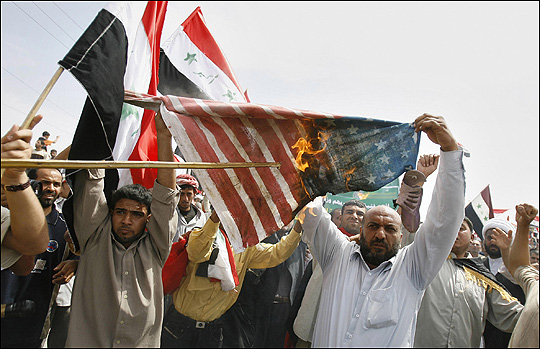
Photo by
Ahmad Al-Rubaye
Iraqi
Shiite supporters of cleric
Muqtada al-Sadr burn a U.S.
flag during a rally Monday
[April 9, 2007] - AFP/Getty
Images
Sixty-one days have passed
since I sent Congress an
emergency war spending bill to
provide the funds our troops
urgently need. But instead of
approving that vital funding,
Democrats in Congress have spent
the past 61 days working to pass
legislation that would
substitute the judgment of
politicians in Washington for
the judgment of our generals in
the field.
In both the House and Senate,
Democratic majorities have
passed bills that would impose
restrictions on our military
commanders, set an arbitrary
date for withdrawal from Iraq,
and fund domestic spending that
has nothing to do with the war.
The Democrats who passed these
bills know that I will veto
either version if it reaches my
desk, and they know my veto will
be sustained. Yet they continue
to pursue the legislation. And
now the process is on hold for
two weeks, until the full
Congress returns to session.
I recognize that Democrats are
trying to show their current
opposition to the war in Iraq.
They see the emergency war
spending bill as a chance to
make that statement. Yet for our
men and women in uniform, this
emergency war spending bill is
not a political statement, it is
a source of critical funding
that has a direct impact on
their daily lives.
When Congress does not fund our
troops on the front lines, our
military is forced to make cuts
in other areas to cover the
shortfall. Military leaders have
warned Congress about this
problem. The Chairman of the
Joint Chiefs of Staff, General
Pete Pace, recently testified
that if Congress fails to pass a
bill I can sign by mid-April,
the Army will be forced to
consider cutting back on
training, equipment repair, and
quality of life initiatives for
our Guard and Reserve forces. In
a letter to Congress, Army Chief
of Staff Pete Schoomaker put it
this way: "Without approval of
the supplemental funds in April,
we will be forced to take
increasingly draconian measures
which will impact Army readiness
and impose hardships on our
soldiers and their families."
If Congress fails to pass a bill
I can sign by mid-May, the
problems grow even more acute.
The Army will be forced to
consider slowing or even
freezing funding for depots
where pivotal equipment is
repaired, delaying or curtailing
the training of some active duty
forces, and delaying the
formation of new brigade combat
teams. The bottom line is that
Congress's failure to fund our
troops will mean that some of
our military families could wait
longer for their loved ones to
return from the front lines. And
others could see their loved
ones headed back to war sooner
than they need to. That is
unacceptable to me, and I
believe it is unacceptable to
the American people.
The full Congress will not be
back from spring vacation until
the week of April 16th. That
means the soonest the House and
Senate could get a bill to my
desk will be sometime late this
month, after the adverse
consequences for our troops and
their families have already
begun. For our troops, the clock
is ticking. If the Democrats
continue to insist on making a
political statement, they should
send me their bill as soon as
possible. I will veto it, and
then Congress can go to work on
a good bill that gives our
troops the funds they need,
without strings and without
further delay.
We have our differences in
Washington, D.C., but our troops
should not be caught in the
middle. All who serve in elected
office have a solemn
responsibility to provide for
our men and women in uniform. We
need to put partisan politics
aside, and do our duty to those
who defend us.
- George W. Bush, Radio
Address, April 7, 2007
source:
http://www.whitehouse.gov/news/releases/2007/04/20070407.html
Iraq, obviously, has got the
attention of the United States,
as it should. It's a tough war.
The American people are weary of
this war. They wonder whether or
not we can succeed. They're
horrified by the suicide
bombings they see. I analyzed
all the situation here this fall
-- I listened to the advice from
the military, I listened to the
advice from the political people
-- all in reaction to the fact
that al Qaeda and the extremists
bombed a sacred place, which
caused sectarian violence to
begin to rage. And it looked
like that if action wasn't
taken, the capital of this young
democracy would be overwhelmed
by chaos.
And I had a choice to make, and
that is whether or not to pull
back and hope that chaos
wouldn't spread, or to do
something about the sectarian
violence that was taking place
and to help the Iraqis bring
order to their capital in order
to give them breathing space,
time to reconcile their
differences after having lived
under the thumb of a tyrant for
years.
In weighing the options I
thought about the consequences
of a country that could sustain
itself and defend itself and
serve as an ally in the war on
terror. And those consequences
will have profound impact over
the next years, over the
decades, to know that in the
midst of the Middle East there
can flourish free societies,
societies where people can live
together, societies where people
can express their opinions,
societies where people can live
a free life.
That's important because history
has proven, has shown that free
societies don't war with each
other. But it's also important
to have allies in this war
against the extremists who would
do us harm.
I've also thought about the
consequences of failure and what
it would mean to the American
people. If chaos were to reign
in the capital of that country
it could spill out to the rest
of the country; it could then
spill out to the region, where
you would have religious
extremists fighting each other
with one common enemy, the
United States of America, or our
ally, for example, like Israel.
The enemy that had done us harm
would be embolden. They would
have seen the mighty United
States of America retreat before
the job was done, which would
enable them to better recruit.
They have made it clear -- they,
being people like Osama bin
Laden or Zawahiri -- have made
it clear they want to drive us
from Iraq to establish safe
haven in order to launch further
attacks. In my judgment, defeat
-- leaving before the job was
done, which I would call defeat
-- would make this United States
of America at risk to further
attack.
In other words, this is a war in
which, if we were to leave
before the job is done, the
enemy would follow us here.
That's the lesson of September
the 11th. It's an integral part
of my thinking about how to
secure this country -- to do the
most important job that the
government must do, and that is
to protect the American people.
So I made a decision, in
consultation with our military
commanders, people of sound
military judgment; people who
have made a career about how to
set strategies in place to
achieve military victories. And
the new strategy we developed
was to, rather than retreat,
reenforce; rather than pull back
was to go in with additional
troops to help this young
democracy do the job that the 12
million people who voted in free
elections want them to do, which
is to provide security, so a
mother can raise her child the
way we would want our mothers to
be able to raise our children;
to provide security so that the
political reconciliation
necessary can go forward in a
more secure environment.
As I made the decision to send
in more troops, I also made the
decision to send in a new
commander, General David
Petraeus. He's an expert on
counter-insurgency. Right now
about half of the reinforcements
that are expected to go to
Baghdad have arrived. American
and Iraqi troops are, however,
on the move. They're rounding up
both Shia and Sunni extremists;
they're rounding up those who
would do harm to innocent
people.
We're after al Qaeda. After all,
al Qaeda wants us to fail
because they can't stand the
thought of a free society in
their midst. We're destroying
car bomb factories, killing and
capturing hundreds of
insurgents. And neighborhoods
are being reclaimed. There is
progress, but the enemy sees
that progress and they're
responding in a brutal way.
I was amazed by the story of the
extremists who put two children
into a automobile so that they
could make it into a crowded
area -- then they got of the car
and blew up the car with the
children inside. It only hardens
my resolve to help free Iraq
from a society in which people
can do that to children, and it
makes me realize the nature of
the enemy that we face, which
hardens my resolve to protect
the American people. The people
who do that are not people --
you know, it's not a civil war;
it is pure evil. And I believe
we have an obligation to protect
ourselves from that evil. So
while we're making progress, it
also is tough. And so the way to
deal with it is to stay on the
offense, is to help these
Iraqis.
I had a meeting, a SVTS -- what
they call a SVTS, it's a
real-time video conference --
with Prime Minister Maliki. I
urged him, of course, to
continue making the actions
necessary to reconcile in their
society: pass an oil law, a de-Baathification
law. It's interesting to watch a
government emerge. It's
interesting to watch this new
democracy begin to take on
responsibilities. And they are.
They said they would commit
additional troops into Baghdad;
they have. They said they'd name
a commander for the city of
Baghdad; they did. They said
they would man checkpoints; they
are. They said they'd spend a
significant amount of their own
money for their reconstruction;
they have -- budgeted $10
billion.
And there's more work to be
done. And I reminded the Prime
Minister of that. And I reminded
him that our patience is not
unlimited. I also reminded him
that we want him to succeed,
that it's in the interest of the
United States that this young
democracy succeed. It's in the
interest we gain a new ally in
the war on terror, in the midst
of a part of the world that
produced 19 kids that came and
killed 3,000 of our citizens.
Just as the strategy is starting
to make inroads, a narrow
majority in the Congress passed
legislation they knew all along
I would not accept. Their bills
impose an artificial deadline
for withdrawal from Iraq. Their
bills substitute the judgment of
Washington politicians for the
judgment of our military
commanders. Their bills add
billions of dollars in pork
barrel spending, spending that
is unrelated to the war that
you're engaged in. Then, instead
of sending an acceptable bill to
my desk, they went on spring
break.
In the meantime, the clock is
ticking for our military. The
Secretary of Defense, the
Chairman of the Joint Chiefs of
Staff, and the Chief of Staff of
the Army have warned that if
Congress delays these funds past
mid-April, we'll have
significant consequences for our
Armed Forces. Army Chief of
Staff says this: "Without
approval of the supplemental
funds in April, we will be
forced to take increasingly
draconian measures, which will
impact Army readiness and impose
hardship on our soldiers and
their families."
For example, the Army says that
without these funds, it will be
forced to consider cutting back
on training for Guard and
Reserve units, and eventually
for active duty personnel. The
folks at Fort Irwin know
firsthand how important training
is. Washington has a
responsibility to ensure that
you have the resources you need
to keep this training going.
Soon Congress will return from
its break. I urge them to work
on legislation to fund our
troops, but that does not tell
our military how to conduct war
and sets an artificial timetable
for withdrawal. The enemy does
not measure the conflict in Iraq
in terms of timetables. They
plan to fight us, and we've got
to fight them, alongside the
Iraqis. A strategy that
encourages this enemy to wait us
out is dangerous -- it's
dangerous for our troops, it's
dangerous for our country's
security. And it's not going to
become the law.
There are fine, fine people
debating this issue in
Washington, D.C. They're
patriotic. They're people who
have got passionate points of
view about this war. And I
understand that. Yet, we cannot
allow honest differences in
Washington to harm our troops in
battle, or their families here
at home. Members of Congress
have sent their message; now
they need to send me a
war-spending measure that I can
sign into law, so we can provide
our troops and their families
with the funds and support they
deserve and they need.
I spent some time with the
soldiers out in the field, and I
want to share with you what I
told them. The work that you
have volunteered to do will have
a lasting impact on the world in
which we live. When we succeed
in helping this Iraqi government
become a country that can
sustain itself, defend itself,
govern itself, and serve as an
ally in the war on terror, we
will have delivered a
significant blow to those who
have designs on harming the
American people, because they
can't stand the thought of free
societies in their midst. They
can't stand the thought of
people being able to have a
government of, by, and for the
people. It is the opposite of
what they do.
- George W. Bush, Visit with
the Troops at Fort Irwin,
California , April 4, 2007
source:
http://www.whitehouse.gov/news/releases/2007/04/20070404-6.html
We've stated very
forthrightly what our objectives
are. We don't want to stay in
Iraq any longer than necessary,
but we want to get the job done.
And that means we've got to have
a government that's stood up,
that is able to govern the
country effectively. And they've
had three national elections
now, new constitution, they've
got a government in place that
has been there less than a year,
and they're making progress in
that area.
The other thing that needs to
happen is the Iraqis need to
have adequate security forces so
they can handle the threats, if
you will, of the instability
that exists inside Iraq. That's
a fairly straightforward
proposition. The problem we're
having, I think, is we see some
in the Congress trying to make
some kind of a political
statement by trying to come up
with amendments to the
supplemental appropriation, I
think to achieve a political
purpose, rather than to achieve
a victory. And we think that's
unfortunate.
The President has made it clear
that if he gets a bill that's
got a lot of restrictions on it,
or that has a lot of pork added
to it, unnecessary federal
spending, he'll veto it.
- U.S. Vice President Richard
"Dick" Cheney, ABC news radio
interview, April 4, 2007
source:
http://www.whitehouse.gov/news/releases/2007/04/20070404-3.html
The Congress is exercising
its legitimate authority as it
sees fit right now. I just
disagree with their decisions. I
think setting an artificial
timetable for withdrawal is a
significant mistake. It is a --
it sends mixed signals and bad
signals to the region, and to
the Iraqi citizens.
Listen, the Iraqis are wondering
whether or not we're going to
stay to help. People in America
wonder whether or not they've
got the political will to do the
hard work -- that's what Plante
was asking about. My
conversations with President
[sic] Maliki, he seems dedicated
to doing that. And we will
continue to work with him to
achieve those objectives. But
they're wondering whether or not
America is going to keep
commitments. And so when they
hear withdrawal, and timetables,
it, rightly so, sends different
kinds of signals.
It's interesting that Harry
Reid, Leader Reid spoke out with
a different option. Whatever
option they choose, I would hope
they get home, get a bill, and
get it to my desk. And if it has
artificial timetables of
withdrawal, or if it cuts off
funding for troops, or if it
tells our generals how to run a
war, I'll veto it. And then we
can get about the business of
giving our troops what they need
-- what our generals want them
to have, and give our generals
the flexibility necessary to
achieve the objectives that we
set out by reinforcing troops in
Iraq.
You know, what's interesting is
you don't hear a lot of debate
about Washington as to what will
happen if there is failure.
Again, Plante mentioned that
people don't think we can
succeed -- in other words,
there's no chance of succeeding.
That's a part of the debate. But
what people also have got to
understand, what will happen if
we fail. And the way you fail is
to leave before the job is done;
in other words, just abandon
this young democracy -- say
we're tired; we'll withdraw from
Baghdad and hope there's not
chaos.
I believe that if this capital
city were to fall into chaos,
which is where it was headed
prior to reinforcing, that there
would be no chance for this
young democracy to survive.
That's why I made the decision I
made. And the reason why I
believe it's important to help
this young democracy survive is
so that the country has a chance
to become a stabilizing
influence in a dangerous part of
the world.
I also understand that if the
country -- if the experience
were to fail, radicals would be
emboldened. People that had been
-- that can't stand America
would find new ways to recruit.
There would be potentially
additional resources for them to
use at their disposal.
The failure in Iraq would
endanger American security. I
have told the American people
often it is best to defeat them
there so we don't have to face
them here, fully recognizing
that what happens over there can
affect the security here. That's
one of the major lessons of
September the 11th. In that
case, there was safe haven found
in a failed state, where killers
plotted and planned and trained,
and came and killed 3,000 of our
citizens. And I vowed we weren't
going to let that happen again.
Secondly, the way to defeat the
ideology that these people
believe is through a competing
ideology, one based upon liberty
and human rights and human
dignity. And there are some who,
I guess, say that's impossible
to happen in the Middle East. I
strongly disagree. I know it is
hard work. I believe it is
necessary work to secure this
country in the long run.
- George W. Bush, Remarks on
the Emergency Supplemental,
April 3, 2007
source:
http://www.whitehouse.gov/news/releases/2007/04/20070403.html
BIRMINGHAM, Alabama (CNN) --
Vice President Dick Cheney on
Monday blasted "self-appointed
strategists" on Capitol Hill for
trying to force the withdrawal
of U.S. troops from Iraq,
declaring the U.S. military
answers to the president, not
Congress.
Speaking to a fundraising
luncheon for Sen. Jeff Sessions,
a Republican from Alabama,
Cheney repeated President Bush's
promise to veto an upcoming
emergency war-spending bill if
it contains any timetable for a
withdrawal.
"It's time the self-appointed
strategists on Capitol Hill
understood a very simple
concept: You cannot win a war if
you tell the enemy you're going
to quit," he said.
Both Bush and congressional
leaders say each other would be
to blame for stalling money for
the war effort if the president
vetoes the bill.
Cheney said Democrats are trying
to push the president into
accepting "unwise and
inappropriate restrictions on
our commanders."
"The fact is that the United
States military answers to one
commander-in-chief in the White
House, not 535
commanders-in-chief on Capitol
Hill," he added. "We expect the
House and the Senate to meet the
needs of our military on time,
in full, and with no strings
attached."
He urged Congress to "stop the
political theater" and send Bush
an acceptable war-spending bill
before the Pentagon begins to
run low on cash later this
spring.
Meanwhile, the standoff between
Congress and the White House
over Iraq ratcheted up another
notch Monday over war funding.
Majority Leader Harry Reid of
Nevada is joining Sen. Russ
Feingold, D-Wisconsin, in
sponsoring a new Iraq bill that
would end the majority of Iraq
war funding after March 31,
2008, the day Senate Democrats
originally proposed pulling
troops out of the war-ravaged
nation.
The bill would permit spending
in only three areas: fighting al
Qaeda, training Iraqis and
protecting the U.S. Embassy and
personnel.
Reid's spokesman, Jim Manley,
concedes passing the bill won't
be easy.
"This is an uphill battle, but
it's the next step in a series
of things to try and change the
president's policy in Iraq," he
said.
White House spokesman Dana
Perino responded by accusing
Democrats of changing their
stance on Iraq. "It's almost
shifting so fast, it's like a
sandstorm," she said.
Perino insisted funding is
essential.
At the Sessions fundraiser,
Cheney said Democrats are
essentially telling U.S. troops
to "retreat -- with no regard
whatsoever for the actual
conditions on the ground in
Iraq."
"When members of Congress speak
not of victory but of time
limits, deadlines or other
arbitrary measures, they're
telling the enemy to simply
watch the clock and wait us
out," he said.
"It's time the self-appointed
strategists on Capitol Hill
understood a very simple
concept: You cannot win a war if
you tell the enemy you're going
to quit."
Last week, the Senate passed a
$123 billion Iraq spending
measure that recommends a final
withdrawal of all troops by
March 31, 2008, and mandated
that troops begin redeployment
within four months of the bill's
passage.
Congressional negotiators are
trying to reconcile that bill
with a House version calling for
an August withdrawal.
Bush, meanwhile, is threatening
to veto any bill that sets a
timetable for withdrawing
troops, even if the bill
contains vital war money.
Cheney reiterated that threat
during his Monday speech, saying
that "if either version comes to
the president's desk, he will
use the veto power, no question
about it."
He added, "It's also clear that
we've got enough supporters of
the military in Congress to
sustain a veto, and so it is
pointless for the Democrats to
continue pursuing this
legislation."
Reid apparently is trying to
leverage the White House by
toughening the bill, and he is
pushing to vote on the new
measure within the next two
months.
In a statement, Reid said that
if Bush vetoes the legislation,
"I will work to ensure this [new
bill] receives a vote in the
Senate in the next work period."
The work period begins April 10,
when the Senate returns from its
spring recess, and ends Memorial
Day.
Republican staff members tell
CNN that Senate Minority Leader
Mitch McConnell is looking
closely at the bill. McConnell
has repeatedly challenged
anti-war lawmakers to cut off
funds for the war rather than
impose conditions that would
force a withdrawal, but he said
Monday that Reid's measure
amounts to "an arbitrary
surrender date."
"The chosen date isn't tied to
circumstances on the ground or
the needs of the military
commanders," the Kentucky
Republican said in a written
statement. "It's completely
arbitrary. It was pulled out of
thin air, and the terrorists
have already marked it on their
calendars."
A McConnell aide told CNN that
Reid simply cannot get the votes
to support this latest bill, but
Manley rejected that assessment.
Manley scoffs at that assertion:
"No one knows where the votes
are until we call the roll."
- Cheney: 'Self-appointed
strategists' forcing withdrawal,
CNN, April 2, 2007
source:
http://www.cnn.com/2007/POLITICS/04/02/senate.funds/index.html
© 2007 Cable News Network.
In recent days, the House and
Senate each passed emergency war
spending bills that undercut our
troops in the field. Each of the
Democrats' bills would
substitute the judgment of
politicians in Washington for
that of our generals on the
ground. Each bill would impose
restrictive conditions on our
military commanders. Each bill
would also set an arbitrary
deadline for surrender and
withdrawal in Iraq, and I
believe that would have
disastrous consequences for our
safety here at home.
The Democrats loaded up their
bills with billions of dollars
in domestic spending completely
unrelated to the war, including
$3.5 million for visitors to
tour the Capitol, $6.4 million
for the House of
Representatives' Salaries and
Expenses Account, and $74
million for secure peanut
storage. I like peanuts as much
as the next guy, but I believe
the security of our troops
should come before the security
of our peanut crop. For all
these reasons, that is why I
made it clear to the Democrats
in Congress, I will veto the
bill.
- George W. Bush, Radio
Address, March 31, 2007
source:
http://www.whitehouse.gov/news/releases/2007/03/20070331.html
WASHINGTON (AP) -- Senate
Democrats ignored a veto threat
and pushed through a bill
Thursday requiring President
Bush to start withdrawing troops
from "the civil war in Iraq,"
dealing a rare, sharp rebuke to
a wartime commander in chief.
In a mostly party line 51-47
vote, the Senate signed off on a
bill providing $122 billion to
pay for the wars in Iraq and
Afghanistan. It also orders Bush
to begin withdrawing troops
within 120 days of passage while
setting a nonbinding goal of
ending combat operations by
March 31, 2008.
The vote came shortly after Bush
invited all House Republicans to
the White House to appear with
him in a sort of pep rally to
bolster his position in the
continuing war policy fight.
"We stand united in saying loud
and clear that when we've got a
troop in harm's way, we expect
that troop to be fully funded,"
Bush said, surrounded by
Republicans on the North
Portico, "and we got commanders
making tough decisions on the
ground, we expect there to be no
strings on our commanders."
"We expect the Congress to be
wise about how they spend the
people's money," he said.
The Senate vote marked its
boldest challenge yet to the
administration's handling of a
war, now in its fifth year, that
has cost the lives of more than
3,200 American troops and more
than $350 billion. In a show of
support for the president, most
Republicans opposed the measure,
unwilling to back a troop
withdrawal schedule despite the
conflict's widespread
unpopularity.
"Surely this will embolden the
enemy and it will not help our
troops in any way," said Sen.
Richard Shelby, R-Alabama.
Forty-eight Democrats and
independent Bernard Sanders of
Vermont were joined by two
Republicans, Chuck Hagel of
Nebraska and Gordon Smith of
Oregon, in voting for the
measure. Opposed were 46
Republicans and Connecticut
independent Joseph Lieberman.
Sens. Mike Enzi, R-Wyoming, and
Tim Johnson, D-South Dakota, did
not vote.
The House, also run by
Democrats, narrowly passed
similar legislation last week.
Party leaders seem determined
that the final bill negotiated
between the two chambers will
demand some sort of timetable
for winding down the war --
setting them on course for a
veto showdown with the
president.
Reid: 'The American people
wanted us to speak'
"We've spoken the words the
American people wanted us to
speak," said Senate Majority
Leader Harry Reid, D-Nevada.
"There must be a change of
direction in the war in Iraq,
the civil war in Iraq."
"The Senate and the House have
held together and done what
we've done," he told reporters.
"It's now in his corner to do
what he wants to do."
In a letter to Bush, House
Speaker Nancy Pelosi and Reid
had said earlier: "This Congress
is taking the responsible course
and responding to needs that
have been ignored by your
administration and the prior
Congress."
White House spokeswoman Dana
Perino said the president
respects the role of Congress --
and Congress should respect his.
"I think the founders of our
nation had great foresight in
realizing that it would be
better to have one commander in
chief managing a war, rather
than 535 generals on Capitol
Hill trying to do the same
thing," she said. "They're
mandating failure here."
The legislation represents the
Senate's first, bold challenge
of Bush's war policies since
Democrats took control of
Congress in January. With Senate
rules allowing the minority
party to insist on 60 votes to
pass any bill and Democrats
holding only a narrow majority,
Reid previously had been unable
to push through resolutions
critical of the war.
This latest proposal was able to
get through because Republicans
said they didn't want to block
an appropriations bill needed
for the war.
"I think the sooner we can get
this bill ... down to the
president for veto, we can get
serious about passing a bill
that will get money to the
troops," said Minority Leader
Mitch McConnell, R-Kentucky.
Promised veto unlikely to be
overridden
Democrats acknowledge they do
not have enough support in
Congress to override Bush's
veto, but say they will continue
to ratchet up the pressure until
he changes course.
The looming showdown was
reminiscent of the GOP-led fight
with President Clinton over the
1996 budget, which caused a
partial government shutdown that
lasted 27 days. Newt Gingrich,
R-Georgia, the House speaker at
the time, eventually relented
but claimed victory because the
bill represented a substantial
savings over the previous year's
spending.
Bush said the money is needed by
mid-April or else the troops
will begin to run out of money,
but some Democrats say the real
deadline is probably closer to
June.
Gen. Peter Pace, chairman of the
Joint Chiefs of Staff, told the
House Defense Appropriations
Committee Thursday that a delay
in funding would have a chain
reaction that could keep units
in Iraq longer than planned.
If the bill is not passed by May
15, he said the Army will have
to cut back on reserve training
and equipment repairs, possibly
delaying the formation of new
Army units to relieve those
deployed.
Shortly before the final vote,
the Senate agreed 98-0 to add
$1.5 billion for mine-resistant
vehicles for Marines, and 93-0
to aid a program to track down
convicted sex offenders.
Members also agreed 96-1 to
prohibit funds in the bill to be
used for spinach farmers. The
vote was orchestrated by
Republicans to target some of
the extra spending added to the
bill by Democrats; while the
Senate bill didn't include any
funding for spinach growers, the
House measure contained $25
million.
- Senate passes war spending
bill with withdrawal deadline,
AP via CNN, March 29, 2007
source:
http://www.cnn.com/2007/POLITICS/03/29/us.iraq.ap/index.html
Copyright 2007 The Associated
Press.
WASHINGTON (CNN) -- Defying
President Bush, the
Democratic-led Senate turned
back a Republican attempt to
remove a call for U.S.
withdrawal from Iraq from a $124
billion war-spending bill,
Tuesday.
Though the 50-48 vote is far
short of the two-thirds majority
needed to override a veto,
Democrats said the measure was a
sign of growing support for
bringing the four-year-old war
to an end.
"This is a strong message which
amplifies the action of the
House and reflects the
overwhelming sentiment of the
American people," said Sen. Jack
Reed, D-Rhode Island. "It's a
message that must be heeded by
the president and by the
government of Iraq."
The bill would require U.S.
combat troops to begin
withdrawing from Iraq within 120
days and complete that pullout
by next March. A reduced
American contingent would stay
to focus on training Iraqi
troops and police and battling
al Qaeda terrorists.
Senate Minority Leader Mitch
McConnell, R-Kentucky, said that
effectively sets a "surrender
date" in the war.
"Setting a date for withdrawal
is like sending a memo to our
enemies that tells them to rest,
refit and re-plan until the day
we leave," he said. "It's a memo
to our friends, too, telling
them we plan to walk away and
leave them on their own,
regardless of what we leave
behind."
The $124 billion appropriation
comes on top of $70 billion
already approved for this year
and would drive the price tag
for the now-unpopular war past
the half-trillion-dollar mark.
The Pentagon says it would have
to start diverting funds from
other programs to Iraq unless it
passes by mid-April.
The spending bill passed the
House of Representatives with an
August 2008 deadline last week.
But Bush has vowed to veto any
bill that contains a call for a
U.S. withdrawal or what he
considers extraneous pork-barrel
spending, and dismissed the
House measure as "political
theater."
White House spokeswoman Dana
Perino reiterated that threat
Tuesday.
"Regardless of the success our
troops are achieving in the
field, this bill would require
their withdrawal," she said.
"This and other provisions would
place freedom and democracy in
Iraq at grave risk, embolden our
enemies and undercut the
administration's plans to
develop the Iraqi economy."
Earlier this month, the Senate's
Democratic majority fell short
of another attempt to impose a
timeline for withdrawal.
Republicans had used the threat
of a filibuster to kill previous
statements of opposition to the
war. But McConnell said the GOP
would not use that tactic, which
requires 60 votes to overcome,
in this case because "it's
important to get the money to
the troops."
Democratic Whip Dick Durbin of
Illinois said the call for a
pullout is a step toward
bringing "the worst foreign
policy mistake of our time" to
an end.
"Now it's time for us to make it
clear to the Iraqis it is their
country. It is their war. It is
their future," he said.
The Senate vote went down to the
wire, with the White House
hustling Vice President Dick
Cheney to Capitol Hill to break
a possible tie. Earlier, Senate
Majority Leader Harry Reid
acknowledged, "We don't know how
it's going to turn out."
Two Republicans -- Sens. Chuck
Hagel of Nebraska and Gordon
Smith of Oregon -- joined 48
Democrats to turn back the
GOP-backed amendment.
"The American people are
demanding that we develop a
bipartisan consensus for an
honorable and responsible exit
strategy from Iraq," said Hagel,
a possible Republican
presidential candidate. "If we
fail to build a bipartisan
foundation for an exit strategy,
America will pay a high price
for this blunder, one that we
will have difficulty recovering
from in the years ahead."
One Democrat, Mark Pryor of
Arkansas, joined Connecticut
independent Joe Lieberman to
vote with the Republican
leadership. And Virginia Sen.
John Warner, a leading GOP
opponent of Bush's plan to send
30,000 more troops to Iraq,
rejoined the Republican fold on
Tuesday's vote, warning that
calling for withdrawal would
sound "the bugle of retreat."
"It would be echoed and repeated
from every minaret in Iraq that
coalition forces have begun to
take the first step backwards,"
said Warner, a former chairman
of the Senate Armed Services
Committee. "We cannot take that
step -- not at this time."
- Withdrawal timeline
survives Senate vote, CNN, March
27, 2007
source:
http://www.cnn.com/2007/POLITICS/03/27/us.iraq/index.html
© 2007 Cable News Network.
Good morning. In times of
war, Congress has no greater
obligation than funding our war
fighters. And next week, the
House will begin debate on an
emergency war spending bill.
The purpose of this legislation
should be to give our troops on
the front lines the resources,
funds, and equipment they need
to fight our enemies.
Unfortunately, some in Congress
are using this bill as an
opportunity to micromanage our
military commanders, force a
precipitous withdrawal from
Iraq, and spend billions on
domestic projects that have
nothing to do with the war on
terror.
Our troops urgently need
Congress to approve emergency
war funds. Over the past several
weeks, our Nation has begun
pursuing a new strategy in Iraq.
Under the leadership of General
David Petraeus, our troops have
launched a difficult and
dangerous mission to help Iraqis
secure their capital. This plan
is still in its early stages,
yet we're already seeing signs
of progress. Iraqi and American
troops have rounded up more than
700 people affiliated with Shia
extremists. They've also
launched aggressive operations
against Sunni extremists. And
they've uncovered large caches
of weapons that could have been
used to kill our troops. These
are hopeful signs. As these
operations unfold, they will
help the Iraqi government
stabilize the country, rebuild
the economy, and advance the
work of political
reconciliation. Yet the bill
Congress is considering would
undermine General Petraeus and
the troops under his command
just as these critical security
operations are getting under
way.
First, the bill would impose
arbitrary and restrictive
conditions on the use of war
funds and require the withdrawal
of forces by the end of this
year if these conditions are not
met. These restrictions would
handcuff our generals in the
field by denying them the
flexibility they need to adjust
their operations to the changing
situation on the ground. And
these restrictions would
substitute the mandates of
Congress for the considered
judgment of our military
commanders.
Even if every condition required
by this bill was met, all
American forces -- except for
very limited purposes -- would
still be required to withdraw
next year, regardless of the
situation in Iraq. The
consequences of imposing such an
artificial timetable would be
disastrous.
Here is what Secretary of
Defense Robert Gates recently
told Congress: Setting a fixed
date to withdraw would
"essentially tell [the enemy]
how long they would have to wait
until we're gone." If American
forces were to step back from
Baghdad before it is more
secure, the scale and scope of
attacks would increase and
intensify. A contagion of
violence could spill out across
the entire country, and in time,
this violence would engulf the
region. The enemy would emerge
from the chaos emboldened with
new safe havens, new recruits,
new resources, and an even
greater determination to harm
America. Such an outcome would
be a nightmare for our country.
Second, the bill would cut
funding for the Iraqi security
forces if Iraqi leaders did not
meet rigid conditions set by
Congress. This makes no sense.
Members of Congress have often
said that the Iraqis must step
forward and take more
responsibility for their own
security -- and I agree. Yet
Members of Congress can't have
it both ways: They can't say
that the Iraqis must do more and
then take away the funds that
will help them do so. Iraq is a
young democracy that is fighting
for its survival in a region
that is vital to American
security. To cut off support for
their security forces at this
critical moment would put our
own security at risk.
Third, the bill would add
billions of dollars in domestic
spending that is completely
unrelated to the war. For
example, the House bill would
provide $74 million for peanut
storage, $48 million for the
Farm Service Agency, and $35
million for NASA. These programs
do not belong in an emergency
war spending bill. Congress must
not allow debate on domestic
spending to delay funds for our
troops on the front lines. And
Members should not use funding
our troops as leverage to pass
special interest spending for
their districts.
We are a Nation at war, and the
heaviest responsibilities fall
to our troops in the field. Yet
we in Washington have
responsibilities, as well.
General Petraeus was confirmed
by the Senate without a single
vote in opposition, and he and
his troops need these resources
to succeed in their mission.
Many in Congress say they
support the troops, and I
believe them. Now they have a
chance to show that support in
deed, as well as in word.
Congress needs to approve
emergency funding for our
troops, without strings and
without delay. If they send me a
bill that does otherwise, I will
veto it.
- George W. Bush, Radio
Address, March 17, 2007
http://www.whitehouse.gov/news/releases/2007/03/20070317.html
Protesters in Baghdad say,
'No America!'
Sadr urges followers to unite
against 'the grand devil,' even
as the U.S. touts joint patrols
in his stronghold as a success.
By Tina Susman, Times Staff
Writer
March 17, 2007
BAGHDAD — Residents of the
Shiite neighborhood of Sadr City
on Friday showed signs of
growing resentment toward the
presence of U.S. troops in the
area, chanting "No occupation!"
and "No America!" in a march
demanding the removal of a U.S.
base there.
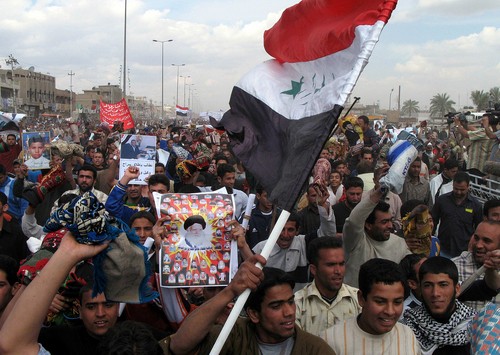
March 17, 2007. People
march during a protest against
the U.S. military presence in
Sadr City, a Shiite enclave in
Baghdad.
(Adil al-Khazali / Associated
Press)
source:
http://www.latimes.com/news/nationworld/world/middleeast/la-fg-iraq17mar17,0,6734476.story?coll=la-middleeast
And we fight this war on many
fronts. In Afghanistan and Iraq,
we removed two of the world's
most brutal regimes. And now we
are undertaking the complex work
of helping the people of these
two countries establish
functioning democracies that can
protect their own people and be
allies in this global war on
terror. Sometimes we lose
sight of the importance of this
work in the midst of heated
debates -- and this is
especially true when it comes to
Iraq. The fight in Iraq is more
than a conflict in one country,
it is part of a larger struggle
against extremism that is
unfolding across the broader
Middle East. The extremists are
fighting to take control of Iraq
so they can establish it as a
base from which to overthrow
moderate governments in the
region, and plan new attacks on
the American people. If we fail
in Iraq, the enemy will follow
us home. Their success in
Iraq would bring danger to
America, and that is why America
must prevail in Iraq.
I appreciate your strong support
for those who have volunteered
to wear our uniform. Thousands
of courageous men and women have
stepped forward to protect us.
And they're not alone. Since
this war began, nearly 120,000
Iraqis have volunteered to serve
in their army. More than 8,000
Iraqis in uniform have died in
the defense of their new nation.
Recently in Anbar province,
where al Qaeda terrorists have
gathered, 1,000 Sunnis
volunteered for the police force
in a period of two weeks. Last
month in Hillah, an Iraqi police
officer threw himself onto a
suicide bomber -- a final,
heroic act that saved an untold
number of Iraqis gathered
outside a local mosque.
Every month, Iraqis risk
reprisals from the terrorists
and extremists to provide
thousands of tips to coalition
and Iraqi authorities. One
recent tip from an Iraqi led to
the discovery of a factory where
insurgents developed
sophisticated roadside bombs to
kill our troops. With these acts
of bravery, the Iraqis are
standing up for the democratic
future that 12 million of them
voted for. The vast
majority of Iraq's citizens want
to live in peace, and they're
showing their courage every day.
And the United States of America
will not abandon them in their
hour of need.
To reach our goals, and to
prevail, we must recognize that
the nature of the war in Iraq
has changed. In 2005, the
terrorists tried and failed to
stop the Iraqi people as they
held three national elections.
They choose a transitional
government, they adopted the
most progressive, democratic
constitution in the Arab world,
and then they elected a
government under that
constitution. So a thinking
enemy adjusted their tactics,
and in 2006 they struck.
Last February, al Qaeda and
other Sunni extremists blew up
the Golden Mosque of Samarra.
This atrocity was designed to
provoke retaliation from the
Iraqi Shia -- and it succeeded.
Radical Shia elements, some of
whom receive support from Iran,
formed death squads. And the
result was a tragic escalation
of sectarian rage and reprisal.
This changed the nature of the
conflict in Iraq. We still faced
the threat from al Qaeda, but
the sectarian violence was
getting out of hand, and
threatened to destroy this young
democracy before it had a chance
to succeed. So last fall, I
ordered my national security
team to conduct a comprehensive
review of our strategy in Iraq.
We devised an approach that is
markedly different from previous
efforts. This approach demands
more from Iraq's elected
government, makes bringing
security to Baghdad our top
priority, and gives our troops
the reinforcements they need to
carry out their missions. And to
carry out this strategy, I put
in place a highly-regarded
commander, an expert on
counterinsurgency -- General
David Petraeus.
General Petraeus' mission is to
help Iraq's leaders implement
the plan that they developed to
secure Baghdad. Today they can't
do this on their own. So I have
ordered reinforcements of more
than 20,000 additional combat
soldiers and Marines to Iraq.
The majority will go to Baghdad,
where they will help Iraqi
forces to clear and secure
neighborhoods, and where they
will partner with Iraqi units.
The Iraqis in the lead, our
forces will help secure the city
by chasing down the terrorists,
insurgents, and murderers, and
roaming death squads.
We're fixing one of the major
problems with our previous
approach in Baghdad. In the
past, our forces would help
Iraqis clear out neighborhoods
during the day, and then go back
to their bases at night, and
often the enemy returned as soon
as American forces left. This
time, we will hold the
neighborhoods we have cleared by
establishing over 30 "joint
security stations" throughout
Baghdad. These will be
neighborhood outposts where
Iraqi forces, with U.S. help,
will be deployed 24 hours a day
to secure the population,
provide emergency aid to the
communities, and gather
information to root out
extremist networks throughout
the capital. At the same time,
our forces will continue to
train Iraqi Army and Police, so
that we can help ensure that the
Iraqi forces left behind are
capable of providing security
that Baghdad needs.
It's too early to judge the
success of this operation.
General Petraeus recently
arrived in the Iraqi capital,
and the plan he is executing is
in its early stages. This
strategy is going to take time.
And we can expect al Qaeda and
other extremists to try to
derail the strategy by launching
spectacular attacks.
Yet even at this early hour,
there are some encouraging
signs: The Iraqi government has
completed the deployment of
three additional Iraqi Army
brigades to the capital. They
said they were going to employ
three brigades, and they did.
Iraq's leaders have lifted
restrictions on Iraqi and
coalition forces that prevented
them from going into certain
areas. Already, about half of
the joint security stations have
been established in
neighborhoods across Baghdad.
Iraqi and U.S. forces have
rounded up more than 700 people
affiliated with Shia extremists.
They have recovered large
weapons caches, including mortar
weapons systems and
rocket-propelled grenades.
Iraqi and American forces have
also launched successful
operations against the Sunni
extremists. U.S. and Iraqi
forces recently killed al Qaeda
terrorists in Baghdad, who were
responsible for some of those
bomb attacks that you're seeing
on your TV screens. In the past
two weeks, U.S. and Iraqi forces
have also uncovered large
stockpiles of Explosively Formed
Projectiles -- or EFPs -- which
are used by extremist groups to
attack our troops. Iraqi and
U.S. forces are making gradual
but important progress almost
every day, and we will remain
steadfast until our objectives
are achieved.
In addition to the steps they
are taking to secure their
capital, Iraq's leaders are also
taking steps to achieve
political reconciliation --
reconciliation that is necessary
after years of brutal tyranny.
They have committed themselves
to a series of benchmarks to
advance this reconciliation --
to share oil revenues amongst
all Iraq's citizens, to put the
wealth of Iraq into rebuilding
of Iraq, to allow more Iraqis to
re-enter their nation's civic
life, to hold local elections,
and to take responsibility for
security in every Iraqi
province.
Iraqis have already begun to
deliver on some of these
promises. For example, Iraq's
Council of Ministers recently
agreed on legislation they will
submit to their parliament on
the development of Iraq's oil
resources and the sharing of
revenues. Last month, the Iraqi
government approved a budget
that includes $10 billion for
reconstruction and capital
investment. These are
encouraging signs. And now
Iraq's leaders must meet the
other pledges they have made.
To succeed, Iraq's leaders also
need the help of the
international community. So the
United States supports the Iraqi
government as it pursues an
international initiative to
build diplomatic, economic, and
security support for its young
democracy. Last week, the Iraqis
announced that they will hold a
conference in Baghdad that will
include officials from Iraq's
neighboring countries, as well
as the permanent members of the
U.N. Security Council, the Arab
League, and the Organization of
Islamic Conference.
It will be followed next month
by a second conference that
includes Secretary Rice and her
counterparts from around the
world. These meetings will be an
important test. They'll be a
test of whether Iran and Syria
are truly interested in being
constructive forces in Iraq. It
will be a test for the
international community to
express its support for this
young democracy, to support a
nation that will be at peace
with its neighbors.
Diplomacy is going to play an
important part of securing
Iraq's future. Yet diplomacy
will fail without a robust
military strategy. The goal of
the enemies in Iraq is power,
and they're willing to kill
themselves and innocent men,
women, and children to achieve
that goal. People like these
can't be satisfied by
negotiations or diplomatic
concessions. Our strategy
recognizes the hard truth. So
we're going to continue to
pursue our enemies in Iraq
relentlessly, and at the same
time, we'll work with moderate
forces to achieve reconciliation
between sectarian factions.
Here in Washington, we have
important decisions on Iraq
ahead of us. And the most
pivotal question is whether the
United States Congress will
stand behind General Petraeus
and our troops as they work to
secure Baghdad. General Petraeus
has my confidence, and he also
has the confidence of the United
States Senate. In fact, he was
recently confirmed to his post
without one single vote against
him. Yet almost immediately the
House passed a resolution that
disapproved of his strategy for
success in Iraq. I know you find
that puzzling -- (laughter) --
you're not the only one.
(Laughter.) This may be the
first time in the history of the
United States Congress that
voted to send a new commander
into battle and then voted to
oppose the plan he said was
critical in winning that battle.
Members of Congress have every
right to express their opinion.
They have every right. They also
have a responsibility to fund
our war fighters. Some in
Congress have called for cutting
off funds for our troops, only
to find opposition from their
colleagues on Capitol Hill. Now
others in Congress are planning
to use an emergency war spending
bill that will provide funds for
the war on terror as an
opportunity to add on billions
of dollars for unrelated
domestic programs. Tacking extra
domestic spending to an
emergency war spending bill only
will complicate Congress'
ability to provide the support
that our troops urgently need. I
ask the Congress to approve the
funds we requested and our
troops are counting on without
strings and without delay.
Equally important to funding our
troops is giving our commanders
the flexibility to carry out
their missions, without undue
interference from politicians in
Washington. Some members
of Congress say that we can
succeed in Iraq without
providing the reinforcements
that our forces have been
promised and are expecting. I
disagree. More importantly, our
commanders disagree. Other
members of Congress seem to
believe that we can have it all:
that we can fight al Qaeda,
pursue national reconciliation,
initiate aggressive diplomacy,
and deter Iran's ambitions in
Iraq -- all while withdrawing
from Baghdad and reducing our
force levels. That sounds good
in theory, but doing so at this
moment would undermine
everything our troops have
worked for.
There are no short cuts in Iraq.
Our intelligence and military
experts agree that given the
current situation, Iraq will not
be a stable nation until its
capital is more secure.
Political reconciliation is
difficult when a country's seat
of government is under constant
siege. Economic improvements
cannot take root when Baghdad's
neighborhoods are the scene of
daily sectarian violence and
reprisals. And you cannot
effectively battle al Qaeda by
ignoring the sectarian violence
they are inciting, especially in
the capital.
If American forces were to step
back from Baghdad now, before it
is more secure, the scale and
scope of attacks would increase
and the intensity would
increase. A contagion of
violence could spill out across
the entire country, and in time,
the entire region. The enemy
would emerge from the chaos
emboldened, with new safe havens
and new recruits and new
resources and an even greater
determination to harm America.
For our country, this is a
nightmare scenario. For the
enemy, it's their plan. They're
not debating whether the war in
Iraq is worth it. Hear the words
of bin Laden, in a message to
the American people just last
year. He says of Iraq: "The war
is for you or for us to win. If
we win it, it means your defeat
and disgrace forever." In the
face of such a determined enemy,
the idea of pulling back from
the fight and hoping for the
best is not a reasonable
position. America did not drive
al Qaeda out of their safe haven
in Afghanistan only to let them
set up a shop in a free Iraq.
Now that the battle for Baghdad
is underway, our country is best
served by standing behind our
troops and doing everything we
can to aid in their success. The
outcome of this conflict
involves more than the fortunes
of any one President or any
political party. Our mission is
America's mission, and our
failure would be America's
failure.
Our country is fortunate that
our mission is in the hands of
America's finest citizens -- the
men and women who wear our
uniform. They've been on
the battlefield. They have seen
this war up close. They know the
consequences of failure. And
they appreciate something
larger: the consequences of
success. We know what a
free Iraq could mean for the
region and the world, because we
know how your sacrifices half a
century ago helped create a free
Germany that transformed Europe,
and a free Japan that sparked a
wave of democracy and prosperity
throughout much of Asia. We know
that a free Iraq has the
potential to spark a similar
transformation in the Middle
East, and bring us closer to the
day when moms and dads in the
Arab world see a future of hope
for their children. And we know
that the sacrifices that our
troops are making in Iraq today
will lay the foundation of peace
for generations of Americans to
come.
- George W. Bush, President
Bush Discusses Care for
America's Returning Wounded
Warriors, War on Terror at
American Legion, March 6, 2007
source:
http://www.whitehouse.gov/news/releases/2007/03/20070306-1.html
LONDON, England (CNN) --
British Prime Minister Tony
Blair on Wednesday announced
plans for the imminent
withdrawal of around 1,600 of
his country's troops from Iraq.
In a statement to lawmakers in
the House of Commons, Blair said
the UK's coalition contingent
based in Basra would be reduced
in the coming months -- but only
if Iraqi security forces could
secure the southern part of the
country.
"The actual reduction in forces
will be from the present 7,100
-- itself down from over 9,000
two years ago and 40,000 at the
time of the conflict -- to
roughly 5,500," Blair said.
He said the withdrawal reflected
the relative stability in Basra,
where the sectarian rifts that
have turned Baghdad and northern
Iraq into a powderkeg are less
of a problem.
"The next chapter in Basra's
history will be written by
Iraqis," Blair said.
Britain's plans prompted U.S.
Secretary of State Condoleezza
Rice, speaking at a news
conference in Berlin with German
Foreign Minister Frank-Walter
Steinmeier, to reject
suggestions the American-led
coalition in Iraq was crumbling.
"The British have done what is
really the plan for the country
as a whole, which is to be able
to transfer security
responsibilities to the Iraqis
as conditions permit," she said.
Rice said that "the coalition
remains intact and in fact the
British will have thousands of
soldiers deployed in Iraq in the
south."
Blair said British troops would
increasingly play a support and
training role with Iraqi forces
assuming responsibility for
security operations.
He said there would be no
diminution in British combat
resources and said a military
presence would remain into 2008
"for as long as we are wanted
and have a job to do."
"The speed at which this happens
depends, of course, in part on
what we do, what the Iraqi
authorities themselves do, but
also on the attitude of those we
are together fighting."
More than 130 British troops
have been killed in Iraq since
the U.S.-led invasion in 2003.
Meanwhile Denmark on Wednesday
announced it would withdraw its
contingent of coalition forces
by August. Lithuania also said
it was considering withdrawing
its 53 troops. Denmark's 460
soldiers serve under British
command in Basra.
U.S. Secretary of State Rice
said the moves were in line with
long term plans for Iraq and
would not compromise security or
the strenght of the coalition.
"The coalition remains intact
and in fact the British will
have thousands of soldiers
deployed in Iraq in the south,"
she said at a joint news
conference with German Foreign
Minister Frank-Walter Steinmeier,
Reuters reported.
"It is the plan that as it is
possible to transfer
responsibility to the Iraqis,
that coalition forces would no
longer be needed in those
circumstances," she added.
Blair's statement followed a
weekend television interview in
which he declared that the
British mission in Basra --
codenamed "Sinbad" -- had been
"completed" and "successful."
"The issue is the operation that
we have been conducting in Basra
is now complete... And it has
been successful as an operation
and as a result there has been
reconstruction that has come in
behind it and we have been able
to make real progress."
On Wednesday the Sun newspaper
reported that the first British
troops would return home "within
weeks" and said that 3,000 will
follow by the end of the year.
The Guardian and The Sun
reported that all British forces
would leave Iraq by the end of
2008.
The Guardian, quoting defense
sources, said British troops
would continue carrying out long
range patrols in Maysan province
along the border with Iran from
a single base in Basra.
Defence officials have been
encouraged by a campaign to root
out criminals and Shia militia
supporters from the Basra police
force, the paper reported.
CNN's Nic Robertson said British
forces had adopted a
"softly-softly approach" to
policing Basra in comparison
with their American allies in
Baghdad.
"The assessment has clearly been
made for political reasons or
because the situation is much
better now in Basra that this is
a safe operating status that can
be put in place there," said
Robertson.
"They would go out with berets
on their heads instead of
helmets, they would patrol the
streets more frequently than
U.S. troops typically would and
try to engage the local
population. But in the last year
that has not been as successful
a tactic as it was in the first
year or so."
The British announcement came
one day after the Iraqi Army
division based in Basra
transferred from coalition
command to Iraqi command. That
Iraqi unit "is now -- for the
first time -- taking its orders
direct from an Iraqi
headquarters in Baghdad,"
according to a statement on
Britain's Ministry of Defense
Web site.
In Basra many Iraqis greeted the
news with relief, while others
voiced fears the British
withdrawal was premature amid
fears over tensions between Shia
parties bubbling beneath the
surface.
Salam al-Maliki, a senior
official in the bloc loyal to
radical young cleric Moqtada al-Sadr
which has long opposed a foreign
presence in Iraq, said any
violence in the city would cease
once the foreign troops have
left.
"The militias and militant
groups in these areas only fired
their weapons at the occupier
and when they go, all of the
violence here will end," he
said.
U.S. sends more troops to Iraq
In Washington, the White House
welcomed the British move, even
as the U.S. sends more troops
into Iraq in an effort to put
down a wave of sectarian
violence in Baghdad and pacify
Anbar province, the heart of the
Sunni insurgency.
"The president views this as a
success," National Security
Council spokesman Gordon
Johndroe said. "The president
wants to do the same thing, to
bring our troops home as soon as
possible.
"The president is grateful for
the support of the British
forces in the past and into the
future. While the United Kingdom
is maintaining a robust force in
southern Iraq, we're pleased
that conditions in Basra have
improved sufficiently that they
are able to transition more
control to the Iraqis."
"The United States shares the
same goal of turning over to the
Iraqi security forces and
reducing the number of American
troops in Iraq," the statement
added.
Johndroe said Blair briefed
President Bush about the plan
during one of their "routine"
calls Tuesday morning.
But Democrat Senator Ted Kennedy
called Blair's announcement a
"stunning rejection of President
Bush's high risk Iraq policy."
"No matter how the White House
tries to spin it, the British
government has decided to split
with President Bush and begin to
move their troops out of Iraq.
This should be a wake up call to
the administration," Kennedy
said in a statement.
"Eighteen other countries have
already withdrawn or
dramatically reduced their troop
presence in Iraq. A majority of
the American people voted last
November for a changed policy in
Iraq. A majority of the House
and the Senate, a unanimous
Baker- Hamilton Commission and
numerous generals have rejected
the Administration's policy in
Iraq. And now our country's
strongest ally has rejected it."
Political damage
Opposition to the war has hurt
Blair politically, with his
ruling Labor Party losing seats
in Parliament and in local
elections in the past two years.
The prime minister announced in
September that he would leave
office within a year.
CNN's Robin Oakley said the
announcement of plans to
withdraw troops from Iraq would
be seen as a "turning point" by
Blair as he prepares for his
exit from government.
"Tony Blair wants to show he got
things moving in the right
direction before he goes," said
Oakley.
Shadow foreign secretary William
Hague of the opposition
Conservative Party said British
forces in Iraq were
overstretched and had probably
reached the limit of what they
could "usefully achieve."
Anti-war protester Lindsey
German of the UK's Stop the War
Coalition said the move was an
admission that the troops were
not doing any good: "[Blair]
needs to come clean on what a
mistake, and what a disaster,
the war has actually been."
Britain contributed about 46,000
soldiers, sailors and air force
personnel to the U.S.-led
invasion of Iraq in March 2003.
More than half those troops were
withdrawn within two months of
the invasion, leaving the
remaining contingent in Basra.
News of the withdrawal comes
three days after it was reported
that Prince Harry would deploy
with his unit to Iraq in April
or May.
CNN's Suzanne Malveaux
contributed to this report.
- Blair: 1,600 troops to
leave Iraq, CNN, February 21,
2007
source:
http://www.cnn.com/2007/WORLD/meast/02/21/uk.iraq.troops/index.html
© 2007 Cable News Network.
To serve that goal, the
terrorists have declared an
intention to arm themselves with
chemical, biological and even
nuclear weapons, to destroy
Israel, to intimidate free
countries and to cause great
harm to the United States. The
terrorists' vision is one of
murder and enslavement. Our
vision is one of humanity and
freedom. And so we are their
prime target. They hate us, they
hate our country, they hate the
liberties for which we stand.
They want to destroy our way of
life, so that freedom no longer
has a home and a defender in
this world. That leaves us only
one option: to rise to America's
defense, to take the fight
directly to the enemy, and to
accept no outcome but victory.
The terrorists have made Iraq
the central front in this war.
And right now our new force
commander in Iraq, General Dave
Petraeus, is carrying out a new
strategy for victory on that
front. We're moving in to help
Iraqis clear and secure Baghdad,
to help them protect the local
population, and to ensure that
the Iraqi forces will be capable
of providing the security
necessary in their capital city.
As General Petraeus said, "the
way ahead will be neither quick
nor easy, and there will
undoubtedly be tough days. We
face a determined, adaptable,
barbaric enemy. He will try to
wait us out. In fact, any such
endeavor is a test of wills, and
there are no guarantees."
The General has it exactly
right. The terrorists know they
cannot beat us in a stand-up
fight. They never have. The only
way they can win is if we lose
our nerve and abandon our
mission. So they continue
committing acts of random
horror, believing they can
intimidate the civilized world
and break the will of the
American people. Bin Laden
continues to predict that the
people of the United States
simply do not have the stomach
to stay in the fight against
terror. He refers to Iraq as the
"third world war," and he knows
the stakes as well as we do. If
the terrorists were to succeed,
they would return Iraq to the
rule of tyrants, make it a
source of instability in the
Middle East, and use it as a
staging area for even more
attacks. The terrorists also
know that as freedom takes hold,
the ideologies of hatred and
resentment will lose their
appeal, and the advance of
liberty and self government in
the broader Middle East will
lead to a much safer world for
our children and our
grandchildren.
This nation has learned the
lessons of history. We know that
terrorist attacks are not caused
by the use of strength; they are
invited by the perception of
weakness. We know that if we
leave Iraq before the mission is
completed, the enemy is going to
come after us. Having seen our
interests attacked repeatedly
over the years, and knowing the
ambitions of the terrorists,
this nation has made a decision:
We will engage these enemies. We
will face them far from home, so
we do not have to face them on
the streets of our own cities.
Every member of our military can
be certain that America will
stay on the offensive in the war
on terror. The President of the
United States and his national
security team understand the
threat -- the enemy's changing
tactics and its unchanging
nature. We are not dealing with
adversaries that will ever
surrender or come to their
senses. We will be flexible.
We'll do all we can to adapt to
conditions on the ground. We'll
make every change necessary to
do the job. And I want you to
know that the American people
will not support a policy of
retreat. We want to complete the
mission, we want to get it done
right, and then we want to
return with honor.
- U.S. Vice President Richard
"Dick" Cheney, Remarks at a
Rally for the Troops, February
21, 2007
source:
http://www.whitehouse.gov/news/releases/2007/02/20070221-5.html
Q So, Mr. Vice President,
Tony Blair is announcing that
the British are beginning their
withdrawal from Iraq. Are you
concerned about that?
THE VICE PRESIDENT: No, they've
indicated for some time now that
they were going to make
adjustments based on conditions
on the ground. I think they
believe that in southern Iraq,
that Basra region where they've
been most active, we have made
significant progress. And I
think that's one of the reasons
they feel that they can draw
down their forces there. I
believe they're at the same time
continuing to be very active in
Afghanistan. And they'll
continue with some forces in
Iraq, but it won't be the same
level it was at before.
Q But how does it look to the
American people to see our most
important ally begin to pull
their troops out as we're
actually sending more troops in?
THE VICE PRESIDENT: I look at
it, and what I see is an
affirmation of the fact that
there are parts of Iraq where
things are going pretty well.
The focus that we've had,
obviously, is Baghdad and the
decision the President made to
surge troops into Baghdad. The
Baghdad Security Plan is based
on conditions in Baghdad.
But in fact, I talked to a
friend just the other day, a guy
who knows the region very well,
has spent a lot of years in that
part of the world who had driven
from Baghdad down to Basra in
seven hours, found the situation
dramatically improved compared
to where it was a year or so
ago, sort of validated the
British view that they have made
progress in southern Iraq, and
that they can therefore afford
to reduce their force posture.
Q Now regarding the U.S. surge,
the Congress is now on record
opposing the President's policy
--
THE VICE PRESIDENT: Well, the
House is on record with a Sense
of the Congress resolution.
Q Does it matter?
THE VICE PRESIDENT: Well, it's
an important debate. I think
it's important to remember that
this is a Sense of the Congress
resolution, that it doesn't have
any binding impact or effect.
It's still hung up in the Senate
because the Democrats haven't
agreed to allow our guys to vote
on a resolution they'd like to
have a vote on which would be a
commitment not to reduce funding
for the troops when they're in
the field. So there's a certain
amount of politics involved, I
suppose.
The important thing is that we
go forward with a successful
strategy to prevail in Iraq.
Ultimately, this ought to be
about winning in Iraq, not about
posturing on Capitol Hill. And I
think the important debate will
come up down the road when we
get time to vote, for example,
on the supplemental, or if there
are votes in the meantime that
do have a significant impact,
have a binding impact, if you
will, especially with respect to
appropriations.
Q Because Congressman Murtha and
Speaker Pelosi have made it
clear that what they would like
to do is they would like to stop
the surge. Can they do it? Do
they have the power to stop the
surge?
THE VICE PRESIDENT: I don't
think so. The question is
whether or not they have the
votes. Jack Murtha is an old
friend of mine. We've done a lot
of business together over the
years. When I was Secretary of
Defense, he was perhaps my
closest ally on Capitol Hill.
Jack clearly has a different
perspective. With respect to
Iraq, I think he's dead wrong. I
think, in fact, if we were to do
what Speaker Pelosi and
Congressman Murtha are
suggesting, all we'll do is
validate the al Qaeda strategy.
The al Qaeda strategy is to
break the will of the American
people -- in fact, knowing they
can't win in a stand-up fight,
try to persuade us to throw in
the towel and come home, and
then they win because we quit.
I think that's exactly the wrong
course to go on. I think that's
the course of action that
Speaker Pelosi and Jack Murtha
support. I think it would be a
huge mistake for the country.
Q Now you just made a very clear
statement in your speech saying
the American people do not
support a policy of retreat.
THE VICE PRESIDENT: I believe
that.
Q Is that policy that we hear
from the Speaker of the House,
Nancy Pelosi -- from other
Democrats, is that a policy of
defeat?
THE VICE PRESIDENT: Yes.
Q So the American people don't
stand with the Democrats, what
the Democrats are trying to do?
THE VICE PRESIDENT: I think the
American people want to see
first and foremost success in
Iraq. I think the preference
would be -- even those who are
not happy with the current
situation, given a choice would
prefer a situation in which we
succeed in Iraq in terms of
being able to deal with the
security situation, turn things
over to the Iraqis so the Iraqis
can govern themselves. But I
think to do what Nancy Pelosi is
suggesting -- and she's made it
very clear on many occasions
that she, in fact, wants to get
out -- that that's exactly the
wrong medicine. It's the wrong
course of action. It will do
nothing but encourage the
terrorists. And it will have the
devastating long-term
consequences in the global war
on terror.
You can't look at Iraq in
isolation. You've got to look at
it in terms of its impact, what
we're doing in Afghanistan, what
we're doing in Pakistan, what
we're doing in Saudi Arabia. All
those areas are part of the
global battlefield, if you will,
and you can't quit in one place
and then persuade all your
allies who are helping you in
all those other theaters, if you
will, to continue the fight. So
the thing we need to do is to
let the President's strategy
have an opportunity to work. The
Senate just confirmed Dave
Petraeus unanimously -- not a
single vote against him -- and
then you've got a lot of
senators turning around saying,
but, we don't want to give you
the resources you need to do the
job we've asked you to do for
us. So I do think that the
important thing here is that we
support the troops and we
support the strategy, that we
give it a chance to work, and
that we not lose sight of the
fact that our ultimate objective
has to be victory.
- U.S. Vice President Richard
"Dick" Cheney, Interview by
Jonathan Karl, ABC News,
February 21, 2007
source:
http://www.whitehouse.gov/news/releases/2007/02/20070221.html
This war against the
terrorists, this war to protect
ourselves, takes place on many
fronts. One such front is Iraq.
We're on the offense in Iraq, as
we should be, against extremists
and killers. I recently
announced a new strategy for
Iraq -- it's a plan that demands
more from the Iraqi government.
Not only do we demand more from
the Iraqi government, but so do
the Iraqi people demand more
from the Iraqi government. They
want to live in peace. It's
important for our fellow
citizens to understand a mother
in downtown Baghdad wants her
child to be able to walk the
streets peacefully, just like
mothers here in America want
their children to be able to go
to a playground and play
peacefully.
I made Baghdad the top security
priority. In other words, it's
important, in order to achieve
our objective, that the capital
city of this grand country be
secure. And I sent
reinforcements to our troops so
they can accomplish that
mission. I spent a lot of time
with members of my
administration thinking about
the way forward in Iraq. And we
listened to a lot of opinions
and a lot of different ideas. In
the end, I chose this course of
action because it provides the
best chance for success.
And the reason why I mention
success is, it's important for
us to succeed. It's important
for us to help this young
democracy fight off the
extremists so moderation can
prevail. It's important for us
to stand with this young
democracy as they live -- as
they try to build a society
under the most modern
constitution written in the
Middle East, a constitution
approved by millions of their
citizens.
One of the interesting things
that I have found here in
Washington is there is strong
disagreement about what to do to
succeed, but there is strong
agreement that we should not
fail. People understand the
consequences of failure. If we
were to leave this young
democracy before the job is
done, there would be chaos, and
out of chaos would become
vacuums, and into those power
vacuums would flow extremists
who would be emboldened;
extremists who want to find safe
haven.
As we think about this important
front in the war against
extremists and terrorists, it's
important for our fellow
citizens to recognize this
truth: If we were to leave Iraq
before the job is done, the
enemy would follow us home.
Our new commander in Iraq,
General David Petraeus, is now
on the ground in Baghdad. I
visited him by secure video
yesterday. He reports that
coalition troops are arriving on
schedule. He says the Iraqi
government is following through
on its commitment to deploy
three additional army brigades
in the capital. Prime Minister
Maliki has said part of our
strategy is to put more Iraqis
in the fight in the capital city
to achieve our objective, and
he's doing that. So far,
coordination between Iraqi and
coalition forces has been good
-- they are beginning joint
operations to secure the city by
chasing down the terrorists, and
insurgents, and the criminals,
and the roaming death squads.
They're doing what the Iraqi
people want in Baghdad -- they
want a peaceful life.
The initial signs of progress
are encouraging. Yet it's
important for us to recognize
that this is the beginning of
what will be a difficult
operation in the Iraqi capital.
Our troops are risking their
lives. As they carry out the new
strategy, they need our
patience, and they need our
support. When General Petraeus'
nomination was considered three
weeks ago in the United States
Senate, the senators voted
unanimously to confirm him to
his new position, and I
appreciate that affirmation,
that strong statement for this
good General.
Now, the House is debating a
resolution that disapproves of
our new strategy. This may
become the first time in the
history of the United States
Congress that it has voted to
send a new commander into battle
and then voted to oppose his
plan that is necessary to
succeed in that battle.
Members of Congress have every
right to express their opinion
-- and I fully expect them to do
so. The resolution they are
debating is non-binding. Soon
the Congress is going to vote on
a piece of legislation that is
binding -- a bill to provide
emergency funding for our
troops. Our men and women in
uniform are counting on their
elected leaders to provide them
with the support they need to
accomplish their mission. We
have a responsibility,
Republicans and Democrats have a
responsibility to give our
troops the resources they need
to do their job and the
flexibility they need to
prevail.
- George W. Bush, President
Bush Discusses Progress in
Afghanistan, Global War on
Terror, February 15, 2007
source:
http://www.whitehouse.gov/news/releases/2007/02/20070215-1.html
I have just finished a
conversation with General David
Petraeus. He gave me his first
briefing from Iraq. He talked
about the Baghdad security plan.
It's the plan that I described
to the nation last January, and
it's a plan that's beginning to
take shape. General Petraeus and
General Odierno talked about how
the fact that the Iraqi
government is following through
on its commitment to deploy
three additional army brigades,
Iraqi army brigades in the
capital. We talked about where
those troops are being deployed,
the position of U.S. troops with
them, as well as the embeds with
the Iraqi troops, and we talked
about the plan.
He also talked about the new
Iraqi commander. The commander
who Prime Minister Maliki picked
to operate the Baghdad security
plan is in place; they're
setting up a headquarters and
they're in the process of being
in a position to be able to
coordinate all forces. In other
words, there's still some work
to be done there to get the
command and control center up
and running in Baghdad.
We talked about the fact that
our coalition troops that are
heading into Baghdad will be
arriving on time. In other
words, I'm paying attention to
the schedule of troop
deployments to make sure that
they're there, so that General
Petraeus will have the troops to
do the job -- the number of
troops to do the job that we've
asked him to do.
We talked about the coordination
between Iraqi and coalition
forces. And I would characterize
their assessment as the
coordination is good. In other
words, there's good
conversation, constant
conversation between the
commanders of our troops and
their troops, and that's a
positive development.
The operation to secure Baghdad
is going to take time, and there
will be violence. We saw on our
TV screens the terrorists will
send car bombs into crowded
markets. In other words, these
are people that will kill
innocent men, women and children
to achieve their objective,
which is to discourage the Iraqi
people, to foment sectarian
violence and to, frankly,
discourage us from helping this
government do its job.
Yesterday there was a suicide
bomber. In other words, there's
an active strategy to undermine
the Maliki government and its
Baghdad security plan. And our
generals understand that, they
know that they're all aimed at,
frankly, causing people here in
America to say it's not worth
it. And I can understand why
people are concerned when they
turn on the TV screens and see
this violence. It's disturbing
to people, and it's disturbing
to the Iraqi people. But it
reminds me of how important it
is for us to help them succeed.
If you think the violence is bad
now, imagine what it would look
like if we don't help them
secure the city, the capital
city of Baghdad.
I fully recognize we're not
going to be able to stop all
suicide bombers. I know that.
But we can help secure that
capital; help the Iraqis secure
that capital so that people have
a sense of normalcy -- in other
words, that they're able to get
a better sense that this
government of theirs will
provide security. People want to
live in peace; they want to grow
up in a peaceful environment.
And the decision I made is going
to help the Iraqi government do
that.
When General Petraeus'
nomination was considered three
weeks ago, the United States
Senate voted unanimously to
confirm him, and I appreciated
that vote by the senators. And
now members of the House of
Representatives are debating a
resolution that would express
disapproval of the plan that
General Petraeus is carrying
out. You know, in recent months,
I've discussed our strategy in
Iraq with members of Congress
from both political parties.
Many have told me that they're
dissatisfied with the situation
in Iraq. I told them I was
dissatisfied with the situation
in Iraq. And that's why I
ordered a comprehensive review
of our strategy.
I've listened to a lot of
voices; people in my
administration heard a lot of
voices. We weighed every option.
I concluded that to step back
from the fight in Baghdad would
have disastrous consequences for
people in America. That's the
conclusion I came to. It's the
conclusion members of my staff
came to. It's the conclusion
that a lot in the military came
to.
And the reason why I say
"disastrous consequences," the
Iraqi government could collapse,
chaos would spread, there would
be a vacuum, into the vacuum
would flow more extremists, more
radicals, people who have stated
intent to hurt our people. I
believe that success in Baghdad
will have success in helping us
secure the homeland.
What's different about this
conflict than some others is
that if we fail there, the enemy
will follow us here. I firmly
believe that. And that's one of
the main reasons why I made the
decision I made. And so we will
help this Iraqi government
succeed. And the first step for
success is to do something about
the sectarian violence in
Baghdad so they can have
breathing space in order to do
the political work necessary to
assure the different factions in
Baghdad, factions that are
recovering from years of
tyranny, that there is a hopeful
future for them and their
families. I would call that
political breathing space.
And by providing this political
breathing space, in other words,
giving the Maliki government a
chance to reconcile and do the
work necessary to achieve
reconciliation, it'll hasten the
day in which we can change our
force posture in Iraq. A
successful strategy obviously --
a successful security strategy
in Bagdad requires more than
just military action. I mean,
people have to see tangible
results in their lives. They
have to see something better.
They not only have to feel
secure where they live, but
they've got to see positive
things taking place.
The other day, the Iraqi
government passed a $41 billion
budget, $10 billion of which is
for reconstruction and capital
investment. There's a lot of
talk in Washington about
benchmarks. I agree --
"benchmarks" meaning that the
Iraqi government said they're
going to do this; for example,
have an oil law as a benchmark.
But one of the benchmarks they
laid out, besides committing
troops to the Iraqi security
plan, was that they'll pass a
budget in which there's $10
billion of their own money
available for reconstruction and
help. And they met the
benchmark. And now, obviously,
it's important they spend the
money wisely.
They're in the process of
finalizing a law that will allow
for the sharing of all revenues
among Iraq's peoples. In my
talks with members of Congress,
some have agreed with what I'm
doing, many who didn't -- they
all, though, believe it's
important for the Iraqi
government to set benchmarks and
achieve those benchmarks. And
one benchmark we've all
discussed was making it clear to
the Iraqi people that they have
a stake in the future of their
country by having a stake in the
oil revenues. And so the
government is in the process of
getting an oil revenue law that
will help unify the country.
The Iraqi government is making
progress on reforms that will
allow more of its citizens to
reenter political life.
Obviously, I'm paying close
attention to whether or not the
government is meeting these
benchmarks, and will continue to
remind Prime Minister Maliki
that he must do so.
We've given our civilians and
commanders greater flexibility
to fund our economic assistance
money. Part of the strategy in
Baghdad is to clear, and then to
hold, and then to build. We've
been pretty good about clearing
in the past; we haven't been
good about holding -- "we" being
the Iraqis and coalition forces.
So we spent time today talking
to General Petraeus about the
need, his need and his
understanding of the need to
hold neighborhoods so that the
people, themselves, in the
capital city feel more secure.
But also part of the strategy is
to make sure that we build. So
we're giving our commanders
flexibility with reconstruction
money that they have at their
disposal. We're also sending
more PRTs, provincial
reconstruction teams, into Iraq,
trying to speed up their arrival
into Iraq so that the Iraqi
people see tangible benefits
from the government that they
elected under one of the most
progressive constitutions in the
Middle East.
Later this week the House of
Representatives will vote on a
resolution that opposes our new
plan in Iraq -- before it has a
chance to work. People are
prejudging the outcome of this.
They have every right to express
their opinion, and it is a
non-binding resolution. Soon
Congress is going to be able to
vote on a piece of legislation
that is binding, a bill
providing emergency funding for
our troops. Our troops are
counting on their elected
leaders in Washington, D.C. to
provide them with the support
they need to do their mission.
We have a responsibility, all of
us here in Washington, to make
sure that our men and women in
uniform have the resources and
the flexibility they need to
prevail.
...
Q Mr. President, do you agree
with the National Intelligence
Estimate that we are now in a
civil war in Iraq? And, also,
you talk about victory, that you
have to have victory in Iraq; it
would be catastrophic if we
didn't. You said again today
that the enemy would come here,
and yet you say it's not an
open-ended commitment. How do
you square those things?
THE PRESIDENT: You know, victory
in Iraq is not going to be like
victory in World War II. It's
one of the challenges I have to
explain to the American people
what Iraq will look like in a
situation that will enable us to
say we have accomplished our
mission.
First, the -- Iraq will be a
society in which there is
relative peace. I say "relative
peace" because if it's like zero
car bombings, it never will
happen that way. It's like --
the fundamental question is, can
we help this government have the
security force level necessary
to make sure that the ethnic
cleansing that was taking place
in certain neighborhoods has
stopped.
Look, there's criminality in
Iraq, as well as the ethnic
violence. And we've got to help
the Iraqis have a police force
that deals with criminals. There
is an al Qaeda presence in Iraq,
as you know. I believe some of
the spectacular bombings have
been caused by al Qaeda. As a
matter of fact, Zarqawi -- the
terrorist Zarqawi, who is not an
Iraqi, made it very clear that
he intended to use violence to
spur sectarian -- car bombings
and spectacular violence to spur
sectarian violence. And he did a
good job of it.
And so there -- and then there's
this disaffected Sunnis, people
who believe that they should
still be in power in spite of
the fact that the Shia are the
majority of the country, and
they're willing to use violence
to try to create enough chaos so
they get back in power.
The reason I described that is
that no matter what you call it,
it's a complex situation, and it
needed to be dealt with inside
of Iraq. We've got people who
say civil war, we've got people
on the ground who don't believe
it's a civil war. But
nevertheless, it is -- it was
dangerous enough that I had to
make a decision to try to stop
it, so that a government that is
bound by a constitution, where
the country feels relatively
secure as a result of a security
force that is even-handed in its
application of security; a place
where the vast resources of the
country -- this is a relatively
wealthy country, in that they've
got a lot of hydrocarbons -- is
shared equally amongst people;
that there is a federalism that
evolves under the Constitution
where the local provinces have
got authority, as well; and
where people who may have made a
political decision in the past
and yet weren't criminals can
participate in the life of the
country; and is an ally in the
war on terror. In other words,
that there is a bulwark for
moderation, as opposed to a safe
haven for extremism. And that's
what I would view as successful.
Q Do you believe it's a civil
war, sir?
THE PRESIDENT: I can only tell
you what people on the ground,
whose judgment -- it's hard for
me, living in this beautiful
White House, to give you an
assessment, firsthand
assessment. I haven't been
there; you have, I haven't. But
I do talk to people who are and
people whose judgment I trust,
and they would not qualify it as
that. There are others who think
it is. It is, however, a
dangerous situation, thereby
requiring action on my part.
Listen, I considered several
options -- one, doing nothing,
and that if you don't believe
the situation was acceptable,
then you should do something.
And I didn't believe the
situation was acceptable.
Secondly, I could have listened
to the advice of some and pulled
back and hoped for the best. I
felt that would be
extraordinarily dangerous for
this young democracy, that the
violence in Baghdad could
escalate mightily and then spill
out across the country, creating
chaos, vacuums into which
extremism would flow; or make
the decision I made, which is to
reinforce the troops that were
on the ground, to help this
Iraqi government and security
force do what they're supposed
to do.
...
Q I'd like to ask you about
troop morale.
THE PRESIDENT: Yes.
Q As you know, a growing number
of troops are on their second,
third or fourth tour in Iraq.
There have been a growing number
of reports about declining
morale among fighting men. I
spoke personally to an infantry
commander -- tough guy, patriot
-- who says more and more of the
troops are asking, questioning
what they're doing here. Does
this come as a surprise to you?
Are you aware of this? Is it a
minority opinion, is it a
growing opinion, and does it
concern you?
THE PRESIDENT: I am -- what I
hear from commanders is that the
place where there is concern is
with the family members; that
our troops, who have volunteered
to serve the country, are
willing to go into combat
multiple times, but that the
concern is with the people on
the home front. And I can
understand that. And I -- and
that's one reason I go out of my
way to constantly thank the
family members. You know, I'm
asking -- you're obviously
talking to certain people, or a
person. I'm talking to our
commanders. Their job is to tell
me what -- the situation on the
ground. And I have -- I know
there's concern about the home
front. I haven't heard deep
concern about the morale of the
troops in Iraq.
Q -- tell you?
THE PRESIDENT: Yes, they'd tell
me that. Sure, absolutely. Just
like they told me that they
thought they needed extra troops
to do the job. Sure.
Listen, I want our troops out of
there as quickly as possible.
But I also want to make sure
that we get the job done. And I
made the decision I made in
order to do so.
...
Q Thank you, Mr. President.
Mr. President, it seems pretty
clear where this Iraq vote in
the House is headed. Your press
secretary has said repeatedly
that members of Congress ought
to watch what they say and be
concerned about the message that
they're sending to our enemy.
I'm wondering, do you believe
that a vote of disapproval of
your policy emboldens the enemy?
Does it undermine your ability
to carry out your policies
there? And, also, what are you
doing to persuade the Democratic
leadership in Congress not to
restrict your ability to spend
money in Iraq?
THE PRESIDENT: Yes, thanks. A
couple of points. One, that I
understand the Congress is going
to express their opinion, and
it's very clear where the
Democrats are, and some
Republicans; I know that. They
didn't like the decision I made.
And by the way, that doesn't
mean that I think that they're
not good, honorable citizens of
the country. I just have a
different opinion. I considered
some of their opinions and felt
like it would not lead to a
country that could govern
itself, sustain itself, and be
an ally in the war on terror.
One.
Secondly, my hope, however, is
that this non-binding resolution
doesn't try to turn into a
binding policy that prevents our
troops from doing that which I
have asked them to do. That's
why I keep reminding people, on
the one hand you vote for David
Petraeus in a unanimous way, and
then the other hand you say that
you're not going to fund the
strategy that he thought was
necessary to do his job, a
strategy he testified to in
front of the Senate. I'm going
to make it very clear to the
members of Congress, starting
now, that they need to fund our
troops and they need to make
sure we have the flexibility
necessary to get the job done.
Secondly, I find it interesting
that there is a declaration
about a plan that they have not
given a chance to work. Again, I
understand, I understand. The
other part of your question?
Q It emboldens --
THE PRESIDENT: The only thing I
can tell you is that when I
speak, I'm very conscience [sic]
about the audiences that are
listening to my words. The first
audience, obviously, is the
American people. The second
audience would be the troops and
their families. That's why I
appreciate the question about
whether or not -- about the
troop morale, it gave me a
chance to talk to the families
and how proud we are of them.
Third, no question people are
watching what happens here in
America. The enemy listens to
what's happening, the Iraqi
people listen to the words, the
Iranians. People are wondering;
they're wondering about our
commitment to this cause. And
one reason they wonder is that
in a violent society, the people
sometimes don't take risks for
peace if they're worried about
having to choose between
different sides, different
violent factions. As to whether
or not this particular
resolution is going to impact
enemy thought, I can't tell you
that.
But I can tell you that people
are watching the debate. I do
believe that the decision I made
surprised people in the Middle
East. And I think it's going to
be very important, however, that
the Iraqi government understand
that this decision was not an
open-ended commitment, that we
expect Prime Minister Maliki to
continue to make the hard
decisions he's making.
Unlike some here, I'm a little
more tolerant of a person who
has been only in government for
seven months and hasn't had a
lot of -- and by the way, a
government that hasn't had a lot
of experience with democracy.
And on the other hand, it's
important for him to know, and I
believe he does know, that the
American people want to see some
action and some positive
results. And listen, I share
that same desire.
The faster that the Maliki
government steps up security in
Baghdad, the more quickly we can
get to what Baker-Hamilton
recommended, and that is
embedding and training over the
rise in presence, protection of
the territorial integrity of
Iraq, and a strong hunt for al
Qaeda, and terrorists who would
try to use that country as safe
haven. I thought the
Baker-Hamilton made a lot of
sense, their recommendations. We
just weren't able to get there
if the capital was up in flames.
That's why I made the decision I
made.
- George W. Bush, Press
Conference, February 14, 2007
source:
http://www.whitehouse.gov/news/releases/2007/02/20070214-2.html
WASHINGTON (CNN) -- Defense
Secretary Robert Gates said
Tuesday that the United States
could start withdrawing troops
from Iraq later this year -- "if
circumstances on the ground
permit."
Gates made the remark in answer
to questioning from Sen. Robert
Byrd, D-West Virginia, during a
hearing before the Senate
Committee on Armed Services.
Gates was asked how much longer
troops would remain deployed in
Iraq before the United States
begins to draw them down.
"It's hard to make any kind of a
real prediction, especially
where our adversaries have a
vote," Gates said.
However, he said, "I would hope
we would be able to begin
drawing down our troops later
this year" -- if a "plan to
quiet Baghdad is successful,"
Iraqis accept "their
responsibilities" and assume
"leadership," and they also
carry out "political
reconciliation."
...
Gates also said President
Bush's "surge" plan to send an
additional 21,500 troops into
Baghdad and the
insurgent-stricken Anbar
province is "not the last
chance" in Iraq.
Many observers agree there would
be "serious consequences for
this country and for the region
were we to leave Iraq in chaos,"
Gates told the panel.
The defense chief responded to
questions and remarks from Sen.
John Warner, R-Virginia, who
cited quotes calling the
operation "the last chance" or
"the last, best chance."
"To me, that type of rhetoric is
inviting -- almost it's a
timetable for the Baghdad
operation. If it doesn't
succeed, it was our last
chance," Warner said.
Warner is a sponsor -- along
with the committee's Democratic
chairman, Sen. Carl Levin of
Michigan -- of a Senate
resolution that opposes the
president's new security plan.
The Senate was scheduled to
debate and vote on the
resolution this week, but
Republican senators late Monday
succeeded in blocking the
resolution from coming to the
floor by winning a procedural
vote.
Warner asked whether the Bush
administration is "thinking
beyond the Baghdad operation" to
develop other ways to help the
Iraqi government in case the
plan doesn't meet its goals.
Gates said he is thinking about
alternatives.
"I think that if this operation
were not to succeed -- and we
clearly are hoping it will
succeed, planning for it to
succeed, allocating the
resources for it to succeed --
but I would tell you that I
think I would be irresponsible
if I weren't thinking about what
the alternatives might be if
that didn't happen. But we, at
this point, are planning for its
success," Gates said.
- Defense chief: Iraq
drawdown could begin this year,
CNN, February 6, 2007
source:
http://www.cnn.com/2007/POLITICS/02/06/us.iraq/index.html
© 2007 Cable News Network LP,
LLLP.
Q Let's start with Iraq, if I
may. There's a lot of skepticism
on the Hill, even inside the
administration about the Iraqi
Prime Minister's abilities,
desire to take down the
militias. Some people have said
the militias have put him into
power, so why would he take them
down or want to take them down.
So what gives you the confidence
to think that he can actually be
up to the job?
THE VICE PRESIDENT: Well, I
think we've got a lot of people
who want to judge the success of
the Maliki administration after
some nine months in office. I
think it's a little premature. I
think he has been direct and
forthright in responding to our
concerns. I think there is some
evidence that he's already
beginning to act in terms of,
for example, Iraqi forces
rounding up as many as 600
members of the Jaish al Mahdi in
the last couple of weeks. His
commitment to us is to go after
those who are responsible for
the violence, whoever they may
be -- whether they're Baathist
or former regime elements or
militia, Shia militia or
criminal elements. And I think
at this stage, we don't have any
reason to doubt him.
Q You don't think it's a token
gesture?
THE VICE PRESIDENT: I think it's
-- people are trying to make a
judgment on whether or not this
plan is going to work I think
far too early. And I think in
fairness to the Iraqis, they
need to be given an opportunity
to follow through on their
commitments.
Q The President and I think you
also have spoken about the
possibility of regional war in
case of American withdrawal, a
chaos in Iraq, and I think the
President referred to it as an
epic battle between extremists.
What's the basis for thinking
that it would be a broader war?
What lies behind that kind of
analysis in your mind?
THE VICE PRESIDENT: Well, I
think it's a concern that the
current level of sectarian
violence -- Shia on Sunni and
Sunni on Shia violence would
increase, and perhaps break out
in other parts of the country.
It's pretty well concentrated
right now in the Baghdad area.
There are a lot of other
concerns, as well, with what
would happen if we were to
withdraw from Iraq and do what
many in the Democratic Party
want us to do. It clearly would
have, I think, consequences on a
regional basis in terms of the
efforts that we've mounted not
only in Iraq, but also in
Afghanistan and Pakistan and
Saudi Arabia. This is a conflict
that we're involved in on a wide
variety of fronts in that part
of the world. And hundreds of
thousands of people literally
have signed on in that battle to
take on the al Qaeda or the al
Qaeda types, in part because the
United States is there, because
we're committed, because we
provide the leadership, and
because we're working closely
with people like President
Musharraf in Pakistan, and
Karzai in Afghanistan and so
forth.
And a decision by the United
States to withdraw from Iraq I
think would have a direct
negative impact on the efforts
of all of those other folks who
would say wait a minute, if the
United States isn't willing to
complete the task in Iraq that
they may have to reconsider
whether or not they're willing
to put their lives on the line
serving in the security forces
in Afghanistan, for example, or
taking important political
positions in Afghanistan, or the
work that the Saudis have done
against the al Qaeda inside the
kingdom.
All of a sudden, the United
States which is the bulwark of
security in that part of world
would I think no longer -- could
no longer be counted on by our
friends and allies that have put
so much into this struggle.
Q But would that encourage them
to take a role in an Iraqi civil
war? There's this idea that
regional powers would step in.
THE VICE PRESIDENT: No, I think
-- I think when you look at
Iraq, you have to look at Iraq
in the broader context. And you
cannot evaluate the consequences
of the U.S. withdrawal from Iraq
only in terms of Iraq. You've
got to look at it in terms of
what it means in other parts of
the globe, really.
Remember what the strategy is
here for al Qaeda. Their
strategy is that they can break
our will. They can't beat us in
a stand-up fight. They never
have -- but they believe firmly
because they talk about it all
the time -- that they can, in
fact, break the will of the
American people and change our
policies if they just kill
enough Americans, or kill enough
innocent civilians.
And they cite Beirut in 1983,
and Mogadishu in 1993 as
evidence of that, and then they
see the debate here in the
United States over whether or
not we've got the right policy
in Iraq, whether or not we ought
to stay committed there as
evidence reinforcing their view
that, in fact, the United States
can be forced to withdraw if
they simply stay the course that
they're on, that is to say the
al Qaeda and the terrorist
extremists stay the course that
they're on.
So Iraq to some extent is a test
of that basic fundamental
proposition. Is their strategic
view that we won't complete the
job correct? Or is our strategic
view correct, that we can, in
fact, organize people in that
part of the world, as well as
use our forces in order to
achieve a significant victory
and defeat those elements that,
among other things launched an
attack on the United States on
9/11 and killed 3,000 Americans.
Q You've made the case that a
collapsed Iraq would become a
terrorist haven. The President
has also said that. Al Qaeda is
essentially --
THE VICE PRESIDENT: Look at what
happened to Afghanistan.
Q But al Qaeda is essentially a
new organization in Iraq, a
Sunni organization and it has
this element of foreign
fighters. Isn't there a reason
to think that if there was
full-blown civil war, the Shia
would essentially beat them and
neutralize that as being a
hostile force as they take
control of the country?
THE VICE PRESIDENT: What's the
basis for that?
Q There are more Shia.
THE VICE PRESIDENT: Well, let's
look at Afghanistan. In 1996,
there were no al Qaeda in
Afghanistan. That's when bin
Laden moved in and found refuge
there. A handful of Arabs,
foreign fighters, if you will,
subsequently opened up training
camps, trained somewhere --
estimates range from 10,000 to
20,000 terrorists in the late
'90s, developed a safe haven and
a base of operations from which
they blew up American embassies
in East Africa, attacked the USS
Cole, launched the planning and
training for 9/11. That all took
place in Afghanistan under
circumstances that are similar
to what you've just hypothesized
about for Iraq.
Q Okay. Can we talk about Iran?
You've traveled the region, you
have extensive contact
especially in the Gulf, the
Saudis, what are you hearing
about their concerns about
Iran's rise, its role in the
region now?
THE VICE PRESIDENT: I think
there's widespread concern
throughout the region about
Iran, and in particular, Iran
under Ahmadinejad. I think a lot
of people in the area -- I don't
want to attribute this to any
one particular government -- but
a lot of people in the area feel
directly threatened. They're
concerned about Iran using
surrogates such as the Syrians
and Hezbollah, for example, in
an effort to topple the
government of Lebanon. They're
concerned about Iran working
through Hamas to prevent any
progress of the peace process
vis-a-vis Israel. They are
concerned about sort of a
struggle for leadership of the
Islamic world between Shia and
Iran and Sunnis elsewhere.
They're concerned about Iran's
drive to acquire nuclear
weapons. And of course, there's
a long history of Iran trying to
asset itself as the dominant
power in the region. It has been
a theme that you can find
running back several decades.
And one of the unique things I
find now as I talk to
representatives of governments
from the region is they're all
pretty much in agreement on that
proposition -- greater agreement
if you will among the folks in
the region than I can recall on
most other propositions in
recent years.
Q Is there a concern from those
allies that America is too tied
down, too overwhelmed with the
situation in Iraq to deal or
have the capacity to deal with
Iran?
THE VICE PRESIDENT: I haven't
seen that. I think most of the
nations in that part of the
world believe their security is
supported, if you will, by the
United States. They want us to
have a major presence there.
When we -- as the President did,
for example, recently -- deploy
another aircraft carrier task
force to the Gulf, that sends a
very strong signal to everybody
in the region that the United
States is here to stay, that we
clearly have significant
capabilities, and that we are
working with friends and allies
as well as the international
organizations to deal with the
Iranian threat.
Q That deployment I suppose
raised another round of
speculation inside Washington
that military action was being
worked on, that something was
around the corner, can you see a
scenario where air strikes on
Iran would be justified?
THE VICE PRESIDENT: I'm not
going to speculate about --
Q It's my job.
THE VICE PRESIDENT: -- security
action. You've got to ask, but
the fact is we are doing what we
can to try to resolve issues
such as the nuclear question
diplomatically through the
United Nations, but we've also
made it clear that we haven't
taken any options off the table.
Q Can we switch to some politics
right now? Politics of Iraq,
especially. There has been
little open support for the
President's plan for extra
troops in Iraq from the
Republican Party. John Warner
has obviously come out fairly
strongly against it. Do you
worry that the party has lost
the stomach for the fight?
THE VICE PRESIDENT: Well, I
think -- my sense of it is that
the election results last
November obviously represented a
blow to our friends on the Hill,
Republicans on the Hill -- to go
from majority to minority
status. I think a lot of members
were concerned or felt that
their political fortunes were
adversely affected by our
ongoing operations in Iraq.
My sense of it is that what's
happened here now over the last
few weeks is that the President
has shored up his position with
the speech he made a couple of
weeks ago, specifically on Iraq.
And I think the speech, frankly
Tuesday night, the State of the
Union address was one of his
best. I think there's been a
very positive reaction of people
who saw the speech. And I think
to some extent that's helped
shore us up inside the party on
the Hill.
Now, we haven't had a lot of
votes yet. The one vote that
we've seen was the Senate
Foreign Relations Committee
yesterday where -- with the
exception of Chuck Hagel -- the
Republicans were united in
opposing what Biden and Levin
and so forth were suggesting. So
I think at this stage, that most
members on our side of the aisle
recognize that what's ultimately
going to count here isn't sort
of all the hoorah that surrounds
these proposals so much as it's
what happens on the ground in
Iraq. And we're not going to
know that for a while yet.
We've got a very good man in
Dave Petraeus going out to take
command and I think a credible
program. And the ultimate test
will be how well it works.
Q Senator Hagel said some pretty
harsh things about the
administration yesterday. He
said, there was no strategy. He
said --
THE VICE PRESIDENT: It's not the
first time.
Q Well, he said it was a -- the
"ping-pong game with human
beings." Do you have a reaction
to that kind of comment?
THE VICE PRESIDENT: I thought
that Joe Lieberman's comments
two days ago before -- it was
when the Armed Services
Committee had General Petraeus
up for his confirmation hearings
were very important. And Joe
basically said that the plan
deserved an opportunity to
succeed that -- I think this was
Joe, if it wasn't Joe, one of
the other members did -- that
we're sending General Petraeus
out with probably a unanimous or
near unanimous vote, and that it
didn't make sense for Congress
to simultaneously then pass a
resolution disapproving of the
strategy in Iraq.
There are consequences of what
Congress does under these
circumstances. And I thought Joe
was effective in pointing out
some of those consequences, both
from the standpoint of our
people who are putting their
lives on the line and for the
nation, as well as consequences
from the standpoint of our
adversaries.
Q So you don't think Senator
Hagel -- and now you dodged
completely responding to his
comments -- but they're not
helpful to the cause and to the
mission?
THE VICE PRESIDENT: Let's say I
believe firmly in Ronald
Reagan's 11th commandment: Thou
shalt not speak ill of a fellow
Republican. But it's very hard
sometimes to adhere to that
where Chuck Hagel is involved.
Q May I ask about public opinion
here because a series of -- a
succession of polls have shown
this low level of support for
the war, for the President's new
plan, looking back, you made
some comments before the war
talking about being greeted as
liberators. You weren't the only
one. And of course, the early
part of the invasion did go
better than people expected. But
do you think that people weren't
sufficiently prepared, public
opinion wasn't sufficiently
prepared for the length of this
conflict, for the difficulties
involved? And do you have any
regrets about your own role in
preparing public opinion for
that?
THE VICE PRESIDENT: Well, we --
the comments I made were based
on the best information we had.
I think there's no question but
what the struggle has gone on
longer than we anticipated,
especially in Baghdad, that the
events such as the bombing of
the Golden Dome in Samarra a
year ago was a deliberate al
Qaeda strategy that Zarqawi
pursued, and it worked. He
finally provoked the Shia to
retaliate against the Sunni.
Things like that, that have I
think constituted setbacks.
It does not, though, lead me to
conclude that what we're doing
in terms of our overall effort,
taking down Saddam Hussein's
regime standing up a new
democracy in Iraq isn't a worthy
objective. I think it is. I
think we have made significant
progress. There's still a lot
more to do -- no question about
it.
But I guess, the other sense I
have that the conflict we're
involved in -- not just Iraq but
on the broader basis against al
Qaeda, against the threat that's
represented by the extreme
elements of Islam on a global
basis now is going to go on for
a long time. And it's not
something that's going to end
decisively, and there's not
going to be a day when we can
say, there, now we have a
treaty, problem solved. It's a
problem that I think will occupy
our successors maybe for two or
three or four administrations to
come.
It is an existential conflict.
It is, in fact, about the future
of civilization on large parts
of the globe, in terms of what's
represented by al Qaeda and
their associates. And it's very
important that we recognize it's
a long-term conflict, and we
have to be engaged. There might
have been a time when we could
retreat behind our oceans and
feel safe and secure and not
worry about what was happening
in other parts of the globe. But
that day passed on 9/11.
And now, when we face the very
real prospect that attacks can
be mounted against the United
States from various parts of the
globe, including Europe --
remember, the last threat was
out of the U.K. with airliners
to be blown up over the Atlantic
-- and where the possibility
exists that the terrorists could
next time have far deadlier
weapons than anything they have
used to date, this is a very
serious problem. And the United
States cannot afford not to
prevail.
- U.S. Vice President Richard
"Dick" Cheney, Interview by
Richard Wolffe, Newsweek
Magazine, January 28, 2007
source:
http://www.whitehouse.gov/news/releases/2007/01/20070128.html
BLITZER: The current
situation there is very
unstable. The president himself
speaks about a nightmare
scenario right now. He was
contained, as you repeatedly
said throughout the '90s, after
the first Gulf War, in a box,
Saddam Hussein.
CHENEY: He was -- after the
first Gulf War, had managed to
kick out all of the inspectors.
He was provided payments to
families of suicide bombers. He
was a safe haven for terrorism,
one of the prime state sponsors
of terrorism, designated by our
State Department for a long
time. He'd started two
wars. He had violated 16 U.N.
Security Council resolutions.
If he were still there today,
we'd have a terrible situation.
BLITZER: But there is --
CHENEY: No, there is not.
There is not. There's problems
-- ongoing problems -- but we
have in fact accomplished our
objectives of getting rid of the
old regime, and there is a new
regime in place that's been
there for less than a year, far
too soon for you guys to write
them off. They have got a
democratically-written
constitution -- first ever in
that part of the world. They've
had three national elections. So
there's been a lot of success.
BLITZER: How worried are you
--
CHENEY: We still have more
work to do to get a handle on
the security situation, and the
president's put a plan in place
to do that.
BLITZER: How worried are you
of this nightmare scenario, that
the U.S. is building up this
Shiite-dominated Iraqi
government with an enormous
amount of military equipment,
sophisticated training, and then
in the end, they're going to
turn against the United States?
CHENEY: Wolf, that's not
going to happen. The problem is,
you've got --
BLITZER: They're -- warming
up to Iran and Syria right now.
CHENEY: Wolf, you can come up
with all kinds of what-ifs;
you've got to be deal with the
reality on the ground. The
reality on the ground is, we've
made major progress. We've still
got a lot of work to do. There's
a lot of provinces in Iraq that
are relatively quiet. There's
more and more authority
transferred to the Iraqis all
the time. But the biggest
problem we face right now, is
the danger than the United
States will validate the
terrorist's strategy, that in
fact what will happen here, with
all of the debate over whether
or not we ought to stay in Iraq,
where the pressure is from some
quarters to get out of Iraq, if
we were to do that, we would
simply validate the terrorist's
strategy, that says the
Americans will not stay to
complete the task --
CHENEY: That we don't have
the stomach for the fight.
That's the biggest threat.
BLITZER: Here's the problem
as I see it, and tell me if I'm
wrong -- that he seems to be
more interested right now -- the
prime minister of Iraq -- in
establishing good relations with
Iran and Syria than he is with
moderate Arab governments,
whether in Jordan, or Egypt or
Saudi Arabia.
CHENEY: I just think you're
wrong, Wolf. He's been working
with all of them. They're all in
the neighborhood. He's got to
develop relationships with all
of them, and he is.
BLITZER: Because he's a Shia,
and these moderate Arab
governments are Sunni.
CHENEY: He's also an Iraqi.
He's not a Persian. There's a
big difference between the
Persians and the Arabs, although
they're both Shia. So you can't
just make the simple statement
that he's Shia, therefore he's
the enemy. The majority of the
population in Iraq is Shia. And
for the first time, they've had
elections, and majority rule
will prevail there. But
the notion that somehow the
effort hasn't been worth it, or
that we shouldn't go ahead and
complete the task is just dead
wrong.
BLITZER: Here's what Jim
Webb, senator from Virginia said
in the Democratic response last
night -- he said, "The president
took us into this war
recklessly. We are now, as a
nation, held hostage to the
predictable and predicted
disarray that has followed." And
it's not just Jim Webb; it's
some of your good Republican
friends in the Senate and the
House are now seriously
questioning your credibility,
because of the blunders and the
failures. Gordon Smith...
CHENEY: Wolf, Wolf, I simply
don't accept the premise of your
question. I just think it's
hogwash.
BLITZER: That what? There
were no blunders? The president
himself said --
CHENEY: Remember with me what
happened after in Afghanistan.
The United States was actively
involved in Afghanistan in the
'80s, supported the effort
against the Soviets. The
mujahideen prevailed and
everybody walked away. And in
Afghanistan, within relatively
short order, the Taliban came to
power. They created this safe
haven for al Qaeda. Training
camps were established, where
some 20,000 terrorists trained
in the late '90s. And out of
that, out of
Afghanistan -- because we walked
away and ignored it -- we had
the attack on the USS Cole, the
attack on the embassies in East
Africa and 9/11, where the
people trained and planned in
Afghanistan for that attack and
killed 3,000 Americans. That is
what happens when we walk away
from a situation like that in
the Middle East.
CHENEY: We might have been
able to do that before 9/11. But
after 9/11, we learned that we
have a vested interest in what
happens on the ground in the
Middle East. If you are going to
walk away from Iraq today, and
say, "Well, gee, it's too tough,
we can't complete the task, we
just are going to quit," you'll
create exactly that same kind of
situation again.
Now, the critics have not
suggested a policy. They haven't
put anything in place. All they
want to do, all they've
recommended is to redeploy or to
withdraw our forces. The fact is
we can complete the task in
Iraq. And we're going to do it.
We've got Petraeus, General
Petraeus taking over. It is a
good strategy. It will work. But
we have to have the stomach to
finish the task.
BLITZER: What if the Senate
passes a resolution saying, This
is not good idea? Will that stop
you?
CHENEY: It won't stop us. And
it would be, I think,
detrimental from the standpoint
of the troops. As General
Petraeus said yesterday -- he
was asked by Joe Lieberman,
among others, in his testimony
about this notion that somehow
the Senate could vote
overwhelmingly for him, send him
on his new assignment and then
pass a resolution at the same
time, say, "But we don't agree
with the mission you've been
given."
BLITZER: You're moving
forward, no matter what the
Congress does.
CHENEY: We are moving
forward. We are moving forward.
The Congress has control over
the purse strings. They have the
right, obviously, if they want,
to cut off funding. But, in
terms of this effort, the
president's made his decision.
We've consulted extensively with
them. We'll continue to consult
with the Congress. But the fact
of the matter is, we need to get
the job done. I think General
Petraeus can do it. I think our
troops can do it. And I think
it's far too soon for the
talking heads on television to
conclude that it's impossible to
do, it's not going to work, it
can't possibly succeed.
BLITZER: What was the biggest
mistake you made?
CHENEY: I think, in terms of
mistakes, I think we
underestimated the extent to
which 30 years of Saddam's rule
had really hammered the
population, especially the Shia
population, into submissiveness.
It's very hard for them to stand
up and take responsibility, in
part because anybody who's done
that in the past have had their
heads chopped off.
BLITZER: Do you trust Nouri
al-Maliki?
CHENEY: I do. At this point,
I don't have any reason not to
trust him.
BLITZER: Is he going to go
after Muqtada al Sadr, the
anti-American Shiite cleric who
controls the Mehdi Army?
CHENEY: I think he has
demonstrated -- I think he has
demonstrated a willingness to
take on any elements that
violate the law.
BLITZER: Do you want him to
arrest Muqtada al Sadr?
CHENEY: He has been active,
just in recent weeks, in going
after the Mehdi Army. There have
been some six hundred of them
arrested within the last --
BLITZER: Should he be
arrested, Muqtada al Sadr?
CHENEY: That's a decision
that's got to be made --
BLITZER: Because, as you
know, the first U.S. general
over there, Sanchez, said, This
guy killed Americans, he has
blood on his hands, he was
wanted basically dead or alive.
Whatever happened?
CHENEY: Wolf, you've got to
let Nouri Maliki deal with the
situation as he sees fit. And I
think he will.
BLITZER: You think he's going
to go after the Mehdi Army?
CHENEY: I think he will go
after all of those elements in
Iraq that are violating the law,
that are contributing to
sectarian violence. There
are criminal elements, there are
Baathists -- former regime
elements -- all of them have to
be the target of the effort.
He'll have a lot of help,
because he'll have 160,000 U.S.
forces there to work alongside
the Iraqis to get the job done.
BLITZER: Here's the problem
that you have, the
administration: credibility with
the Congress and with the
American public, because of the
mistakes, because of previous
statements, "the last throes,"
the comment you made a
year-and-a-half ago, the
insurgency was in its last
throes. How do you build up that
credibility, because so many of
these Democrats and a lot of
Republicans now are saying, they
don't believe you?
CHENEY: Well, Wolf, if the
history books were written by
people who are so eager to write
off this effort or declare it a
failure, including many of our
friends in the media, the
situation obviously would have
been over a long time ago.
Bottom line is that we've had
enormous successes and we will
continue to have enormous
successes. It is hard. It is
difficult. It's one of the
toughest things any president
has to do. It's easy to stick
your finger in the air and
figure out which way the winds
are blowing, and then to try to
get in front of the herd. This
president doesn't work that way.
He also will be very clear, in
terms of providing leadership
going forward, for what we need
to do in Iraq. Now the fact is,
this is a vitally important
piece of business. It needs to
be done. The consequences of our
not completing the task are
enormous. Just think for a
minute -- think for a minute,
Wolf, in terms of what policy is
being suggested here. What
you're recommending, or at least
what you seem to believe the
right course is, is to bail out
--
BLITZER: Yes, I am. I'm just
asking.
CHENEY: No, you're not
asking.
BLITZER: I'm just asking...
CHENEY: Implicit in what the
critics are suggesting, I think,
is an obligation of saying,
Well, here's what we need to do,
or, We're not going to do
anything else, we're going to
accept defeat. Defeat is not an
answer. We can, in fact, prevail
here and we need to prevail. And
the consequences of not doing so
are enormous.
- Vice President Richard
"Dick" Cheney, Interview with
Wolf Blitzer on CNN’s “The
Situation Room”, January 24,
2007
source:
http://i.a.cnn.net/cnn/2007/images/01/24/cheney.transcript.pdf
© 2007 Cable News Network LP,
LLLP.
In Iraq, al Qaeda and other
Sunni extremists blew up one of
the most sacred places in Shia
Islam -- the Golden Mosque of
Samarra. This atrocity, directed
at a Muslim house of prayer, was
designed to provoke retaliation
from Iraqi Shia -- and it
succeeded. Radical Shia
elements, some of whom receive
support from Iran, formed death
squads. The result was a tragic
escalation of sectarian rage and
reprisal that continues to this
day.
This is not the fight we entered
in Iraq, but it is the fight
we're in. Every one of us wishes
this war were over and won. Yet
it would not be like us to leave
our promises unkept, our friends
abandoned, and our own security
at risk. Ladies and gentlemen:
On this day, at this hour, it is
still within our power to shape
the outcome of this battle. Let
us find our resolve, and turn
events toward victory.
We're carrying out a new
strategy in Iraq -- a plan that
demands more from Iraq's elected
government, and gives our forces
in Iraq the reinforcements they
need to complete their mission.
Our goal is a democratic Iraq
that upholds the rule of law,
respects the rights of its
people, provides them security,
and is an ally in the war on
terror.
In order to make progress toward
this goal, the Iraqi government
must stop the sectarian violence
in its capital. But the Iraqis
are not yet ready to do this on
their own. So we're deploying
reinforcements of more than
20,000 additional soldiers and
Marines to Iraq. The vast
majority will go to Baghdad,
where they will help Iraqi
forces to clear and secure
neighborhoods, and serve as
advisers embedded in Iraqi Army
units. With Iraqis in the lead,
our forces will help secure the
city by chasing down the
terrorists, insurgents, and the
roaming death squads. And in
Anbar Province, where al Qaeda
terrorists have gathered and
local forces have begun showing
a willingness to fight them,
we're sending an additional
4,000 United States Marines,
with orders to find the
terrorists and clear them out.
We didn't drive al Qaeda out of
their safe haven in Afghanistan
only to let them set up a new
safe haven in a free Iraq.
The people of Iraq want to live
in peace, and now it's time for
their government to act. Iraq's
leaders know that our commitment
is not open-ended. They have
promised to deploy more of their
own troops to secure Baghdad --
and they must do so. They
pledged that they will confront
violent radicals of any faction
or political party -- and they
need to follow through, and lift
needless restrictions on Iraqi
and coalition forces, so these
troops can achieve their mission
of bringing security to all of
the people of Baghdad. Iraq's
leaders have committed
themselves to a series of
benchmarks -- to achieve
reconciliation, to share oil
revenues among all of Iraq's
citizens, to put the wealth of
Iraq into the rebuilding of
Iraq, to allow more Iraqis to
re-enter their nation's civic
life, to hold local elections,
and to take responsibility for
security in every Iraqi
province. But for all of this to
happen, Baghdad must be secure.
And our plan will help the Iraqi
government take back its capital
and make good on its
commitments.
My fellow citizens, our military
commanders and I have carefully
weighed the options. We
discussed every possible
approach. In the end, I chose
this course of action because it
provides the best chance for
success. Many in this chamber
understand that America must not
fail in Iraq, because you
understand that the consequences
of failure would be grievous and
far-reaching.
If American forces step back
before Baghdad is secure, the
Iraqi government would be
overrun by extremists on all
sides. We could expect an epic
battle between Shia extremists
backed by Iran, and Sunni
extremists aided by al Qaeda and
supporters of the old regime. A
contagion of violence could
spill out across the country --
and in time, the entire region
could be drawn into the
conflict.
For America, this is a nightmare
scenario. For the enemy, this is
the objective. Chaos is the
greatest ally -- their greatest
ally in this struggle. And out
of chaos in Iraq would emerge an
emboldened enemy with new safe
havens, new recruits, new
resources, and an even greater
determination to harm America.
To allow this to happen would be
to ignore the lessons of
September the 11th and invite
tragedy. Ladies and gentlemen,
nothing is more important at
this moment in our history than
for America to succeed in the
Middle East, to succeed in Iraq
and to spare the American people
from this danger.
This is where matters stand
tonight, in the here and now. I
have spoken with many of you in
person. I respect you and the
arguments you've made. We went
into this largely united, in our
assumptions and in our
convictions. And whatever you
voted for, you did not vote for
failure. Our country is pursuing
a new strategy in Iraq, and I
ask you to give it a chance to
work. And I ask you to support
our troops in the field, and
those on their way.
- George W. Bush, State of
the Union Address, January 23,
2007
source:
http://www.whitehouse.gov/news/releases/2007/01/20070123-2.html
Q: You're in the midst of a
program to try to explain your
new program (on Iraq). We've had
no weapons of mass destruction,
we've had continuing violence,
we've had problems — are you
afraid that people are going to
just tune you out, in terms of
Iraq?
A: People want to know whether
or not we've got a plan to
succeed. And I will tell them
that the plan I have … and what
I will then summarize in the
speech, again, is the best
chance to succeed. A lot of
Americans understand that
failure … could lead to great
danger for the United States —
if we fail in Iraq, this country
becomes less secure.
Q: Are you seeing any evidence
that people are listening or
responding to your argument?
A: What matters is what happens
on the ground. That would be the
best way to show the American
people that the strategy, the
new strategy I've outlined, will
work.
Q: Are you worried about a mass
exodus from your party over
Iraq?
A: There's no question there's a
lot of skepticism, both
Republicans and Democrats. And
the best way to convince them
that this makes sense is to
implement it and show them that
it works; show them that there
is security in the capital … And
what I would say to the members
of Congress … for those who have
condemned the plan before it had
a chance to work, that you have
a special obligation to put
forth a plan that you think will
work.
Q: Now Gen. Casey said today
we're talking a surge of four to
six months. Now after six
months, can people start looking
forward to bringing troops home?
A: We don't set timetables in
this administration because an
enemy will adjust their tactics
based upon perceived action by
the United States.
Iraqi Prime Minister Nouri al-Maliki
Q: What specifically do you see
in (al-Maliki) to make you think
he is, in fact, the right guy
for Iraq?
A: The Iraqi government has put
out benchmarks. They have said
they're going to move brigades
into Baghdad, which is necessary
to have the security plan work.
Last time … Iraqi battalions
didn't show up in Baghdad, and
there weren't enough troops to
clear and hold. And so the prime
minister, in the plan that he
submitted to his people and
worked with us on, said, "I will
commit three brigades." And he
said he has done so.
Secondly, he said the rules of
engagement will be changed. In
other words, Iraqi troops and
U.S. troops will be able to
chase down these death squad
leaders and these people that
are wreaking havoc on some of
the neighborhoods inside of
Baghdad, regardless of their
political affiliation. I said
that's important. And then
notice the other day that 500 or
600 (Shiite) militia have been
brought to justice as a result
of … primarily Iraqi-led
operations with U.S. help.
And so those are two areas right
there on the security front
where he has said he's going to
do something, and he's beginning
to do it. What matters to me is
what happens on the ground.
Thirdly … we're beginning to see
some progress toward an oil law.
And my point to … the
government, particularly Prime
Minister Maliki, is we
appreciate you saying you're
going to do these things and now
is the time for you to do them,
and he's beginning to.
Q: What makes you think he
really will? Because there seems
like some tension between him
and you or him and the Secretary
of State?
A: What?
Q: Well, he criticized your
comments about the hanging (of
Saddam Hussein), for example.
A: I have got a good working
relationship with Prime Minister
Maliki. What matters, though,
David, is his primary audience
is the Iraqi people. He was
elected after 12 million people
went to the polls. Most people
want to live in peace. Most
people want to have a chance to
succeed in life. Most people
want the riches of a country
shared.
And so the prime minister and
his government put out plans to
spend $10 billion to help with
jobs and to help improve
people's lives. He said he's
going to do it, and the Iraqi
people expect him to do it, and
so do we.
Iraq after Bush's presidency
Q: Now I've often heard you say
during the campaign, "The job of
the president is to confront
problems, not to pass them on to
future presidents or future
generations." Is Iraq going to
be a problem for the next
president?
A: The war on terror will be a
problem for the next president.
Presidents after me will be
confronting with this, with an
enemy that would like to strike
the United States again, an
enemy that is interested in
spreading their vision — I call
it a totalitarian vision of
governance — an enemy that will
kill innocent people to achieve
their objectives and an enemy
that would like to acquire
weapons that could do serious
damage.
This will be a long struggle.
That's one reason why I believe
it's important to increase the
size of our United States Army
and Marines, so future
presidents will be in a position
to utilize our military, if need
be, to stay on the offense. It's
also why I felt like the ruling
… on (the) terrorist
surveillance program was very
important, because presidents
will need to use this tool to
better protect the homeland.
Q: Where do you see Iraq on Jan.
20, 2009? What kind of shape
will it be in?
A: I see, first of all, Baghdad
as a place where Iraqis, more
and more, are taking the lead in
operations, just like they did
the other day in taking the lead
against (Shiite) killers, but
operations against people who
would do harm to the Iraqi
citizens. I see an atmosphere
that had been affected by
violence begin to change, and
for people to begin to have
faith in their government. I see
the Iraqi government working the
reconciliation process with an
oil law, and changing the de-Baathification
law — in other words, working
for unity. I see a young
government getting confidence,
this unity government getting
confidence, so that it can
govern itself and sustain
itself.
Q: Will the U.S. be out of Iraq
in January of '09?
A: That's a timetable; I just
told you we don't put out
timetables. But I agreed with
the Baker-Hamilton commission
report that we need to be in a
position where the Iraqis are in
the lead and we would be
embedded and/or training …
additional Iraqi forces so that
the people see that there's
security on their behalf, and
it's secured by Iraq.
- George W. Bush, Interview
with USA Today's David Jackson,
January 22, 2007
source:
http://www.usatoday.com/news/washington/2007-01-21-bush-qanda_x.htm
Copyright 2007 USA TODAY
The United States can
"dramatically" cut its troop
presence in Iraq within three to
six months if it released the
necessary weapons to the
war-torn country's army, Iraqi
Prime Minister Nuri al-Maliki
said in an interview published
in an early edition of The
Times.
Maliki said that the violent
insurgency in Iraq was bloodier
and longer than it should have
been because the United States
refused to part with arms, and
also rejected claims that his
government was on "borrowed
time" as US Secretary of State
Condoleezza Rice has said.
"If we succeed in implementing
the agreement between us to
speed up the equipping and
providing weapons to our
military forces, I think that
within three to six months our
need for American troops will
dramatically go down," Maliki
was quoted as saying by The
Times.
"That is on condition that there
are real, strong efforts to
support our military forces and
equipping and arming them."
The United States has held back
from supplying the Iraqi Army
with large quantities of weapons
because they have sometimes
ended up with militia forces and
even insurgents.
Speaking to The Times, White
House national security
spokesman Gordon Johndroe
admitted that some of the Iraqi
prime minister's criticisms were
"valid."
By "self-admission we have had
to re-do our training and
equipment program," he said.
- Maliki calls on US to
better arm Iraqi army, AFP,
January 18, 2007
source:
http://news.yahoo.com/s/afp/20070117/wl_mideast_afp/usiraqmilitarydefence
Copyright © 2007 Agence
France Presse
PRESIDENT GEORGE W. BUSH:
Thank you, sir.
MR. LEHRER: How do you feel
about the way the Iraqi
government handled the hangings
of Saddam Hussein, and now more
recently, two of his top aides?
PRESIDENT BUSH: You know, I was
pleased with the trials they
got; I was disappointed and felt
like they fumbled the -
particularly the Saddam Hussein
- execution. It reinforced
doubts in people's minds that
the Maliki government and the
unity government of Iraq is a
serious government, and - which
makes it harder for me to make
the case to the American people
that this is a government that
does want to unify the country
and move forward. The Saddam
execution, however, was an
important moment in some ways
because it closed a terrible
chapter and gives the unity
government a chance to move
forward. In other words, there's
people that were around Iraq
saying, well, I think he may
come back. And that obviously is
not going to happen. But I
expressed my disappointment to
Prime Minister Maliki when I
talked to him the other day.
MR. LEHRER: Message not a good
one about the government?
PRESIDENT BUSH: Well, the
message is that it's a confusing
message. It basically says to
people, look, you conducted a
trial and gave Saddam justice
that he didn't give to others.
But then, when it came to
execute him, it looked like it
was kind of a revenge killing.
And it sent a mixed signal to
the American people and the
people around the world. And it
just goes to show that this is a
government that has still got
some maturation to do.
MR. LEHRER: Today, the United
Nations issued a report that
said 34,000 Iraqi civilians have
died in sectarian violence in
the last year. What's the
message of that, Mr. President?
PRESIDENT BUSH: Message is we
better help this government stop
the sectarian violence. I hear
all kinds of different numbers,
but the fact is that too many
have died as the result of Shias
killing Sunnis, Sunnis killing
Shias and that I have made the
decision that it is best to try
to help this government stop
this sectarian violence. Because
otherwise, the violence - in my
judgment, and I think in the
judgment of others - if we don't
help them stop it, it's going to
get a lot worse, believe it or
not. In other words, that if the
United States does not step up
to help the Iraqis secure
Baghdad in particular, in other
words, if we don't crack this
now, that there is - the
violence will spiral out of
control. And if that were to
happen, it will embolden Iran;
it will provide safe haven for
Sunni killers; I mean, it would
just really create a very
dangerous situation for the
American people in the longer
run.
MR. LEHRER: Just today, another
35 people were killed in
bombings; 80 over the weekend.
PRESIDENT BUSH: Yeah, there is a
difference between - look, death
is terrible - but remember, some
of these bombings are done by
al-Qaida and their affiliates,
all trying to create doubt and
concern and create these death
squads or encourage these death
squads to roam neighborhoods.
And it's going to be hard to
make Baghdad zero - to make it
bomb-proof. We do believe it's
possible to help the Iraqis,
working side by side with the
Iraqis to secure some of these
neighborhoods, which this
government must do. It must
provide for the security of its
people.
Failure vs. success in Iraq
MR. LEHRER: Mr. President, do
you have a feeling of personal
failure about Iraq right now?
PRESIDENT BUSH: I'm frustrated
at times about Iraq because I
understand the consequences of
failure. I want the Iraqis to
succeed for our own sake. This
is a war; part of a broader war,
and that if we fail in Iraq,
there is a better likelihood
that the enemy comes and hurts
us here. And so, I am frustrated
with the progress. If you were
to take it and put me in an
opinion poll and said do I
approve of Iraq, I'd be one of
those that said, no, I don't
approve of what's taking place
in Iraq. On the other hand, I do
believe we can succeed. Look, I
had a choice to make, Jim, and
that is - one - do what we're
doing. And one could define that
maybe a slow failure. Secondly,
withdraw out of Baghdad and hope
for the best. I would think that
would be expedited failure. And
thirdly is to help this Iraqi
government with additional
forces - help them do what they
need to do, which is to provide
security in Baghdad.
I chose the latter because I
think it's going to more likely
be successful. Failure - and
this is what is hard, I think,
for the American people to
understand and one of the
reasons why I appreciate talking
to you is that people have got
to understand that if we fail in
Iraq, it is likely there will be
safe haven from which people
will be able to launch attacks
from America. It is likely there
would be enormous clashes
between radical Shia and radical
Sunnis. It is likely that
moderate governments could be
toppled, in which case, people
could get a hold of oil
resources. You mix all that with
an Iran with a nuclear weapon
and we're looking at a
generation of Americans
threatened. And so therefore,
we've got to get it - we've got
to succeed. And that is why I
put out the plan I put, because
I think it's one that has got a
better chance of any one I've
seen around here that will
succeed.
MR. LEHRER: But to be very
direct about it, Mr. President,
you had a few years here and
you've been in charge. And
you've made a lot of decisions;
you've made a lot of judgments
about things and they haven't
worked. And so now you've made a
new one. So why should anybody
expect the new ones to work when
the prior ones did not?
PRESIDENT BUSH: Well, actually -
I will sound defensive - but
some of my decisions actually
have worked, like getting rid of
Saddam Hussein and helping the
Iraqi government form a unity
government that is based on a
novel constitution for the
Middle East. As a matter of
fact, in 2005, I thought - I
mean, in 2006, I thought I'd be
in a position to remove troops
from Iraq, in other words, hand
over more of the authorities to
the Iraqis so they could take
the fight, and then this
sectarian violence that you
described broke out. And the
question is, do we try to stop
it? Do we help the Iraqis stop
it? And a year ago, I felt
pretty good about the situation;
I felt like we were achieving
our objective, which is a
country that can govern,
sustain, and defend itself. No
question, 2006 was a lousy year
for Iraq. And so the question
I'm now faced with is do I react
to that or do we just begin to
leave, which is - some people -
decent people on Capitol Hill
think we ought to do. I made the
decision, let's succeed; let's
work for success not work for
failure.
MR. LEHRER: What does success
mean in these terms now, Mr.
President?
PRESIDENT BUSH: Yeah, well,
success, Jim, means a government
that is providing security for
its people. A success means for
the American people to see Iraqi
troops chasing down killers with
American help initially. A
success means a Baghdad that is,
you know, relatively calm
compared to last year so that
people's lives can go forward
and a political process can go
forward along with it. Success
means the government taking
steps to share the oil wealth or
to deal with a de-Baathification
law, to encourage local
elections. Success means
reconstruction projects that
employ Iraqis. Success also
means making sure al-Qaida
doesn't get a foothold in Iraq,
which they're trying to do in
Anbar province. So success is
measurable; it's definable; and
last year was a year in which
there was a setback to success.
MR. LEHRER: I guess the real
question that remains on top of
all of this, how was this
allowed to happen that there was
a bad 2006? I mean, that's 365
days; it was reported on a daily
basis. People kept talking about
it. There were all kinds of
comments about it. So how did
this happen, Mr. President?
PRESIDENT BUSH: Well, first of
all, let's start with the
Samarra bombing. And there was
actually a fair amount of
constraint by the Shias after
the Samarra bombing, which took
place I think in February or
March last year. And the
sectarian violence really didn't
start spiraling out of control
until the summer. Part of the
failure for our reaction was
ourselves. I mean, we should
have found troops and moved
them. But part of it was that
the Iraqis didn't move troops.
And I take responsibility for us
not moving our own troops into
Baghdad -
MR. LEHRER: Why didn't we move
the troops, Mr. President?
PRESIDENT BUSH: Well, because I
think the commanders there felt
like it was important to make
sure the Iraqis did first, or
that the Iraqis made a focused,
concerted effort. And they just
didn't. There were supposedly
six brigades committed and they
sent two. And what's going to
change this time is that they've
now - we will watch them move
brigades in that Baghdad -
brigades that they promised they
would. But we want the Iraqis in
the lead in this fight. This is
their government; this is their
country. They were elected by 12
million people. And the American
role is to help them. And help
them this time means embedding
with them, which we have done
before, continuing to train an
Iraqi force, expand the Iraqi
force, help them get better
equipment - but also in this
case, serve side by side with
the Iraqi forces as they secure
these neighborhoods in Baghdad.
Deciding on the number of troops
MR. LEHRER: Is there a little
bit of a broken egg problem
here, Mr. President, that there
is instability and there is
violence in Iraq - sectarian
violence, Iraqis killing other
Iraqis, and now the United
States helped create the broken
egg and now says, okay, Iraqis,
it's your problem. You put the
egg back together, and if you
don't do it quickly and you
don't do it well, then we'll get
the hell out.
PRESIDENT BUSH: Yeah, you know,
that's an interesting question.
I don't quite view it as the
broken egg; I view it as the
cracked egg --
MR. LEHRER: Cracked egg?
PRESIDENT BUSH: -- that - where
we still have a chance to move
beyond the broken egg. And I
thought long and hard about the
decision, Jim. Obviously it's a
big decision for this theater in
the war on terror, and you know,
if I didn't believe we could
keep the egg from fully
cracking, I wouldn't ask 21,000
kids - additional kids to go
into Iraq to reinforce those
troops that are there.
What's different is an Iraqi
attitude, and it is - look,
failure last time was not enough
troops in Baghdad, and the rules
of engagement were such that our
troops couldn't move when given
an order. Their order was
countermanded by Iraqi
politicians - in other words,
you need to go get this guy in a
particular neighborhood, and
they would be moving in toward
him, and then the Iraqis would
pull - say, well, we'd better
not make that move right now,
we'd better - it may be too much
politics. And Prime Minister
Maliki has assured his commander
and our commander that the rules
of engagement will be different
this time. And so things have
changed. In other words, I'm not
putting troops into a situation
where there hadn't been enough
changes to assure me that we can
make progress.
MR. LEHRER: General Casey said
yesterday that the commander
said that it may be spring or
even summer before we have any
signs of success from the new
program -
PRESIDENT BUSH: Yes.
MR. LEHRER: -- from the new
strategy, and even then I can't
guarantee you that it's going to
work. That's the general; that's
the guy who is the commander.
PRESIDENT BUSH: Well, I - look,
I mean, I think that's a -
MR. LEHRER: That's -
PRESIDENT BUSH: -- that's a
sober assessment. Well, it's a
sober assessment. I think he's
not going to stand up and make
guarantees that may or may not
happen, but he is also the
general who felt like we needed
more troops, and he's also the
general that believes this is
the best chance of working. I
think he's giving a realistic
assessment for people.
I also said in my speech you can
expect more killing. In other
words, it's still going to be a
dangerous environment because
the enemy is likely to step up
attacks to try to discourage the
Iraqi government and to
discourage the American people.
MR. LEHRER: Well, Mr. President,
how can there then be a strategy
based on trying to attain
success if even more people are
going to die - Americans as well
as Iraqis?
PRESIDENT BUSH: Well, the - the
purpose of the strategy, Jim, is
to settle Baghdad down, is to
secure neighborhoods, is to give
the Iraqi people a chance to
live in peace, which is what
they want. And the way to do
that is to send troops into
neighborhoods to clean the
neighborhoods of insurgents and
terrorists, and it's to hold the
neighborhoods. And the problem
in the past, there weren't
enough troops to hold the
neighborhoods after
neighborhoods had been cleared.
And then to build is to have a
political process behind it that
will work.
We think this is the most
comprehensive way of succeeding.
The question is: is it worth it?
And my point to you earlier was
- and the point I made to
Congress is - is that failure is
- shouldn't be an option. As a
matter of fact, most people in
Washington agree with that. My
point then is that if failure is
not an option, what is your idea
for success? And I've listened
to all kinds of ideas on this.
One idea was just keep doing
what you're doing; another idea
was to pull out of Baghdad, make
it a slow-withdrawal concept. A
lot of people believe - me
included - that that would
exacerbate the situation. It
would make it impossible to
succeed in Iraq. And then the
final option is secure the
capital and at the same time
chase al-Qaida into Anbar. And
what's different is that there
would be more troops this time
and better rules of engagement
so that the Iraqi troops and our
troops, working side by side,
will be able to go after the
enemy.
MR. LEHRER: Mr. President, is
21,500 troops really that many
more troops to 130-some
thousand? Is that really enough
to do all the things that you
intend and hope will do?
PRESIDENT BUSH: Well, that's
certainly a question I had to
consider. It's a - at some point
in time, you know, the president
- you listen to all the
different points of view. I've
heard somebody say none, and
people say 40,000, but it's
really going to be up to the
military to make the final
numbers that they think are
necessary to achieve the
mission, and that's what I have
done in this case. I've listened
to the commanders, five brigades
- six brigades are committed to
Iraq, five into Baghdad, so it's
not 21,000 into Baghdad; it is -
MR. LEHRER: Seventeen-five
(17,500).
PRESIDENT BUSH: Seventeen-five
(17,500) into Baghdad; four
(thousand) into Anbar. But this
is the number that they felt
comfortable with in achieving
the mission, particularly with
the additional Iraqi brigades
that will be going into Baghdad.
MR. LEHRER: And yet, as we just
discussed, the commanders say,
hey, we need this - we think we
can get this done, but we're not
sure that this will even work.
That's what the commanders -
PRESIDENT BUSH: Well, I think -
you know, I - I didn't listen to
General Casey's comments. The
only thing I can tell you is
what he told me. He said this
has got the best chance of
working. And we thought about
what is the best way to succeed,
and this is the best way to
succeed in his mind and in my
mind.
Weighing the public's reaction
MR. LEHRER: Putting the whole
thing together, Mr. President,
there were two major factors
that everybody said that played
in your mind and in your
decision making. One was the
results of the mid-term
elections. Another was the -
were the findings and the
recommendations of the
Baker-Hamilton Commission. And
the end result - some of the
folks are saying - was that you
decided a bipartisan approach,
that - come up with something
that everybody could accept and
try to work together on as a
result of the elections, as a
result of Baker-Hamilton. You
rejected that as an idea. Am I
right about that?
PRESIDENT BUSH: Not really. I -
the elections - you know, what
made my determination that we
needed to change policy was what
was happening in Iraq; not what
was happening in American
elections. I want to succeed in
Iraq.
And I fully understand, Jim, by
the way, that the American
people are going to say, okay,
show us whether this works. When
it's all said and done, what
really matters is not my speech
or my interview with you, but
what happens on the ground. And
that's my primary concern in
coming up with something
different, was that it wasn't
working in Baghdad, so therefore
we've got to do something
different. One option was to
leave, one option was to step up
- but let me talk about
Baker-Hamilton.
I welcomed James Baker and Lee
Hamilton's work. First of all, I
respect them as good, solid
citizens who care a lot about
this country. Second, they had
some really good ideas in there,
some of which I embraced. The
notion of kind of embedding and
removing combat troops makes a
lot of sense to me, but not now
- until we crack the - help the
Iraqis crack the sectarian
violence in Baghdad. They have a
good strategy inherent in their
report toward the role of U.S.
troops inside Iraq. It's just
that there needs to be an
interim stage in order to
achieve that objective. As a
matter of fact, their report
itself at one point suggested
more troops might be needed in
the interim before we implement
their recommendations on -
particularly for the military in
their report.
MR. LEHRER: But the bottom line,
Mr. President, was that when you
put the plan together -- you
spent, you know, five or six
weeks developing the plan -
PRESIDENT BUSH: Yes.
MR. LEHRER: -- that it was not
driven primarily by, hey, we
want something that the American
people - Republicans and
Democrats -- and members of
Congress - Republicans and
Democrats - that the experts -
these and those and whatevers -
can support. That was not what
drove you?
PRESIDENT BUSH: Well - listen, I
fully understand the president
has got to convince the American
people it's worth it and that we
can succeed, and no doubt - and
I've spent a lot of time during
my presidency talking to the
American people and educating
the American people about the
stakes and what we're trying to
get done.
But my first consideration - and
listen, I hope Republicans and
Democrats support this, but no
question there's a headwind.
There's a lot of skepticism in
Washington, D.C. There's
skepticism about whether or not
there's enough troops, whether
we should be putting any troops,
and there's skepticism whether
the Maliki government will make
the tough decisions necessary to
succeed.
The common ground is - that I'm
finding is most people say we
can't fail, and no question I'd
love to have bipartisan support.
I mean, I'd love for Democrats
and Republicans to stand behind
me in the Rose Garden as I
outline the plan, but the
primary objective has got to be
to succeed in Iraq. And so I'm
not surprised that people are
saying, okay, you may think this
is necessary for success, but
we're skeptical. And so we're in
a period of - there's some
pessimism and some skepticism
here in Washington that I'm
going to have to continue to
work through. And - but
ultimately, Jim, what's going to
matter is whether or not there
is success on the ground.
MR. LEHRER: But when - but when,
Mr. President, does the
skepticism and the criticism
become so heavy and so prevalent
that it becomes a factor? In
other words, simply put, how in
the world does any president of
the United States run a war
without the support of a
majority of the American people
and a majority of the Congress
of the United States, no matter
what the ins and outs are?
PRESIDENT BUSH: No, and no
question about that. And that's
why I'm having this interview
with you. I'm trying to do my
very best to explain to people
why success is vital. In other
words, people have got to
understand that if we decide and
we grow weary of - and there's a
lot of war weariness in this
country, and I fully understand
that -- and we say, okay, well,
let's just leave; we can leave
in stages, but let's just leave,
or let's just pull back and hope
that the Iraqis are able to
settle their business, the
consequences of that decision
will be disastrous for the
future of this country. And
therefore, we got to keep
working on ways to succeed, as
far as I'm concerned.
And again I want to repeat this,
if you don't mind.
MR. LEHRER: Sure.
PRESIDENT BUSH: The world will
see - 20 years from now, it's
conceivable the world will see a
Middle East that's got Shia -
radical Shia and radical Sunnis
competing against each other for
power, which will cause people
to have to choose up sides in
the Middle East, supporting
ideologies that are the exact
opposite of what we believe.
Secondly, it is likely, if that
scenario were to develop, that
Middle Eastern oil would fall in
the hand of radicals, which they
could then use to blackmail
Western governments.
Thirdly, when you throw a
nuclear weapon race in the midst
of this, you've got a - you
know, a kind of - a chance for
radicals to use weapons of mass
destruction in a form that would
cause huge devastation. In other
words, there would be a cauldron
of radicalism and extremism that
a future generation would have
to deal with.
Now is the time to succeed in
Iraq. That's why in my State of
the Union address, and why in
other speeches I have and will
spend time talking about the
need to defeat this ideology
with an ideology that is hopeful
- the ideology of hate with an
ideology of hope, and that would
be democracy.
And so the - Iraq is - Jim, is -
must be viewed in a context just
larger than that single
battlefield. It must be viewed
in context of how Iran reacts.
It must be viewed in the context
of democracies like Lebanon and
the Palestinian territories -
all being - these young
democracies, by the way, being
attacked by the same type of
extremists that are attacking
the democracy in Iraq. I'm
not for it because raising taxes
will hurt this growing economy.
And one thing we want during
this war on terror is for people
to feel like their life's moving
on, that they're able to make a
living.
Public contributions?
MR. LEHRER: Let me ask you a
bottom-line question, Mr.
President. If it is as important
as you've just said - and you've
said it many times - as all of
this is, particularly the
struggle in Iraq, if it's that
important to all of us and to
the future of our country, if
not the world, why have you not,
as president of the United
States, asked more Americans and
more American interests to
sacrifice something? The people
who are now sacrificing are, you
know, the volunteer military -
the Army and the U.S. Marines
and their families. They're the
only people who are actually
sacrificing anything at this
point.
PRESIDENT BUSH: Well, you know,
I think a lot of people are in
this fight. I mean, they
sacrifice peace of mind when
they see the terrible images of
violence on TV every night. I
mean, we've got a fantastic
economy here in the United
States, but yet, when you think
about the psychology of the
country, it is somewhat down
because of this war.
Now, here in Washington when I
say, "What do you mean by
that?," they say, "Well, why
don't you raise their taxes;
that'll cause there to be a
sacrifice." I strongly oppose
that. If that's the kind of
sacrifice people are talking
about, I'm not for it because
raising taxes will hurt this
growing economy. And one thing
we want during this war on
terror is for people to feel
like their life's moving on,
that they're able to make a
living and send their kids to
college and put more money on
the table. And you know, I am
interested and open-minded to
the suggestion, but this is
going to be -
MR. LEHRER: Well -
PRESIDENT BUSH: -- this is like
saying why don't you make
sacrifices in the Cold War? I
mean, Iraq is only a part of a
larger ideological struggle. But
it's a totally different kind of
war, than ones we're used to.
MR. LEHRER: Well, for instance,
Mr. President, some people have
asked why -- and I would ask you
about -- have you considered
some kind of national service
program, that would be civilian
as well as military, that would
involve more people in the
effort to - not just militarily,
but you talk about ideology, all
this sort of stuff - in other
words, to kind of muster the
support of young Americans, and
other Americans, in this
struggle that you say is so
monumental and so important.
PRESIDENT BUSH: Yeah, I have
considered whether it ought to
be compulsory, non-military
service, I guess is the best way
to put it. I'm not for
compulsory military service, by
the way. I think the volunteer
army is working and we got to
keep it strong.
I made the decision early on to
set up what's - something called
the USA Freedom Corps, which
could encourage volunteerism;
call people to take time out of
their lives to serve our country
with compassionate acts. And by
the way, volunteerism is high in
America.
But no, you know, I thought
through compulsory national
service and thought that the
route that we picked was the
best route.
MR. LEHRER: The best route. How
would you define, finally, where
the best route is going to end?
If you - in other words, you
have a plan now -
PRESIDENT BUSH: Right.
MR. LEHRER: -- and eventually,
the plan is going to have to
result in something. You said
yourself it's going to have to
result in something on the
ground.
PRESIDENT BUSH: Right. Right.
Right.
MR. LEHRER: What is that result
going to be?
PRESIDENT BUSH: A Baghdad which
is less violent, neighborhoods
that are not being cleansed of
sectarian violence, and a
government that has got a
security force - army and
national police force - that is
chasing down killers, whether
they be Sunni killers or Shia
killers. In other words, a
country that is beginning to
function, first and foremost - a
government functioning as - to
provide security for people.
Most people want to live in
peace, and yet, the violence is
such that they're not able to do
so.
Secondly, I want to see a
political process that tends to
unify the country as opposed to
divide the country. And that
would be an oil law; that would
be reforming the de-Ba'athification
law; that will be local
elections. The Iraqi government
said they're going to spend $10
billion. We want to see the $10
billion spent equitably. We'd
like to see this country
continue its small business
growth and continue to flourish.
We want the country to be
territorially intact. We want it
to be an ally in this war on
terror, not a safe haven for
terrorists. And this is doable.
I would like very much at some
point in time, of course, to
have fewer U.S. troops. But
there is no timetable to do this
on. All timetables do is
embolden the enemy. Look, I want
the Iraqi government to work.
And it's in our interests that
we help it work, it seems like
to me, and that's why I made the
decision I made.
MR. LEHRER: And you're an
optimist - you're optimistic
about it all at this point?
PRESIDENT BUSH: I am. No
question there's a - look, a
year ago if we'd been having
this discussion prior to the
Samarra bombing, I'd have been -
look what happened. And then the
enemy responded. And by the way,
it was al-Qaida that bombed the
Samarra mosque. It was al-Qaida
that said, we're losing;
democracy is something we can't
stand, so let us kill innocent
lives and bomb a holy site in
order to try to provoke
sectarian violence. And they
were successful. This guy,
Zarqawi, did a good job.
It's important for the American
people to understand it is al-Qaida
that is doing a lot of these
spectacular bombings. Why?
Because they want a safe haven.
They still have ambitions about
hurting America. The very same
guys - type of guys that flew
those airplanes on September
11th are still the ones that are
battling against a young
democracy in Iraq. And we've got
to defeat them, we got to defeat
them there. And what changed in
2005 was this level of - and
2006, was this level of
sectarian violence that you have
accurately described. And the
decision I had to make was, does
it make sense to help the Iraqis
with additional U.S. forces go
in and secure those
neighborhoods and not only drive
them out, drive the insurgents
out, but to have enough troops
to hold them, and so that the
politics and the reconstruction
could go forward. And I spent a
lot of time thinking about it,
Jim, obviously. You mentioned
five weeks. This is what
presidents do; they take time,
they listen. I listened to a lot
of folks, a lot of good, decent
folks, and came up with this
answer as the best way to
succeed. And my only call to
Congress is that if you've got a
better way to succeed, step up
and explain it. I fully
understand your skepticism, I
say to them, but if you share
with me the concern that
failure's not an option, then
what is - what's your - what's
your prescription for success?
And I think they owe that
explanation to the American
people.
- George W. Bush, Interview
with Jim Lehrer, PBS Newshour,
January 16, 2007
source:
http://www.pbs.org/newshour/bb/white_house/jan-june07/bush_01-16.html
Copyright ©1996-2006 MacNeil/Lehrer
Productions
WALLACE: Let's start with the
president's speech this week in
which he said that U.S. forces
in Iraq — and let's put it up on
the screen — are "engaged in a
struggle that will determine" —
his word — "determine the
direction of the global War on
Terror and our safety here at
home."
If you and the president really
believe that, why not send even
more troops into Iraq? And why
depend on the Iraqi army and
government, which have failed us
again and again? Why not say,
"This is a U.S. war, and we will
do whatever it takes to win"?
CHENEY: Well, in effect, we have
said that. And we are putting in
the force we think is what's
required to do the job. It's
based on the best military
advice we can get.
It can't be just a U.S. show, in
the sense that ultimately the
Iraqis are going to have to be
responsible for defending Iraq,
for governing themselves. That's
always been our ultimate
objective, and that hasn't
changed.
But it's clear, based on recent
developments, that they need
help, that we can provide that
help by putting additional
forces in for the foreseeable
future, and work in conjunction
with the Iraqis.
The Iraqis will be there, too,
right alongside us. This is not
just an all-U.S. show. It's
always been a question of trying
to balance what's the right
amount of American force and
American leadership with the
question of handing over
authority and responsibility and
transitioning to the Iraqis.
We're still very much engaged in
that process. We've clearly made
a judgment here, both the Iraqis
have and the United States, that
we need to do more to get a
handle on the situation in
Baghdad.
WALLACE: But to repeat my
opening question, ultimately,
will the U.S. do whatever it
takes to win?
CHENEY: I believe we will.
I think that if you look at the
conflict that's involved here
and remember that Iraq is just
part of the larger war — it is,
in fact, a global war that
stretches from Pakistan all the
way around to North Africa.
We've been engaged in Pakistan.
We've been engaged in
Afghanistan. We clearly are
working closely with the Saudis,
with the Gulf states, with the
Egyptians.
That we have gone in and,
aggressively, since 9/11, gone
after state sponsors of terror,
gone after safe havens where
terrorists trained and equipped
and planned and operated to
strike the United States.
And we've got people now like
Karzai in Afghanistan and
Musharraf in Pakistan who are
great allies, who put their
lives on the line every single
day that they go to work —
assassination attempts on their
lives.
And for us to succeed in all of
those other areas, those people
have got to have confidence in
the United States, that they can
count on us. If the United
States doesn't have the stomach
to finish the job in Iraq, we
put at risk what we've done in
all of those other locations out
there.
Remember what bin Laden's
strategy is. He doesn't think he
can beat us in the stand-up
fight. He thinks he can force us
to quit. He believes that, after
Lebanon in '83 and Somalia in
'93, that the United States
doesn't have the stomach for a
long war.
And Iraq is the current central
battlefield in that war, and we
must win there. It's absolutely
essential that we win there, and
we will win there.
WALLACE: Over the last 46
months, the president and you
have repeatedly said that you
are on the path to victory,
sometimes proposing exactly the
opposite policy of what the
president did this week. Let's
take a look.
(BEGIN VIDEO CLIPS)
PRESIDENT GEORGE W. BUSH:
Sending more Americans would
undermine our strategy of
encouraging Iraqis to take the
lead in this fight.
BUSH: Not only can we win the
war in Iraq, we are winning the
war in Iraq.
BUSH: Will we be nimble enough?
You know, will we be able to
deal with the circumstances on
the ground? And the answer is,
yes, we will.
BUSH: Absolutely we're winning.
(END VIDEO CLIPS)
WALLACE: Mr. Vice President, why
should we believe that, this
time, you've got it right?
CHENEY: Well, I think if you
look at what's transpired in
Iraq, Chris, we have, in fact,
made enormous progress.
Remember where we were four
years ago: Saddam Hussein was in
power, a guy who'd started two
wars, who had produced and used
weapons of mass destruction,
violated 16 U.N. Security
Council resolutions, prime
sponsor of terror, paying the
families of suicide bombers.
Saddam has been brought to
justice. He's dead. He was
executed, as we all know, here a
few weeks ago. His government is
gone.
There have been three national
elections in Iraq. There's a new
constitution. There's a new
government that's been in place
now for all of nine months. A
lot of people are eager to go
out and write them off now. I
think it's far too soon.
The fact is we've come a long
way from where we started in
Iraq. We still have a lot to do.
It's been tougher and taken
longer than we thought it would.
One of the things...
WALLACE: But the fact is, some
of these policies that you've
proposed, that we talked about
there, haven't worked. Why
should we believe this policy
will?
CHENEY: One of the things that,
in fact, transpired that's
changed the circumstances over
there was the successful
strategies that Zarqawi pursued.
We went up, until the spring of
'06, the Shia sat back and did
not respond to the attacks on
them. They sat there and took
it. But after they got hit at
the Golden Dome in Samarra, that
precipitated the sectarian
violence that we're seeing now.
We've got to get a handle on
that in order to be able to
succeed. We do have to change
and adjust and adapt our tactics
if we're going to succeed from a
strategic standpoint. But that's
what we're doing.
Now, no war ever goes smoothly
all the way. Lots of times you
have to make adjustments, and
that's what we're doing here.
WALLACE: Throughout this war,
the president has said that he
listens to the generals on the
ground and he gives them what
they want.
But in November, General Abizaid,
the commander of all U.S. forces
in the Middle East, spoke before
the Senate committee and said
that, after meeting with every
divisional commander, that
sending more troops into Iraq
would prevent the Iraqis from
taking on the responsibility
they should take. Let's take a
look.
(BEGIN VIDEO CLIP)
GENERAL JOHN ABIZAID: General
Casey, the Corps commander,
General Dempsey, we all talked
together. And I said, "In your
professional opinion, if we were
to bring in more American troops
now, does it add considerably to
our ability to achieve success
in Iraq?" And they all said no.
(END VIDEO CLIP)
WALLACE: Mr. Vice President, why
did you and the president decide
to overrule the commanders?
CHENEY: Well, I don't think
we've overruled the commanders.
The fact is the plan we've got
here now has been embraced by
Abizaid, by General Casey, by...
WALLACE: But how do you explain
what he said right then, less
than two months ago?
CHENEY: Well, it was two months
ago.
We've, in fact, looked very
carefully at the situation, and
we have a plan now that has, in
fact, been endorsed by the
generals, including Fox Fallon,
who's the new CENTCOM commander
who's about to replace General
Abizaid, and Bob Gates, who's
the new secretary of defense.
Part of the debate has been,
Chris, over this question of how
much emphasis you put on the
priority of transitioning to
Iraqi control and how much you
put on the question of using
U.S. forces to deal with the
security situation. And there's
a balance to be struck there.
And the old balance basically,
in the past, placed the emphasis
on transition to the Iraqis. But
we've made the decision and came
to the conclusion that, until we
got a handle on the security
situation in Baghdad, the Iraqis
weren't going to be able to make
the progress they need to make
on the economic front, on the
political front and so forth.
And so, the conclusion is that,
with the plan that we put in
place now, that we're going to
place a greater emphasis upon
going after the security problem
in Baghdad, that that has to
come first. Political
reconciliation is important,
economic progress is important,
but that we've got to get a
handle on the security situation
in Baghdad. That means more
Iraqi forces; that means more
U.S. forces.
WALLACE: Iraqi Prime Minister
Maliki, I think it's fair to
say, has disappointed us over
and over again. Let's take a
look at the record.
In mid-October, he demanded that
the U.S. military free an aide
to Muqtada al-Sadr who was
suspected of leading a death
squad. On October 31st, he made
the U.S. end a blockade of Sadr
City, where we were searching
for a missing U.S. soldier. On
December 30th, he ignored our
calls to delay the execution of
Saddam Hussein, leading to an
event the president says was
right below Abu Ghraib as an
embarrassment for our country.
Question: How direct has the
president been with Maliki that
he can't fail us again?
CHENEY: Well, we've been very
direct with him. And I think
Maliki and his government
understand very well that they,
in fact, need to step up and
take responsibility; that we
need to have new rules of
engagement, that there will not
be any political interference,
if you will, phone calls from
government officials that
interfere with the legitimate
military activities of the
security forces...
WALLACE: Let me ask you a
specific question about that. If
U.S. forces want to go into Sadr
City and take on Muqtada al-Sadr,
can you pledge to the American
people we'll do that regardless
of what Maliki says?
CHENEY: I believe we'll be able
to do whatever we need to do in
order to get a handle on the
security situation there, and
Prime Minister Maliki will be
directly involved in it.
This is just as much his program
as it is ours. He's the one,
ultimately, who has to perform,
in terms of the capabilities of
Iraqi forces.
So I think we do have the right
understanding. Time will tell.
We'll have to wait and see what
happens here.
But I do believe that, based on
the conversations we've had with
Prime Minister Maliki and with
his senior people, direct
conversations between the
president and Prime Minister
Maliki, commitments that we've
made to him and that he's made
to us, that, in fact, we do have
an understanding that will allow
us to go forward and get the job
done.
WALLACE: The question a lot of
people ask is, "Or else?" In
other words, the Iraq Study
Group said if Maliki didn't live
up to his promises, we would
begin to cut aid, support
troops. What do we do if he
doesn't live up to his promises?
Is there an "or else"?
And specifically, because
there's all this talk about,
"Well, it's a democracy," would
the U.S. consider backing
another Iraqi?
CHENEY: I'm not going to get
into that, Chris. We've got a
good plan. We're just now
beginning the execution of the
plan. Why don't we get together
in a couple of months and see
how it worked.
WALLACE: Well, that's an
invitation that I'll accept.
CHENEY: All right.
WALLACE: But the question is, is
there anyone else?
CHENEY: I'm not going to go
beyond what I've said. We're
focused on making this plan
work.
WALLACE: But it's not an
open-ended commitment.
CHENEY: We're focused on making
this plan work.
WALLACE: Does Congress have any
control over how you and the
president conduct this war?
CHENEY: Well, Congress certainly
has a significant role to play
here. They have clearly been
instrumental and a major player,
in terms of appropriating the
funds to support the force and
the activities in the global
conflict as well as our
operations in Iraq.
We talk to the Congress a lot.
We consulted with over 120
members of Congress before the
president made his
pronouncement.
We agreed to set up an advisory
group, if you will, that draws
on the chairman and ranking
members of the key committees of
the House and Senate, as we go
forward.
So Congress clearly has a role
to play. It's an important...
WALLACE: But that's a
consultative role. The question
I'm asking...
CHENEY: It is a consultative
role.
WALLACE: ... though, is, if they
want to stop it, can they?
CHENEY: The president is the
commander in chief. He's the one
who has to make these tough
decisions. He's the guy who's
got to decide how to use the
force and where to deploy the
force.
And the Congress, obviously, has
to support the effort through
the power of the purse. So
they've got a role to play, and
we certainly recognize that.
But you also — you cannot run a
war by committee, you know. The
Constitution is very clear that
the president is, in fact, under
Article 2, the commander in
chief.
WALLACE: So let me ask you a
couple of specific questions. If
Congress passes a resolution
opposing increasing the troops
in Iraq, will that stop you?
CHENEY: It would be a sense of
the Congress' resolution, and
we're interested in it and what
Congress has to say about it.
But it would not affect the
president's ability to carry out
his policy.
WALLACE: What do you say to
members of Congress who may try
to block your efforts, your
policy in Iraq? Would they be,
in effect, undercutting the
troops?
CHENEY: Well, I think they would
be.
But I think, more than that,
Congress clearly has every right
to express their opinion and to
agree or disagree with
administration policy, and they
will. They haven't had any
qualms at all about that. But
there's a new element here, I
think, Chris, and that is to
say, the Democrats have now
taken control of the House and
the Senate. It's not enough for
them to be critics anymore.
We have these meetings with
members of Congress, and they
all agree we can't fail; the
consequences of failure would be
too great. But then they end up
critical of what we're trying to
do, advocating withdrawal or
so-called redeployment of force,
but they have absolutely nothing
to offer in its place.
I have yet to hear a coherent
policy out of the Democratic
side, with respect to an
alternative to what the
president's proposed in terms of
going forward. They basically,
if we were to follow their
guidance — the comments, for
example, that a lot of them made
during the last campaign about
withdrawing U.S. forces — we
simply go back and revalidate
the strategy that Osama bin
Laden has been following from
day one, that if you kill enough
Americans, you can force them to
quit, that we don't have the
stomach for the fight. That's
not an answer.
If, in fact, this is as critical
as we all believe it is, then,
if the Democrats don't like what
we're proposing, it seems to me
they have an obligation to put
forward their proposal. And so
far we haven't seen it.
WALLACE: Mr. Vice President,
it's not just Democrats, though,
who oppose the plan. This week
there were a number of leading
Senate Republicans who also came
out against it. Let's watch.
(BEGIN VIDEO CLIP)
SEN. NORM COLEMAN, R-MINN.: I'm
not prepared, at this time, to
support that.
SEN. DAVID VITTER, R-LA.: Too
little, maybe too late.
SEN. CHUCK HAGEL, R-NEB.: The
most dangerous foreign policy
blunder in this country since
Vietnam.
(END VIDEO CLIPS)
WALLACE: Aren't you losing a lot
of support in your own caucus?
CHENEY: Well, I don't think
Chuck Hagel has been with us for
a long time.
The most dangerous blunder here
would be if, in fact, we took
all of that effort that's gone
in to fighting the global war on
terror and the great work that
we have done in Pakistan and
Afghanistan and Saudi Arabia and
across the globe out there and
saw it dissipated because the
United States now decides that
Iraq is too tough and we're
going to pack it in and go home.
And we leave high and dry those
millions of people in their part
of the world that have signed on
in support of the U.S. or
supported governments that are
allied with the U.S. in this
global conflict.
This is an existential conflict.
It is the kind of conflict
that's going to drive our policy
and our government for the next
20 or 30 or 40 years.
We have to prevail, and we have
to have the stomach for the
fight, long term. And for us to
do what Chuck Hagel, for
example, suggests or to buy into
that kind of analysis — it's not
really analysis; it's just
criticism — strikes me as
absolutely the wrong thing to
do.
These are tough decisions, but
the president's made it. It's a
good decision. It's a good
policy. We think, on reflection,
it's the best way for us to move
forward to achieve our
objectives...
WALLACE: I want to ask you one
more question about this, and
then we'll talk about other
issues.
Iraq was a big issue in the
November election. I want you to
take a look at some numbers from
the election. According to the
National Exit Poll, 67 percent
said the war was either very or
extremely important to their
vote, and only 17 percent
supported sending in more
troops.
By taking the policy you have,
haven't you, Mr. Vice President,
ignored the express will of the
American people in the November
election?
CHENEY: Well, Chris, this
president, and I don't think any
president worth his salt, can
afford to make decisions of this
magnitude according to the
polls. The polls change day by
day...
WALLACE: Well, this was an
election, sir.
CHENEY: Polls change day by day,
week by week. I think the vast
majority of Americans want the
right outcome in Iraq. The
challenge for us is to be able
to provide that. But you cannot
simply stick your finger up in
the wind and say, "Gee, public
opinion's against; we'd better
quit."
That is part and parcel of the
underlying fundamental strategy
that our adversaries believe
afflicts the United States. They
are convinced that the current
debate in the Congress, that the
election campaign last fall, all
of that, is evidence that
they're right when they say the
United States doesn't have the
stomach for the fight in this
long war against terror.
They believe it. They look at
past evidence of it: in Lebanon
in '83 and Somalia in '93,
Vietnam before that. They're
convinced that the United States
will, in fact, pack it in and go
home if they just kill enough of
us. They can't beat us in a
stand-up fight, but they think
they can break our will.
And if we have a president who
looks at the polls and sees the
polls are going south and
concludes, "Oh, my goodness, we
have to quit," all it will do is
validate the Al Qaeda view of
the world.
It's exactly the wrong thing to
do. This president does not make
policy based on public opinion
polls; he should not. It's
absolutely essential here that
we get it right.
- U.S. Vice President Richard
"Dick" Cheney, FOX News Sunday
With Chris Wallace, January 14,
2007
source:
http://www.foxnews.com/story/0,2933,243632,00.html
© 2007 FOX News Network, LLC
On Wednesday night, I
addressed the Nation from the
White House to lay out a new
strategy that will help Iraq's
democratic government succeed.
America's new strategy comes
after a difficult year in Iraq.
In 2006, the terrorists and
insurgents fought to reverse the
extraordinary democratic gains
the Iraqis have made. In
February, the extremists bombed
a holy Shia mosque in a
deliberate effort to provoke
reprisals that would set off a
sectarian conflict. They
succeeded, and the ongoing
sectarian violence, especially
in Baghdad, is making all other
progress difficult.
Only the Iraqis can end the
sectarian violence and secure
their people. Their leaders
understand this, and they are
stepping forward to do it. But
they need our help, and it is in
our interests to provide that
help. The changes in our
strategy will help the Iraqis in
four main areas:
First, we will help the Iraqis
execute their aggressive plan to
secure their capital. Eighty
percent of Iraq's sectarian
violence occurs within 30 miles
of Baghdad. The new plan to
secure Baghdad fixes the
problems that prevented previous
operations from succeeding. This
time, there will be adequate
Iraqi and U.S. forces to hold
the areas that have been
cleared, including more Iraqi
forces and five additional
brigades of American troops
committed to Baghdad. This time,
Iraqi and American forces will
have a green light to enter
neighborhoods that are home to
those fueling sectarian
violence. Prime Minister Maliki
has pledged that political or
sectarian interference with
security operations will not be
tolerated.
Second, America will step up the
fight against al Qaeda in its
home base in Iraq -- Anbar
province. Our military forces in
Anbar are killing and capturing
al Qaeda leaders, and protecting
the local population. Recently,
local tribal leaders have begun
to show their willingness to
take on al Qaeda. And as a
result, our commanders believe
we have an opportunity to deal a
serious blow to the terrorists,
so I've given orders to increase
American forces in Anbar
province by 4,000 troops. These
troops will work with Iraqi and
tribal forces to increase the
pressure on the terrorists.
America's men and women in
uniform took away al Qaeda's
safe haven in Afghanistan, and
we will not allow them to
reestablish it in Iraq.
Third, America will hold the
Iraqi government to benchmarks
it has announced. These include
taking responsibility for
security in all of Iraq's
provinces by November, passing
legislation to share oil
revenues among all Iraqis, and
spending $10 billion of its own
money on reconstruction projects
that will create new jobs. These
are strong commitments. And the
Iraqi government knows that it
must meet them, or lose the
support of the Iraqi and the
American people.
Fourth, America will expand our
military and diplomatic efforts
to bolster the security of Iraq
and protect American interests
in the Middle East. We will
address the problem of Iran and
Syria allowing terrorists and
insurgents to use their
territory to move in and out of
Iraq. We will encourage
countries like Saudi Arabia,
Egypt, Jordan, and the Gulf
states to increase their
economic assistance to Iraq.
Secretary Rice has gone to the
region to continue the urgent
diplomacy required to help bring
peace to the Middle East.
My national security team is now
making our case on Capitol Hill.
We recognize that many members
of Congress are skeptical. Some
say our approach is really just
more troops for the same
strategy. In fact, we have a new
strategy with a new mission:
helping secure the population,
especially in Baghdad. Our plan
puts Iraqis in the lead.
Others worry that we are
pursuing a purely military
solution that makes a political
solution less likely. In fact,
the sectarian violence is the
main obstacle to a political
solution, and the best way to
help the Iraqis reach this
solution is to help them put
down this violence.
Members of Congress have a right
to express their views, and
express them forcefully. But
those who refuse to give this
plan a chance to work have an
obligation to offer an
alternative that has a better
chance for success. To oppose
everything while proposing
nothing is irresponsible.
Whatever our differences on
strategy and tactics, we all
have a duty to ensure that our
troops have what they need to
succeed. Thousands of young men
and women are preparing to join
an important mission that will
in large part determine the
outcome in Iraq. Our brave
troops should not have to wonder
if their leaders in Washington
will give them what they need. I
urge members of Congress to
fulfill their responsibilities,
make their views known, and to
always support our men and women
in harm's way.
- George W. Bush, Radio
Address, January 13, 2007
source:
http://www.whitehouse.gov/news/releases/2007/01/20070113-2.html
SEC. RICE: Good morning.
Today Secretary Gates and I will
head to Capitol Hill to discuss
with the Congress the new
strategy for Iraq that President
Bush outlined last night.
All Americans know that the
stakes in Iraq are enormous, and
we all share the belief that the
situation is currently
unacceptable. On this we are
united.
The president has outlined a
strategy that relies on three
main points. First, and most
importantly, the Iraqis have
devised their own strategy --
political, economic and military
-- and our efforts will support
theirs. Among Americans and
Iraqis, there is no confusion
over one basic fact: It is the
Iraqis who are responsible for
what kind of country Iraq will
be; it is they who must decide
whether Iraq will be
characterized by national unity
or sectarian conflict. The
president has conveyed to the
Iraqi leadership that we will
support their good decisions,
but that Americans' patience is
limited.
Second, we will further
decentralize and diversify our
civilian presence in Iraq to
better assist the Iraqi people.
Iraq has a federal government.
We must, therefore, get our
civilians out of the embassy,
out of the Green Zone, and into
the field across Iraq to support
promising local leaders and
promising local structures. This
will enhance and diversify our
chances of success in Iraq. The
mechanism to accomplish this is
the provincial reconstruction
team or PRT. The logic behind
PRTs is simple: Success in Iraq
relies on more than military
efforts; it requires robust
political and economic progress.
Our military operations must be
fully supported and integrated
with our civilian and diplomatic
efforts across the entire U.S.
government to help Iraqis clear,
hold, and build throughout all
of Iraq.
We in the State Department fully
understand our role in this
mission, and we are prepared to
play it. We are ready to
strengthen, indeed, to surge our
civilian efforts. We plan to
expand our PRTs in Iraq from 10
to at least 18. In Baghdad, we
will go from one PRT to six; and
in Anbar province, from one to
three, because local leaders are
taking encouraging steps there
to confront violent extremists
and to build hope for their
people.
To oversee our economic support
for the Iraqi people and to
ensure that it is closely
integrated with our political
assistance and our security
strategy, I am pleased to
announce today that I am
appointing Ambassador Tim Carney
to the new position of
coordinator for Iraq
transitional assistance.
Ambassador Carney was formerly
our ambassador to Haiti. He has
enormous experience in
post-conflict stabilization and
reconstruction and development.
He will be based in Baghdad,
where he will coordinate and
work closely with his Iraqi
counterparts.
Finally, we are anchoring our
efforts in Iraq within a
regional diplomatic strategy, as
the Iraq Study Group
recommended. We're supporting
The Iraqi government in crafting
an international compact with
the international community,
based on mutual obligations. And
we're working with Turkey and
Iraq on concerns about terrorism
from the Kurdish Workers Party.
Iraq is central to the future of
the Middle East. The security of
this region is an enduring vital
interest for the United States,
and our continued leadership in
this part of the world will
contribute greatly to its
stability and success.
Our regional diplomacy is based
on the substantially changed
realities in the Middle East.
Historic change is unfolding in
the region, unleashing old
grievances, new anxieties and
some violence. But it is also
revealing a promising new
strategic realignment in the
Middle East.
This is the same alignment that
we see in Iraq. On one side are
the many reformers and
responsible leaders who seek to
advance their interests
peacefully, politically and
diplomatically. On the other
side are extremists of every
sect and ethnicity, who use
violence to spread chaos, to
undermine democratic government,
and to impose agendas of hate
and intolerance.
Our most urgent diplomatic goal
is to empower reformers and
responsible leaders across the
region, and to confront
extremists. The proper partners
in our regional diplomacy are
those who share these goals: our
allies, Israel and Turkey, of
course, but democratic reformers
and leaders in places like
Lebanon, the Palestinian
territories and Iraq, and the
responsible governments of the
Gulf states, plus Egypt and
Jordan, or the GCC plus two.
Tomorrow I leave for the Middle
East to continue consultations
with our partners.
Two governments have
unfortunately chosen to align
themselves with the forces of
extremism, both in Iraq and
across the Middle East.
One is Syria. Despite many
appeals, including from Syria's
fellow Arab states, the leaders
in Damascus continue to support
terrorism and to destabilize
Iraq and their neighbors. The
problem here is not a lack of
engagement with Syria, but a
lack of action by Syria.
Iran is the other. If the
government in Tehran wants to
help stabilize the region, as it
now claims, then it should end
its support for violent
extremists who destroy the
aspirations of innocent
Lebanese, Palestinians and
Iraqis, and it should end its
pursuit of nuclear weapons.
I repeat an offer that I've made
several times today: If Iran
suspends its uranium enrichment,
which is an international
demand, not just an American
one, then the United States is
prepared to reverse 27 years of
policy, and I will meet with my
Iranian counterpart any time,
anywhere. Thus we would have the
possibility to discuss every
facet of our country's
relations. Until then, the
international community must
continue to hold the Iranian
government accountable.
Syria and Iran should end their
destabilizing behavior in the
region. They cannot be paid to
do so. That would only embolden
our enemies and demoralize our
friends, both in Iraq and across
the region, all of whom are
watching to see whether America
has the will to keep its
commitments. The United States
will defend its interests and
those of our friends and allies
in this vital region.
And now I'm happy to turn the
podium over to Secretary Gates,
who will talk about the military
aspects of the plan.
SEC. GATES: Thank you, Secretary
Rice.
This afternoon, General Pace and
I will appear before the House
Armed Services Committee to
discuss the military aspects of
the Iraq Study -- Strategy
announced by the president last
night. Tomorrow we will appear
before the Senate Armed Services
Committee.
The security plan is designed to
have Iraqi forces lead a
campaign with our forces in
support to protect the
population of Baghdad from
intimidation and violence
instigated by Sunni and Shi'a
extremist groups and to enable
the Iraqi government to take the
difficult steps necessary to
address that nation's underlying
issues. This means, above all,
strengthening those in Iraq who
are prepared to address its
problems peacefully against
those who seek only violence,
death and chaos.
The term "surge" has been used
in relation to increasing U.S.
troop levels, and an increase
certainly will take place. But
what is really going on and what
is going to take place is a
surge across all lines of
operations: military and
nonmilitary, Iraqi and
coalition. The president's plan
has Iraqis in the lead and seeks
a better balance of U.S.
military and nonmilitary efforts
than was the case in the past.
We cannot succeed in Iraq
without the important
nonmilitary elements Secretary
Rice just mentioned.
The increase in military forces
will be phased in. It will not
unfold overnight. There will be
no D-Day. It won't look like the
Gulf War. The timetable for the
introduction of additional U.S.
forces will provide ample
opportunity early on and before
many of the additional U.S.
troops actually arrive in Iraq
to evaluate the progress of this
endeavor and whether the Iraqis
are fulfilling their commitments
to us.
This updated plan builds on the
lessons and experiences of the
past. It places new emphasis on
and adds new resources to the
holding and building part of the
clear, hold and build strategy.
At this pivotal moment, the
credibility of the United States
is on the line in Iraq.
Governments in the region, both
friends and adversaries, are
watching what we do and will
draw their own conclusions about
our resolve and the
steadfastness of our
commitments.
Whatever one's views on how we
got to this point in Iraq, there
is widespread agreement that
failure there would be a
calamity that would haunt our
nation in the future and in the
region. The violence in Iraq, if
unchecked, could spread outside
its borders and draw other
states into a regional
conflagration. In addition, one
would see an emboldened and
strengthened Iran, a safe haven
and base of operations for
jihadist networks in the heart
of the Middle East, a
humiliating defeat in the
overall campaign against violent
extremism worldwide and an
undermining of the credibility
of the United States. Given what
is at stake, failure in Iraq is
not an option.
I would like to conclude my
remarks with two announcements.
First, the president announced
last night that he would
strengthen our military for the
long war against terrorism by
authorizing an increase in the
overall strength of the Army and
the Marine Corps. I am
recommending to him a total
increase in the two services of
92,000 soldiers and Marines over
the next five years -- 65,000
soldiers and 27,000 Marines. The
emphasis will be on increasing
combat capability. This increase
will be accomplished in two
ways.
First, we will propose to make
permanent the temporary increase
of 30,000 for the Army and 5,000
for the Marine Corps. Then we
propose to build up from that
base in annual increments of
7,000 troops a year for the Army
and 5,000 for the Marine Corps
until the Marine Corps reaches a
level of 202,000, and the Army
would be at 547,000.
We should recognize that while
it may take some time for these
new troops to become available
for deployment, it is important
that our men and women in
uniform know that additional
manpower and resources are on
the way.
Second, for several months, the
Department of Defense has been
assessing whether we have the
right policies to govern how we
manage and deploy members of the
Reserves, the National Guard,
and our active component units.
Based on this assessment and the
recommendations of our military
leadership, I am making the
following changes in department
policy.
First, the mobilization of
ground reserve forces going
forward will be managed on a
unit instead of an individual
basis. This change will allow us
to achieve greater unit cohesion
and predictability in how
reserve units train and deploy.
Second, from this moment
forward, from this point
forward, members of the reserves
who will be involuntarily
mobilized for a maximum of one
year at a time, in contrast to
the current practice of 16 to 24
months.
Third, the planning objective
for Guard and reserve units will
remain one year of being
mobilized, followed by five
years demobilized. However,
today's global demands will
require a number of selected
Guard and reserve units to be
remobilized sooner than this
standard. Our intention is that
such exceptions be temporary.
The goal for the active force
rotation cycle remains one year
deployed for every two years at
home station. Today, most active
units are receiving only one
year at home station before
deploying again. Mobilizing
select Guard and reserve units
before this five-year period is
complete will allow us to move
closer to relieving the stress
on the total force.
Fourth, I'm directing the
establishment of a new program
to compensate individuals in
both the active and reserve
components who are required to
mobilize or deploy early or
extend beyond the established
rotation policy goals.
Fifth, I am also directing that
all commands and units review
how they administer the hardship
waiver program to ensure that
they are properly taking into
account exceptional
circumstances facing military
families of deployed service
members.
It is important to note that
these policy changes have been
under discussion for some time
within the Department of Defense
and would be needed
independently of the president's
announcement on Iraq last night.
And there will be a handout
afterward on the details of
these changes, since they are a
little complicated.
Finally, I'm pleased to report
that all active branches of the
United States military exceeded
their recruiting goals for the
month of December, with
particularly strong showings by
the Army and the Marine Corps.
Our nation is truly blessed that
so many talented and patriotic
young people have stepped
forward to defend our nation,
and that so many service men and
women have chosen to continue to
serve.
Thank you. And we'll be happy to
take your questions.
Q Secretary Gates, how long do
you expect to maintain the surge
in Iraq? And what happens if the
Iraqis do not live up to their
commitments?
SEC. GATES: Well, as I
indicated, we're going to know
pretty early on whether the
Iraqis are meeting their
military commitments in terms of
being able to go into all
neighborhoods, in terms of the
Iraqis being in the lead in
carrying out the leadership in
the fighting, and for there not
to be political interference in
the military operations that are
going forward. As I say, this is
going to unfold over a period of
time, and so I think that, as I
indicated in my remarks, before
very many American soldiers have
been sent to Iraq, we'll have a
pretty good early indications of
their performance.
We'll have to see in terms of
the length of time. It's really
hard to say at this point. It's
viewed as a temporary surge. But
I think no one has a really
clear idea of how long that
might be.
Q Can you define what success
will be then, sir? I mean, if
you don't know how long it will
be -- I know one of the things
over the last few months, the
president was saying, "We're
winning in Iraq, we're winning
in Iraq." Suddenly, he didn't
think we were. So how do you
define success, how do you know
if it's not working? Certainly
there will be a period where
it's bloodier, more violent. But
at what point do you really know
it's working?
SEC. GATES: Well, let me take a
crack at it and then invite
Condi to comment.
I think that what we will see
over time is a lessening of
violence in Baghdad. If the
strategy is successful, over
time we will see a lessening of
violence in Baghdad. We're going
to be, to a certain extent, the
prisoners of anyone who wants to
strap on a bomb and blow
themselves up. But if -- but if
the environment in Baghdad
improves to the point where the
political process can go
forward, where the
reconciliation process can go
forward, where an oil law can be
passed for the distribution of
the revenues from the oil sales,
where provincial elections can
go forward, and where the
government is actually beginning
to make its writ felt outside
Baghdad, and we see the
government of Iraq beginning to
operate more effectively, I
think all of these things -- as
the president said last night,
and as I suggested this morning,
it isn't going to be like
anything we've experienced
before in terms of when we'll
know whether or not we're being
successful, it's going to take a
little time. And we will
probably have a better view a
couple of months from now in
terms of whether we are making
headway in terms of getting
better control of Baghdad, with
the Iraqis in the lead and with
the Iraqis beginning to make
better progress on the
reconciliation process.
But let me ask Secretary Rice --
SEC. RICE: Well, I would
underscore the point about
political reconciliation. I do
think the Iraqis obviously have
to pass an oil law. They have to
follow through on the promises
that they've made to their own
people about the inclusiveness
of the political process.
I think as to -- I'd make one
point about Baghdad and one
point about the rest of the
country. What has really
happened in Baghdad -- and Prime
Minister Maliki said this to the
president -- is that the Iraqi
people have lost confidence in
the ability of their government
to defend them in their capital,
to protect them in their
capital. And in fact, there are
some, because of the sectarian
overtones, who wonder if in fact
their government is willing to
protect them if they come from
one sect or another. And I think
what the Iraqi government is
trying to do, and needs to do,
is to reestablish civil order in
the sense that they are, in
fact, willing to and capable of
protecting all Iraqis who live
in Baghdad. That means the kinds
of activities that take place in
these neighborhoods wouldn't be
tolerated, and they would, in
fact, go after some of the
violent people on either side
who are causing the problems.
And I think that will be a
measure of how well they are
doing.
In the provinces -- it's also
important to recognize that not
everything -- as important as
Baghdad is, not everything rests
on Baghdad. One reason that
we're diversifying and
decentralizing into the
provinces and the localities is
that you want to strengthen the
governance from the bottom up as
well. And we've learned that it
is somewhat more effective to be
able to deliver governance and
economic development and
reconstruction at a more local
level. And I think it's starting
to have an effect. We've seen it
work in Mosul, we've seen it
work in Tall Afar. And as the
secretary said -- Bob said, in
Anbar, we're beginning to get
some signs that the tribal
sheikhs there want to fight the
violent extremists. And we've
been in Anbar for a while now
working politically.
So, I think you should think of
what the government needs to
show in Baghdad, but also the
building of governance
structures outside of the
country.
Q Secretary Rice, can I ask you
a more fundamental question --
and a question for Secretary
Gates as well.
SEC. GATES: He doesn't need to
find something -- (off mike) --
(laughter) --
Q As you look at what's happened
in Iraq, even recently, I mean
the spectacle of the execution
of Saddam Hussein, the trouble
in the police ranks, and there's
other examples, why should the
American people believe at this
point that the Iraqis want
reconciliation and a stable
democratic government as much as
the United States wants it for
them?
And for Secretary Gates I have a
a tactical question. Is the
United States military and/or
the Iraqi government prepared
now to arrest or kill Muqtada
al-Sadr as part of this new
increase?
SEC. RICE: David, on the first
point, obviously this is a
country that has had years and
years of tragedy in which
certain people were oppressed by
other people, and it's perhaps
not surprising that the passions
and the anger runs pretty deep,
and sometimes it expresses
itself in ways that I think are
not appropriate, but it
expresses itself. The Saddam
trial was extremely unfortunate
-- the Saddam hanging was
extremely unfortunate. But of
course, we have to keep in mind
too the victims and remember
them first. But these passions
do get expressed.
But as to whether the Iraqi
people want to live in peace, I
think that 12-1/2 million of
them voted, against a lot of
terrorist threats, because they
wanted a single Iraq. I think
that you have to look at the way
that their leaders are trying to
work together. One of the things
that's interesting about this
national oil law, to which they
are close, is that that's a very
good sign of overcoming
sectarian differences for a
larger political purpose.
And it's not as if they're not
sacrificing for this unified
Iraq. Tariq al-Hashimi, who is
the leading Sunni leader, has
lost two brothers and a sister,
not actually to sectarianism,
but to insurgents who want him
-- do not want Sunnis to be a
part of the process, and yet he
remains a part of the process.
So I think both at the level of
the population and at the level
of the political class, you have
people who are intent on staying
together in one Iraq, trying to
overcome their differences with
these fragile new political
institutions, and who are being
buffeted and challenged in that
by violent people on the
extremes who are using sectarian
purpose to kill innocent Iraqis.
And what the Iraqi government
has to do is to demonstrate
firmly that it is fully
committed to the protection of
all Iraqis, it is fully
committed to the punishment of
any Iraqi who is engaged in
killing innocents. And I think
then you will begin to see more
room for the kind of national
reconciliation process that's
been going on but, I think, has
frankly been undermined by the
sectarian violence since
February of '06.
SEC. GATES: I think a source of
frustration for both Iraqi and
American forces in the past has
been political interference
during clearing operations. And
there are a number of instances
that we've heard about of
someone being detained and then
a call being placed from some
office in the government and all
of a sudden that person is
released because of political
influence.
I think one of the most
important commitments that the
prime minister has made is that
in this offensive, the military
will have the authority to go
after all law breakers. There
are no exceptions. I'm not going
to hang specific targets on
specific people, but all law
breakers are susceptible to
being detained in this -- or
taken care of in this campaign.
Q Sir, why are you vague on the
treatment of al-Sadr? Because he
has a long history here in this
conflict as being on the
most-wanted list of the United
States; then the Iraqis
persuaded the U.S. not to arrest
him; he leads the Mahdi Army. I
mean, this is the bad guy that
the United States makes clear is
helping to bring down this
government, so why not commit to
what our posture is with regard
to him now?
SEC. GATES: What I will say is
that all parts of Baghdad are
going to be involved in this
campaign, including Sadr City.
(Cross talk.) (Laughter.)
SEC. RICE: Please, ask the
chairman a question.
Q Thank you. We have heard
repeatedly over the past year --
James Rosen with Fox News. We
have heard repeatedly over the
past year and President Bush was
fairly explicit about it last
night, that Iran has been
supplying ordnance that has been
killing American troops. If this
is so, why are we not matching
Iranian force with force of our
own? And why are we content to
continue issuing statements of
displeasure? What do we think
that's going to accomplish? And
have you made any
recommendations along these
lines?
GEN. PACE: What we've been doing
and we'll continue to do is to
track the networks of
individuals regardless of their
nationality inside of Iraq that
are providing weapons that are
designed to kill our troops. I
think it's instructive that in
the last couple of weeks two of
those raids that we conduct to
go after these folks that are
providing these kinds of
weapons, two of those raids had
policed Iranians. So it is clear
that the Iranians are complicit
in providing weapons, and it's
also clear that we will all we
need to do to defend our troops
in Iraq by going after the
entire network regardless of
where those people come from.
Q Are you going after them in
Iran? Why not go to the source?
GEN. PACE: We can take care of
the security for our troops by
doing the business we need to do
inside of Iraq, and there are
other methods, especially the
kind that Secretary Rice has
outlined, to deal with
government-to-government
relationships with Iran. But
with regard to those who are
physically present trying to do
harm to our troops, regardless
of nationality, we will go after
them and defend ourselves.
Q One last attempt at this, let
me take one last different way.
Has anyone in the military
recommended operations inside
Iran?
GEN. PACE: No.
Q Mr. Chairman, I'd like to ask
you a question as long as he's
at the podium.
SEC. RICE: Why don't you go
ahead while he's still at the
podium.
Q Okay. General Pace, can you
talk about the numbers? The
president, Secretary Gates,
everyone has said this is the
most important operation; you
have to succeed in this. So why
just 20,000 troops? The studies
from Rand show a much greater
number would probably be needed.
Why just 20,000, and is it
because we don't really have
more troops to go in there? And
were there recommendations for
much larger numbers of troops
within the Joint Staff?
GEN. PACE: First of all, this is
not a reinvasion of Iraq. This
is looking at the problem areas,
specifically Baghdad and Al
Anbar, to determine what we can
do to help the Iraqi government
to protect their own people. In
doing the military analysis of
that, let's take Baghdad, for
example, we looked at the Iraqi
plan, which is a commander --
two divisions commanders, nine
districts, each of which would
have an Iraqi brigade at his
lead, and then our ability to
reinforce each of those brigades
with a battalion of our own and
also provide additional advisers
inside those battalions.
When you then take a look at the
activities that they must
conduct -- the patrolling, the
checkpoints, the quick reaction
forces, the going door to door
to see the people and let them
know that there is a security
presence -- when you look at
those kinds of activities and
you do what we call
troop-to-task analysis, you end
up needing more forces in
Baghdad than are currently
there, preferably Iraqi forces.
And the Iraqis are going to
provide additional forces. But
when you look at capacity, there
are still unique capabilities
that the U.S. armed forces have
that are useful to assisting the
Iraqi government, and that's how
our commanders on the ground did
the analysis. And that's why
General Casey and his commanders
came forward and asked for
additional forces.
They asked for additional forces
for Baghdad and they asked for
additional forces for Al Anbar.
In fact, we have put into the
pipeline to go more forces than
their analysis on the ground
indicated they would need
initially to ensure that, as the
enemy makes decisions and
decides and what they're going
to do, that we have the capacity
available to our commanders on
the ground to get the job done.
Q (Off mike) -- that we're so
stretched?
GEN. PACE: Being stretched is
part of the equation, but it
does not impact the
recommendation about how many
troops are needed. We have
sufficient capacity inside the
U.S. armed forces to be able to
do this plus-up. But we should
not -- we must be mindful of the
fact that our active forces have
been rotating in and out at
about one year in, one year out,
and our Guard and Reserve forces
have been going in at about one
year and coming out as -- for
about five.
The total force mix of the
United States that the secretary
talked about is available to
solve this problem in Iraq and
also to handle any other
problems. So it very much is on
our mind as far as how we
resource this plus-up, but it
had nothing to do with the
division -- with the decision
the commanders on the ground as
far as how many troops were
needed.
They tell us here in Washington
how many they need. And once
that is accepted as the
requirement, then we have the
responsibility to find the
proper mix of forces to go do
that, and that's what General
Schoomaker and the Army and
that's what General Conway and
the Marine Corps will be doing.
Q Secretary Gates --
Q Secretary Rice --
Q I'm sorry, go ahead.
Q Secretary Rice --
(Cross talk.)
Q Secretary Gates, is it clear,
if the Iraqis -- if it appears
that the Iraqis are not meeting
the commitments they have made,
will we withhold sending these
troops on this phased-in
process?
SEC. GATES: I think that if we
get some indication that the
Iraqis are not fulfilling their
commitments, the way this is
going to unfold -- we are going
to have a number of
opportunities to go back to the
Iraqis and point out where they
have failed to meet their
commitments and to move forward.
I think that, frankly, based on
the president's conversations
and the conversations that our
ambassador and General Casey
have had not just with the prime
minister but with President
Talabani and with other leaders
in the Iraqi government that
there is a broad commitment in
the Iraqi government across
several different groups in the
government to make this work. So
I think our assumption going
forward is that they every
intention of making this work,
of fulfilling their commitments.
And, frankly, you know, the
notion that the Iraqis are
standing by while we're doing
the fighting is really not an
accurate statement. In fact, one
of our military folks told me
the other day that now more than
half of the casualties coming
into U.S. military hospitals in
Iraq are Iraqi military. So they
are fighting, and as we saw in
the streets of Baghdad just in
the last couple of days, they
are fighting.
So I think that -- our belief is
they will fulfill these
commitments. But if we see them
falling short, we will make sure
that they know that and how
strongly we feel about it.
Q Does that -- Secretary Rice,
there's been a great deal of
emphasis on Maliki's government
performing and whether or not
there is too much pressure being
put on him. If you would in all
fairness respond to a Reuters
wire that's just crossed --
comments that Reuters reports
that was made in an open
microphone between television
interviews this morning -- it
quotes you saying as, "I don't
want to descend on the Maliki
government and look like, you
know, just sort of beat their
brains out. The president was
pretty tough last night, and
we'll pretty tough today; give
them a little time now to do
something, a little breathing
space." Are these accurate
comments from Reuters? And is
there a sense or a risk of being
too hard on Maliki?
SEC. RICE: I don't think there's
a sense of not being very tough
about the commitments and the
obligations that we expect.
And yes, it's an accurate quote.
It was an open mike. But it was
an accurate quote. And the point
was, I was asked, "Are you going
to go to Baghdad right away?"
And I said that I thought it was
important to have the Maliki
government have a little time
now to make its plan work.
After all, this is the Maliki
government's plan. They came to
the president with this plan in
Amman. They said we need to put
together a plan that will help
us to deal with the problem that
our population doesn't believe
that we can secure them.
I believe that Bob's point
about, you know, they're sitting
on the sidelines is just not the
right view.
However, they haven't performed
in the past. And so the
president is absolutely right,
and we have all been saying to
them, "You have to perform."
I do think now Prime Minister
Maliki needs to work with his
government, get his Baghdad
commander in place, get his
forces in place, get his
reconstruction coordinator
appointed. And then I fully
expect at that time, probably in
not very long, to go to Baghdad
and to work with them. But I do
think it's important to give
them a little time to organize.
Q And when you say breathing
space or a little time, do you
have a certain sense -- a
timetable? Is that months or --
SEC. RICE: No. No.
Q Was the --
SEC. RICE: They have to get
organized right away, and they
are. He announced a Baghdad
commander. They're going to put
this in place. I think their
forces start to flow in on
February 1st. So this is coming
in very quick order.
But again, the question was, are
you going to go immediately to
Baghdad? And my point was that I
think the -- we've made very
clear what the expectations are
of the Maliki government -- very
clear both in public and in
private what those expectations
are. And now I expect the Maliki
government is going to organize
itself to carry out those
obligations.
(Cross talk.)
Q (Inaudible) -- for just a
second and get a little bit back
into what James was talking
about. The president's language
last night was rather muscular
when he talked about "seek and
destroy" these networks. Does
that extend beyond the kinds of
operations that General Pace --
if you both could answer this,
actually -- beyond the kinds of
operations that General Pace was
talking about? Was the raid this
morning, for instance, part of
that? Will we see more of that
in the coming days? Can you
explain a little bit more about
what he meant when he used that
language last night?
SEC. RICE: Well, I think General
Pace has spoken to what we think
the necessity is and what it is
we intend to do. We've made very
clear to the Iranian government
and the Syrian government, for
that matter, that we don't
expect them to continually
engage in behavior that is
destabilizing to the Iraqi
government but also that
endangers our troops, and that
we will do what is necessary for
force protection.
But we leave to those who deal
with issues of force protection
how these raids are going to be
taken out (sic). I think you've
got an indication of that in
what has been happening, which
is the networks are identified,
they are identified through good
intelligence, they are then
acted upon. It is without regard
to whoever is in them, whatever
the nationality. And we're going
to protect our troops.
Now, as to state-to-state
relations, or the lack thereof,
in 27 years, that's a different
matter. And we've been very
clear with the Iranians that
through others and probably --
that they need to stop pursuing
a nuclear weapon -- we have a
policy on that -- that we have a
Chapter VII resolution, and that
we believe that puts Iran in a
very unfavorable category of
states, and therefore that
people ought to be careful in
how they deal with financial
relations with the Iranians. And
you'll continue to see those
efforts, too.
But I think General Pace has
spoken to what we think we need
to do in Iraq.
Q Secretary Rice, could I ask
you about the future shape and
role of the international
coalition in Iraq, and also the
idea of a regional conference
for Iraq?
SEC. RICE: Yeah. Well, as for
the future shape in coalition,
there continue to be coalition
forces operating in Iraq. The
South Koreans, the Japanese,
others have re-upped their
forces again to continue
operating in Iraq. And there is
a NATO training mission for
officers in Iraq.
And so I think you'll continue
to see that kind of
international support.
Now, the International Compact
for Iraq is a framework in which
there can be real support for
Iraq that is, in fact, a kind of
conditional support. The Iraqis
undertake to do certain
obligations. We undertake, as an
international community, to
match those obligations with
resources. Many of the states
that, for instance, the Iraqis
owed debt to have agreed to very
favorable terms: 80 percent of
debt reduction. We've agreed to
100 percent of debt reduction,
and I think you'll see more of
that.
Now, I'm going to the Middle
East with the GCC because I feel
very strongly that those states
that are part of an alignment
that understands that there are
extremist forces that need to be
resisted, need to be mobilized
and rallied in support of this
Iraqi government. The states,
like Saudi Arabia and Jordan and
others, have been helping with
Sunni outreach. I'd hope that
they will help with more.
But I think the International
Compact is the right framework
for now, because it is an
international effort that is
actually led by the Iraqis and
the United Nations, which is
really the proper way for Iraq
to engage its neighbor.
Q And please, for anyone. Is
there anything you could do for
protection of foreign workers in
Iraq, including Russians? Russia
has a fair number of workers
there.
GEN. PACE: Well, I think each
country that has civilians there
is responsible to provide
security for their own folks. So
if the Russians have folks there
that they want to have doing
certain activities, I'm sure
that they've taken into account
the kind of security they need
to provide for them.
Q Secretary Gates?
STAFF: Last question.
Q Can you explain the practical
effect of the mobilization
changes you announced today?
Does this wipe the slate clean
for Guards members who have
already gone to Iraq? And do you
anticipate having to mobilize
units that have already done
stints there again?
SEC. GATES: Let me ask General
Pace to answer that question.
GEN. PACE: There will be
remobilization of forces, and
that remobilization has been
contemplated before the
announcement of these additional
forces, because we have a
rotation base of active forces
that we try to maintain one year
overseas, two years home. And
that rotation has gone to one
year overseas, one year home.
On the Guard and Reserve side,
we try to get one year mobilized
and five years demobilized. It's
really been more like a
year-and-a- half to almost two
years mobilized, and then -- so
the secretary's comments not
only allow us to remobilize
forces that we need to assist in
the total force effort that
we've got going on in Iraq, but
also significantly ensure that
when we do remobilize -- or, for
those who have not yet been
mobilized, when we mobilize them
-- that their time will be one
year. From the time we've called
them to active duty, they train
up; they deploy, do their
mission, come home, and
demobilize -- all inside of one
year, which is a significant
planning factor for the folks
who have been enormously
effective and critical to the
success of our overall mission.
The Guard and Reserve have been
wonderful in the way that
they've performed their
assignments.
Q But if the 24-month cumulative
requirement that many Guard
members have come close to
meeting were met already, is
that wiped clean now, and are we
starting from ground zero in
terms of eligibility of Guard
members to be mobilized and
deployed?
GEN. PACE: Inside the policy of
one year mobilized and five
years demobilized, that one year
would have been part of the
cumulative process. When you
have your -- what we call "dwell
time" at home, you're not
mobilized. When you start again,
you're starting again. We're not
adding that to the previous.
So, I'm not sure I'm answering
your question exactly
accurately. But for any one
mobilization, we are constrained
not to keep anybody more than 24
months. For subsequent
mobilization, we're constrained
not to keep anybody more than 24
months. What we're committing to
is that we will not keep anybody
more than one year on a
subsequent mobilization.
Q So, if you've already been
mobilized for 18 months, and
you've gone to Iraq for a tour
and your unit gets mobilized,
and you still have -- and you
went to Iraq -- I'm sorry, this
gets very complicated -- and you
want to Iraq fewer than four
years ago, you could be
mobilized and have to go. Is
that correct?
GEN. PACE: That's correct. But
your time, as the secretary has
indicated, will be no more than
12 months when you go the second
time. Or, if you happen to be a
new recruit and you go the first
time, it will still be for 12
months.
- Press Conference with
Secretary Robert Gates,
Secretary Condoleezza Rice, and
General Peter Pace, January 11,
2007
source:
http://www.defenselink.mil/Transcripts/Transcript.aspx?TranscriptID=3863
(C) COPYRIGHT 2005, FEDERAL
NEWS SERVICE, INC.,
Tonight in Iraq, the Armed
Forces of the United States are
engaged in a struggle that will
determine the direction of the
global war on terror -- and our
safety here at home. The new
strategy I outline tonight will
change America's course in Iraq,
and help us succeed in the fight
against terror.
When I addressed you just over a
year ago, nearly 12 million
Iraqis had cast their ballots
for a unified and democratic
nation. The elections of 2005
were a stunning achievement. We
thought that these elections
would bring the Iraqis together,
and that as we trained Iraqi
security forces we could
accomplish our mission with
fewer American troops.
But in 2006, the opposite
happened. The violence in Iraq
-- particularly in Baghdad --
overwhelmed the political gains
the Iraqis had made. Al Qaeda
terrorists and Sunni insurgents
recognized the mortal danger
that Iraq's elections posed for
their cause, and they responded
with outrageous acts of murder
aimed at innocent Iraqis. They
blew up one of the holiest
shrines in Shia Islam -- the
Golden Mosque of Samarra -- in a
calculated effort to provoke
Iraq's Shia population to
retaliate. Their strategy
worked. Radical Shia elements,
some supported by Iran, formed
death squads. And the result was
a vicious cycle of sectarian
violence that continues today.
The situation in Iraq is
unacceptable to the American
people -- and it is unacceptable
to me. Our troops in Iraq have
fought bravely. They have done
everything we have asked them to
do. Where mistakes have been
made, the responsibility rests
with me.
It is clear that we need to
change our strategy in Iraq. So
my national security team,
military commanders, and
diplomats conducted a
comprehensive review. We
consulted members of Congress
from both parties, our allies
abroad, and distinguished
outside experts. We benefitted
from the thoughtful
recommendations of the Iraq
Study Group, a bipartisan panel
led by former Secretary of State
James Baker and former
Congressman Lee Hamilton. In our
discussions, we all agreed that
there is no magic formula for
success in Iraq. And one message
came through loud and clear:
Failure in Iraq would be a
disaster for the United States.
The consequences of failure are
clear: Radical Islamic
extremists would grow in
strength and gain new recruits.
They would be in a better
position to topple moderate
governments, create chaos in the
region, and use oil revenues to
fund their ambitions. Iran would
be emboldened in its pursuit of
nuclear weapons. Our enemies
would have a safe haven from
which to plan and launch attacks
on the American people. On
September the 11th, 2001, we saw
what a refuge for extremists on
the other side of the world
could bring to the streets of
our own cities. For the safety
of our people, America must
succeed in Iraq.
The most urgent priority for
success in Iraq is security,
especially in Baghdad. Eighty
percent of Iraq's sectarian
violence occurs within 30 miles
of the capital. This violence is
splitting Baghdad into sectarian
enclaves, and shaking the
confidence of all Iraqis. Only
Iraqis can end the sectarian
violence and secure their
people. And their government has
put forward an aggressive plan
to do it.
Our past efforts to secure
Baghdad failed for two principal
reasons: There were not enough
Iraqi and American troops to
secure neighborhoods that had
been cleared of terrorists and
insurgents. And there were too
many restrictions on the troops
we did have. Our military
commanders reviewed the new
Iraqi plan to ensure that it
addressed these mistakes. They
report that it does. They also
report that this plan can work.
Now let me explain the main
elements of this effort: The
Iraqi government will appoint a
military commander and two
deputy commanders for their
capital. The Iraqi government
will deploy Iraqi Army and
National Police brigades across
Baghdad's nine districts. When
these forces are fully deployed,
there will be 18 Iraqi Army and
National Police brigades
committed to this effort, along
with local police. These Iraqi
forces will operate from local
police stations -- conducting
patrols and setting up
checkpoints, and going
door-to-door to gain the trust
of Baghdad residents.
This is a strong commitment. But
for it to succeed, our
commanders say the Iraqis will
need our help. So America will
change our strategy to help the
Iraqis carry out their campaign
to put down sectarian violence
and bring security to the people
of Baghdad. This will require
increasing American force
levels. So I've committed more
than 20,000 additional American
troops to Iraq. The vast
majority of them -- five
brigades -- will be deployed to
Baghdad. These troops will work
alongside Iraqi units and be
embedded in their formations.
Our troops will have a
well-defined mission: to help
Iraqis clear and secure
neighborhoods, to help them
protect the local population,
and to help ensure that the
Iraqi forces left behind are
capable of providing the
security that Baghdad needs.
Many listening tonight will ask
why this effort will succeed
when previous operations to
secure Baghdad did not. Well,
here are the differences: In
earlier operations, Iraqi and
American forces cleared many
neighborhoods of terrorists and
insurgents, but when our forces
moved on to other targets, the
killers returned. This time,
we'll have the force levels we
need to hold the areas that have
been cleared. In earlier
operations, political and
sectarian interference prevented
Iraqi and American forces from
going into neighborhoods that
are home to those fueling the
sectarian violence. This time,
Iraqi and American forces will
have a green light to enter
those neighborhoods -- and Prime
Minister Maliki has pledged that
political or sectarian
interference will not be
tolerated.
I've made it clear to the Prime
Minister and Iraq's other
leaders that America's
commitment is not open-ended. If
the Iraqi government does not
follow through on its promises,
it will lose the support of the
American people -- and it will
lose the support of the Iraqi
people. Now is the time to act.
The Prime Minister understands
this. Here is what he told his
people just last week: "The
Baghdad security plan will not
provide a safe haven for any
outlaws, regardless of [their]
sectarian or political
affiliation."
This new strategy will not yield
an immediate end to suicide
bombings, assassinations, or IED
attacks. Our enemies in Iraq
will make every effort to ensure
that our television screens are
filled with images of death and
suffering. Yet over time, we can
expect to see Iraqi troops
chasing down murderers, fewer
brazen acts of terror, and
growing trust and cooperation
from Baghdad's residents. When
this happens, daily life will
improve, Iraqis will gain
confidence in their leaders, and
the government will have the
breathing space it needs to make
progress in other critical
areas. Most of Iraq's Sunni and
Shia want to live together in
peace -- and reducing the
violence in Baghdad will help
make reconciliation possible.
A successful strategy for Iraq
goes beyond military operations.
Ordinary Iraqi citizens must see
that military operations are
accompanied by visible
improvements in their
neighborhoods and communities.
So America will hold the Iraqi
government to the benchmarks it
has announced.
To establish its authority, the
Iraqi government plans to take
responsibility for security in
all of Iraq's provinces by
November. To give every Iraqi
citizen a stake in the country's
economy, Iraq will pass
legislation to share oil
revenues among all Iraqis. To
show that it is committed to
delivering a better life, the
Iraqi government will spend $10
billion of its own money on
reconstruction and
infrastructure projects that
will create new jobs. To empower
local leaders, Iraqis plan to
hold provincial elections later
this year. And to allow more
Iraqis to re-enter their
nation's political life, the
government will reform de-Baathification
laws, and establish a fair
process for considering
amendments to Iraq's
constitution.
America will change our approach
to help the Iraqi government as
it works to meet these
benchmarks. In keeping with the
recommendations of the Iraq
Study Group, we will increase
the embedding of American
advisers in Iraqi Army units,
and partner a coalition brigade
with every Iraqi Army division.
We will help the Iraqis build a
larger and better-equipped army,
and we will accelerate the
training of Iraqi forces, which
remains the essential U.S.
security mission in Iraq. We
will give our commanders and
civilians greater flexibility to
spend funds for economic
assistance. We will double the
number of provincial
reconstruction teams. These
teams bring together military
and civilian experts to help
local Iraqi communities pursue
reconciliation, strengthen the
moderates, and speed the
transition to Iraqi
self-reliance. And Secretary
Rice will soon appoint a
reconstruction coordinator in
Baghdad to ensure better results
for economic assistance being
spent in Iraq.
As we make these changes, we
will continue to pursue al Qaeda
and foreign fighters. Al Qaeda
is still active in Iraq. Its
home base is Anbar Province. Al
Qaeda has helped make Anbar the
most violent area of Iraq
outside the capital. A captured
al Qaeda document describes the
terrorists' plan to infiltrate
and seize control of the
province. This would bring al
Qaeda closer to its goals of
taking down Iraq's democracy,
building a radical Islamic
empire, and launching new
attacks on the United States at
home and abroad.
Our military forces in Anbar are
killing and capturing al Qaeda
leaders, and they are protecting
the local population. Recently,
local tribal leaders have begun
to show their willingness to
take on al Qaeda. And as a
result, our commanders believe
we have an opportunity to deal a
serious blow to the terrorists.
So I have given orders to
increase American forces in
Anbar Province by 4,000 troops.
These troops will work with
Iraqi and tribal forces to keep
up the pressure on the
terrorists. America's men and
women in uniform took away al
Qaeda's safe haven in
Afghanistan -- and we will not
allow them to re-establish it in
Iraq.
Succeeding in Iraq also requires
defending its territorial
integrity and stabilizing the
region in the face of extremist
challenges. This begins with
addressing Iran and Syria. These
two regimes are allowing
terrorists and insurgents to use
their territory to move in and
out of Iraq. Iran is providing
material support for attacks on
American troops. We will disrupt
the attacks on our forces. We'll
interrupt the flow of support
from Iran and Syria. And we will
seek out and destroy the
networks providing advanced
weaponry and training to our
enemies in Iraq.
We're also taking other steps to
bolster the security of Iraq and
protect American interests in
the Middle East. I recently
ordered the deployment of an
additional carrier strike group
to the region. We will expand
intelligence-sharing and deploy
Patriot air defense systems to
reassure our friends and allies.
We will work with the
governments of Turkey and Iraq
to help them resolve problems
along their border. And we will
work with others to prevent Iran
from gaining nuclear weapons and
dominating the region.
We will use America's full
diplomatic resources to rally
support for Iraq from nations
throughout the Middle East.
Countries like Saudi Arabia,
Egypt, Jordan, and the Gulf
States need to understand that
an American defeat in Iraq would
create a new sanctuary for
extremists and a strategic
threat to their survival. These
nations have a stake in a
successful Iraq that is at peace
with its neighbors, and they
must step up their support for
Iraq's unity government. We
endorse the Iraqi government's
call to finalize an
International Compact that will
bring new economic assistance in
exchange for greater economic
reform. And on Friday, Secretary
Rice will leave for the region,
to build support for Iraq and
continue the urgent diplomacy
required to help bring peace to
the Middle East.
The challenge playing out across
the broader Middle East is more
than a military conflict. It is
the decisive ideological
struggle of our time. On one
side are those who believe in
freedom and moderation. On the
other side are extremists who
kill the innocent, and have
declared their intention to
destroy our way of life. In the
long run, the most realistic way
to protect the American people
is to provide a hopeful
alternative to the hateful
ideology of the enemy, by
advancing liberty across a
troubled region. It is in the
interests of the United States
to stand with the brave men and
women who are risking their
lives to claim their freedom,
and to help them as they work to
raise up just and hopeful
societies across the Middle
East.
From Afghanistan to Lebanon to
the Palestinian Territories,
millions of ordinary people are
sick of the violence, and want a
future of peace and opportunity
for their children. And they are
looking at Iraq. They want to
know: Will America withdraw and
yield the future of that country
to the extremists, or will we
stand with the Iraqis who have
made the choice for freedom?
The changes I have outlined
tonight are aimed at ensuring
the survival of a young
democracy that is fighting for
its life in a part of the world
of enormous importance to
American security. Let me be
clear: The terrorists and
insurgents in Iraq are without
conscience, and they will make
the year ahead bloody and
violent. Even if our new
strategy works exactly as
planned, deadly acts of violence
will continue -- and we must
expect more Iraqi and American
casualties. The question is
whether our new strategy will
bring us closer to success. I
believe that it will.
Victory will not look like the
ones our fathers and
grandfathers achieved. There
will be no surrender ceremony on
the deck of a battleship. But
victory in Iraq will bring
something new in the Arab world
-- a functioning democracy that
polices its territory, upholds
the rule of law, respects
fundamental human liberties, and
answers to its people. A
democratic Iraq will not be
perfect. But it will be a
country that fights terrorists
instead of harboring them -- and
it will help bring a future of
peace and security for our
children and our grandchildren.
This new approach comes after
consultations with Congress
about the different courses we
could take in Iraq. Many are
concerned that the Iraqis are
becoming too dependent on the
United States, and therefore,
our policy should focus on
protecting Iraq's borders and
hunting down al Qaeda. Their
solution is to scale back
America's efforts in Baghdad --
or announce the phased
withdrawal of our combat forces.
We carefully considered these
proposals. And we concluded that
to step back now would force a
collapse of the Iraqi
government, tear the country
apart, and result in mass
killings on an unimaginable
scale. Such a scenario would
result in our troops being
forced to stay in Iraq even
longer, and confront an enemy
that is even more lethal. If we
increase our support at this
crucial moment, and help the
Iraqis break the current cycle
of violence, we can hasten the
day our troops begin coming
home.
In the days ahead, my national
security team will fully brief
Congress on our new strategy. If
members have improvements that
can be made, we will make them.
If circumstances change, we will
adjust. Honorable people have
different views, and they will
voice their criticisms. It is
fair to hold our views up to
scrutiny. And all involved have
a responsibility to explain how
the path they propose would be
more likely to succeed.
Acting on the good advice of
Senator Joe Lieberman and other
key members of Congress, we will
form a new, bipartisan working
group that will help us come
together across party lines to
win the war on terror. This
group will meet regularly with
me and my administration; it
will help strengthen our
relationship with Congress. We
can begin by working together to
increase the size of the active
Army and Marine Corps, so that
America has the Armed Forces we
need for the 21st century. We
also need to examine ways to
mobilize talented American
civilians to deploy overseas,
where they can help build
democratic institutions in
communities and nations
recovering from war and tyranny.
In these dangerous times, the
United States is blessed to have
extraordinary and selfless men
and women willing to step
forward and defend us. These
young Americans understand that
our cause in Iraq is noble and
necessary -- and that the
advance of freedom is the
calling of our time. They serve
far from their families, who
make the quiet sacrifices of
lonely holidays and empty chairs
at the dinner table. They have
watched their comrades give
their lives to ensure our
liberty. We mourn the loss of
every fallen American -- and we
owe it to them to build a future
worthy of their sacrifice.
Fellow citizens: The year ahead
will demand more patience,
sacrifice, and resolve. It can
be tempting to think that
America can put aside the
burdens of freedom. Yet times of
testing reveal the character of
a nation. And throughout our
history, Americans have always
defied the pessimists and seen
our faith in freedom redeemed.
Now America is engaged in a new
struggle that will set the
course for a new century. We
can, and we will, prevail.
- George W. Bush, President's
Address to the Nation, January
10, 2007
source:
http://www.whitehouse.gov/news/releases/2007/01/20070110-7.html
BAGHDAD — U.S. troops could
pull back to Baghdad's outskirts
in a matter of months if Iraqi
forces step up security, the new
commander of U.S. combat forces
in Iraq said Sunday.
U.S. Army Lt. Gen. Raymond
Odierno said it could be years
before Iraqi forces can assume
complete responsibility for the
country's security. But a new
security thrust in Baghdad could
put Iraqi forces in the lead
role by summer or fall, while
U.S. troops provide support from
outside the capital, he said.
"If you ask me where I want to
be three to four months from
now, I want (Iraqi security
forces) operating in Baghdad and
we are on the outskirts of
Baghdad, providing support," he
said.
Odierno, 52, recently replaced
Lt. Gen. Peter Chiarelli as the
No. 2 U.S. commander in Iraq. He
will answer to Lt. Gen. David
Petraeus, who is replacing Gen.
George Casey as the top U.S.
commander in Iraq.
Odierno's remarks came as
President Bush prepared an
overhaul of U.S. strategy in
Iraq. The revision, to be
announced this week, could boost
the number of U.S. troops in the
country from the current
132,000.
Ahead of Bush's announcement,
Iraqi Prime Minister Nouri al-Maliki
unveiled on Saturday a major
security plan for Baghdad. He
promised to root out militias
"regardless of sect or
politics."
Odierno said Sunday that the
massive Iraq-U.S. security
operation underway in Baghdad
since summer has not succeeded.
"We were able to clear areas. We
were not able to hold the
areas," he said. "You have to go
after both (Shiite) and Sunni
neighborhoods, and (Operation)
Together Forward was focused
mostly on Sunni neighborhoods."
U.S. commanders have complained
that al-Maliki's Shiite-led
government has prevented them
from targeting Shiites involved
in the violence, including
officials close to anti-American
Shiite cleric Muqtada al-Sadr.
Odierno called for a "balanced
approach" targeting extremists
of both sects. The new strategy
would consist of clearing
neighborhoods of insurgents and
patrolling those areas heavily;
creating more jobs; launching
provincial elections; and
outlawing militias, he said.
"Unfortunately, we're starting
to show a lack of patience. And
I understand why," said Odierno,
whose son, Army Capt. Anthony
Odierno, lost his left arm while
on combat duty in Baghdad. "But
I think the outcome here is too
important not to have patience."
U.S. general aims for Baghdad
pullback, By Rick Jervis, USA
TODAY, January 8, 2007
source:
http://www.usatoday.com/news/world/iraq/2007-01-07-iraq-general_x.htm
Copyright 2007 USA TODAY, a
division of Gannett Co. Inc.
"(We're) fighting an
insurgency in a new country;
it's going to take time," [Lt.
Gen. Raymond Odierno] said. "We
have yet to be able to protect
the population of Baghdad."
Odierno highlighted three things
he believes will help put Iraq
back on the right track.
First, the economy: He believes
that with more money and jobs,
there will be less violence.
Second, Odierno said, the Iraqi
government must propose a policy
on militias, about 20 percent of
which operate outside the law.
When asked if he believes the
Iraqi army can take care of
these lawless militias, he
simply answered, "Yes."
Odierno also stressed that the
Iraqi people must trust the
security forces.
Battling more than just a
homegrown insurgency, Odierno
said he and other soldiers are
facing off with Iranians who are
playing a large part in the
violence.
The general said his forces have
found Iranian-made RPGs,
mortars, and improvised
explosive devices (IEDs) in
Baghdad -- all made in Iran and
brought across the border to
assist Shiite fighters.
Of course, many attempts have
been made to stem the sectarian
warfare in the Iraqi capital --
including the much-touted
"Operation Together Forward,"
launched in June 2006.
"'Operation Together Forward'
was a failure because we were
not able to hold the areas,"
Odierno said.
When asked about new operations,
he stressed that "the Iraqis
will be in the lead in Baghdad."
How much longer will people wait
until things get better?
"The Joint Chiefs of Staff has
the patience, the administration
has the patience ... the
question, of course, is with the
American people," Odierno said.
- A top U.S. commander's view
from the ground, By Cal Perry,
CNN, January 8, 2007
source:
http://www.cnn.com/2007/WORLD/meast/01/08/iraq.warrior/index.html
© 2007 Cable News Network LP,
LLLP.
If you know of any other instances where a top official describes the exit strategy (or non-exit strategy) from Iraq, please
email the information to me.
In accordance with Title 17 U.S.C. Section 107, the material on this site is distributed without profit to those who have expressed a prior interest in receiving the included information for research and educational purposes. For more information go to:
http://www.law.cornell.edu/uscode/17/107.shtml. If you wish to use copyrighted material from this site for purposes of your own that go beyond 'fair use', you must obtain permission from the copyright owner.
What is the latest exit strategy from Iraq?
What is the Iraq exit strategy?
What is the exit strategy from Iraq?
What is the Iraq war's exit strategy?
What is the official exit strategy from the war in Iraq?
What is the Iraq war's official exit strategy?
Page created on February 7, 2005